The New Era of Discovery Why Usefulness Beats Scale in an AI Driven World
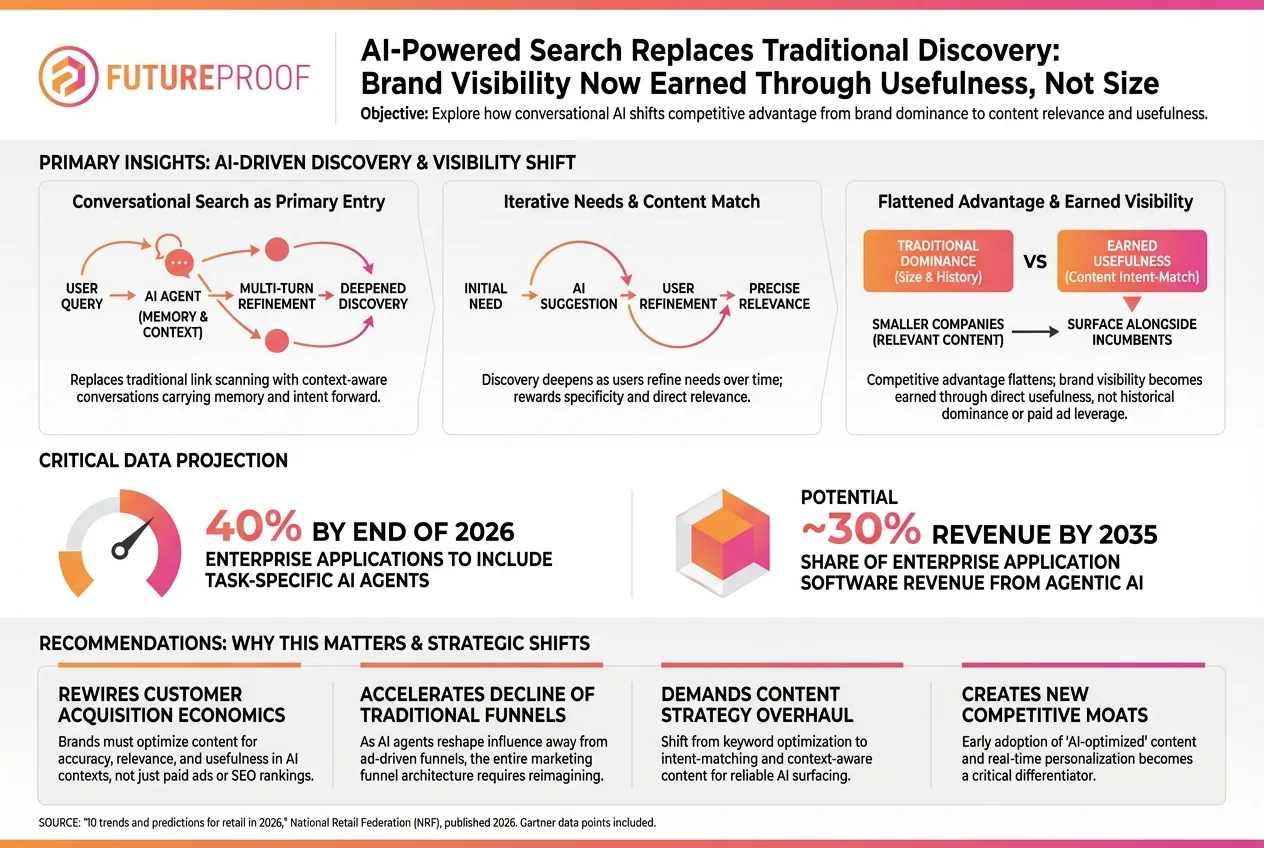
The landscape of information discovery is undergoing a profound transformation, one that is fundamentally reshaping how brands achieve visibility and connect with their audience. For decades, the digital realm was dominated by the brute force of traditional keyword-based search, where "who is biggest" often dictated who surfaced at the top. Massive budgets for SEO dominance and pervasive paid placements were the hallmarks of a winning strategy. However, a new era is dawning, powered by sophisticated artificial intelligence, and it’s an era where usefulness, relevance, and specificity are the new currencies of success. This monumental shift levels the playing field, offering unprecedented opportunities for nimble, insight-driven smaller companies to outmaneuver their larger, slower-moving competitors by truly understanding and answering real user intent.
The traditional discovery model, characterized by one-shot queries and a battle for generic keyword rankings, is rapidly becoming obsolete. Consumers are evolving past simple search strings, now engaging with AI-powered systems through multi-turn conversations. These intelligent agents, from voice assistants to advanced chatbots, don’t just process keywords; they interpret context, understand nuance, and anticipate further needs. This means the superficial aspects of content creation – cramming keywords and chasing backlinks without genuine value – are losing their efficacy. Instead, content must be meticulously crafted to be an accurate, contextual, and genuinely useful resource within these conversational flows. The implications for brand visibility are staggering: it’s no longer about merely being present, but about being the most helpful and precise answer at the exact moment of need.
This seismic shift fundamentally rewires acquisition economics for marketers. The old playbooks, prioritizing broad SEO dominance and widespread paid placement, are yielding diminishing returns. AI systems are designed to prioritize the user's journey, seeking the most accurate and contextually relevant information, regardless of a brand's traditional marketing spend or perceived industry clout. What matters now is how well your content directly addresses and resolves a user's underlying intent within a conversational interaction. This necessitates a strategic pivot from focusing on keyword density to mastering intent matching. Marketers must now delve deeper into understanding their audience's problems, questions, and desired outcomes, crafting content that serves as a direct, valuable solution. The investment must shift from broad-stroke campaigns to intelligent content strategies that anticipate and fulfill conversational requirements.
The power dynamic is unmistakably shifting from the established giants to the agile innovators. Where once a large brand’s sheer volume of content and domain authority almost guaranteed visibility, AI-powered discovery cares more about the utility embedded within a piece of content. Smaller companies, often with a more defined niche and a deeper understanding of specific customer pain points, are uniquely positioned to excel in this new environment. Their ability to create highly specific, laser-focused content that directly answers particular queries and resolves precise problems gives them a distinct advantage. They can bypass the need to compete on broad, expensive keywords and instead dominate long-tail, intent-driven conversations where their specialized knowledge truly shines. This democratizes discovery, making quality and genuine helpfulness the ultimate arbiters of success.
Multi-turn conversations represent the pinnacle of this new discovery paradigm. Unlike a single keyword search, a multi-turn conversation involves an ongoing dialogue where an AI system processes initial queries, understands follow-up questions, and iteratively refines its search based on the user's evolving needs. This demands an unparalleled level of specificity from brand content. Generic, broad-stroke articles that cover a wide topic superficially will falter. Instead, brands need to produce content that is precise, comprehensive in its specific scope, and anticipates the natural progression of a user's inquiry. Imagine a customer asking, "What's the best eco-friendly shampoo for oily hair?" and then following up with, "Does it contain sulfates?" Your content needs to not only address the initial query with highly relevant product suggestions but also contain the detailed information necessary to answer subsequent, more specific questions directly and accurately. This level of granular detail, meticulously structured and easily digestible, is what elevates content from merely informative to truly useful in an AI-driven world.
For marketers, this evolution represents a complete rewiring of acquisition economics. The focus is no longer on optimizing for search engine crawlers with technical tricks, but on optimizing for human intent, mediated by intelligent AI. The days of simply buying top positions through paid placement without substance are numbered, as AI systems will prioritize organic relevance and usefulness even in advertising displays. Budget allocations need to shift dramatically. Instead of pouring funds into generic ad campaigns or broad keyword SEO, resources should be directed towards deep audience intelligence, conversational design principles, and the creation of highly specialized, problem-solving content. Success metrics will also transform, moving beyond click-through rates to engagement duration, problem resolution rates, user journey completion, and the capacity for content to facilitate a seamless, satisfying multi-turn conversational experience. This is an investment in understanding human psychology and leveraging AI to bridge the gap between user needs and brand solutions.
Building content for intent matching is a paradigm shift from the old ways of keyword density. It requires marketers and content creators to become diagnosticians, delving into the core motivations behind user queries. Instead of asking "What keywords should I target?", the question becomes "What problem is my user trying to solve? What information do they truly need to make a decision or complete a task?" This involves a comprehensive understanding of user personas, their pain points, their common questions, and their decision-making process. Content should be structured not just for readability, but for answerability. This means leveraging semantic SEO, rich snippets, and structured data to help AI systems understand the precise context and value of your information. Instead of isolated blog posts, think in terms of comprehensive resource hubs that anticipate an entire user journey, offering detailed answers, comparisons, tutorials, and next steps all within a cohesive, easily navigable framework. Every piece of content should be a helpful assistant, guiding the user towards their desired outcome.
The future of this AI-powered discovery isn't just theoretical; it's already rapidly becoming a reality. The Gartner projection, highlighted by the National Retail Federation, reveals a profound trend: by the end of 2026, a staggering 40 percent of enterprise applications will incorporate task-specific AI agents. This isn't a distant vision but an imminent operational reality. Furthermore, agentic AI is poised to generate nearly 30 percent of enterprise application software revenue by 2035. This data point underscores the pervasive integration of AI into the very fabric of how businesses operate and, critically, how they will interact with their customers. These task-specific AI agents will become the frontline for many customer interactions, performing functions from answering FAQs to facilitating purchases and resolving issues. For brands, this means visibility will increasingly hinge on whether their content is structured and trusted enough to be directly utilized by these AI agents. Being "most useful" will mean being the go-to source for the AI itself, making your brand's information the factual bedrock upon which these agents operate and deliver value to consumers.
The implications are profound: brands must prepare for a future where their presence is mediated not just by search algorithms, but by intelligent agents acting on behalf of users. The content that wins will be that which is precise, verifiable, and effortlessly consumable by AI, allowing it to accurately and confidently serve the end user. This necessitates an investment in data hygiene, structured content, and a deep understanding of how AI agents interpret and utilize information. Your brand's voice and expertise must be translated into a format that AI can readily deploy, ensuring that when an agent needs an answer, your brand is the trusted, accurate, and most useful source. This isn't just about search engine ranking anymore; it's about becoming an indispensable knowledge partner for the AI-driven future.
In conclusion, the era of AI-powered search marks an irreversible shift in brand visibility, one that fundamentally redefines the rules of engagement for businesses of all sizes. The focus has moved definitively from "who is biggest" to "who is most useful," from superficial keyword density to profound intent matching, and from one-shot queries to complex, multi-turn conversations. This transformation is not a distant threat but a present reality, with task-specific AI agents rapidly becoming integral to enterprise applications and customer interactions. For marketers, the mandate is clear: adapt or be left behind. Embrace this new paradigm by prioritizing genuine utility, crafting content with unparalleled specificity, and deeply understanding the true intent behind every customer query. Smaller companies, armed with agility and focused expertise, have an unprecedented opportunity to redefine their competitive landscape. The future of discovery is here, and it belongs to those who prioritize being the most relevant, the most specific, and above all, the most useful. By recalibrating strategies to meet the demands of conversational AI, brands can not only survive but thrive in this exciting new chapter of digital engagement, securing their place as indispensable resources in the moment of need.