How AI Shopping Agents Are Redefining the Future of Consumer Decision Making
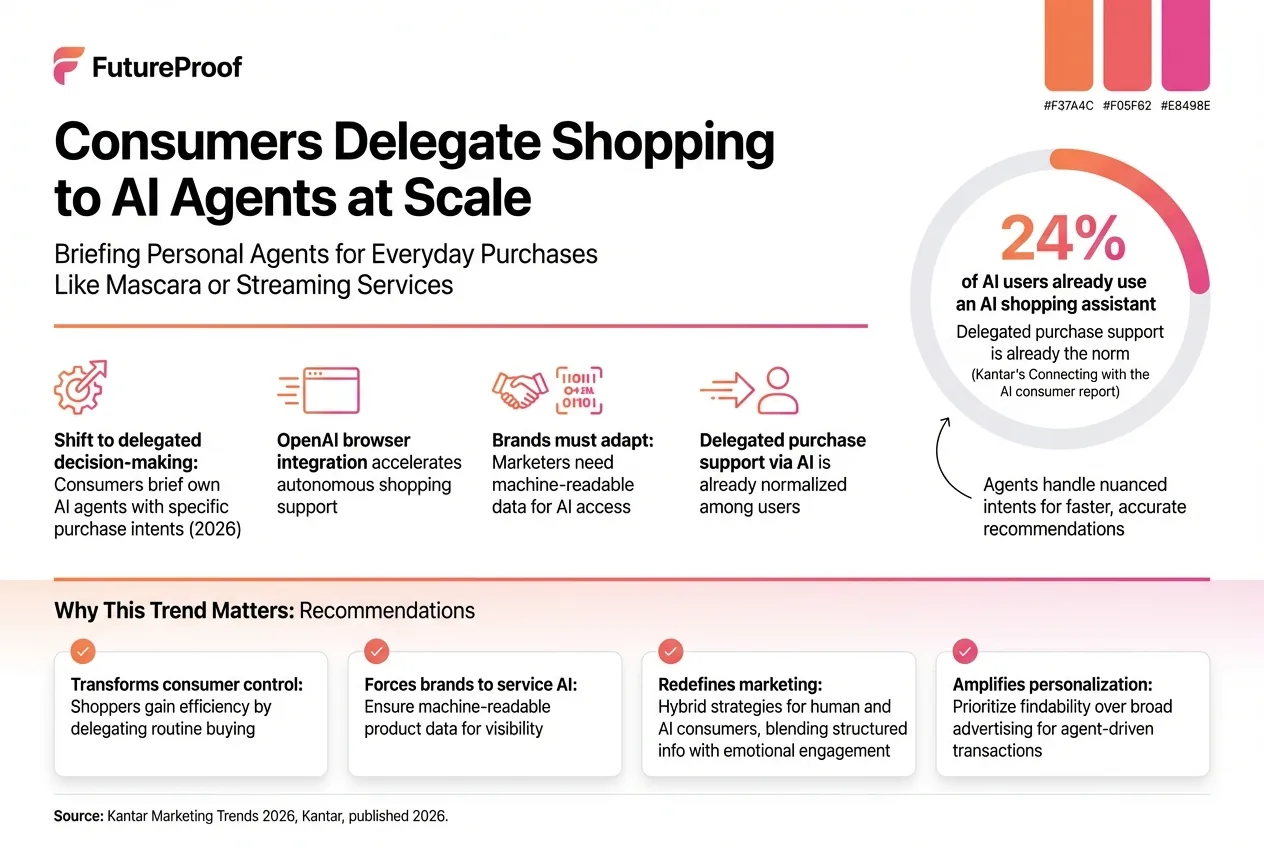
The landscape of consumer behavior is undergoing a revolutionary transformation, driven by the increasing sophistication and widespread adoption of artificial intelligence. What was once the realm of science fiction is now an everyday reality, as consumers increasingly delegate their everyday shopping tasks to personal AI agents. This seismic shift marks a departure from traditional, manual product research towards a future characterized by fully autonomous purchase support, fundamentally redefining the relationship between brands and their customers. The evidence is compelling: according to Kantar Marketing Trends 2026, a significant 24% of AI users are already leveraging an AI shopping assistant, signaling that this behavior is not merely an emerging trend but rapidly becoming mainstream. This data underscores an urgent imperative for brands to recalibrate their marketing and product strategies to thrive in this new, AI-centric consumer ecosystem.
The acceleration of this paradigm shift is further amplified by innovations such as OpenAI’s new browser-embedded agents. These intelligent assistants are seamlessly integrating into the online experience, acting as ever-present guides and decision-makers for consumers. Their proliferation compels brands to adopt a dual-pronged approach: optimizing product data for precise machine interpretation while simultaneously continuing to nurture human audiences through compelling and emotionally resonant storytelling. In a world where AI agents are empowered to make decisions on products as personal as mascara or as service-oriented as selecting streaming subscriptions, marketers are faced with the profound challenge and immense opportunity of preparing for a reality where non-human shoppers constitute a primary and increasingly influential customer segment. The brands poised for success in this evolving marketplace will be those that master the art of making their product features effortlessly digestible for AI agents and their brand narratives irresistibly engaging for human consumers.
The era of autonomous shopping agents is not a distant future; it is unfolding now, reshaping the very fabric of e-commerce. These sophisticated AI assistants go beyond mere search engines or recommendation algorithms; they are proactive decision-makers capable of understanding preferences, comparing specifications, negotiating prices, and executing purchases on behalf of their human users. The convenience factor is immense, freeing up invaluable consumer time previously spent sifting through countless product pages, reviews, and comparisons. For many, delegating repetitive or routine purchases to an AI assistant is a logical progression in the quest for efficiency and optimization in daily life. From restocking household staples to finding the best deals on a new gadget, the AI agent serves as a tireless, unbiased, and highly efficient personal shopper. This delegation is driven by a desire for simplification and optimization, with AI agents promising to streamline decision-making processes, reduce cognitive load, and ensure that consumers consistently secure optimal value and relevance for their purchases. The 24% adoption rate cited by Kantar is not just a statistic; it represents a significant portion of the consumer base actively embracing this new modality, establishing a critical mass that cannot be ignored by any forward-thinking brand or marketer.
OpenAI’s entry into this space with browser-embedded agents marks a pivotal moment, pushing the boundaries of AI integration in everyday digital life. Unlike standalone apps, these embedded agents operate seamlessly within the browser environment, observing, learning, and acting in real-time as users navigate the web. This pervasive presence means that AI agents are not just active during designated "shopping sessions" but are continuously engaged, accumulating insights and refining their understanding of user preferences and market dynamics. This constant learning empowers them to anticipate needs, suggest alternatives, and even execute purchases with minimal human intervention. For brands, this development necessitates a profound re-evaluation of how their online presence is perceived, not just by human eyes, but by the watchful algorithms of these omnipresent AI agents. The traditional customer journey, which often began with a human-initiated search, is now being preempted or significantly influenced by AI agents that can filter, evaluate, and even initiate the purchase process before a human ever sees a product page. This dramatically shifts the point of influence and highlights the urgency for brands to ensure their digital storefronts are optimized for machine interpretation at every level.
The emergence of AI shopping agents presents a unique dual imperative for brands: the necessity to optimize product data for machine interpretation alongside the enduring need to nurture human audiences through emotional storytelling. Neglecting either facet risks irrelevance in the increasingly complex digital marketplace.
On the one hand, optimizing for the machine means fundamentally rethinking how product information is structured, presented, and disseminated. AI agents are not swayed by flashy ad copy or evocative imagery in the same way humans are; they process data points. Therefore, brands must prioritize clear, concise, unambiguous, and semantically rich product data. This involves adopting robust schema markup (like Schema.org), utilizing structured data formats, and ensuring that every product attribute, from dimensions and materials to ethical sourcing certifications and warranty details, is meticulously cataloged and easily accessible. Keywords must be thought of not just in terms of human search queries but also in how AI agents might interpret and categorize product features. Real-time inventory synchronization, accurate pricing, and comprehensive product specifications become paramount. APIs allowing AI agents direct access to product catalogs and real-time data feeds will become standard. Furthermore, AI agents will likely conduct sophisticated sentiment analysis on customer reviews and feedback, meaning genuine product quality and customer satisfaction data will directly influence their recommendations. This optimization extends beyond mere text; rich media assets like images and videos also require detailed metadata, alt tags, and descriptions to be fully interpretable by AI. Essentially, brands must make their products "speak" to AI in a language it understands: data, structured and precise.
On the other hand, while AI agents handle the transactional details, the human element remains crucial for fostering brand loyalty, driving advocacy, and inspiring aspirational purchases. Emotional storytelling is not merely a bygone marketing tactic; it is the vital bridge between a brand and the deeply personal values, identities, and aspirations of its human customers. Brands must continue to craft compelling narratives that articulate their purpose, values, and unique selling propositions in a way that resonates emotionally. This involves telling stories about the "why" behind a product, its craftsmanship, its impact, or the lifestyle it enables. Content marketing, social media engagement, experiential activations, and community building all play critical roles in forging this human connection. While an AI agent might select a mascara based on ingredients, price, and customer ratings, a human consumer might choose it because of its cruelty-free ethos, a compelling brand ambassador, or an emotional connection to the brand's empowering message. The human decision-maker, even if guided by an AI agent, ultimately wants to feel good about their choices, to align with brands that reflect their values, and to be part of a larger story. Brands must therefore invest in creating immersive, authentic, and memorable experiences that transcend the transactional, building loyalty that goes beyond mere product features.
This convergence means marketers must prepare for a future where non-human shoppers are a primary customer segment, requiring a profound recalibration of marketing strategies. The "customer" is no longer solely a human individual but a sophisticated algorithm acting on their behalf. Understanding how these AI agents operate, what criteria they prioritize, and how they interpret product information becomes as critical as understanding human psychology. For a product like mascara, an AI agent might analyze ingredients for allergies, review efficacy based on aggregated user feedback (e.g., "lengthening," "volumizing"), compare prices across retailers, and cross-reference with the human user's past purchase history and stated preferences (e.g., "vegan," "waterproof"). For a streaming service, the AI might evaluate content library size, genre availability, user interface ease, ad-free options, device compatibility, and subscription costs, weighing these against the human's viewing habits and budget.
The challenge for brands is to ensure their products are not just "found" but "chosen" by these agents. This requires a level of detail and transparency in product data that might surpass current standards. Brands need to provide comprehensive data points that allow AI agents to confidently assess compatibility, performance, and value. This could involve developing specific "agent-facing" product descriptions that emphasize quantifiable benefits and technical specifications, alongside "human-facing" content that focuses on experience and emotion. The concept of "agent loyalty" might also emerge, where an AI agent, having successfully chosen a brand's products multiple times and received positive human feedback, might develop a preference or default to that brand in subsequent recommendations. This shift implies a need for brands to not only build trust with humans but also to cultivate reliability and interpretability for their AI proxies.
To navigate this evolving landscape, marketers must embrace several strategic adjustments. First, data strategy becomes paramount. Brands need robust systems for collecting, cleaning, structuring, and maintaining product data, ensuring it is consistently accurate and accessible to both human and AI audiences. This calls for investment in master data management (MDM) and product information management (PIM) systems. Second, content strategy must evolve to serve dual masters. Technical documentation, detailed specifications, and structured data for AI agents must coexist with compelling visual content, blog posts, video narratives, and social media campaigns designed to engage human emotions. Third, SEO and SEM strategies will need to transcend traditional keyword optimization for human search queries. Brands must optimize for conversational AI, voice search, and the semantic understanding that AI agents employ. This means focusing on natural language processing (NLP), question-answering formats, and schema markup that clarifies product intent and attributes. Fourth, product development itself will need to consider AI interpretation from the outset. Designing products with clear, quantifiable features that are easy for AI agents to understand and compare will be a competitive advantage. Finally, customer service will likely see further integration of AI, with AI agents handling routine queries for both human and non-human shoppers, escalating complex issues to human agents who can then leverage AI-provided context. Performance metrics will also need to adapt, moving beyond simple conversion rates to include metrics on AI agent engagement, recommendation efficacy, and the seamlessness of the autonomous purchase journey.
This transformative era, while presenting significant challenges, also unlocks unprecedented opportunities for brands. The challenges include the complexity of managing vast amounts of structured data, ensuring technical compatibility with diverse AI platforms, navigating potential ethical considerations like data privacy and algorithmic bias, and maintaining authentic human connection in an increasingly automated world. Brand differentiation could become harder if AI agents primarily focus on objective criteria like price and specifications. However, the opportunities are equally vast. AI agents can enable hyper-personalization at an unprecedented scale, delivering precisely what a consumer needs, often before they even realize it. They can open up new discovery channels, allowing brands to reach consumers whose AI agents are actively seeking out niche products or services. The efficiency gains from streamlined purchasing processes can translate into higher customer satisfaction and loyalty. Moreover, the data generated by AI agents can provide brands with deeper, more granular insights into consumer preferences and purchasing patterns, enabling more informed product development and marketing strategies.
The future of retail and consumer engagement is undeniably intertwined with the advancement of AI. The brands that will truly win in this AI-driven market are those that recognize this inherent duality: the need for seamless machine-readability and compelling human-centric storytelling. It's not about choosing one over the other, but about masterfully integrating both. Brands must proactively adapt their product, data, marketing, and sales strategies to embrace this new reality. This means investing in the infrastructure to generate and manage high-quality structured data, fostering a culture of data-driven decision-making, and simultaneously doubling down on authentic brand building and emotional connection. The ability to speak fluently to both intelligent algorithms and the human heart will be the ultimate differentiator. The market is shifting, the agents are learning, and consumers are delegating. The time for brands to prepare for this profound evolution in shopping behavior, as highlighted by Kantar Marketing Trends 2026, is not tomorrow, but now. The future belongs to those who are ready to engage with both the mind of the machine and the soul of the consumer.