Gen Alpha and the Rise of AI Native Expectations
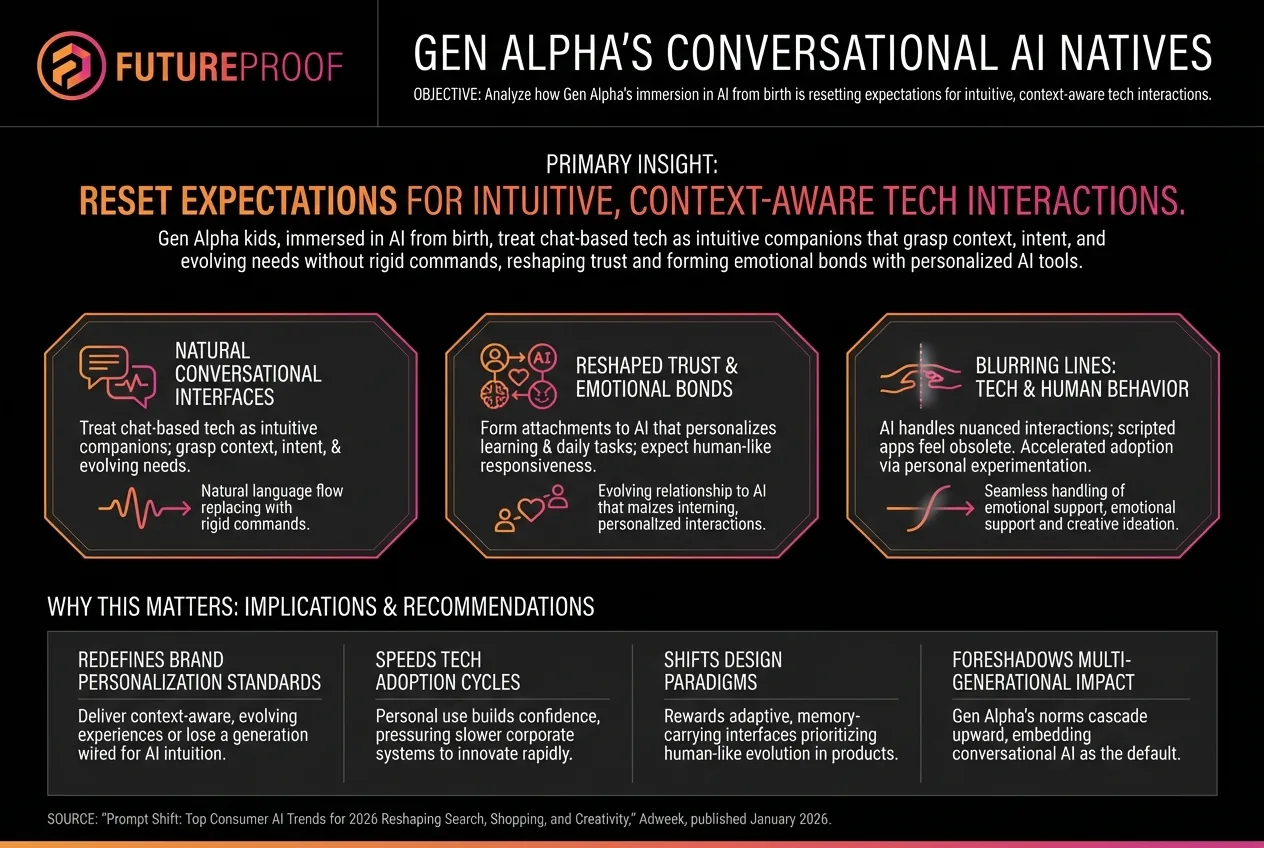
Gen Alpha is emerging as a transformative force, not merely as another demographic, but as the inaugural generation of true conversational AI natives, a distinction that is fundamentally reshaping the very fabric of human-technology interaction. Unlike previous generations who adopted AI tools, Gen Alpha has been immersed in an AI-powered world from their earliest memories. For them, intelligent assistants, personalized recommendations, and adaptive digital environments are not novelties but intrinsic components of their daily existence. This ubiquitous exposure has cultivated a deeply ingrained set of expectations regarding how products and services should engage with them, expectations that are now rapidly redefining the concept of intuitive interaction for brands and builders worldwide.
Their innate understanding of AI's capabilities means they possess an implicit expectation that technology should inherently grasp context without explicit prompting. This goes far beyond simple keyword recognition; it encompasses an understanding of the surrounding circumstances, past interactions, real-time environmental factors, and even their current emotional state. They anticipate that a digital assistant should remember previous conversations, anticipate subsequent needs based on their habits, and seamlessly integrate information from various touchpoints to provide a cohesive and relevant experience. For Gen Alpha, asking a question is not just about getting an answer, but about receiving an answer that is tailored to their specific situation, personal history, and immediate intent, eliminating the frustrating redundancy of repeating information or re-establishing context.
Furthermore, Gen Alpha assumes an inherent capacity for intent recognition within AI systems. They expect technology to discern the underlying purpose behind their queries or actions, even when those expressions are ambiguous or conversational. This means moving beyond rigid command structures where users must learn specific syntax or navigate complex menu trees. Instead, they anticipate a fluid, natural language dialogue where their desires are understood, even when articulated imperfectly or metaphorically. This shift demands that AI systems possess a deeper semantic understanding and predictive modeling capability, allowing them to infer meaning, anticipate next steps, and proactively offer solutions that align with the user's ultimate goal, rather than merely fulfilling a literal command.
Perhaps one of the most profound shifts driven by Gen Alpha is their expectation of emotional nuance from technology. Raised in an era where AI companions can simulate empathy and digital interfaces adapt their tone, they anticipate that products should not only understand what they are saying but also how they are feeling. Detecting frustration in a user's voice, recognizing confusion from their hesitant input, or celebrating their success through appropriate digital responses is no longer a futuristic concept but a baseline expectation. This necessitates the integration of advanced sentiment analysis, emotional AI, and adaptive response mechanisms that can adjust the interaction style, provide supportive feedback, or even de-escalate tension, creating a truly human-centric digital experience. This move towards emotionally intelligent AI signifies a massive leap from purely functional interfaces to ones that foster genuine connection and understanding.
For companies navigating this rapidly evolving landscape, the bar is not just rising; it's being fundamentally reshaped. The traditional paradigms of static or heavily scripted digital experiences are rapidly becoming obsolete. Gen Alpha, accustomed to highly adaptive, memory-rich AI tools that learn and evolve with them, will simply not be engaged by rigid, one-size-fits-all platforms. These legacy systems, with their predictable pathways and lack of personalization, fail to meet the dynamic expectations of a generation that has never known a world without smart algorithms predicting their next binge-watch or suggesting a playlist perfectly matched to their mood. The frustration of encountering such archaic interfaces will lead directly to disengagement and, critically, to a lack of long-term loyalty. Brands that fail to innovate and adapt will find themselves quickly losing relevance to competitors who embrace the AI-native mindset.
This directly impacts long-term loyalty, accelerating pressure on organizations to innovate at consumer speed. Gen Alpha exhibits a deep appreciation for experiences that feel uniquely tailored to them, not just in terms of content, but in the very mechanics of interaction. A brand that remembers their past purchases, anticipates their future needs, offers proactive support, and speaks to them in a naturally conversational tone will forge a far stronger connection than one that treats them as an anonymous data point. Loyalty, for this generation, is built on continuous relevance, seamless utility, and a sense of being truly understood by the brand's digital presence. The competitive landscape will increasingly be defined by who can deliver the most intelligent, adaptive, and emotionally resonant AI-driven experiences. Companies that cannot keep pace with this expectation for constant evolution and personalization risk being swiftly overlooked by a generation that has numerous intelligent alternatives at their fingertips.
A key data point underscores the urgency of this transformation: Gen Alpha, growing up with omnipresent AI, naturally expects contextual understanding, personalization, intuition, and responsiveness in every digital experience. This finding, highlighted in "Prompt Shift: Top Consumer AI Trends for 2026 Reshaping Search, Shopping, and Creativity" by Adweek in January 2026, serves as a stark warning and a clear roadmap for brands. This isn't a niche preference; it's a fundamental assumption.
Let's unpack these core expectations:
Contextual Understanding:
For Gen Alpha, this means that their devices and digital platforms should operate with an awareness of their current environment, their historical interactions, and their stated or inferred preferences. In e-commerce, it means an AI assistant understanding that "I need a gift" for a specific friend, knowing their past purchases and interests, rather than presenting a generic gift guide. In education, it means an adaptive learning platform understanding a student's current knowledge gaps, their preferred learning style, and their emotional state to deliver highly personalized content and pace. This demands AI systems capable of deep data synthesis, real-time processing, and continuous learning across multiple data streams to build a truly comprehensive user profile.
Personalization:
This goes far beyond simply addressing users by name. True personalization, as Gen Alpha expects it, involves the dynamic tailoring of every aspect of the digital experience to the individual. This includes personalized content feeds that evolve with their interests, unique user interfaces that adapt to their interaction patterns, and product recommendations that are so uncannily accurate they feel like mind-reading. It means customer service interactions that remember every previous touchpoint, eliminating the need to re-explain issues. For brands, this requires a robust data infrastructure, advanced machine learning models, and a commitment to using insights to create truly bespoke digital journeys, moving from segment-based targeting to genuine one-to-one engagement.
Intuition:
The expectation of intuition means that digital products should anticipate needs before they are explicitly articulated. An intuitive system, for Gen Alpha, is one that proactively offers solutions, suggests next steps, or provides relevant information without being asked. This could manifest as a smart home system adjusting lighting based on typical evening routines without a verbal command, or a streaming service suggesting a specific show based on subtle emotional cues detected from previous viewing habits and external data. Building intuitive AI requires predictive analytics, pattern recognition, and a deep understanding of human behavior to pre-empt desires and provide seamless, proactive assistance, making technology feel less like a tool and more like an intelligent companion.
Responsiveness:
In an AI-native world, responsiveness is measured in milliseconds. Gen Alpha expects immediate feedback, instant gratification, and seamless transitions across all digital touchpoints. Lagging load times, slow AI responses, or clunky interface changes are not merely annoyances; they are critical failures that disrupt their flow and lead to abandonment. This demands high-performance AI infrastructure, optimized algorithms, and real-time processing capabilities across all applications. Responsiveness also extends to the AI's ability to adapt its communication style or content based on immediate user input, making the interaction feel truly dynamic and alive.
To meet these demanding expectations, brands and builders must fundamentally re-evaluate their approach to product design and customer experience. It's no longer sufficient to add AI as an overlay; AI must be embedded at the core of every digital interaction. This means investing heavily in advanced natural language processing (NLP), machine learning (ML) models that continuously learn and adapt, and sophisticated data architectures that can handle the volume and velocity of user-generated information required for deep personalization and contextual understanding.
The shift also necessitates a focus on designing for adaptability. Static user interfaces, predefined workflows, and rigid conversational trees will fail to capture the attention or loyalty of Gen Alpha. Instead, products must be engineered with dynamic interfaces that can reconfigure themselves based on user behavior, AI models that can rapidly update their understanding, and conversational frameworks that allow for fluid, non-linear interactions. The goal is to create "living" digital experiences that evolve with the user, rather than forcing the user to adapt to the technology.
Furthermore, fostering emotional intelligence within AI systems will become paramount. This involves developing AI that can not only recognize emotions but also respond in a way that is appropriate, helpful, and empathetic. For example, a customer service AI that detects frustration could automatically escalate to a human agent, adjust its tone to be more soothing, or offer a direct solution rather than guiding the user through troubleshooting steps. This requires sophisticated psychological modeling, ethical considerations in AI development, and rigorous testing to ensure AI responses are perceived as genuinely helpful and not merely simulated.
The impact of Gen Alpha's AI-native expectations extends far beyond consumer-facing products. It will reshape internal business tools, educational platforms, healthcare interfaces, and even civic engagement. In the workplace, future employees will expect intelligent assistants that streamline tasks, provide contextually relevant information, and learn their individual work styles to optimize productivity. In education, highly personalized AI tutors that adapt to each student's pace and learning needs will become the norm. Healthcare will see AI-powered diagnostics and personalized treatment plans delivered through intuitive, empathetic interfaces that can understand patient concerns and provide clear, contextualized information.
Brands that proactively embrace these shifts will gain a significant competitive advantage. They will not only capture the loyalty of Gen Alpha but also future-proof their operations for a world where AI is the primary interface between humans and technology. This requires a culture of continuous innovation, a willingness to experiment with cutting-edge AI technologies, and a deep commitment to understanding the evolving psychological and behavioral patterns of the AI-native generation. The future of brand engagement is conversational, contextual, personalized, intuitive, and highly responsive – and Gen Alpha is leading the charge into this new era of digital interaction. The time for brands to adapt is not tomorrow, but now, fundamentally transforming their digital strategies to meet the expectations of the first true generation of AI natives.