The Rise of Delegated Commerce and the New Imperative of Optimizing for AI Agents
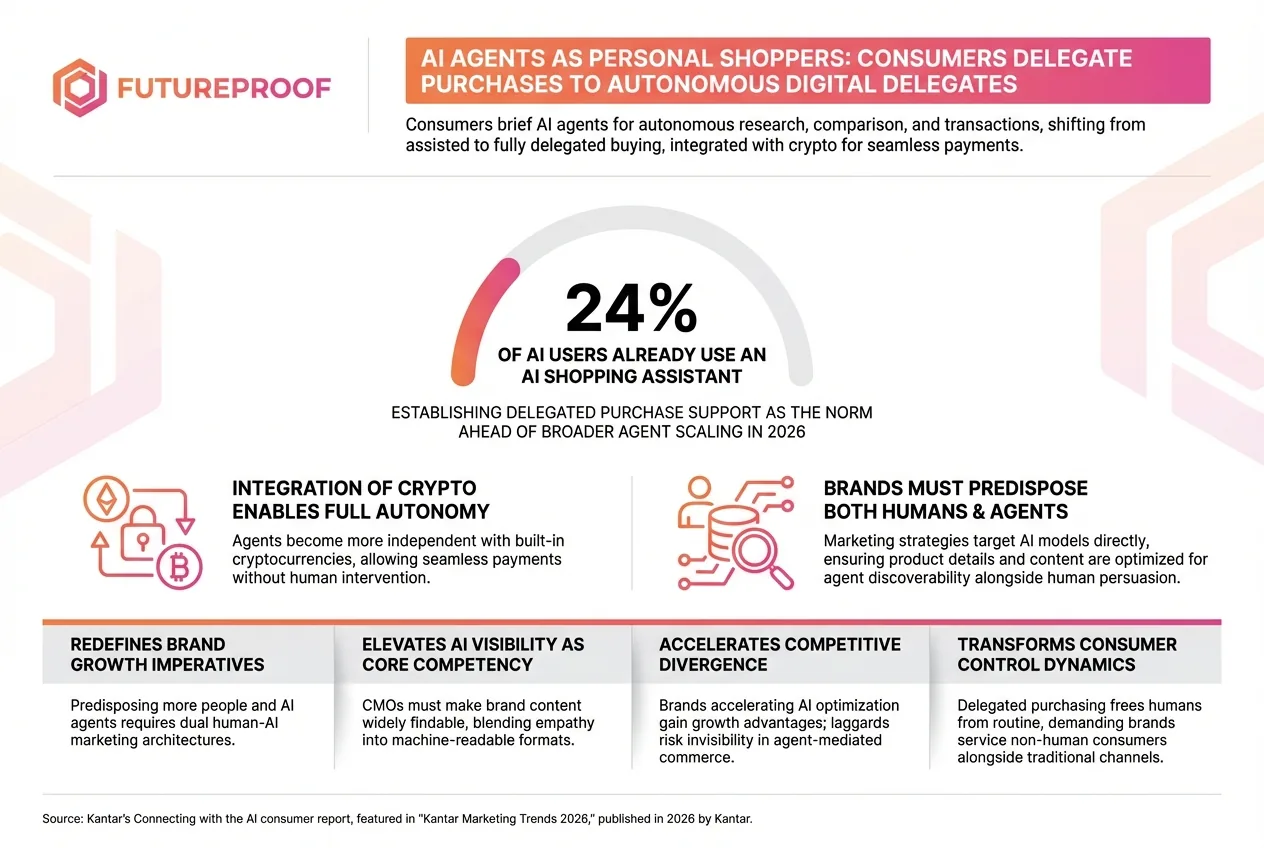
The landscape of consumer commerce is undergoing a radical transformation, propelled by the rapid evolution of artificial intelligence. AI agents are no longer confined to theoretical discussions; they are swiftly becoming personal shoppers, fundamentally altering how consumers discover, evaluate, and purchase products and services. This paradigm shift, often referred to as delegated commerce, empowers autonomous digital delegates to handle research, comparison, and even end-to-end purchasing, liberating consumers from time-consuming tasks and decision fatigue. The acceleration of this trend is particularly notable with the emergence of crypto-enabled agents, which facilitate seamless, secure, and trustless transactions, signaling a new, highly automated era of commerce that demands immediate strategic adaptation from brands worldwide. Recent major tech releases have significantly bolstered the capabilities of these AI agents, making them more sophisticated, intuitive, and integrated than ever before, truly cementing their role as invaluable consumer proxies.
At the heart of this revolution is the AI agent's ability to act as an extension of the consumer, learning preferences, understanding needs, and navigating complex marketplaces with unprecedented efficiency. These digital delegates don't just search; they synthesize information, weigh pros and cons based on predefined or learned criteria, and execute purchases. This is not a niche behavior; data from Kantar’s Connecting with the AI Consumer report, featured in Kantar Marketing Trends 2026, reveals a compelling statistic: a remarkable 24 percent of AI users already leverage an AI shopping assistant. This establishes delegated purchase support as a mainstream behavior, indicating a clear and present shift in consumer habits that brands cannot afford to overlook. The implications for brand visibility, marketing strategy, and overall growth are profound and immediate.
The integration of crypto capabilities amplifies the power and reach of these AI agents exponentially. Traditional commerce often involves multiple intermediaries and potential friction points in the payment process. Crypto-enabled agents, however, can leverage blockchain technology for secure, transparent, and often instantaneous transactions. This means smart contracts can automate payment upon fulfillment of conditions, micro-transactions can be executed without prohibitive fees, and the entire purchasing journey can be truly end-to-end automated, removing human intervention from the payment step entirely. This distributed ledger technology enhances trust, reduces fraud, and minimizes operational overhead, allowing AI agents to operate with unparalleled autonomy and efficiency. For instance, an agent tasked with procuring a specific component for a smart home system could not only identify the best supplier and price but also execute a self-executing smart contract payment directly from a user's crypto wallet, all without the user lifting a finger after the initial delegation. This seamless integration of AI and blockchain is a game-changer, fostering an environment where delegated commerce can truly thrive without traditional payment bottlenecks.
Recent advancements in AI, particularly in large language models (LLMs), natural language understanding (NLU), and machine learning (ML), have made these agents incredibly adept at interpreting complex queries and interacting with diverse data sources. Coupled with improvements in API standardization and decentralized identity solutions, these tech releases empower AI agents to gather highly granular product information, compare intricate specifications, read and analyze vast quantities of user reviews, and even negotiate prices within defined parameters. The ability to process unstructured data from product pages, blog posts, and forums, combined with structured data from price comparison sites and inventory APIs, allows for a holistic understanding of market offerings. These agents are becoming experts at sifting through noise to identify genuine value and relevance, making their recommendations highly influential. For brands, this means that the quality, accessibility, and structure of their digital content are no longer just about attracting human eyes; they are about convincing sophisticated algorithms.
For brands navigating this evolving landscape, the imperative is clear: a dual focus is essential. Human persuasion, the bedrock of marketing for centuries, remains critically important. Consumers are still humans, driven by emotions, values, aspirations, and the desire for connection. Brand storytelling, emotional resonance, building trust, and fostering loyalty will always be paramount for establishing the initial predisposition and guiding the overall brand preference that a human user might input into their AI agent. A consumer might delegate the purchase of eco-friendly cleaning supplies to their AI, but their initial preference for an "eco-friendly" and "cruelty-free" brand is a human-driven decision, influenced by traditional marketing efforts. Brands must continue to invest in creating compelling narratives and experiences that resonate on a human level, as these foundational preferences will ultimately shape the parameters given to AI agents.
However, the second, equally critical focus is the optimization of marketing content for AI agents. This is where the new frontier lies. Marketing content must now be meticulously structured, discoverable, and parsable by autonomous digital delegates. Visibility to machines is rapidly becoming as critical as, if not more critical than, visibility to people. If an AI agent cannot find, understand, or accurately recommend a brand's products or services, that brand effectively ceases to exist in the delegated commerce ecosystem. This demands a proactive shift in digital marketing strategies, moving beyond traditional SEO for search engines to "AIO" – AI optimization – for intelligent agents.
Structuring content for AI agent discoverability and recommendation requires a deep understanding of how these algorithms process information. Semantic SEO, leveraging structured data markup (Schema.org) for product details, offers, reviews, and specifications, becomes non-negotiable. Clearly defined product attributes, unambiguous descriptions, high-quality images with descriptive alt text, and comprehensive FAQs are no longer best practices; they are necessities. AI agents are adept at parsing factual information, making accuracy, consistency, and completeness paramount. If a brand's product data is inconsistent across different platforms or lacks crucial details, an AI agent may struggle to accurately compare it or even dismiss it outright. Brands must think like an AI agent, anticipating what information it needs to make an informed recommendation. This includes granular details about materials, certifications, sustainability practices, ethical sourcing, and compatibility—all presented in a machine-readable format.
Furthermore, building content authority and trust signals for AI agents mirrors and extends traditional SEO. Authoritative backlinks, credible sources cited, expert endorsements, and positive customer reviews, all contribute to an AI agent's assessment of a brand's reliability and quality. Agents are designed to minimize risk for their human users, meaning they will prioritize brands with a strong, verifiable track record and robust digital presence. This extends to transparency in pricing, return policies, and customer service information, all of which should be readily accessible and machine-parsable. The goal is to make it as easy as possible for an AI agent to confidently identify a brand as the optimal choice for its human principal's needs.
The growth impact of optimizing for AI agents is significant and transformative. As Kantar’s Blueprint for Brand Growth rightly emphasizes the importance of predisposing more people to a brand, in 2026, this crucial objective now explicitly includes predisposing AI models acting as consumer proxies. This means cultivating a "machine reputation" for your brand. It's about ensuring your brand is consistently identified by AI agents as a reliable, high-quality, and relevant option within its category. Brands that strategically optimize early for agent discoverability will secure a formidable competitive advantage as AI-mediated shopping scales from a nascent trend to the dominant mode of commerce. This early adoption isn't just about survival; it's about pioneering market share in a fundamentally new economic paradigm.
To gain this critical edge, brands must undertake several actionable steps. Firstly, conduct a comprehensive audit of all existing digital content to assess its AI agent readability and parsability. This involves evaluating product pages, help centers, blog posts, and social media for structured data implementation, clarity, accuracy, and completeness. Secondly, invest in robust Product Information Management (PIM) systems that can centralize and standardize product data, ensuring consistency across all channels and platforms. Thirdly, develop AI-friendly APIs that allow agents to seamlessly access product catalogs, inventory levels, pricing, and customer support information in real-time. Fourthly, actively participate in developing and adhering to industry standards for data interoperability and semantic web technologies. Finally, engage in continuous monitoring and experimentation, analyzing how AI agents interact with brand content and adapting strategies based on these insights. This includes understanding the specific algorithms and ranking factors employed by different AI shopping assistant platforms, where such information is available.
The transformative impact extends beyond individual brand strategies to the entire customer journey and the e-commerce ecosystem. The traditional sales funnel will evolve, with AI agents handling much of the initial research, comparison, and shortlisting phases. Brand-consumer interaction points will shift, with direct communication potentially occurring more with AI agents than with human customer service representatives in the early stages. Advertising models will need to adapt, perhaps focusing on "agent-facing" advertisements or sponsored content that is optimized for AI discoverability and relevance scoring. Success metrics will broaden to include "agent recommendation frequency," "structured data parse rates," and "AI agent sentiment analysis." Ethical considerations, such as algorithmic bias, transparency in AI recommendations, and data privacy, will also become increasingly central to brand responsibility and consumer trust.
In conclusion, the advent of AI agents as personal shoppers, empowered by crypto-enabled transactions and accelerated by recent technological breakthroughs, represents a seismic shift in commerce. This era of delegated commerce is not a future possibility but a present reality, as evidenced by the significant percentage of consumers already utilizing AI shopping assistants. For brands, this necessitates a strategic duality: preserving the art of human persuasion while mastering the science of machine optimization. Marketing content must evolve to be not only engaging for people but also highly structured, discoverable, and parsable for AI agents. Brands that proactively adapt, optimize for agent discoverability, and understand how to predispose AI models will not merely survive but thrive, securing a decisive advantage in this exhilarating and rapidly evolving AI-mediated shopping landscape. The call to action is clear: embrace the delegated future, or risk being left behind in its wake.