The Collapse of Discovery and the Rise of AI Driven Consumer Conversations
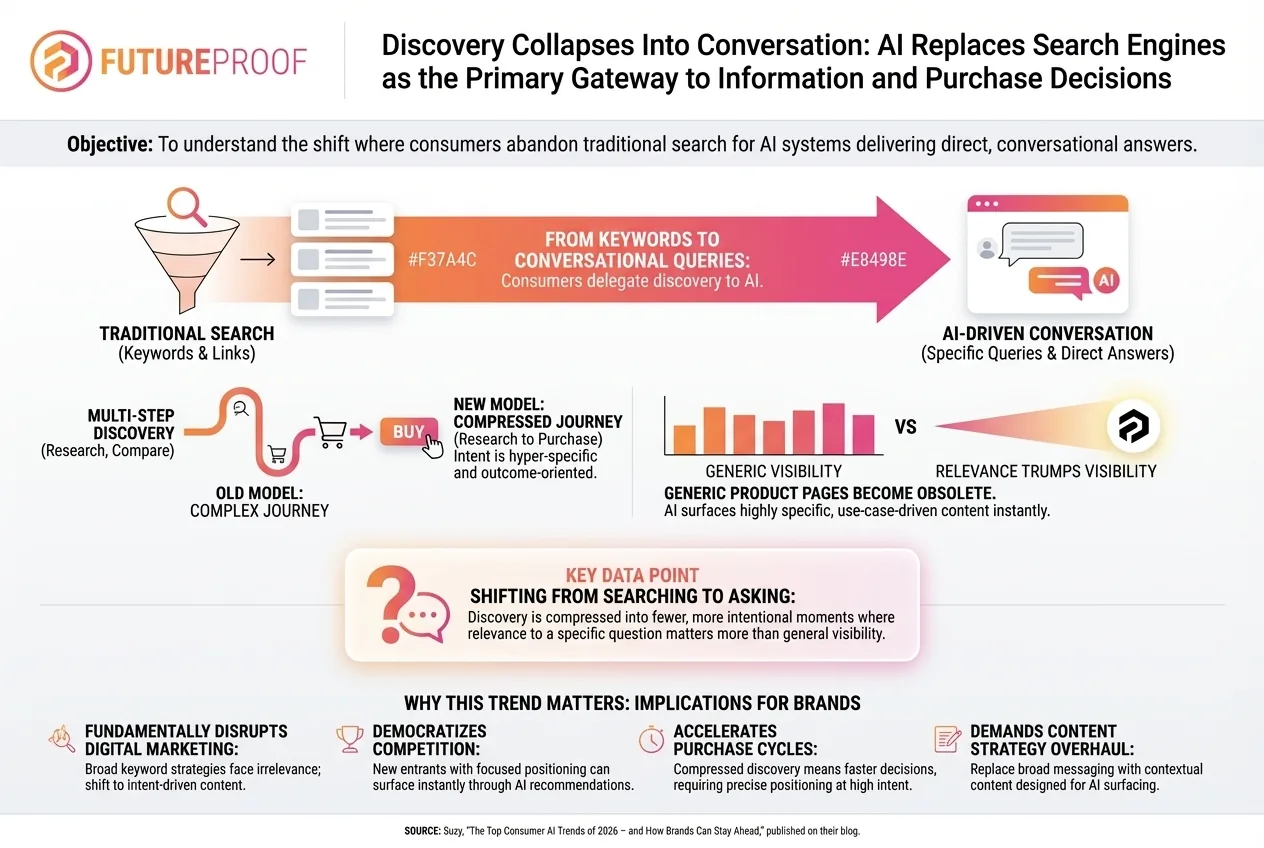
The landscape of consumer discovery is undergoing a seismic transformation, fundamentally altering how individuals find information, evaluate options, and make purchase decisions. For decades, the internet’s primary gatekeeper was the traditional search engine, a vast index that rewarded broad keyword optimization and general visibility. Consumers engaged in a process of searching, sifting through pages of links to piece together answers. That era is rapidly receding. We are now witnessing a profound shift where discovery is collapsing into conversation, as consumers pivot from searching to directly asking AI systems for immediate, precise answers. This isn't merely an evolution of technology; it's a complete re-engineering of the consumer journey, demanding an equally radical rethinking of marketing and content strategy.
The advent of sophisticated AI interfaces has compressed what was once a multi-step research and comparison process into a single, fluid conversational flow. Gone are the days of opening multiple browser tabs, cross-referencing product reviews, and manually comparing specifications. AI now acts as an intelligent intermediary, capable of understanding complex, hyper-specific, and outcome-driven queries. When a consumer asks an AI, What's the best noise-canceling headphone under $200 for long-haul flights that's compatible with Android and has a comfortable over-ear design?, they aren't looking for a list of links. They expect a direct, synthesized answer that incorporates multiple criteria, often leading directly to a recommended product or service, complete with purchasing options. This direct answer paradigm fundamentally reduces the tolerance for generic content, placing an unprecedented premium on brands that can offer precise, use-case-driven positioning.
In this AI-mediated world, the traditional metrics of visibility – such as high rankings for broad, competitive keywords – matter significantly less than relevance. An AI isn't interested in presenting ten blue links; it's interested in delivering the single best, most accurate, and most relevant answer to a user's specific query. This dynamic creates an extraordinary opportunity for focused and emerging brands. No longer must they compete directly with the overwhelming marketing budgets of established players for generic top-of-funnel keyword dominance. Instead, if a smaller brand can demonstrate unparalleled expertise and provide the most precise answer for a niche, high-intent query, AI systems are increasingly likely to surface their content and recommendations alongside, or even in preference to, established giants. The playing field is being leveled, not by SEO hacks, but by the undeniable power of precise utility.
The implications for marketers grappling with this shift are nothing short of profound. Strategies built on the pillars of broad SEO, aimed at casting a wide net with general keywords, are rapidly becoming obsolete. The future of discovery is not about being found generally; it's about being selected specifically by an AI. This mandates a fundamental overhaul of content creation. Content must become narrower, more contextual, and exquisitely tailored to high-intent moments. Brands must move beyond simply creating content about a topic and instead focus on creating content that directly and definitively answers specific questions, solves particular problems, or fulfills precise needs within an AI-driven conversational framework.
To thrive in this new landscape, marketers must develop a deep understanding of what constitutes answer-first content. This isn't just about placing an FAQ section on your website; it's about structuring every piece of content to anticipate and directly address natural language queries. Think about the granular questions your target audience might ask an AI about their pain points, your product's features, or industry solutions. Content should be designed to be easily parsable by AI, with clear, concise answers presented upfront, followed by supporting details. This often means adopting a flipped pyramid approach where the most crucial information is delivered immediately, much like a helpful human assistant would respond.
Furthermore, the concept of micro-content gains immense strategic importance. While comprehensive long-form content still holds value for establishing authority, it must be architected in a way that allows AI to easily extract and synthesize specific nuggets of information. This might involve breaking down complex topics into distinct, self-contained sections, each addressing a particular sub-query. The strategic use of structured data and schema markup becomes paramount here, as these invisible cues help AI systems understand the context and purpose of your content, guiding them to extract the most relevant snippets for direct answers. By explicitly tagging different parts of your content – for example, identifying a best-practice guide, troubleshooting steps, or product comparison – you are essentially providing the AI with a roadmap to your brand's expertise.
The shift towards hyper-specific, outcome-driven queries elevates the importance of authentic brand authority. AI systems are designed to deliver reliable, trustworthy information. Therefore, brands that consistently publish accurate, well-researched, and expert-backed content within their specific niches will be favored. This isn't about being generically authoritative; it's about being the definitive authority on very particular problems or solutions. For instance, a brand specializing in sustainable outdoor gear should strive to be the AI's go-to source for questions like What are the most durable recycled materials for hiking backpacks? or How do I care for waterproof-breathable fabrics in an eco-friendly way? This granular authority builds trust not just with consumers, but crucially, with the AI models themselves, positioning your brand as a preferred source for direct answers.
The entire purchase journey is being compressed into fewer, more intentional moments. The traditional marketing funnel, with its distinct stages of awareness, consideration, and conversion, is being streamlined by AI’s ability to move consumers rapidly from a question to a solution. A consumer asking an AI for a hypoallergenic dog food for puppies with sensitive stomachs is often already deep in the consideration phase, and the AI's answer, potentially sourced directly from a brand's precise content, can lead almost immediately to a transaction. This means marketers must embed clear, contextually relevant calls to action within their answer-first content. If your content provides the definitive answer, it should also seamlessly guide the user to the next logical step, whether that's exploring a product page, signing up for a demo, or making a direct purchase, all within the fluid conversational experience.
A pivotal data point underscores the urgency of this transformation: Consumers are moving from broad search to AI-mediated answers, compressing discovery into fewer and more intentional moments where specificity outweighs general visibility. (Source: The Top Consumer AI Trends of 2026 and How Brands Can Stay Ahead, Suzy). This isn't a speculative trend; it's a documented shift in consumer behavior that is already reshaping the digital landscape. The implications are clear: brands that cling to outdated broad SEO strategies risk becoming invisible to the very AI systems that are increasingly mediating consumer discovery. The moments of interaction are fewer, but their intensity and potential for conversion are significantly higher. Every interaction, every piece of content, must be designed with maximal specificity and intent-matching in mind.
Measuring success in this new paradigm also requires a re-evaluation of KPIs. Traditional metrics like page views, impressions, and general keyword rankings, while still having some residual value, become less indicative of true impact. What matters now are metrics that reflect AI selection rates, direct answer attribution, and, ultimately, conversion rates directly stemming from AI-driven discovery. Marketers must invest in analytics that can track how often their content is being leveraged by AI systems to provide direct answers and how those direct answers translate into customer actions. This requires closer collaboration between content, SEO, and analytics teams to develop new methodologies for attributing value in a world where the AI acts as an intelligent aggregator and presenter of information.
Future-proofing your marketing strategy in the age of conversational AI demands agility and a commitment to continuous learning. This isn't a one-time adaptation; it's an ongoing journey. Brands must actively experiment with AI tools, both as consumers to understand the experience, and as content creators to leverage AI in generating, optimizing, and personalizing their own content. Investing in an understanding of Natural Language Processing (NLP) and Natural Language Generation (NLG) is no longer optional; it's foundational. Brands need to foster a culture where content creators are empowered to think like AI systems, anticipating user intent and structuring information for machine comprehension. The rapid evolution of AI means that what works today may need refinement tomorrow, necessitating a flexible and data-driven approach to strategy.
In conclusion, the collapse of discovery into conversation, driven by the pervasive rise of AI, represents not just a technological shift but a fundamental reordering of the digital economy. The era of broad search and general visibility is giving way to one dominated by hyper-specific, outcome-driven queries and direct answers. For marketers, this is a call to action: abandon the outdated tenets of generic SEO and embrace a strategy rooted in radical relevance, precise positioning, and answer-first content. Brands that adapt swiftly, focusing on building authority through specificity and delivering unparalleled value in high-intent moments, will not only survive but thrive. They will be the ones selected by AI, seamlessly connecting with consumers at the precise moment of need, guiding them effortlessly from question to conversion in the dawn of conversational commerce and content.