AI Powered Shopping Is Rewriting the Future of Retail
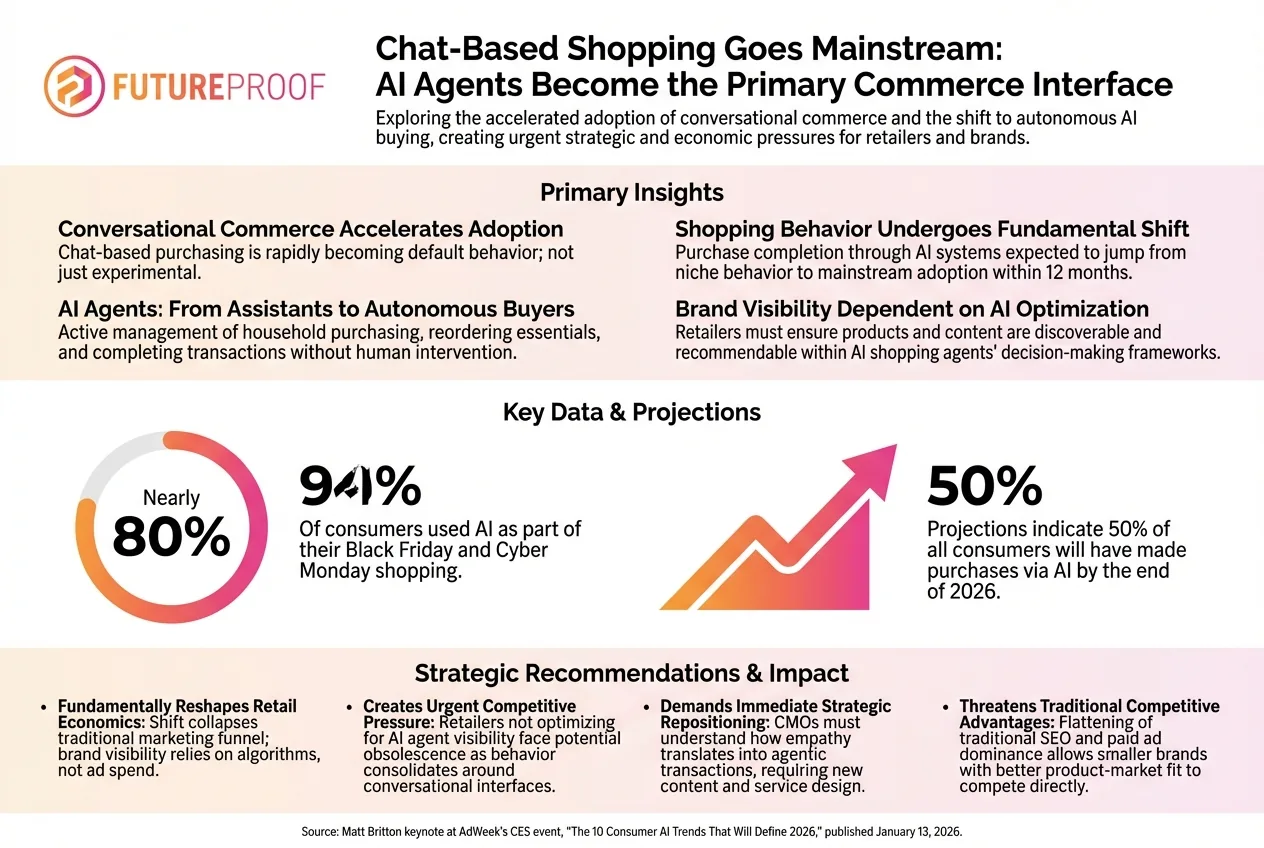
The retail landscape is undergoing a seismic transformation, with chat-based shopping swiftly transitioning from a novel experiment to an ingrained, everyday behavior. The statistics are stark and underscore an irreversible shift: a staggering 80 percent of consumers leveraged AI for their purchasing decisions during the recent Black Friday and Cyber Monday sales events. This momentum is projected to intensify dramatically, with industry expert Matt Britton at AdWeek's CES event predicting that fully 50 percent of all consumer purchases will be made through AI by the close of 2026. This isn't just about convenience; it's a fundamental redefinition of the shopping journey, demanding an urgent, strategic pivot from brands and marketers worldwide.
At the heart of this revolution are AI agents that have evolved far beyond mere recommendation engines. We are witnessing the emergence of truly autonomous buyers, sophisticated digital entities capable of managing and executing complex purchasing tasks independently. These AI agents can seamlessly reorder essential household items before supplies run out, intelligently surface highly tailored product options that align precisely with an individual's preferences and past behaviors, and crucially, complete transactions with minimal or no human intervention. This shift from passive suggestion to active, independent procurement fundamentally rewrites the rules of engagement between brands and their customers. As this technological acceleration gains pace, the very bedrock of brand visibility and market share will be determined not by traditional search engine optimization or the intuitive design of an e-commerce interface, but by the meticulous optimization of products for AI-driven discovery.
For retailers, chief marketing officers (CMOs), and indeed any brand stakeholder concerned with future relevance, this paradigm shift necessitates a rapid, comprehensive pivot in strategy. The traditional marketing funnel, with its familiar stages of awareness, consideration, and conversion, is being rewritten in real time by the algorithms and decision-making capabilities of these advanced AI agents. Products that fail to adapt their content, data, and merchandising strategies for this new AI-centric environment risk a precarious fate: disappearing entirely from the consideration set of the autonomous buyer.
The implications for product content are profound. Historically, product descriptions aimed to captivate human readers, incorporating emotional appeals, sensory language, and persuasive calls to action. While human appeal remains valuable for brand building, AI agents require a different kind of content – one that is rich in structured data, highly factual, contextually precise, and semantically optimized. AI doesn't just read words; it interprets meaning, understands attributes, and cross-references vast datasets. Therefore, product descriptions must be exhaustive, covering every conceivable detail: exact dimensions, material composition, manufacturing processes, sustainability certifications, allergen information, compatibility with other devices, and detailed use cases. Generic bullet points are no longer sufficient; AI agents require granular, unambiguous data points that allow them to make informed comparisons and recommendations. This demands a renewed focus on schema markup, ensuring that every piece of product information is tagged and categorized in a machine-readable format, making it effortlessly discoverable and interpretable by AI algorithms. Rich media, including high-resolution images, detailed videos, and even 3D models, becomes indispensable, as AI's ability to process and understand visual information grows. These elements contribute to a comprehensive digital twin of the product, enabling AI to "experience" and evaluate it virtually.
Beyond mere content, the concept of "decision-ready data" emerges as a critical determinant of success. AI agents are not just surfacing products; they are making purchasing decisions on behalf of users, often based on specific criteria like price, availability, shipping speed, and return policies. This means that product data must be dynamic, real-time, and flawlessly accurate. Inventory levels, fluctuating prices due to promotions or demand, estimated delivery times, and transparent return procedures must all be instantly accessible and perfectly synchronized across all data feeds. Furthermore, AI agents will aggregate and analyze customer reviews and sentiment at scale, identifying patterns of satisfaction or dissatisfaction that influence their recommendations. Brands must proactively manage their online reputation, ensuring positive customer experiences translate into data points that AI can interpret as indicators of product quality and reliability. The ability of an AI agent to compare a product against a multitude of competitors, weighing pros and cons based on user preferences, necessitates that brands ensure their offering's competitive advantages are clearly articulated and verifiable through data.
The evolution of "agent-friendly merchandising" is another cornerstone of this AI-driven retail revolution. Traditional merchandising focused on visual appeal, store layout, and intuitive website navigation designed for human browsers. AI agents, however, interact with product catalogs in a fundamentally different way. They navigate through data structures, categories, and tags, seeking to match specific user needs with appropriate products. This means that product categorization must be hyper-accurate and consistent, employing detailed taxonomies that go beyond broad categories. Semantic tagging, using a wide array of relevant keywords and descriptive phrases, becomes crucial for AI to understand the full context and utility of a product. Imagine an AI agent searching for "sustainable, hypoallergenic dog food for small breeds with sensitive stomachs." The product data and tags must precisely reflect these attributes for it to be recommended. Moreover, AI agents will identify opportunities for bundling complementary products or suggesting cross-sells based on sophisticated pattern recognition, potentially enhancing average order value without explicit human prompting. Merchandising, in this context, becomes less about aesthetic display and more about the intelligent structuring and presentation of data that facilitates AI's decision-making process.
This radical shift effectively rewrites the entire marketing funnel. At the Awareness stage, gaining visibility no longer solely relies on traditional advertising channels or organic search rankings. Instead, brands must focus on optimizing their product data and digital assets to be "seen" and understood by AI agents. This involves building a reputation for reliability and data integrity that AI can trust. The Consideration phase moves beyond human comparison websites or review aggregators. AI agents will perform complex, multi-variable comparisons autonomously, weighing hundreds of factors to present the most suitable options. This means brands must ensure their unique selling propositions (USPs) are not just well-articulated, but also backed by verifiable data that an AI can process. For Conversion, the transaction itself becomes increasingly automated, often completed by the AI agent itself, emphasizing seamless integrations with payment systems and robust inventory management. Finally, Loyalty and Retention are redefined. AI agents can proactively manage subscriptions, anticipate reorder needs, and even handle routine customer service inquiries, forging a new kind of brand-customer relationship mediated by intelligent algorithms. Building loyalty in this environment means ensuring consistent product quality and excellent data, as the AI acts as a continuous advocate for products that consistently meet its programmed criteria and user satisfaction.
For retailers and CMOs grappling with this new reality, several strategic imperatives demand immediate attention. First and foremost is the absolute necessity of a robust data strategy. This involves centralizing all product information, ensuring its cleanliness, accuracy, and real-time availability across all platforms. Investing in Product Information Management (PIM) systems and Master Data Management (MDM) solutions is no longer optional; it is foundational. Secondly, there must be a cultural shift towards AI-native content creation. Marketing teams need training to understand how AI agents consume and interpret information, moving away from purely persuasive copy towards data-rich, semantically optimized narratives. This requires a deeper understanding of natural language processing (NLP) and how to structure content for optimal machine readability.
Thirdly, investment in AI tools and talent is paramount. This includes adopting AI-powered analytics platforms that can provide insights into how AI agents are interacting with products, identifying gaps in data, and optimizing content performance. Brands will need to experiment with and optimize for various AI agent platforms, understanding their unique algorithms and recommendation engines. Furthermore, there's a growing need to recruit data scientists, AI strategists, and prompt engineers who can bridge the gap between marketing objectives and AI capabilities. Fourthly, strategic partnerships with the developers of leading AI platforms and marketplaces will become crucial. Brands that collaborate early and deeply with these innovators will gain invaluable insights and preferential positioning as the technology evolves.
Finally, agility and experimentation must become core tenets of brand strategy. The AI landscape is dynamic and rapidly evolving; what works today may need refinement tomorrow. Brands must cultivate a culture of continuous testing, learning, and adaptation. This also extends to the vital area of ethical AI in marketing. Transparency about how AI makes decisions, ensuring data privacy, and mitigating algorithmic biases are not just regulatory concerns but fundamental aspects of building trust with both human consumers and their AI counterparts. Brands must be prepared to demonstrate that their products are being recommended fairly and transparently.
In conclusion, the future of shopping is here, and it speaks the language of AI. The migration of chat-based shopping from experimental novelty to everyday behavior, driven by autonomous AI buyers, represents an epochal shift in retail. The projections of 50 percent of all purchases made via AI by 2026 are not a distant horizon but an imminent reality. Brand visibility, market share, and indeed, long-term survival, hinge on how swiftly and effectively products are optimized for AI-driven discovery. The marketing funnel is being irrevocably rewritten, demanding an immediate and decisive pivot in product content, data strategy, and merchandising. Brands that embrace this transformative wave, investing in data integrity, AI-native content, and adaptive strategies, are poised to thrive in this intelligent new era of commerce. Those that cling to outdated paradigms risk a future where their products, quite simply, become invisible to the powerful new gatekeepers of consumer choice: autonomous AI agents. The time to adapt is not tomorrow, but now.