AI Powered Search Is Becoming the New Front Door to the Internet
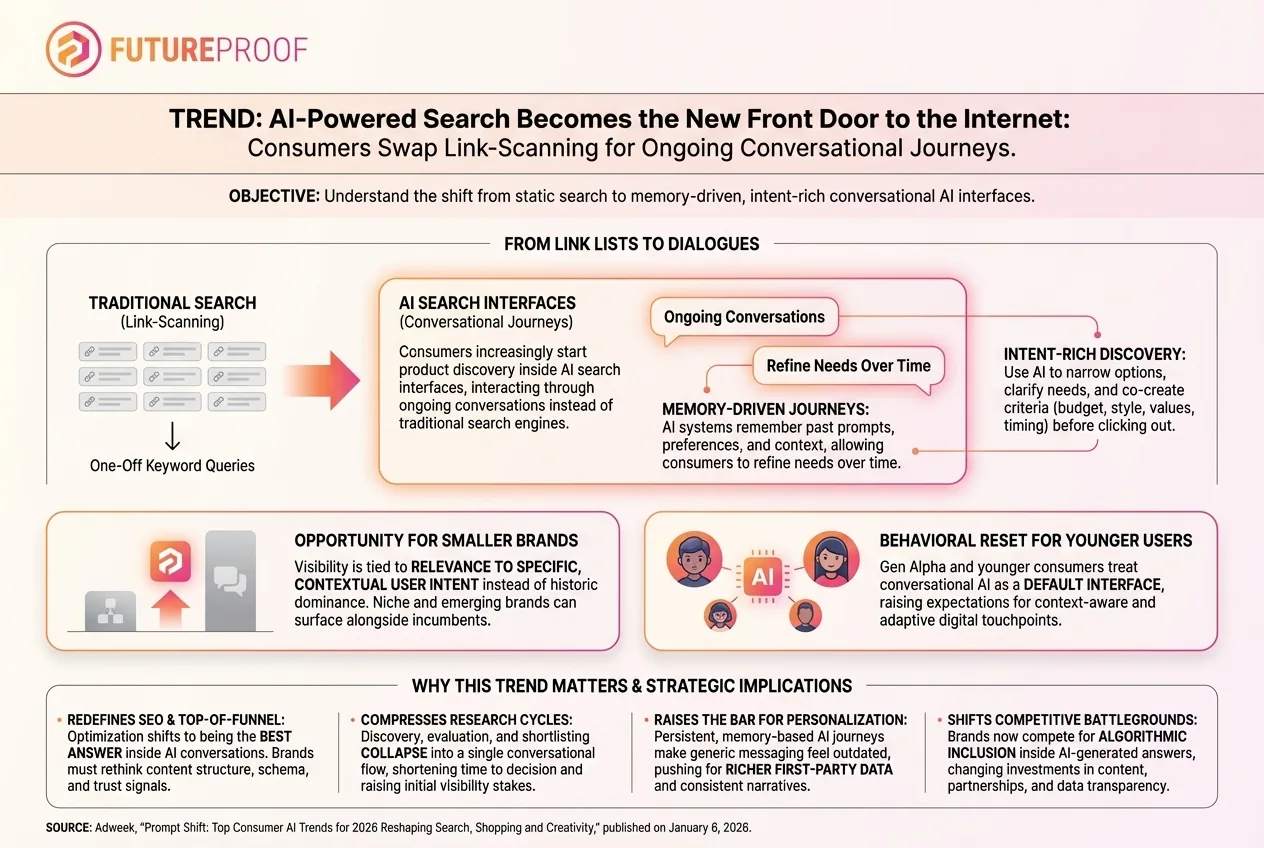
AI-powered search is rapidly transforming the digital landscape, fundamentally altering how consumers interact with the internet and discover information, marking a profound shift that positions these intelligent interfaces as the new front door to the online world. Gone are the days when users meticulously scanned through extensive lists of links, sifting through pages of organic results to find what they needed; today’s internet users are increasingly engaging in ongoing, dynamic conversational journeys with AI interfaces that understand context, refine needs, and proactively surface highly relevant options. This evolution, as highlighted by Adweek, is not merely an incremental update to search technology but a complete behavioral reset, ushering in an era where the depth and personalization of interaction far outweigh the superficiality of traditional keyword queries and subsequent link clicking. Consumers now leverage AI to articulate complex needs, explore a wider array of possibilities, and even co-create their decision criteria, all seamlessly integrated within a single, evolving conversational thread that remembers prior interactions and builds upon them. This paradigm shift compresses the traditional research cycles that often involved multiple searches across various platforms, instead offering a streamlined, efficient path from initial inquiry to informed decision-making. The bar for personalization has been significantly raised, as users come to expect tailored responses that reflect their unique preferences, past behaviors, and immediate context, pushing brands to innovate beyond generic targeting. Furthermore, this redefines how brands secure visibility and engage in crucial discovery moments, moving away from a sole reliance on high organic search rankings to a more nuanced imperative: being the most relevant and authoritative answer within an AI-driven conversation. This change democratizes visibility to an extent, as relevance to user intent now crucially outweighs historic domain authority or sheer content volume, creating a clearer and more accessible path for smaller, niche brands to reach their target audiences by providing exceptional value and precise answers. The emerging generation, Gen Alpha, is not merely adapting to this change but actively accelerating this behavioral reset, intuitively treating conversational AI as their default method for searching, learning, and even making purchasing decisions, thereby solidifying this trend as the future standard of digital interaction. For brands navigating this evolving environment, the new SEO is fundamentally about optimizing to be the absolute best possible answer within these intricate and highly personalized AI conversations, ensuring their presence is not just found, but truly valued and integrated into the user’s journey.
The transition from a link-centric web to a conversation-first internet heralds a deeper, more meaningful engagement model for users. Instead of simply presenting a list of potential solutions, AI-powered search engines act as intelligent digital concierges, capable of understanding nuanced questions, interpreting implicit intent, and synthesizing information from vast datasets to formulate comprehensive and contextually appropriate responses. This capability extends beyond simple Q&A; users can iteratively refine their queries, explore tangential topics, and even generate creative ideas or complex plans within a continuous dialogue. For instance, a user might start by asking for dinner recipes, then specify dietary restrictions, inquire about ingredient substitutions, ask for wine pairings, and finally request a grocery list, all within the same evolving chat interface. This level of granular interaction fundamentally changes the nature of online exploration, making it more akin to consulting an expert rather than sifting through an encyclopedia. The implications for customer experience are immense, promising unparalleled convenience and efficiency. Brands that can effectively integrate themselves into these conversational flows, not just as a source of information but as a contributing participant in the user’s decision-making process, will gain a significant competitive advantage. This requires a profound understanding of user psychology, natural language processing, and the ability to anticipate follow-up questions or related needs. The AI's ability to "remember" previous turns in a conversation means that brand interactions can become increasingly personalized and persistent, building a relationship over time rather than just a single transactional touchpoint.
The compression of research cycles is a particularly critical consequence for brands, meaning that the traditional customer journey funnels, often depicted as multi-stage processes spanning days or weeks, are now collapsing into much shorter, more direct pathways. Consumers are moving from need recognition to solution discovery and even purchase intent within a single, albeit evolving, AI-powered interaction. This drastically reduces the number of touchpoints and the time available for brands to make an impression through conventional advertising or organic discovery methods. Therefore, brands must ensure their value proposition and relevant answers are immediately accessible, clear, and compelling within the AI-generated responses. There’s less opportunity for incremental persuasion; the initial interaction must be impactful. This necessitates a strategic pivot from broad keyword targeting to an intense focus on semantic understanding and comprehensive content that addresses specific user intents with authority. The heightened expectation for personalization means that generic marketing messages will increasingly fall flat. AI-powered search excels at understanding individual user context—their location, past search history, stated preferences, and even emotional tone—to deliver hyper-relevant content. Brands must rise to this challenge by developing highly adaptable content that can be dynamically personalized and presented by AI systems, ensuring messages resonate deeply with the individual rather than a generalized demographic. This might involve creating granular content modules that can be reassembled by AI based on specific user prompts or investing in technologies that allow for real-time content customization.
The shift also fundamentally alters how brands achieve discovery. Traditionally, appearing on the first page of Google’s organic search results was the holy grail of SEO. Now, being "found" means being intelligently surfaced as a key part of an AI’s answer, often without the user ever seeing a direct link to the brand’s website in the initial conversational response. This moves the emphasis from pure ranking algorithms to the quality, accuracy, and comprehensiveness of the information itself, which the AI then synthesizes and presents. A brand's authority is no longer solely measured by backlinks or domain rating but by its ability to provide credible, definitive, and useful answers that AI models can trust and incorporate into their summaries. This dynamic levels the playing field, as smaller, niche brands with highly specialized knowledge or unique offerings can now gain unprecedented visibility by simply being the absolute best source for specific, long-tail, or intricate queries. Their depth of expertise can be directly fed into AI models, bypassing the historical dominance of large, generic competitors that may have historically outranked them due to sheer brand recognition or massive content libraries. The new SEO, therefore, is not about tricking algorithms but about becoming an indispensable resource, creating content that is genuinely valuable, contextually rich, and meticulously factual, thereby making it an attractive source for AI to reference and recommend. This demands an emphasis on thought leadership, industry expertise, and transparent data presentation.
Gen Alpha’s role in this accelerating behavioral reset cannot be overstated. This generation, born into a world saturated with smart devices, voice assistants, and increasingly sophisticated AI, interacts with technology in a fundamentally different way. For them, conversational interfaces are not a novelty but a natural, intuitive, and expected mode of interaction. They are growing up treating AI as the default method for obtaining information, learning new skills, and even navigating their shopping journeys. This inherent comfort and reliance on AI-driven conversations means that the trends we observe today are not temporary fads but the foundational shifts of tomorrow’s digital economy. Brands looking to capture the attention and loyalty of this influential demographic must therefore adapt their digital strategies to align with these ingrained behaviors. This means investing in conversational marketing, creating content optimized for AI synthesis, and ensuring their brand voice is clear and consistent within AI-generated responses. Understanding how Gen Alpha formulates prompts, what they value in an AI interaction, and how they make decisions will be crucial for long-term brand relevance. Their seamless adoption of AI as a primary interface underscores the urgency for all businesses to understand and strategically respond to this technological evolution. The future of customer engagement is conversational, and Gen Alpha is leading the charge in defining its parameters.
To successfully navigate this AI-powered landscape, brands must fundamentally rethink their content strategies. Traditional keyword research and SEO tactics, while still relevant for some aspects, must evolve to incorporate a deeper understanding of semantic search and natural language processing. The focus should shift from optimizing for specific keywords to optimizing for comprehensive conceptual coverage and user intent. This means creating content that exhaustively answers potential questions, addresses common pain points, and explores related topics in a structured and easily digestible manner, making it ideal for AI models to parse, synthesize, and present. Structured data, schema markup, and other semantic web technologies become more critical than ever, as they provide clear signals to AI about the nature and context of your content, helping it accurately interpret and utilize the information. Furthermore, brands must cultivate an online presence that exudes expertise, authoritativeness, and trustworthiness (E-A-T), as AI models are designed to prioritize credible sources to avoid propagating misinformation. Building a robust reputation through peer recognition, expert contributions, and transparent communication will directly contribute to a brand’s likelihood of being cited and recommended by AI. This also involves proactively monitoring how your brand is represented in AI-generated responses and engaging in prompt engineering exercises to understand how AI interprets your brand’s messaging.
The shift necessitates a profound re-evaluation of digital marketing budgets and resource allocation. Investment in AI-specific analytics tools will become crucial to track how users are engaging with brand information within conversational interfaces, measuring attribution in a world where direct click-throughs to a brand’s website may become less common. Understanding which pieces of content are most frequently synthesized by AI, which questions lead to brand mentions, and how users interact with AI-generated responses involving your brand will provide invaluable insights for refining content and strategy. Brands might need to invest in dedicated prompt engineers or train their marketing teams to understand the nuances of crafting queries that elicit specific, desired responses from generative AI models. This internal capability will be essential for both auditing existing brand presence within AI and for proactively shaping future content creation. The competitive advantage will lie not just in having the information but in having the right information, presented in a way that AI can easily consume, trust, and reproduce effectively. This calls for a data-driven approach, where insights from AI interactions feed directly back into content creation and brand messaging, creating a virtuous cycle of continuous improvement and relevance.
Moreover, the ethical dimensions of AI-powered search require careful consideration from brands. Ensuring fair, unbiased, and transparent representation of products, services, and information is paramount. AI models learn from vast datasets, and if a brand’s content contributes to or is interpreted by AI in a biased manner, it can have significant reputational repercussions. Brands must therefore commit to creating inclusive and equitable content, actively working to mitigate any potential biases. Furthermore, the imperative to provide "the best possible answer" extends beyond mere factual correctness to encompass a brand’s values and social responsibility. Consumers, especially Gen Alpha, are increasingly conscious of a brand’s stance on social and environmental issues. When AI synthesizes information about a brand, it will likely incorporate publicly available information regarding these aspects. Therefore, a brand’s overall public image and commitment to corporate social responsibility will implicitly become part of its SEO in the AI era. This holistic view of brand presence and perception demands a more integrated approach to marketing, public relations, and corporate communications, ensuring a consistent and authentic narrative across all touchpoints, whether human-facing or AI-driven. The digital footprint must be meticulously managed, as AI has an unprecedented ability to draw connections and summarize vast amounts of information, shaping perceptions in real-time conversations.
Looking ahead, the evolution of AI-powered search will continue to accelerate, with further advancements in multimodal AI, personalization, and predictive capabilities. Brands that embrace this journey early, experimenting with new content formats, engaging with AI tools, and prioritizing genuine user value, will be best positioned for success. This isn't just about adapting to a new technology; it's about reimagining the very nature of brand-consumer interaction in the digital realm. The focus will increasingly shift from simply attracting attention to building trust and relevance within highly intelligent, dynamic conversations. The opportunity for brands to become indispensable partners in their customers' decision-making processes, rather than just vendors, is immense. As Adweek reported, AI-powered search is indeed swiftly becoming the new front door to the internet, moving beyond habitual link scanning to deeply context-aware, conversational experiences. This means the time for brands to act is now, transforming their SEO strategies from focusing on being found in a list to optimizing for being the definitive, trusted, and most helpful answer within the unfolding digital dialogue. Those who understand that the new frontier of search is conversational, and that success lies in providing unparalleled value within these interactions, will unlock unprecedented levels of visibility, engagement, and customer loyalty in the AI-driven future. The landscape is changing not just in how information is accessed, but in how relationships are built, making a proactive and strategic embrace of conversational AI absolutely essential for any brand seeking sustained relevance and growth.