
How AI Driven Job Displacement Is Reshaping Consumer Behavior and Forcing Brands to Adapt in 2026
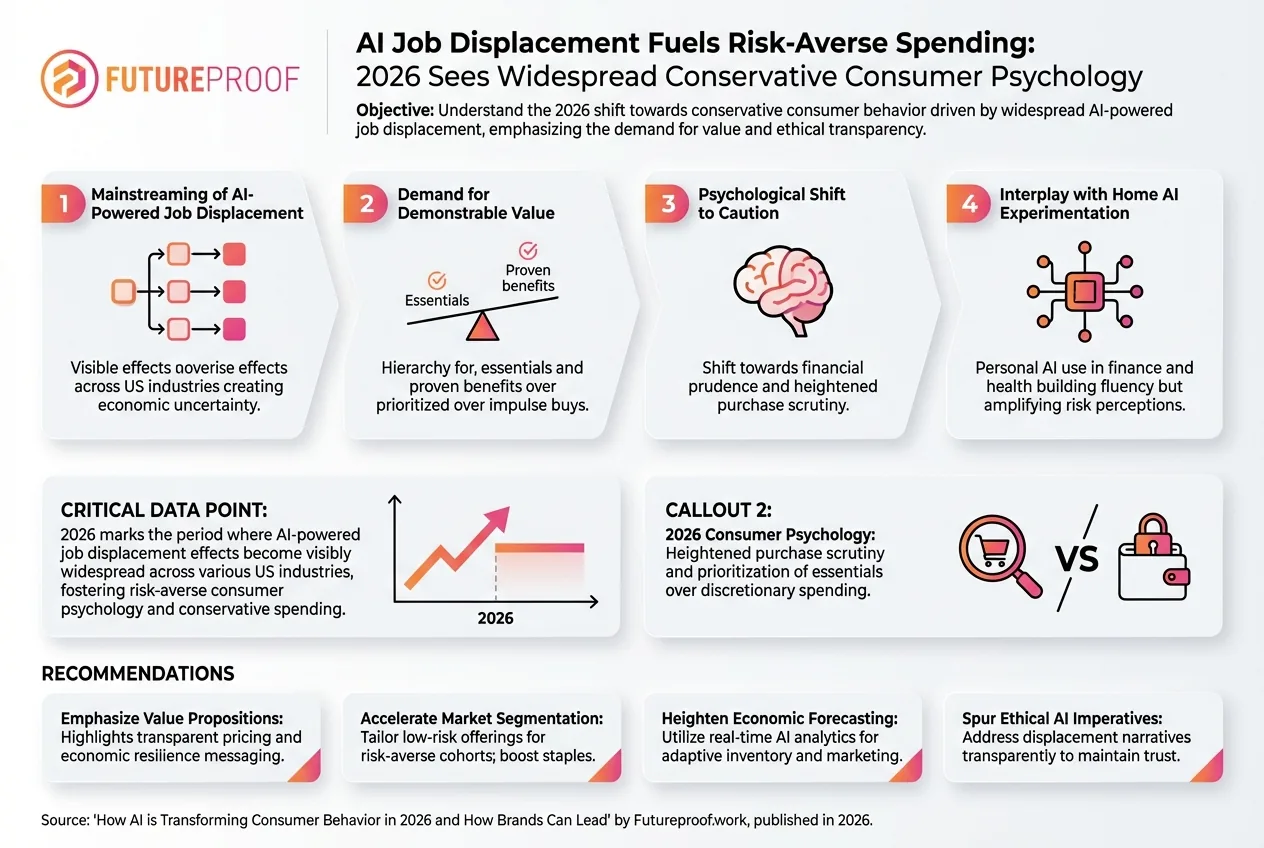
The landscape of American industries is undergoing an unprecedented metamorphosis in 2026, driven by the relentless march of AI-powered automation. The once theoretical concept of AI job displacement has crystallized into a tangible reality, visibly reshaping the economic fabric across the US. This widespread integration of artificial intelligence into operational processes, from manufacturing floors to customer service centers and even knowledge-based roles, is not merely optimizing efficiency; it is fundamentally altering the employment paradigm for millions. As workers confront this new normal of real-time automation and job shifts, a profound and measurable transformation in consumer behavior is taking root, tilting decisively towards a more conservative and financially cautious mindset.
The data is unequivocal: 2026 marks the pivotal period where the effects of AI-powered job displacement become visibly widespread across US industries, driving a measurable rise in financial caution among consumers, according to the comprehensive report, "How AI is Transforming Consumer Behavior in 2026 and How Brands Can Lead," by Futureproof.work. This isn't a fleeting trend but a foundational shift, echoing through every purchasing decision, every budget allocation, and every interaction with the marketplace. Consumers, facing an uncertain job market and potential income instability, are instinctively gravitating towards essentials, proven value, and significantly reduced impulse buying. The psychological impact of automation anxiety is pervasive, fostering a collective desire for security and stability that profoundly influences spending patterns.
For brands navigating this rapidly evolving environment, the demand for a strategic pivot is no longer an option but an urgent imperative. The era of abstract marketing and aspirational branding without concrete substantiation is rapidly fading. In its place, a new set of non-negotiable consumer expectations has emerged: clear Return on Investment (ROI), absolute transparent pricing, and robust low-risk offerings. As the segment of risk-averse consumers expands, their purchasing calculus becomes increasingly pragmatic. Every dollar spent is scrutinized through the lens of necessity, durability, and long-term utility.
Categories traditionally tied to discretionary spending are feeling immense pressure. Luxury goods, non-essential travel, high-end gadgets without a clear practical advantage, and impulse purchases driven by fleeting desires are experiencing significant contractions. The allure of novelty for novelty's sake diminishes as financial security becomes paramount. Consumers are deferring large, non-critical expenditures, instead prioritizing savings, debt reduction, and investments that promise stability or tangible future returns. Brands in these discretionary sectors face the arduous task of either redefining their value proposition to align with new consumer priorities, focusing on extreme quality and longevity as an investment, or innovating to create offerings that straddle the line between luxury and genuine utility.
Conversely, sectors catering to staples, necessities, and value-focused products are experiencing a surge in demand and renewed relevance. Groceries, essential household items, reliable transportation, basic apparel, home maintenance supplies, and affordable healthcare solutions are seeing steady, if not increased, spending. But even within these essential categories, the bar for 'value' has been raised. It's no longer just about the lowest price; it's about the optimal balance of quality, durability, and cost-effectiveness over the product's lifespan. Consumers are becoming adept at identifying products that offer multi-functionality, reduce waste, or save money in the long run, even if the initial outlay is slightly higher. The perceived cost-per-use or cost-per-year becomes a critical metric.
The concept of clear ROI for consumers has expanded beyond monetary savings. While financial benefits remain a primary driver, ROI now also encompasses time savings, increased peace of mind, enhanced personal security, and contributions to long-term well-being. A product that offers durable reliability, minimizing the need for frequent replacements or repairs, delivers a clear ROI in terms of reduced hassle and future expenses. Services that simplify complex tasks or improve efficiency, freeing up valuable time for individuals navigating new career landscapes or adapting to altered work-life dynamics, also present a compelling ROI. Brands must articulate these multi-faceted benefits explicitly, moving away from abstract emotional appeals towards concrete, quantifiable advantages that resonate with a financially cautious audience.
Transparent pricing is no longer a marketing buzzword; it is a fundamental expectation that builds trust in an era of skepticism. Hidden fees, complex pricing structures, and drip pricing tactics are now met with instant distrust and rapid abandonment. Consumers, wary of financial pitfalls, demand full disclosure upfront. Brands that adopt straightforward, all-inclusive pricing models, clearly outlining what a customer is paying for and why, will foster stronger loyalty. This transparency extends to comparing product features and benefits honestly against competitors, allowing consumers to make informed decisions without feeling manipulated. Subscription models, while still popular, must offer unparalleled flexibility, clear terms, and easy cancellation options to build confidence among a population prioritizing control over their finances.
Low-risk offerings are paramount for attracting and retaining financially cautious consumers. This includes robust satisfaction guarantees, flexible return policies with minimal hassle, extended warranties, and comprehensive customer support that addresses concerns proactively. Free trials, 'try before you buy' programs, and clear money-back promises significantly reduce the psychological barrier to purchase. Brands that stand behind their products unequivocally demonstrate a commitment to customer satisfaction that aligns with the consumer's need for security. This also extends to product longevity and repairability. In a world where every purchase is an investment, the ability to repair rather than replace, coupled with readily available spare parts and repair services, adds immense value and reduces perceived risk.
The psychological underpinnings of this shift are profound. The omnipresence of AI job displacement stories – whether personal anecdotes from friends and family, news reports, or industry analyses – creates a pervasive sense of economic vulnerability. This anxiety translates into a desire for control over personal finances and a profound aversion to waste. Every purchase is a decision with magnified consequences. This environment also fosters a renewed appreciation for community and human connection. Brands that demonstrate empathy, social responsibility, and a commitment to supporting their communities, perhaps even through initiatives aimed at reskilling displaced workers or promoting ethical AI development, will resonate more deeply. Brand purpose and values, genuinely lived out, become increasingly important differentiators.
Furthermore, the shift impacts how consumers view brand loyalty. While loyalty is still valued, it is no longer an automatic given based on past purchasing habits. Loyalty in 2026 is earned through consistent delivery of value, transparency, and a demonstrated understanding of the consumer's current challenges. Brands must continuously prove their worth, adapting their offerings and communication to the evolving economic realities. This calls for sophisticated data analytics to understand micro-segments of consumers, identifying specific anxieties and needs within different demographics and geographical regions affected by AI job displacement. Personalized marketing will shift from merely recommending products based on past purchases to offering solutions that address present economic concerns.
The emphasis on utility and durability is redefining product innovation. Instead of chasing fleeting trends, brands are encouraged to invest in research and development that focuses on timeless design, robust engineering, and multi-functional applications. Products that solve multiple problems, offer exceptional longevity, and are easy to maintain will gain significant market share. Consider the home goods sector: consumers are less likely to buy disposable decor and more likely to invest in high-quality, versatile furniture or appliances that are built to last and can adapt to changing needs. The 'buy once, buy well' philosophy is becoming a guiding principle.
Education and skill development are also emerging as critical value propositions. As individuals navigate career transitions due to automation, products and services that facilitate learning new skills, career counseling, or professional development are experiencing increased demand. Brands, even those outside the education sector, can align themselves with this need by offering content, workshops, or partnerships that help their customers upskill or adapt. This positions the brand as a supportive ally rather than just a vendor, building a deeper, more resilient connection.
For marketers, this paradigm shift necessitates a complete overhaul of messaging strategies. The focus must pivot from aspirational lifestyle marketing to concrete problem-solving and tangible benefits. Storytelling will need to emphasize resilience, smart choices, and long-term security. Emotional appeals must be grounded in empathy for the consumer's economic anxieties, offering reassurance and practical solutions. User-generated content showcasing the real-world utility and longevity of products will be more persuasive than polished advertisements. Authenticity, transparency, and a genuine understanding of the customer's financial landscape are now the cornerstones of effective communication.
The rise of AI-powered job displacement also presents an ethical dilemma for brands utilizing AI themselves. Consumers are increasingly aware of the technology's dual nature. Brands that deploy AI transparently, ethically, and in ways that augment human capabilities rather than simply replacing them, or even offer solutions that help individuals adapt to the AI era, will be viewed more favorably. Demonstrating responsible AI usage, investing in fair labor practices, and contributing to solutions for workforce retraining can significantly enhance brand reputation and foster deeper consumer trust in a turbulent period.
In essence, the economic environment of 2026, shaped by widespread AI job displacement, is a proving ground for brands. Those that adapt swiftly and genuinely embrace the new consumer values of clarity, certainty, and demonstrable value will not only survive but thrive. This demands a profound understanding of the prevailing financial caution, a relentless focus on delivering tangible ROI, unwavering transparency in pricing, and an unwavering commitment to low-risk offerings. The brands that lead with empathy, articulate their value proposition with precision, and act as reliable partners in an uncertain world will be the ones that build enduring loyalty and shape the future of commerce in the AI era. It is a moment for introspection, innovation, and a return to fundamental principles of serving customer needs with integrity and strategic foresight.


