How AI Is Becoming the New Source of Consumer Trust
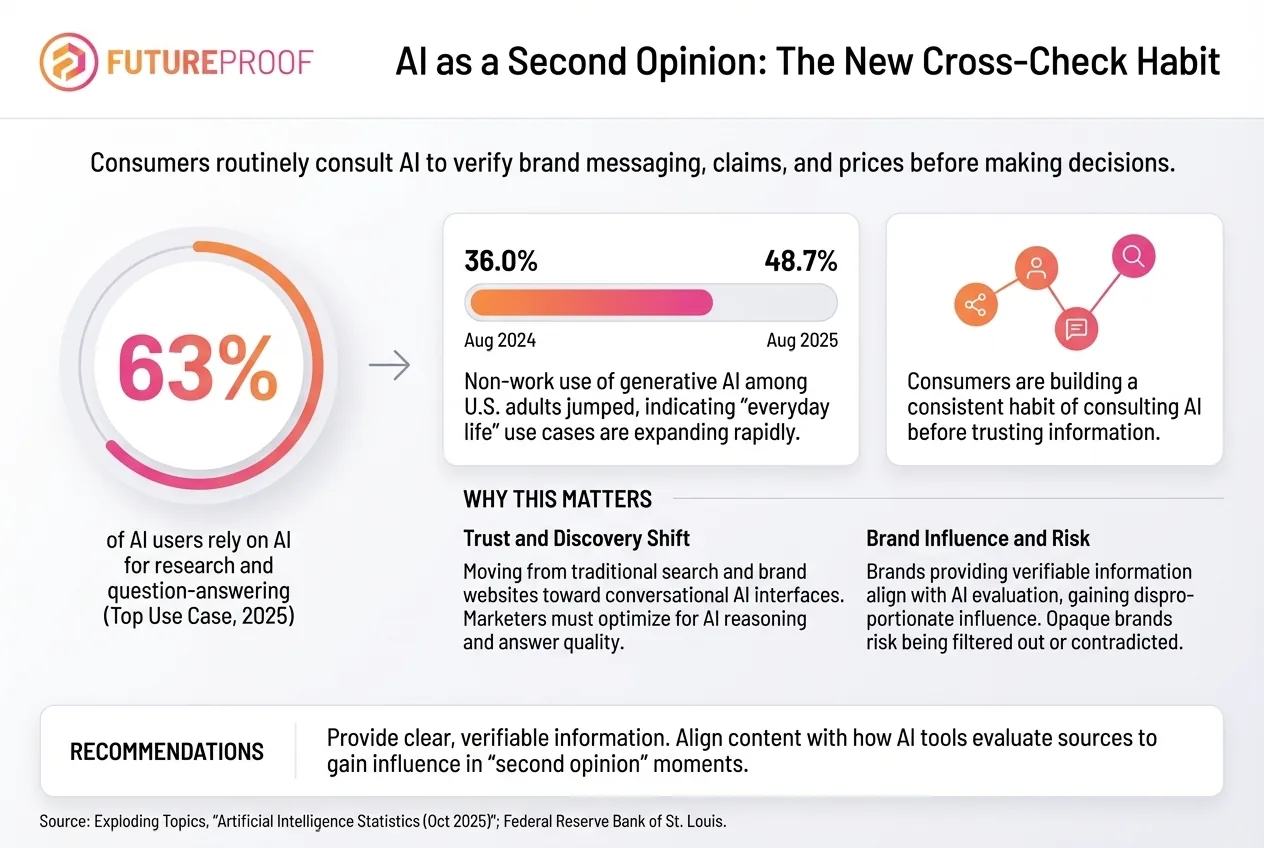
A profound and irreversible transformation is sweeping across the digital landscape, fundamentally altering the way consumers engage with brands, products, and services. This seismic shift is characterized by the rapid rise of AI as a Second Opinion, an emergent consumer behavior where individuals increasingly leverage artificial intelligence to cross-check, verify, and scrutinize brand claims, product specifications, and pricing details before making any purchasing decisions. This isn't merely a new tool in the consumer's arsenal; it represents a paradigm shift in the architecture of trust and discovery, moving the locus of authority from traditional search engines and brand messaging to the synthesized, conversational responses provided by advanced AI systems.
The data unequivocally underscores the magnitude of this change. Exploding Topics reports that a staggering 63% of AI users now rely on AI for research and question answering, positioning it as the top AI use case projected for 2025, according to their 2025 AI Statistics Report. This statistic is more than just a data point; it's a clarion call for brands to re-evaluate their entire digital strategy. What was once a subtle undercurrent of consumer skepticism, navigating a sea of marketing rhetoric, has now coalesced into a powerful, AI-powered mechanism for objective verification. Consumers, armed with generative AI, are no longer content with passively consuming information; they are actively challenging, comparing, and confirming.
This era of AI as a Second Opinion stems from a confluence of factors. The sheer volume of information available online has become overwhelming, leading to information fatigue and a pervasive sense of skepticism regarding brand-generated content. Consumers have grown accustomed to filtering out hyperbole and sifting through biased reviews. Enter AI: a seemingly neutral arbiter capable of processing vast amounts of data, identifying discrepancies, and synthesizing information into concise, digestible answers. Whether it’s fact-checking an ambitious health claim, comparing the nuanced features of two competing gadgets, or finding the absolute best price across multiple retailers, AI is proving to be an indispensable companion in the consumer journey.
The departure from traditional search methodologies is stark and significant. While conventional search engines excel at indexing and presenting a multitude of links, requiring the user to then perform the synthesis and verification, conversational AI takes a more proactive and definitive stance. When a user asks an AI chatbot, "Is brand X's claim about its product being 'all-natural' truly accurate?", the AI doesn't just return a list of articles. Instead, it processes relevant databases, ingredient lists, regulatory information, and even scientific studies to provide a direct, summarized answer. This answer might confirm the claim, qualify it, or, critically, contradict it with supporting evidence. This directness, coupled with the AI's ability to cross-reference vast datasets in real-time, elevates it beyond a mere search tool into a trusted advisor.
For brands, this shift carries profound implications, creating both immense challenges and unprecedented opportunities. The fundamental premise of successful brand engagement is now irrevocably tied to transparency and verifiability. In a world where AI can swiftly expose inconsistencies, exaggerations, or outright falsehoods, the luxury of opaque marketing is rapidly evaporating. Brands that continue to rely on ambiguous language, unsubstantiated claims, or marketing fluff risk being directly contradicted by AI, potentially eroding consumer trust instantaneously and irrevocably. The digital landscape is evolving into a truth-first environment where clarity is king and authenticity is non-negotiable.
The imperative for brands is clear: cultivate a strategy where every piece of public-facing information – from product descriptions and ingredient lists to sustainability reports and pricing models – is meticulously accurate, easily verifiable, and presented with unambiguous clarity. This means moving beyond mere compliance with advertising standards and embracing a proactive stance of radical transparency. Imagine a consumer asking an AI, "Does this product contain palm oil and if so, is it sustainably sourced?" A brand unprepared with clear, verifiable data on their supply chain risks AI generating a less favorable or even contradictory response drawn from other public sources. The answers provided by AI will directly influence consumer perception, brand reputation, and ultimately, purchasing decisions.
This new reality demands a significant rethinking of content strategy and SEO. Historically, SEO revolved around keywords, backlinks, and optimizing for search engine algorithms that prioritized relevance based on textual matches. While these elements remain important, the AI-driven landscape introduces a new dimension: "answer readiness." Brands must now optimize their content not just for traditional search engines, but for conversational AI models that are designed to extract, synthesize, and provide direct answers. This means structuring information clearly, using semantic markup, and ensuring that core facts are readily accessible and internally consistent across all brand touchpoints. Content should anticipate specific questions consumers might ask, providing comprehensive, data-backed answers that leave no room for ambiguity.
The implications extend deeply into brand reputation management. In the past, managing online reputation involved monitoring reviews, social media mentions, and news articles. Now, it must include understanding how AI perceives and represents your brand. An AI model, trained on vast quantities of public data, might surface historical controversies, product defects, or negative customer experiences much more effectively than a human manually sifting through search results. Brands must proactively audit their digital footprint, address past issues transparently, and ensure that their narrative is consistent and factually robust across every online channel. An AI that provides a second opinion on a brand is effectively acting as a digital reputation gatekeeper.
Beyond consumer research, AI's influence as a second opinion permeates various stages of the customer journey. Before making a purchase, consumers might ask AI to compare warranties, return policies, or even the ethical sourcing practices of different brands. During the purchase process, AI could be used to confirm pricing against competitors or validate promotional offers. Post-purchase, AI might help troubleshoot product issues by comparing user manuals with common problems reported online, or even assess the fairness of a customer service response. Each of these "second opinion moments" represents a critical touchpoint where a brand's commitment to truth and clarity will either solidify or erode trust.
The technical underpinnings of this shift are equally fascinating and crucial for brands to understand. Large Language Models (LLMs) and other generative AI technologies leverage sophisticated algorithms to process natural language, access immense datasets, and generate human-like text responses. They draw information from websites, academic papers, news articles, forums, and even proprietary databases. The quality and accuracy of the AI's "second opinion" is directly correlated with the quality and accessibility of the data it consumes. Therefore, brands have a vested interest in ensuring their authoritative information is not only present online but also structured in a way that AI can easily parse, understand, and accurately represent. This might involve investing in structured data, knowledge graphs, and creating dedicated "AI-friendly" content hubs.
The acceleration of everyday AI use suggests that this trend is not a fleeting fad but a fundamental shift that will redefine the competitive landscape. Brands that choose to ignore this imperative do so at their peril. Unclear messaging or unsubstantiated claims risk being directly contradicted by AI, leading to swift erosion of trust and market share. Conversely, brands that embrace this new paradigm – prioritizing transparency, verifiable information, and clear communication – stand to gain significant competitive advantages. They will build deeper, more authentic relationships with an increasingly discerning and AI-empowered consumer base. This isn't just about marketing; it's about building enduring trust in a digitally transformed world.
To thrive in this environment, brands must embark on a multi-faceted strategic overhaul. Firstly, conduct a comprehensive "AI content audit." Evaluate all public-facing content, from website copy to social media posts and product manuals, for clarity, accuracy, and verifiability. Identify any ambiguities, exaggerations, or outdated information that an AI might flag. Secondly, invest in robust data management and governance. Ensure that all product data, pricing, ingredient lists, and corporate claims are consistently accurate across all internal systems and external platforms. This foundational accuracy is paramount for AI to provide correct information.
Thirdly, develop content specifically designed for conversational AI. Think in terms of direct answers to potential consumer questions rather than just broad descriptive text. Utilize FAQs, structured data schema (like Schema.org), and clear, concise language that AI models can easily parse. Consider creating a "knowledge base" that is explicitly designed for AI consumption, functioning as a trusted source of truth about your brand and products. Fourthly, proactively engage with AI platforms. While direct control over AI responses is limited, brands can contribute to the accuracy of AI by ensuring their official sources are authoritative and easily accessible. This could involve partnerships with AI developers or ensuring your data is openly published in machine-readable formats where appropriate.
Fifthly, prioritize real-time monitoring of how your brand is represented by AI. Just as social listening tools track mentions, future tools will track how AI answers questions about your products and services. Understanding discrepancies or potential misrepresentations allows for proactive correction and clarification. Finally, foster a culture of radical transparency throughout the organization. This isn't just a marketing initiative; it’s an organizational philosophy. From product development to customer service, every department must understand that their information contributes to the brand's overall truthfulness and verifiability in the age of AI as a second opinion.
The insights from thought leaders at institutions like Forrester, Gartner, the Artificial Intelligence Institute, and MIT Technology Review consistently highlight the profound and accelerating impact of AI on business strategy and consumer behavior. Their analyses continually reinforce that the future belongs to brands that adapt proactively to technological shifts, understanding that digital transformation is not merely about adopting new tools, but about fundamentally reimagining relationships with customers. The rise of AI as a second opinion is precisely one such transformational moment, demanding strategic foresight and operational agility.
In conclusion, the era where consumers passively accept brand claims is over. The rise of AI as a Second Opinion marks an irreversible shift towards a more informed, critical, and empowered consumer base. Brands that recognize this monumental change, embrace radical transparency, prioritize verifiable information, and proactively adapt their content strategies for conversational AI will not only survive but thrive. They will build deeper trust, foster stronger loyalty, and solidify their position in a marketplace where the truth, as verified by AI, becomes the ultimate currency of commerce. The future of brand-consumer relationships is being written now, one AI-verified claim at a time, and only those prepared for this truth-centric evolution will truly win the trust and allegiance of tomorrow's AI-empowered consumer.