AI Agents Are Collapsing the Shopping Funnel and Redefining the Future of Commerce
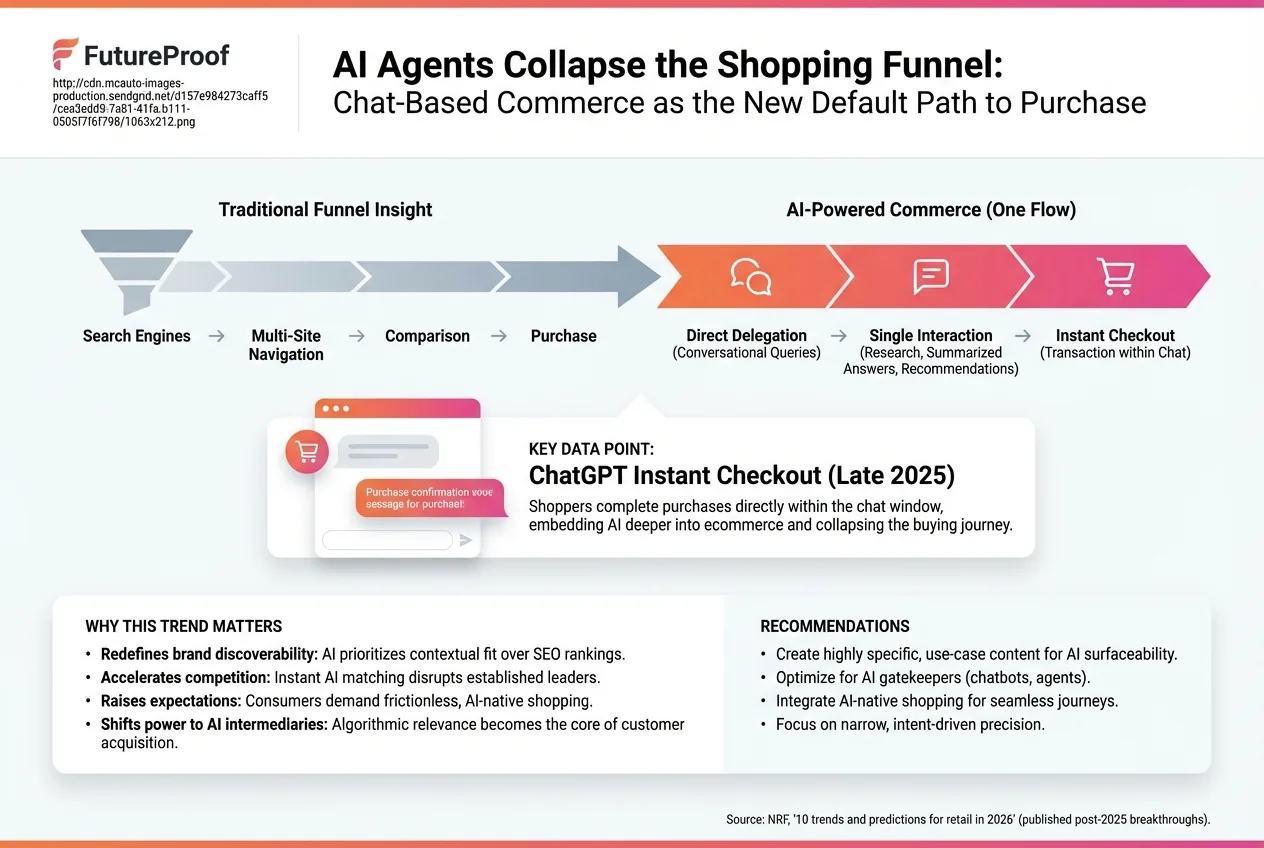
The landscape of retail and consumer decision-making is undergoing a seismic transformation, driven by the rapid evolution and integration of artificial intelligence. Forget the familiar, multi-stage shopping funnel; AI agents are not merely optimizing it – they are utterly collapsing it, redesigning the entire path to purchase into a seamless, often singular, conversational flow. This profound shift redefines not only how consumers discover and buy products but fundamentally alters the strategies brands must employ to remain relevant and visible in an increasingly automated marketplace.
For decades, the traditional shopping funnel served as the bedrock of marketing strategy: Awareness, Interest, Desire, Action. Consumers navigated a laborious journey, moving from initial discovery through extensive research, comparison shopping, and finally, a transaction. Each stage presented friction, demanding separate efforts from brands to capture attention and guide prospects forward. Digital transformation began to compress this funnel, but AI agents are now eliminating it altogether, creating a direct conduit between a consumer's unarticulated need and a fulfilled purchase.
This isn't a theoretical future; it's the immediate present. Consumers are rapidly shifting from active "search" – typing keywords into a search engine – to direct "delegation." Instead of sifting through pages of results, they are increasingly asking AI agents for recommendations: "Find me the best sustainable running shoes for under $150," or "Order flowers for my mom's birthday with same-day delivery." The AI then sifts, analyzes, recommends, and, crucially, completes the transaction in one integrated interaction. This shift is already visible and gaining momentum, epitomized by features like ChatGPT’s Instant Checkout, which allows users to research and buy products without ever leaving the chat interface. As the NRF's 10 trends and predictions for retail in 2026 highlight, this pushes AI even deeper into ecommerce, accelerating the inexorable move toward chat-based shopping and AI-powered purchasing assistants.
The implications for brands are monumental. AI is becoming the new discovery and decision layer, acting as a sophisticated gatekeeper, personal shopper, and transaction facilitator. In this new paradigm, traditional SEO focused on keyword rankings gives way to a premium on algorithmic relevance. Brands must build frictionless paths that perfectly match how consumers now buy, anticipating needs and offering solutions with unprecedented precision and contextual understanding.
The Demise of the Traditional Funnel: From Exploration to Expedited Exchange
To appreciate the magnitude of this shift, it's essential to understand what the traditional shopping funnel entailed and why its demise is so significant. Historically, consumers began with a broad awareness of a problem or desire, then moved to an interest in potential solutions, evaluated specific products or services (desire), and finally made a purchase (action). This journey was often disjointed, involving multiple touchpoints across various platforms – social media, search engines, brand websites, review sites, physical stores. Each stage was a battle for attention, requiring distinct marketing tactics from brand storytelling to detailed product specifications and persuasive calls to action.
However, the digital age, characterized by information overload, shrinking attention spans, and an insatiable demand for convenience, began to erode the funnel's efficacy. Consumers grew weary of endless scrolling and comparison tabs. Mobile devices further accelerated the need for instant gratification, making lengthy research processes feel cumbersome and outdated. The rise of voice search hinted at a future where queries would be more conversational, but the full impact of AI agents takes this to an entirely new level, moving beyond mere information retrieval to direct transactional capabilities.
The traditional funnel, with its inherent friction points, is simply incompatible with a world where AI offers a one-stop solution. Consumers no longer have the patience or the need to navigate multiple steps when a sophisticated AI assistant can understand their intent, evaluate millions of options, and execute a purchase with a single prompt. This represents not just an optimization but a fundamental reimagining of the entire consumer journey, transforming it from a multi-stage exploration into an expedited exchange.
AI Agents as the New Architects of the Path to Purchase
At the heart of this revolution are AI agents – sophisticated algorithms capable of natural language processing, semantic understanding, and complex decision-making. These agents are evolving beyond simple chatbots to become highly intelligent virtual personal shoppers, concierges, and transaction managers. They are collapsing the traditional shopping funnel by integrating several historically distinct stages into a unified, conversational workflow.
- Discovery and Awareness: Instead of passively encountering an advertisement or searching for a product, consumers directly delegate this task to an AI. "What's a good book to read if I like psychological thrillers?" becomes an immediate query, and the AI agent instantly curates a personalized list, potentially even offering summaries or reviews.
- Consideration and Evaluation: The AI doesn't just list options; it can filter, compare, and justify its recommendations based on specified criteria. "Which of these has the best battery life?" or "Compare the warranty policies of these two laptops." The AI acts as an impartial, highly efficient researcher, sifting through vast amounts of data in milliseconds.
- Decision and Purchase: This is where the collapse is most dramatic. With features like ChatGPT's Instant Checkout, the AI agent transitions seamlessly from recommendation to transaction. A user identifies a product they like from the AI's suggestions and, with a single command, the AI initiates and completes the purchase, leveraging pre-configured payment and shipping information. The entire process, from initial query to final payment, occurs within the same conversational interface.
This single conversational flow fundamentally alters the power dynamic. The AI agent, armed with a deep understanding of the user's preferences, historical purchases, and real-time intent, becomes the primary arbiter of choice. It curates the options, influences the decision, and facilitates the execution, effectively becoming the ultimate gatekeeper between brands and consumers.
The Paradigm Shift: From Search to Direct Delegation
The transition from "search" to "direct delegation" is perhaps the most profound behavioral change driven by AI agents. For years, digital marketing revolved around optimizing for search engines, mastering keywords, backlinks, and technical SEO to rank prominently in search results. The assumption was that consumers would actively seek out information, comparing multiple options before making a choice.
Direct delegation flips this model on its head. Consumers are no longer seeking to compare; they are seeking to empower an intelligent agent to do the comparing and deciding for them. They're not looking for a list of links; they're looking for a definitive answer or a direct solution. This means:
- Beyond Keywords to Intent: AI agents excel at semantic understanding and contextual interpretation. They don't just match keywords; they grasp the underlying intent, nuance, and emotional drivers behind a query. A request for "comfortable shoes" will be interpreted differently for a marathon runner versus someone needing everyday office wear, based on the user's profile and previous interactions.
- Trust in the Agent: As AI agents become more sophisticated and consistently deliver valuable, personalized recommendations, consumer trust will grow. The AI evolves into a trusted advisor, much like a personal shopper who understands individual tastes and requirements. This trust is paramount because consumers are delegating not just discovery, but also decision-making authority.
- The Ultimate Convenience Layer: The allure of direct delegation lies in unparalleled convenience. In an increasingly time-poor world, offloading the cognitive load of research and comparison to an AI is a powerful value proposition. The expectation is instantaneous, accurate, and frictionless results.
- AI as the Decision Layer: This is perhaps the most critical shift for brands. The AI agent becomes the primary filter and decision-making layer, operating between the consumer's initial impulse and the brand's product offering. A brand might have the perfect product, but if the AI agent doesn't deem it relevant or prioritize it based on its internal algorithms and the user's intent, the brand might never even enter the consumer's awareness. This necessitates a complete re-evaluation of how brand visibility and preference are cultivated.
Content is King, But Intent is Emperor: Optimizing for Algorithmic Relevance
In this AI-powered commerce era, the traditional tenets of SEO are undergoing a radical redefinition. While search engines will continue to exist, the dominant discovery and decision layer will increasingly be AI agents. This moves the focus from optimizing for "rankings" to optimizing for "algorithmic relevance."
- Precision and Specificity: Generic content that aims to capture broad keyword categories will be less effective. AI agents demand precise, highly specific, and deeply informative content that directly addresses explicit and implicit user needs. Brands must anticipate granular questions and provide authoritative answers.
- Deep Intent Understanding: Content strategists must move beyond surface-level keywords to psychoanalyze the "why" behind a query. What problem is the user trying to solve? What emotional need are they fulfilling? AI agents are adept at discerning intent, and content that aligns perfectly with that intent will be prioritized. This requires a deep dive into customer personas, pain points, and usage scenarios.
- Contextual Richness and Semantic SEO: AI agents don't just look for keywords; they understand concepts, relationships, and context. Content needs to be semantically rich, using a variety of related terms, synonyms, and natural language phrases that cover a topic comprehensively. This helps AI agents connect disparate pieces of information and build a holistic understanding.
- Structured Data and Schema Markup: To help AI agents efficiently process and categorize information, brands must prioritize structured data. Implementing schema markup (e.g., Product, Offer, Review, FAQ schema) provides explicit signals to AI about the nature and attributes of content and products. This is akin to providing an instruction manual for AI, enabling it to extract relevant details quickly and accurately for its recommendations.
- Authenticity, Authority, and Trust: AI agents are designed to provide helpful, unbiased information. They will likely prioritize sources that demonstrate genuine authority, expertise, and trustworthiness. Brands must build and maintain a strong reputation for accurate information, ethical practices, and transparent communication. Customer reviews, expert endorsements, and credible content creation will become even more vital.
- Personalization at Scale: The ultimate goal of AI agents is to deliver hyper-personalized experiences. Brands must build systems and content architectures that allow for dynamic content delivery tailored to individual user profiles, past behaviors, and real-time preferences. This could involve variations in product descriptions, recommended add-ons, or even the language used in AI-generated responses.
- Beyond Text: Multimedia and Accessibility: While conversational AI relies heavily on text, the underlying data that feeds it can be multimedia. Brands should optimize product images, videos, and audio descriptions to be easily digestible by AI, ensuring that all sensory information about a product is digitally accessible and interpretable.
Unlocking New Opportunities: Niche Brands and the Hyper-Targeted Moment
While the AI-powered shift might seem daunting for many, it simultaneously creates unprecedented opportunities, particularly for niche brands. In the traditional search paradigm, smaller brands often struggled to compete with the marketing budgets and domain authority of larger corporations, especially for broad, high-volume keywords. AI agents level the playing field by prioritizing relevance and user intent over raw brand power or historical search rankings.
- Surfacing at the Exact Moment of Need: AI agents are exquisite matchmakers. If a consumer asks for "handmade vegan leather wallets produced by local artisans," a niche brand specializing in precisely that might be recommended directly, bypassing larger retailers who offer a broader but less specific range. The AI's ability to connect highly specific needs with equally specific solutions means niche brands can emerge directly into the spotlight at the precise moment of conversion intent.
- The "Long Tail" Redefined: The long tail of search marketing always championed specificity, but AI agents empower this concept to an exponential degree. Micro-niches, unique value propositions, and highly specialized products can now gain visibility that was previously impossible. A brand selling "ergonomic crochet hooks for arthritic hands" has a far better chance of being discovered and recommended by an AI agent understanding that precise need than relying on traditional search queries.
- Value Proposition Clarity: Niche brands often thrive on a unique selling proposition (USP). AI agents excel at understanding and communicating these USPs. Brands that can clearly articulate their distinct value – whether it's sustainability, ethical sourcing, unique design, or unparalleled craftsmanship – will be favored by AI agents seeking the best possible match for a user's detailed criteria.
- Building Hyper-Relevant Audiences: By being surfaced at these exact moments of need, niche brands can build highly engaged and loyal customer bases. The AI acts as a sophisticated qualifier, delivering customers who are already predisposed to value the brand's specific offering, leading to higher conversion rates and stronger brand affinity. This enables niche brands to compete on relevance and quality, rather than just advertising spend.
Strategies for Brands in the AI-Powered Commerce Era
Adapting to this new reality is not optional; it’s an imperative. Brands must proactively develop strategies that embrace AI as the new commerce backbone.
- Embrace Conversational UI/UX: Invest in conversational interfaces, chatbots, and voice assistants that can seamlessly integrate with AI agents. This means not just having a basic chatbot, but one that can understand complex queries, access product catalogs, check inventory, and process transactions.
- Optimize Product Feeds and Catalogs for AI: This is foundational. Product data must be exceptionally rich, detailed, accurate, and structured. Include every possible attribute: material, dimensions, color, features, benefits, sustainability certifications, care instructions, customer reviews, detailed specifications, high-quality images, and contextual use cases. The more data AI has, the better it can understand and recommend.
- Prioritize Intent-Driven Content: Shift content strategy from broad keywords to deep dives into user intent. Create authoritative, specific, and helpful content that directly answers questions and addresses problems, not just promotes products. Think FAQs, "how-to" guides, comparison articles (from a neutral perspective), and detailed product stories.
- Implement Robust Structured Data (Schema Markup): Make it easy for AI agents to understand your content and products. Utilize schema.org markup extensively for all product pages, services, reviews, and informational content. This is the language AI agents speak.
- Focus on Unique Value Propositions and Differentiators: As AI curates options, it will prioritize brands that offer clear, compelling value propositions. What makes your brand unique? What problem do you solve better than anyone else? This needs to be explicitly communicated in your content and data feeds.
- Build Trust and Transparency: AI agents, by their nature, aim to be helpful and objective. Brands must cultivate an image of trustworthiness through authentic content, transparent practices, ethical sourcing (if applicable), and clear data privacy policies. Strong customer reviews and social proof will remain vital, influencing AI recommendations.
- Personalization and Predictive Analytics: Leverage data to understand individual customer preferences and predict future needs. While AI agents will handle much of the heavy lifting in personalization, brands can feed their own first-party data into their AI integrations to refine recommendations and anticipate customer journeys.
- Beyond the Transaction: AI-Powered Post-Purchase Experience: The conversational flow doesn't end with a purchase. AI can enhance post-purchase support, track orders, manage returns, offer troubleshooting, and cultivate loyalty, all within the same conversational interface, strengthening the overall customer relationship.
- Experiment and Adapt: The AI commerce landscape is incredibly dynamic. Brands must foster a culture of continuous learning, experimentation, and rapid adaptation. What works today might be obsolete tomorrow. Stay abreast of AI advancements and be willing to pivot strategies quickly.
Conclusion: The Conversational Future of Commerce
The rise of AI agents is not merely another technological advancement; it is a fundamental restructuring of the commercial interaction between brands and consumers. By collapsing the traditional shopping funnel into a single, conversational flow, AI agents are transforming how products are discovered, evaluated, and purchased. The consumer shift from active search to direct delegation puts an unprecedented premium on precise, intent-driven content and creates a powerful new avenue for niche brands to surface at the exact moment of need.
Brands that cling to outdated marketing paradigms will find themselves increasingly invisible in this AI-powered future. Success will belong to those who optimize for algorithmic relevance rather than just rankings, who understand the nuances of conversational commerce, and who build frictionless paths that align perfectly with how consumers now choose to buy. The future of shopping is conversational, personal, and profoundly efficient, and brands must now speak the language of AI to thrive.