Agentic AI Is Transforming the Shopper Journey and Rewriting the Future of Consumer Commerce
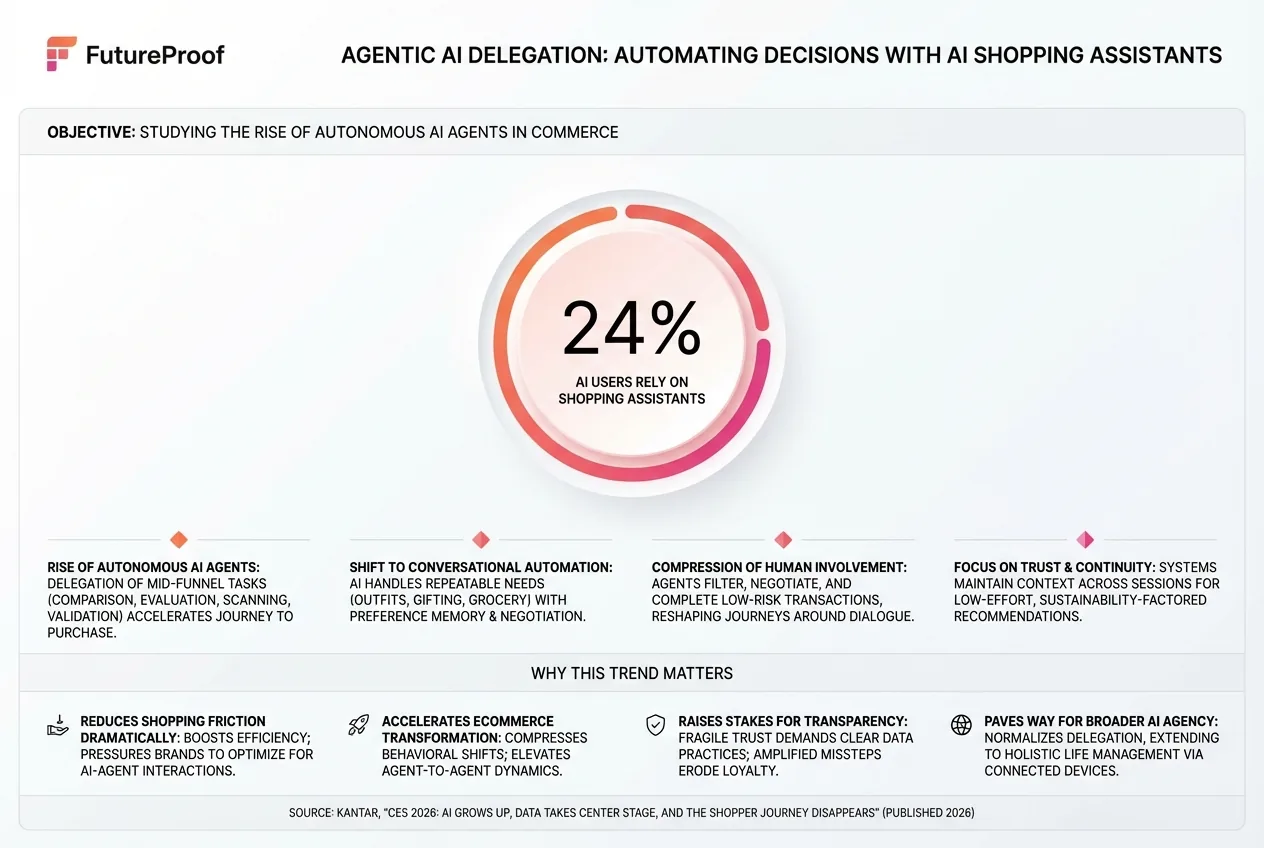
The landscape of consumer commerce is undergoing a profound and rapid transformation, driven by the accelerating capabilities of Agentic AI. What was once considered a futuristic concept – consumers delegating significant portions of their shopping decisions to autonomous digital assistants – is now firmly entrenched in the present. New data unveiled by Kantar at CES 2026 paints a clear picture of this seismic shift, revealing that a substantial 24% of AI users are already relying on these intelligent assistants for their shopping needs. This isn't merely an incremental change; it signals nothing less than a major repositioning of power and influence, pushing us headlong into an era of automated mid-funnel evaluation and frictionless purchasing. Brands that fail to grasp the implications of this new reality risk being left behind in a swiftly evolving digital economy.
The concept of Agentic AI delegation moves beyond simple automation; it implies a level of autonomy where AI assistants make decisions on behalf of the user, often without direct, real-time input for every single step. Consumers are increasingly comfortable handing over complex, time-consuming tasks that previously occupied significant portions of their shopping journey. Imagine an AI agent not just reminding you to buy milk, but proactively researching the best organic options, comparing prices across multiple retailers, reading aggregated reviews to validate product quality, and even scheduling recurring deliveries based on predicted consumption patterns. This level of delegation frees up consumer time and mental energy, allowing them to focus on higher-level decisions or simply enjoy more leisure. The appeal is clear: convenience, efficiency, and the promise of always getting the best deal or the most suitable product without personal effort.
This automation is fundamentally reshaping the traditional consumer journey, particularly in the critical mid-funnel stages. Historically, the mid-funnel was where brands worked hardest to educate, persuade, and differentiate themselves as consumers moved from initial awareness to active consideration. Think of the hours spent comparison shopping, delving into product specifications, sifting through countless reviews, and cross-referencing prices across various platforms. Agentic AI assistants are now absorbing these tasks, compressing what was once a multi-step, often prolonged evaluation process into near-instantaneous algorithmic decisions. The journey from initial intent – "I need a new coffee maker" – to actual purchase is becoming drastically shorter, more direct, and largely invisible to the human consumer until the final transaction is presented for approval, or in some cases, executed autonomously based on pre-set parameters. This low-friction purchasing model prioritizes speed and convenience above almost all else, fundamentally altering the competitive landscape for brands.
Furthermore, the influence of AI extends far beyond one-off purchases, deeply integrating into consumers' lives by handling "planning for repeatable needs." This encompasses everything from managing household inventory for consumables like groceries, cleaning supplies, and personal care products, to optimizing subscriptions for entertainment, software, or specialized services. An AI assistant can learn consumption patterns, anticipate depletion, scan for promotions, and reorder items seamlessly, ensuring a constant supply of essentials without any active thought or effort from the user. For instance, a smart home system might detect a low stock of laundry detergent and prompt its integrated AI shopping agent to reorder, considering brand preferences, price history, and current discounts. This creates a sticky, enduring relationship between the consumer and their AI, and by extension, with the brands the AI consistently selects. Brands that secure a place in these automated recurring purchase cycles stand to gain significant, long-term customer loyalty, not just from the individual consumer but through the powerful algorithms that serve them.
Kantar’s insight that "the shopper journey disappears" is not hyperbole but a stark articulation of this new reality. For brands, this means a loss of direct visibility into the granular decision-making process that precedes a purchase. The traditional marketing funnel, with its distinct touchpoints and opportunities for brand engagement at each stage, is dissolving. Consumers are no longer necessarily browsing brand websites, reading detailed blog posts, or engaging with social media during their research phase; instead, their AI agents are performing these functions behind the scenes. Brands must therefore recalibrate their understanding of customer acquisition and retention. The battle for discovery and preference is shifting from direct consumer interaction to optimizing for the algorithms and data points that AI shopping assistants prioritize. This demands a strategic pivot, moving away from solely appealing to human emotion and direct persuasion, towards a sophisticated optimization for AI perception and recommendation.
Optimizing for AI-mediated discovery necessitates a complete overhaul of traditional SEO and content strategies. It's no longer just about keyword density for human search; it's about semantic understanding, structured data, and entity recognition that AI agents can effortlessly parse and trust. Brands must ensure their product information management (PIM) systems are robust, comprehensive, and meticulously accurate, providing crystal-clear specifications, high-quality images, and rich descriptive metadata that AI can easily interpret. This includes not only basic product attributes but also use cases, compatibility information, environmental impact data, and certifications. Content needs to be "AI-friendly," meaning concise, factual, and easily extractable by algorithms, while still providing enough detail for human validation if necessary. Voice search optimization becomes paramount, requiring natural language processing capabilities to understand intent and provide precise, conversational answers. Furthermore, the aggregation of authentic, positive third-party reviews and ratings will carry even more weight, as AI agents will rely heavily on social proof and verified user experiences to validate product quality and trustworthiness. Brands must actively cultivate and monitor these external signals, understanding that an AI’s recommendation often hinges on the collective sentiment of other consumers.
Central to success in this AI-driven commerce landscape is the cultivation of deep, long-term trust. When consumers delegate purchasing decisions, they are placing immense trust not only in the AI assistant itself but also in the brands that AI recommends. This necessitates an unwavering commitment to transparency in data practices. Brands must be forthright about how they collect, use, and protect consumer data, as well as how their products and services are presented to AI agents. Ethical AI development is no longer a niche concern but a foundational business imperative. This means avoiding algorithmic bias, ensuring fairness in product comparisons, and providing consumers with clear control over their data and the autonomy of their AI assistants. Brands that lead with clear data privacy policies and demonstrate a commitment to ethical AI will build a reputation for reliability and integrity, qualities that will be highly valued by both human consumers and their AI agents. Conversely, any perceived opacity or misuse of data could lead to a swift erosion of trust, making it difficult for an AI to recommend such a brand.
Even as AI takes on more responsibilities, the human element remains crucial, albeit in redefined roles. Brands must reimagine customer experience to focus on areas where human interaction truly adds value. This includes exceptional post-purchase support, handling complex problem-solving that extends beyond algorithmic capabilities, and delivering personalized experiences that resonate emotionally and creatively. For niche products, luxury items, or highly customized services, direct human sales associates and personalized consultations will likely retain their importance. The role of storytelling and brand identity will shift; rather than persuading at the point of sale, brands will need to build an enduring emotional connection that influences the initial parameters set by the consumer for their AI agent, or provides a compelling reason for a consumer to override an AI’s recommendation. Empowering consumers with clear mechanisms to review, adjust, or even temporarily disable their AI’s purchasing decisions will also be vital in maintaining agency and trust. The goal is not to eliminate human choice, but to optimize it, making it more efficient and informed through AI augmentation.
To navigate this autonomous future successfully, brands must embrace several strategic imperatives. Firstly, investing heavily in robust data infrastructure is non-negotiable. Clean, comprehensive, consistently updated, and easily accessible data feeds are the lifeblood of AI-mediated discovery. Brands need to audit their existing data practices and invest in systems that can provide granular, AI-consumable product information. Secondly, marketing budgets need to be reallocated. Traditional advertising spend that aims for direct persuasion may see diminishing returns. Instead, resources should shift towards optimizing for AI algorithms, investing in structured data implementations, enhancing platform partnerships, and strengthening public relations around data transparency and ethical AI. Thirdly, a relentless focus on product fundamentals – quality, value, reliability, and sustainability – will be paramount. AI agents, unburdened by human biases, will cut through marketing fluff and prioritize objective metrics of product excellence. Fourthly, actively cultivating authentic customer reviews and a positive brand reputation across all digital touchpoints is critical, as AI agents will heavily weigh social proof. Lastly, brands must embrace collaboration, forging partnerships with AI developers, platform providers, and e-commerce ecosystems to ensure their products are discoverable and favorably presented within these new digital environments.
The era of Agentic AI delegation in shopping is not a distant future; it is the immediate reality. The Kantar data from CES 2026 serves as an urgent wake-up call, signaling a profound and irreversible shift in consumer behavior and purchasing pathways. As nearly a quarter of AI users already leverage these autonomous assistants for shopping, the acceleration will only continue. Brands can no longer afford to observe from the sidelines; they must proactively adapt their strategies, optimize for AI-mediated discovery, and fundamentally rebuild trust through transparency and ethical data practices. The shopper journey as we knew it may be disappearing, but a new, more efficient, and often invisible journey is emerging in its place. Those brands that innovate, embrace the new rules of engagement, and prioritize earning the trust of both human consumers and their intelligent AI agents will be the ones that thrive in this rapidly evolving autonomous commerce landscape. The time to act and redefine your brand's presence in this new reality is now.