Teens Are Redefining Content Creation and Raising the Bar for Every Brand
The landscape of digital expression is undergoing a seismic shift, driven not by tech giants or industry leaders, but by the generation poised to inherit and reshape our world: teenagers. Far from merely interacting with artificial intelligence as a novelty, today’s teens are harnessing its power to become sophisticated producers of custom media at an unprecedented scale. This isn't a slow burn; it's a rapid evolution, outpacing the understanding and adaptation of many established brands. New research paints a vivid picture of this transformation, revealing a surge in teen-driven visual creation that is fundamentally reshaping expectations for how content is conceived, crafted, and shared across digital ecosystems. The implications for marketing, customer engagement, and the burgeoning creator economy are profound and immediate.
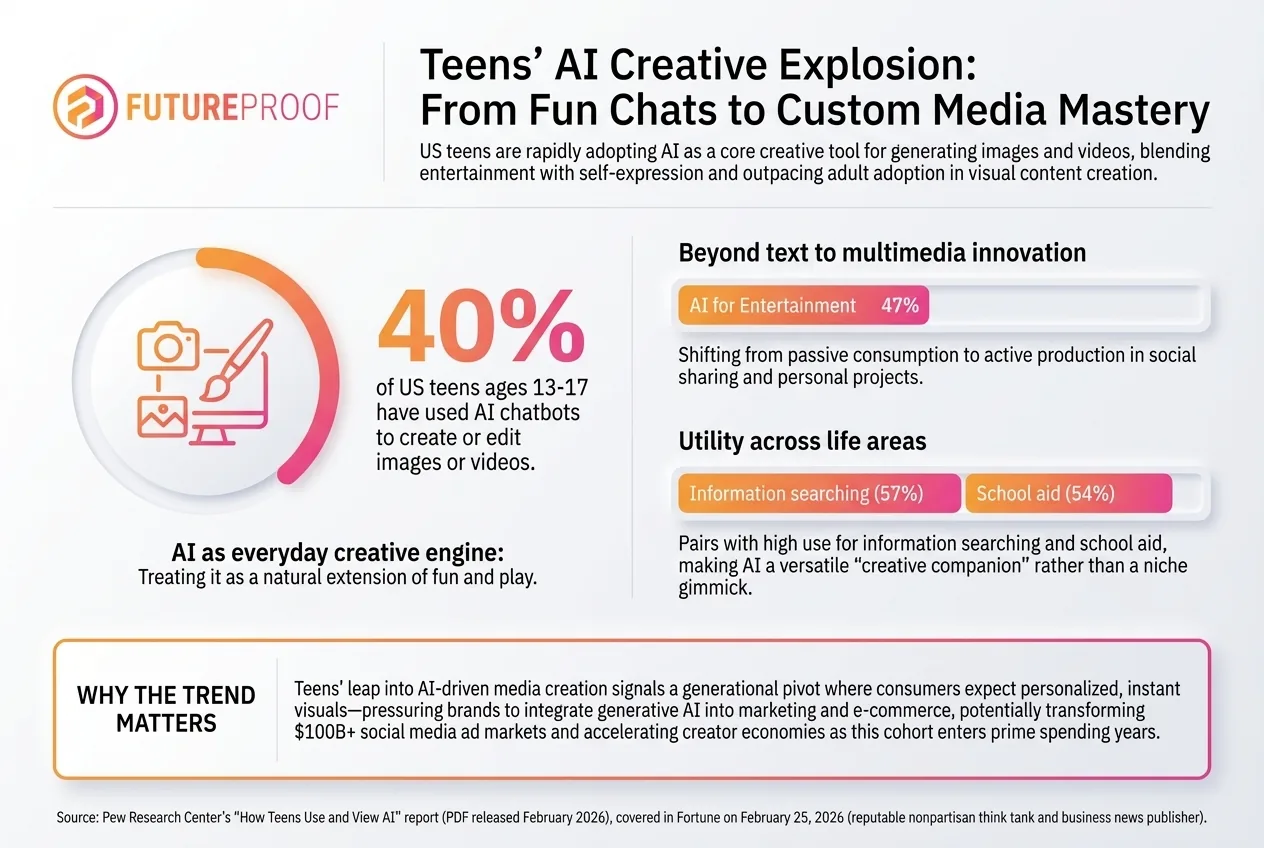
The evidence is clear and compelling: AI-powered tools are no longer niche applications but have become a normalized part of daily creative expression for this demographic. A groundbreaking report from the Pew Research Center, "How Teens Use and View AI" (February 2026), illuminates this accelerating trend, revealing that a staggering 40 percent of US teens now use AI chatbots to create or edit images and videos. This isn't just about passive consumption or simple experimentation; it signifies a confident leap into active, AI-assisted content production. This generation, fluent in digital languages and intuitive interfaces, sees generative tools not as a technological hurdle but as a natural extension of their creative faculties, empowering them to bring their visions to life with speed and precision previously unimaginable.
This significant embrace of AI for visual content creation is not an isolated phenomenon but rather a cornerstone of broader AI integration into teen life. The same Pew Research Center findings, further reported in Fortune, reveal a pervasive pattern of AI utility: 47 percent of teens use AI for entertainment, 57 percent leverage it for information searches, and 54 percent rely on it for schoolwork. These statistics paint a holistic picture of a generation that considers AI an indispensable utility across various facets of their existence. From AI-generated story prompts for a casual evening to AI-summarized research for a school project, or AI-enhanced visuals for a social media post, generative AI has seamlessly woven itself into the fabric of their digital routines. This widespread familiarity and comfort with AI's capabilities across different contexts naturally translates into an eager adoption of AI for creative production. Teens are emerging as confident multimedia creators, unafraid to experiment and innovate, rather than remaining passive consumers of pre-packaged content. Crucially, they are adopting AI-powered production capabilities far faster than their adult counterparts, setting a new benchmark for digital literacy and creative fluency.
Why does this matter with such urgency? Because this generation, already accustomed to instant gratification and hyper-personalization, now expects the same level of agility and bespoke experiences from the brands they interact with. As teens increasingly generate their own instant, personalized visuals, the bar for brand content will inevitably rise. Brands that fail to integrate generative AI into their marketing strategies and customer experiences risk appearing antiquated, out of touch, and ultimately irrelevant. The impact of this shift will reverberate across every social platform, demanding new approaches to engagement, and will fundamentally reshape the creator economy, influencing markets worth more than a colossal 100 billion dollars.
The era of mass-produced, one-size-fits-all content is rapidly drawing to a close. Teens, armed with intuitive AI tools, are creating hyper-specific, visually rich content tailored to their immediate needs and niche communities. This necessitates a radical rethinking of content pipelines for brands. Imagine a teen needing a specific visual for a school presentation, a unique meme for their friend group, or a personalized avatar for a gaming profile. Instead of searching endlessly or learning complex software, they simply prompt an AI. This ease of access and power democratizes creation, putting sophisticated tools into the hands of anyone with an idea. Brands must acknowledge this inherent expectation: if a teen can conjure any image or video with a few text commands, why would they settle for generic, uninspired brand messaging?
For marketing departments, this presents both an unprecedented challenge and an extraordinary opportunity. The demand for instant, personalized visuals means brands must pivot towards AI-driven content generation capabilities that can respond with lightning speed to emerging trends, individual preferences, and micro-segmentation. This is no longer about segmenting an audience into broad demographics but understanding individual creative desires. AI can enable brands to generate countless variations of ad creatives, social media posts, and product visuals, each uniquely tailored to resonate with specific user profiles or even in real-time interactions. Think of personalized product demonstrations, interactive virtual try-ons that learn user styles, or marketing campaigns where the audience can co-create brand content using AI tools provided by the brand itself. The future of brand engagement will involve a symbiotic relationship where AI empowers both the brand and the consumer to participate in the creative process.
Beyond marketing, the shift profoundly impacts customer experience (CX). Teens expect immediate, visually rich responses to their queries and interactions. AI-powered customer service, already evolving, will need to incorporate visual components seamlessly. Imagine asking a chatbot about a product and receiving not just text, but an AI-generated image or short video demonstrating a specific feature, customized to your expressed preferences. Personalized shopping experiences could involve AI-generated visuals of products integrated into a user's own environment, or outfits tailored to their unique style and body type, dynamically generated as they browse. The traditional customer journey is being visually augmented and hyper-personalized by AI, making every touchpoint an opportunity for bespoke creative interaction. Brands that can deliver this level of visual and personal responsiveness will build deeper connections with this digitally fluent generation.
The ripple effect extends powerfully into the creator economy. With markets valued at over $100 billion, this sector is a hotbed of innovation and influence. Generative AI is leveling the playing field, drastically lowering the barrier to entry for high-quality content production. Aspiring creators, regardless of their traditional artistic skill set, can now leverage AI to produce stunning visuals, compelling animations, and engaging videos. This empowers a new wave of micro-influencers and niche content producers who can generate high-fidelity content without extensive budgets or technical expertise. The traditional creative workflow, from concept generation to final edits, is being augmented and accelerated by AI, allowing creators to explore more ideas, iterate faster, and publish more frequently. For established creators, this means embracing AI tools to enhance their output and stay competitive; for new creators, it offers a springboard into a crowded market. The very definition of "creator" is expanding to include those who can effectively prompt and direct AI, blurring the lines between artist, technologist, and storyteller. This also creates new opportunities for "prompt engineers" and AI art directors, roles that curate and guide AI's creative output.
However, this rapid adoption of AI creativity by teens also brings critical challenges and considerations for brands. Ethical AI use, transparency, and authenticity become paramount. In a world where AI can conjure any image, questions around deepfakes, misinformation, and intellectual property become more complex. Brands leveraging generative AI must navigate these waters with extreme care, ensuring transparency when content is AI-generated and adhering to ethical guidelines. Teens, as savvy digital natives, are often quick to spot inauthenticity. Brands must strive to use AI to augment genuine human connection and storytelling, rather than replace it entirely. The speed of technological advancement also means that brands must build agile internal teams, capable of continuously learning, experimenting, and iterating their AI strategies. Investing in AI talent, infrastructure, and robust governance frameworks is no longer optional but essential for long-term relevance. Understanding the nuanced ways AI integrates into youth culture, rather than simply imposing AI for AI's sake, will differentiate leading brands from laggards.
To adapt and thrive in this dynamic environment, brands must embrace a multi-faceted strategy. First, they need to invest heavily in AI-powered content creation tools and upskill their marketing and creative teams in prompt engineering and AI integration. Second, fostering co-creation opportunities with their audience will be crucial. Brands can invite teens to use generative AI tools to create personalized brand content, turning consumers into active participants and brand advocates. Third, personalization must become the default, moving beyond broad segmentation to deliver hyper-relevant, visually engaging content at the individual level. This requires sophisticated AI analytics and dynamic content generation capabilities. Fourth, continuous monitoring of AI trends and rapid iteration of strategies are non-negotiable, given the fast-paced evolution of the technology. Finally, brands must remember that AI is a powerful amplifier, not a replacement for compelling, authentic storytelling. The goal is to use AI to tell better, more personalized stories that resonate deeply with a generation that values creativity and individuality above all else.
The future of content is not waiting. It is being built, right now, by a generation of confident, tech-savvy teenagers who view artificial intelligence as a natural extension of their creative potential. The shift from passively playing with AI to actively producing custom media at scale is happening faster than most brands realize, creating an urgent imperative for adaptation. As 40 percent of US teens now routinely use AI chatbots for image and video creation, making generative tools a normal part of their daily expression, the message is undeniable: this generation is not merely anticipating the future of AI creativity; they are actively constructing it. Brands that recognize this monumental shift, embrace the power of generative AI, and integrate it deeply into their marketing and customer experience strategies will not only survive but will flourish, forging authentic connections with the digital natives who are redefining the very essence of content in our interconnected world. The opportunity is immense, but the window for action is narrow.