The Rise of AI as Our Daily Performance Coach
The landscape of human interaction with technology is undergoing a profound transformation, moving beyond the transactional query-and-answer model to embrace a more intimate, continuous partnership. Artificial intelligence, once primarily a tool for instantaneous information retrieval, is rapidly evolving into a daily performance coach, deeply embedded in our routines and actively contributing to our self-improvement journeys. Consumers are no longer just asking AI what to do; they are increasingly relying on it to guide how they write, learn, and manage the intricate tapestry of their daily lives. This pivotal shift signals a new era of personal and professional empowerment, where AI acts as an always-on mentor, constantly refining our skills, expanding our knowledge, and streamlining our responsibilities.
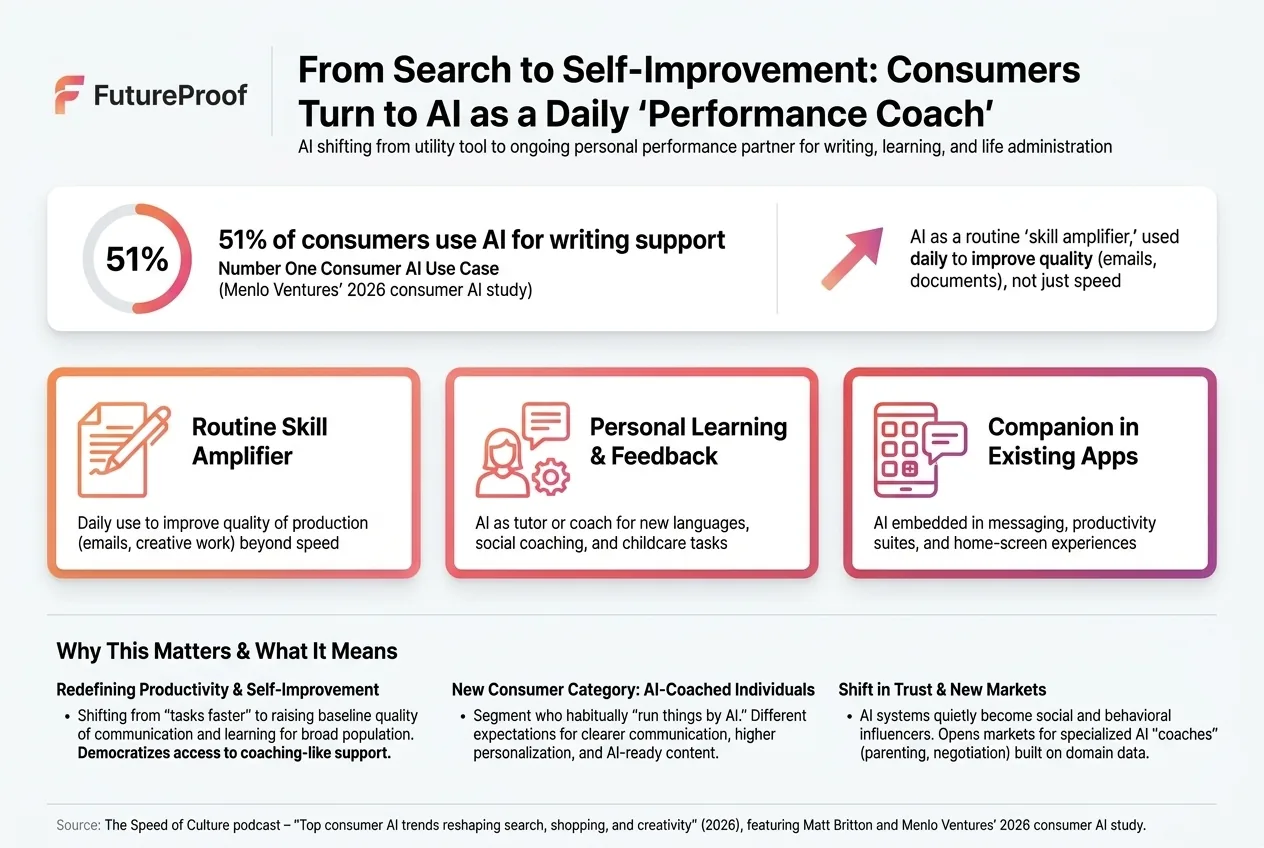
One of the most significant forces propelling this evolution is AI's burgeoning role as a routine skill amplifier. The days of AI being relegated to niche or highly specialized tasks are fading, replaced by its seamless integration into the foundational activities of daily life. Research shared by Menlo Ventures on The Speed of Culture podcast strikingly highlights this trend, revealing that 51 percent of consumers now regularly use AI for writing support, making it the top consumer use case. This statistic underscores a fundamental change: AI is not merely correcting grammar; it's helping individuals overcome writer's block, refine their tone, structure complex arguments, and even brainstorm creative ideas. From crafting professional emails and persuasive reports to generating engaging social media content or personal essays, AI acts as a ubiquitous co-pilot, enhancing clarity, coherence, and impact. It democratizes access to high-quality writing assistance, once the exclusive domain of professional editors or highly skilled wordsmiths. But the amplification extends far beyond writing. AI is assisting with coding, suggesting design improvements, interpreting complex data, and even generating musical compositions. It's becoming an indispensable part of our daily creative and analytical processes, transforming how we approach tasks and significantly elevating the standard of our output. This routine integration means AI isn't just a tool to pick up when needed; it's an always-on, readily available resource that makes us better at what we do, day in and day out.
Furthermore, consumers are increasingly turning to AI for continuous learning, blurring the lines between work productivity and personal development. The thirst for knowledge and skill acquisition is insatiable, and AI offers an unprecedented means to satisfy it. Language practice, for instance, has been revolutionized; AI tutors provide real-time conversational feedback, pronunciation correction, and cultural context, making fluency more accessible than ever before. Beyond academic pursuits, AI is a trusted guide for social learning. It can help users draft sensitive messages, offering insights into emotional intelligence and communication nuances for navigating difficult conversations, whether in personal relationships or professional settings. Imagine rehearsing a challenging negotiation or understanding a different perspective with AI guidance before engaging in a real-world interaction. This personalized, non-judgmental feedback loop fosters growth in areas traditionally requiring human mentors or extensive social experience. From mastering new software and understanding complex financial concepts to personalized fitness plans and advanced culinary skills, AI provides tailored learning paths and immediate feedback, transforming every interaction into an opportunity for growth. This blend of practical application and continuous self-improvement positions AI as an invaluable partner in lifelong learning, adapting to individual paces and preferences to deliver truly personalized educational experiences that transcend traditional classroom settings.
A crucial factor enabling this deep integration is AI's shift from being a standalone tool to an embedded companion within messaging platforms, documents, and everyday applications. The friction of context-switching, once a barrier to AI adoption, is rapidly disappearing. Instead of opening a separate AI application, users encounter AI capabilities directly within the flow of their work and communication. Think of AI features integrated into popular messaging apps like Slack or Microsoft Teams, summarizing long threads, drafting quick replies, or even suggesting relevant files. Consider AI working invisibly within Google Docs or Microsoft Word, offering real-time grammatical corrections, style suggestions, or rephrasing sentences without ever leaving the document. This embedded nature means AI isn't an external consultant; it's an internal intelligence, aware of the immediate context, conversations, and tasks at hand. It anticipates needs, offers relevant assistance, and streamlines processes seamlessly. This omnipresence makes AI less of an intimidating technology and more of an intuitive extension of our digital environment. It meets users precisely where they are, eliminating barriers to adoption and making its powerful capabilities an effortless part of our daily digital existence, fundamentally changing how we interact with technology and how technology interacts with us.
Finally, the growing trend of people offloading at-home tasks to AI underscores its evolving role as a comprehensive life manager. The demands of modern life can be overwhelming, and individuals are increasingly leveraging AI to alleviate cognitive load and free up time for more meaningful pursuits. This ranges from drafting sensitive personal messages—whether an apology, a condolence, or a difficult family discussion—where AI can help articulate feelings and navigate emotional complexities with grace and clarity. Beyond sensitive communication, AI assists with the mundane yet time-consuming tasks of family logistics: planning vacations, organizing intricate schedules, researching schools, creating personalized meal plans based on dietary restrictions, or even managing smart home devices. It acts as a digital household assistant, capable of handling a vast array of organizational and informational tasks that once consumed significant mental energy. Furthermore, AI is becoming a trusted aid in personal finance management, helping with budgeting, simplifying investment research, and providing actionable insights. In the realm of health and wellness, AI can generate personalized workout routines, suggest nutritious meal ideas, and even offer prompts for mental well-being exercises. By delegating these varied domestic and personal responsibilities to AI, individuals can reclaim valuable time and mental space, redirecting their focus towards creative endeavors, deeper human connections, or simply enjoying moments of leisure, thereby significantly enhancing their overall quality of life.
The profound shift towards AI as a daily performance coach carries significant implications that ripple across personal lives, industries, and societal norms. One of the most critical is that productivity now encompasses quality improvement, transcending the traditional metric of mere task speed. In the past, achieving high quality often meant sacrificing speed, relying on extensive human review and iterative feedback. AI changes this equation entirely. It delivers coaching-style feedback that was once exclusively reserved for human experts—editors, mentors, executive coaches, or specialized consultants. Imagine AI meticulously reviewing a business proposal, not just for grammar but for logical flow, persuasive language, tone, and strategic impact, providing actionable suggestions for improvement. This immediate, high-quality feedback democratizes access to expert-level guidance, empowering individuals to produce work of a much higher caliber across virtually all domains, from professional communication to creative output. The goal is no longer just to complete tasks quickly, but to complete them excellently. AI-driven insights ensure that every draft, every presentation, every message is refined, polished, and optimized for maximum effectiveness, fundamentally redefining what "productive" truly means in the modern era.
This emergence of AI as a performance coach is also cultivating a new segment of AI-coached consumers, one with elevated expectations for the content and services they encounter. These consumers, accustomed to highly personalized, instant, and high-quality feedback from their AI partners, now anticipate that brands will deliver clearer, more personalized, and inherently "AI-ready" content. What constitutes AI-ready content? It's information that is structured logically, uses plain language, is easily parsable by AI systems, and offers clear value propositions or calls to action. Brands must recognize that their audience is increasingly interacting with the world through an AI lens, often relying on AI to summarize articles, interpret complex product information, or filter recommendations. Therefore, content needs to be optimized not just for human readers but for AI systems that will process and present that information. This necessitates a strategic shift in content creation, moving towards more digestible formats, leveraging metadata, and focusing on clear, concise communication. Brands that fail to adapt risk becoming invisible or irrelevant to this new generation of AI-fluent consumers who expect tailored experiences and seamless integration of information, whether directly from a brand or filtered through an AI interface.
As emotional and cognitive labor increasingly shifts to AI systems, a significant implication arises: these systems gain considerable influence over our communication styles and even our decision-making processes. This raises critical questions around trust, transparency, and the very nature of human agency. If AI is consistently drafting our sensitive messages, summarizing complex information, or even suggesting how we phrase an apology, does it subtly standardize our voice? Does it inadvertently shape our unique communication patterns, potentially eroding aspects of our authentic selves in favor of an optimized, AI-generated persona? Furthermore, when AI synthesizes vast amounts of data to present us with "optimal" solutions or recommendations, how much do we truly understand the underlying logic, the potential biases embedded in the algorithms, or the data sources it relied upon? The "black box" problem becomes more pertinent as AI's influence grows. While AI offers unparalleled efficiency, the ethical imperative for human oversight, critical thinking, and a transparent understanding of AI's capabilities and limitations becomes paramount. Users must maintain a discerning perspective, recognizing that while AI can augment, it should not supplant human judgment entirely. Navigating this delicate balance is crucial to ensure that AI serves humanity without subtly controlling or inadvertently diminishing our uniquely human attributes.
Finally, the rise of AI as a daily performance coach is unlocking entirely new markets for AI-native coaching experiences across a multitude of sectors. The traditional coaching industry, once characterized by high costs and limited scalability, is being revolutionized by AI's ability to provide personalized, accessible, and continuous guidance. In education, AI-powered platforms offer personalized tutors, adaptive learning paths, and skill development guidance tailored to individual learning styles and paces. The wellness sector is seeing the emergence of AI mental health support apps, personalized fitness coaches that adapt workouts based on real-time biometric data, and nutrition planning tools that evolve with dietary needs. In productivity, AI-driven executive coaching tools help professionals hone their leadership skills, manage time more effectively, and strategize for career growth. Even human resources is benefiting, with AI assisting in onboarding new employees, providing objective performance feedback, and guiding career development. These new markets are all centered on measurable personal improvement, offering platforms that track progress, help set achievable goals, and provide actionable insights. This democratization of coaching, making expert guidance accessible to a far broader audience, represents a significant economic opportunity and a powerful force for widespread personal and professional advancement, fostering a global culture of continuous improvement powered by intelligent systems.
In conclusion, the journey of AI from a sophisticated search engine to a daily performance coach marks a monumental shift in how we interact with technology and, by extension, with ourselves. Driven by its growing prowess as a routine skill amplifier, its capacity for continuous and personalized learning, its seamless embedding into our digital workflows, and its increasing ability to manage personal and domestic tasks, AI is becoming an indispensable partner in navigating modern life. This evolution brings with it profound implications, redefining productivity to include quality improvement, fostering a new generation of AI-coached consumers, and raising critical questions about trust and influence as cognitive and emotional labor shifts. Simultaneously, it opens up vast new markets for AI-native coaching experiences across education, wellness, productivity, and HR, all focused on measurable personal betterment. As AI continues to integrate deeper into the fabric of our existence, the human-AI partnership holds the potential to unlock unprecedented levels of efficiency, learning, and self-actualization, fundamentally transforming what it means to live, work, and grow in the 21st century.