The Rise of Spontaneous AI Driven Shopping in 2026
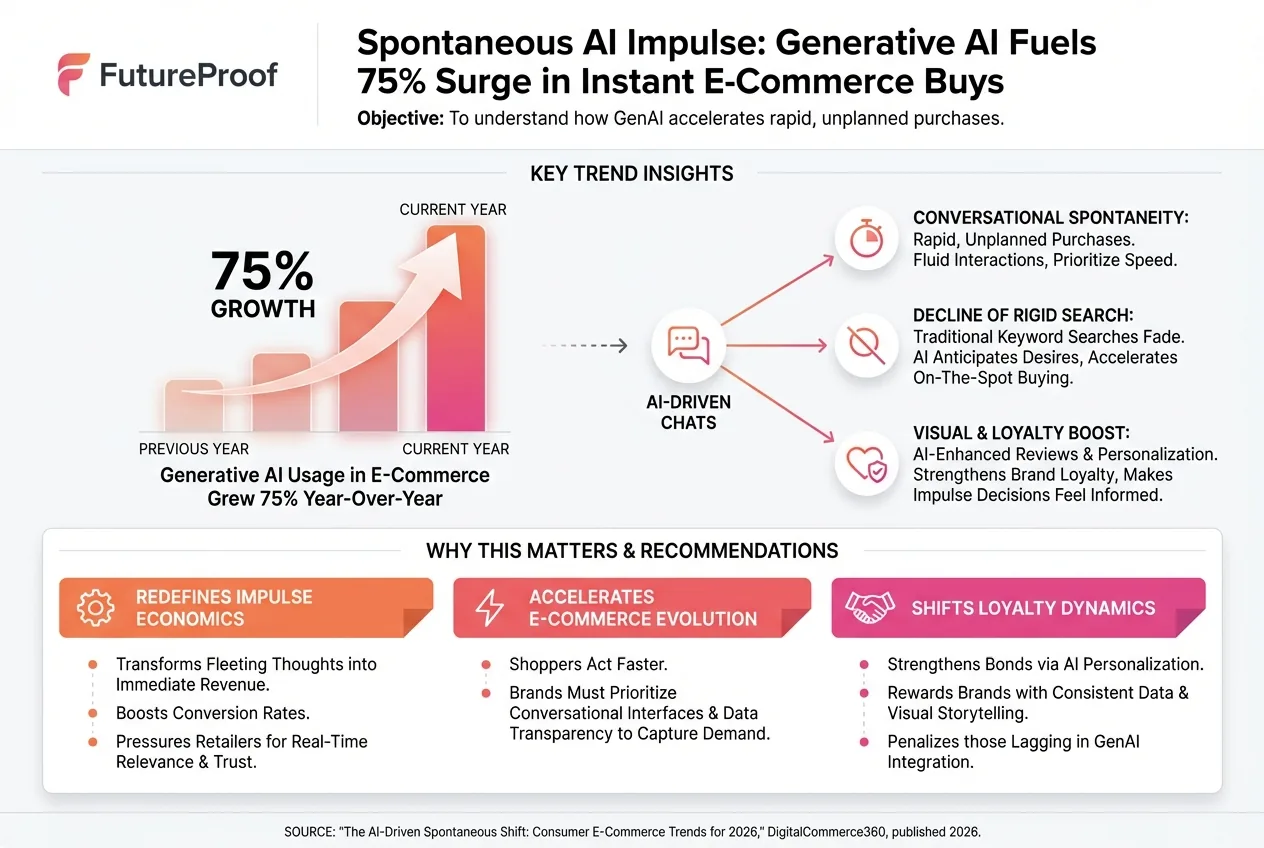
The landscape of online shopping is undergoing a seismic transformation, moving beyond the familiar routines of search bars and endless scrolling. In 2026, the retail world is witnessing the full bloom of spontaneous AI driven shopping, a phenomenon fundamentally reshaping how consumers interact with brands and make purchase decisions. This isn't just an incremental update; it's a complete paradigm shift, where rigid search queries are being supplanted by fluid, intuitive conversational interfaces, catapulting shoppers from initial intent to confirmed purchase in mere seconds. The data speaks volumes: Generative AI adoption in e-commerce has soared by an astonishing 75 percent year over year, fueling a dramatic surge in instant, often unplanned buys among thousands of consumers worldwide, as highlighted in DigitalCommerce360's insightful report, "The AI Driven Spontaneous Shift: Consumer E Commerce Trends for 2026."
This monumental shift demands an urgent re-evaluation of e-commerce strategies. Brands that thrive in this new era will be those that prioritize AI-ready product data, leverage the power of visual reviews, and master the art of real-time personalization. The future of online retail isn't just about selling products; it's about anticipating desires, understanding context, and facilitating near-instant gratification through the intelligent application of artificial intelligence.
The Genesis of Spontaneous AI-Driven Shopping
At its core, spontaneous AI driven shopping refers to the phenomenon where consumers make rapid, often impulse purchases, driven by highly relevant and contextually aware AI recommendations. Unlike traditional impulse buys, which might stem from seeing a display in a physical store, these digital spontaneous purchases are orchestrated by sophisticated AI systems that understand user intent, past behaviors, and even real-time emotional cues. The journey from discovery to checkout is no longer a multi-step process laden with friction but a seamless, almost thoughtless glide.
Consider the traditional online shopping experience: a consumer identifies a need, navigates to an e-commerce site, types a specific search term, sifts through results, compares products, reads reviews, adds to cart, and finally completes the purchase. This linear, often tedious path is rapidly becoming obsolete. In 2026, AI algorithms are so advanced that they can anticipate needs before a consumer even articulates them, presenting perfectly matched products within conversational flows. This instant gratification fulfills a deeply ingrained human desire for convenience and efficiency, making the "unplanned buy" a new norm rather than an exception. The DigitalCommerce360 survey, encompassing 6,000 consumers across five countries, provides irrefutable evidence of this surge in instant, unplanned purchases, signifying a fundamental recalibration of consumer purchasing psychology. The emotional pull of instant gratification, expertly facilitated by AI, is the driving force behind this revolution.
Conversational Interfaces: The New Frontier of Commerce
The linchpin of spontaneous AI driven shopping is the ascendancy of conversational interfaces. These aren't the rudimentary chatbots of yesteryear, but sophisticated AI entities capable of natural language understanding (NLU) and generation (NLG), mirroring human-like dialogue. They have effectively replaced rigid search bars, transforming the act of finding a product into an engaging, dynamic conversation.
Imagine asking a virtual assistant, "I'm looking for a stylish, eco-friendly water bottle for my morning runs, something that keeps water cold for hours and fits easily into a backpack," and receiving not just a list of products, but a curated recommendation, complete with dynamic images and real-time availability, all within a few conversational turns. This is the reality of conversational commerce in 2026. These interfaces excel because they understand context, remember past interactions, and can ask clarifying questions, mimicking the personalized service one might receive from a skilled sales associate. This ability to move from intent—however vaguely articulated—to purchase in seconds dramatically reduces friction points that often lead to cart abandonment in traditional e-commerce. Whether through voice assistants, integrated messaging apps, or on-site AI concierges, these conversational portals are not just tools; they are the new digital storefronts, fostering trust and rapport through intelligent dialogue. For brands, optimizing for conversational discovery means moving beyond keywords to understanding semantic intent and providing comprehensive, easily accessible product information that AI can readily interpret and articulate.
Generative AI: Fueling the Impulse Economy
The staggering 75 percent year-over-year climb in generative AI adoption within e-commerce is the engine powering this spontaneous shopping revolution. Generative AI, capable of creating novel content, experiences, and insights, goes far beyond mere recommendations. It personalizes the entire shopping journey in ways previously unimaginable.
For instance, generative AI can dynamically create hyper-personalized product descriptions based on individual user preferences, generating ad copy that resonates deeply with specific segments, or even designing virtual try-on experiences that allow consumers to visualize products in their own context. This technology isn't just suggesting products; it's crafting compelling narratives and immersive experiences around them in real-time. When a consumer expresses interest in "a new look for summer," generative AI can instantly curate an entire outfit, complete with accessories, based on their past purchases, style preferences, body type, and even prevailing fashion trends, presenting it as a cohesive, irresistible package. This level of predictive personalization and creative content generation directly fuels the surge in instant, unplanned buys. The psychological effect is profound: consumers feel understood, catered to, and delighted by the uncanny relevance of AI-generated suggestions, often leading to purchases they hadn't explicitly planned but implicitly desired. This instant alignment of desire and availability, mediated by powerful generative AI, is a cornerstone of the 2026 e-commerce landscape.
The Consumer at the Heart of the Shift: The Demand for Instant Gratification
The significant findings from the DigitalCommerce360 survey, involving 6,000 consumers across five countries, unequivocally underscore a fundamental shift in consumer expectations. Modern shoppers have little patience for cumbersome processes, irrelevant suggestions, or generic experiences. The surge in instant, unplanned buys is a clear signal that consumers increasingly expect immediate gratification and hyper-relevance in their online purchasing journeys.
This demographic, often accustomed to the speed and efficiency of other digital services, brings these high expectations to e-commerce. They want to move from inspiration to acquisition without friction. The idea of browsing for hours, comparing dozens of similar products, or navigating confusing checkout flows feels antiquated. AI-driven spontaneous shopping directly addresses this demand by collapsing the decision-making cycle. Consumers trust AI to filter the noise, present optimal choices, and facilitate swift transactions. This shift means that brands are no longer just competing on price or product quality alone; they are competing on convenience, speed, and the intelligence of their digital interfaces. Failing to provide an instantly gratifying, AI-powered experience risks losing these agile consumers to competitors who have embraced the future. The blurring of lines between "browsing" and "buying" is complete; in the AI-driven landscape of 2026, every interaction has the potential to become an instant transaction, driven by intelligently curated desire.
Optimizing for the AI-Ready Future: A Brand's Imperative
For brands looking to not just survive but thrive in the spontaneous AI driven shopping ecosystem of 2026, adaptation is not optional; it’s an urgent necessity. The DigitalCommerce360 report clearly outlines the critical optimization areas: AI-ready product data, visual reviews, and real-time personalization. These pillars form the foundation for success in the instant commerce era.
1. The Primacy of AI-Ready Product Data:
The bedrock of any intelligent AI system is data. For spontaneous AI driven shopping, this means product data must be meticulously structured, comprehensive, and semantically rich. Basic SKUs and brief descriptions are no longer sufficient. Brands must invest in creating 'AI-ready' product data that includes:
- Granular Attributes: Beyond color and size, think about texture, material composition, sustainability certifications, specific use cases, compatibility with other products, and even emotional descriptors (e.g., "cozy," "durable," "luxurious").
- Semantic Understanding: Data needs to be structured in a way that AI can understand nuances and relationships. This involves using ontologies, taxonomies, and graph databases that map product features to consumer needs and common linguistic queries.
- Contextual Richness: How does a product fit into a lifestyle? What problem does it solve? Providing this contextual information allows AI to make more intelligent, relevant recommendations within conversational flows. For example, a "running shoe" isn't just a shoe; it's a "stability running shoe for pronators on asphalt," or a "lightweight trail running shoe for competitive athletes."
- Machine-Readable Formats: Ensure data is consistently formatted and easily accessible via APIs for various AI systems to ingest and process seamlessly.
- Regular Updates: Product information must be kept current to reflect stock levels, pricing, promotions, and new features, as AI systems rely on real-time accuracy to avoid frustrating customers.
Poor or incomplete product data means AI systems cannot make accurate recommendations, leading to irrelevant suggestions and lost sales. Brands must consider their product catalog not just as an inventory list, but as an intelligent knowledge base for their AI assistants.
2. Leveraging Visual Reviews and User-Generated Content (UGC):
In a world driven by instant decisions, visual trust signals are paramount. Consumers are increasingly reliant on authentic visual reviews and user-generated content (UGC) to validate their spontaneous purchasing impulses.
- Authenticity and Trust: Visual reviews – photos and videos from actual customers – provide tangible proof of product quality, fit, and appearance in real-world settings. This bypasses skepticism and builds confidence far more effectively than text-only reviews.
- AI Analysis of Visuals: Advanced AI can analyze these visual reviews to extract insights. It can identify common themes (e.g., "this shirt looks great on various body types"), detect product flaws (e.g., recurring complaints about a specific seam in customer photos), and even gauge sentiment from facial expressions or contextual backgrounds in videos.
- Integration with Recommendations: AI-powered conversational interfaces can then present these relevant visual reviews directly within product suggestions. "Customers who bought this dress loved how it fit – here are a few photos they shared!" This immediate, visual social proof significantly accelerates the path to purchase.
- Augmented Reality (AR) and Virtual Try-Ons: Extending the concept of visual proof, generative AI combined with AR allows consumers to "try on" clothes, place furniture in their homes, or visualize makeup directly through their device cameras. This hyper-realistic pre-purchase experience is a powerful catalyst for spontaneous buys, dramatically reducing returns and increasing satisfaction. Brands must actively encourage and incentivize visual UGC and integrate AR capabilities into their product pages.
3. Mastering Real-Time Personalization:
Personalization in 2026 goes far beyond segmenting customers into broad categories. It's about dynamic, real-time adaptation of the shopping experience based on an individual's immediate context, mood, and evolving needs.
- Dynamic Customer Profiles: AI continually updates customer profiles based on every interaction – clicks, views, conversational queries, purchase history, and even inferred sentiment. This allows for an ultra-fine-grained understanding of each shopper.
- Contextual Offers and Recommendations: Real-time personalization means that recommendations, promotions, and even the tone of conversational AI shift based on the customer's current activity. Are they browsing for a gift? Are they looking for a solution to a sudden problem? Are they in a hurry? AI must discern these nuances.
- Predictive AI: The most advanced systems use predictive AI to anticipate future needs. If a customer consistently buys coffee beans every month, AI can prompt them for a reorder precisely when they're about to run out, perhaps with a new flavor suggestion.
- Personalized Interfaces: AI can dynamically reconfigure website layouts, app interfaces, or conversational flows to highlight products and information most relevant to the current user, minimizing cognitive load and accelerating decision-making.
- Ethical Considerations: Brands must implement real-time personalization responsibly, ensuring transparency in data usage and providing consumers with control over their data preferences. Building trust is paramount.
This level of hyper-personalization transforms a generic storefront into a bespoke shopping assistant tailored precisely to the individual, driving unprecedented levels of engagement and spontaneous conversion.
Navigating the Challenges of AI-Driven Commerce
While the opportunities presented by spontaneous AI driven shopping are immense, brands must also address inherent challenges. Data privacy and security remain paramount, requiring robust measures and transparent policies to maintain consumer trust. The ethical implications of AI, including potential biases in algorithms and the need for accountability, must be meticulously managed. Striking a balance between AI efficiency and maintaining a human touch in customer service will also be crucial for brands to differentiate themselves. The initial investment in AI infrastructure, data structuring, and skilled personnel can be substantial, but the long-term competitive advantage far outweighs these upfront costs.
Conclusion: The Future is Instant, Intelligent, and Individualized
The era of spontaneous AI driven shopping is not a distant future; it is the present reality of 2026. As the DigitalCommerce360 report clearly illustrates, the convergence of conversational interfaces, the explosive growth of generative AI, and a pervasive consumer demand for instant gratification has fundamentally redefined online commerce. The shift from rigid search to fluid, intelligent dialogue, and from considered purchases to instant, often unplanned buys, signals a permanent evolution in consumer behavior.
For brands, the message is clear: the time to optimize for this AI-driven future is now. By meticulously curating AI-ready product data, harnessing the persuasive power of visual reviews, and delivering truly real-time, hyper-personalized experiences, companies can unlock unprecedented growth. Those who embrace these pillars will not merely survive but thrive, connecting with consumers on a deeper, more intuitive level, fulfilling desires often before they are consciously articulated. The future of e-commerce isn't just about facilitating a transaction; it's about orchestrating an intelligent, instant, and individualized journey that delights, surprises, and ultimately converts. The spontaneous AI driven purchase is the new frontier, and only the AI-ready will truly conquer it.