The Rise of Agentic AI and the New Era of Zero Click Commerce
The landscape of commerce is undergoing a profound and irreversible transformation, driven by the rapid ascent of Agentic AI. We are witnessing a monumental shift from traditional browsing and deliberate comparison shopping to an era where consumers increasingly delegate their purchasing decisions to autonomous shopping agents. This isn't a futuristic concept; it's the present reality taking shape, profoundly altering how brands connect with their customers and how products make their way into hands and homes. Platforms that once served primarily as information hubs, like ChatGPT, Gemini, and Perplexity, are swiftly evolving into full-fledged retail channels, orchestrating everything from initial product discovery and meticulous comparisons to price optimization and the seamless execution of hands-free reorders.
This paradigm shift holds monumental implications for every brand and retailer. The core message is stark: AI platforms are becoming the new storefront. For brands accustomed to optimizing for search engines and user interfaces, the challenge now lies in optimizing for algorithms and intelligent agents. Those not strategically positioned for zero-click commerce risk fading into obscurity, their products never surfacing in the recommendations generated by these powerful autonomous agents. This isn't merely a theoretical concern; the precedent has already been firmly established in the B2B sector, where buyers have long relied on AI-driven insights and automation to streamline complex purchasing decisions, accelerating their procurement cycles. What was once a niche B2B efficiency gain is now rapidly cascading across the consumer retail landscape, accelerating at an unprecedented pace.
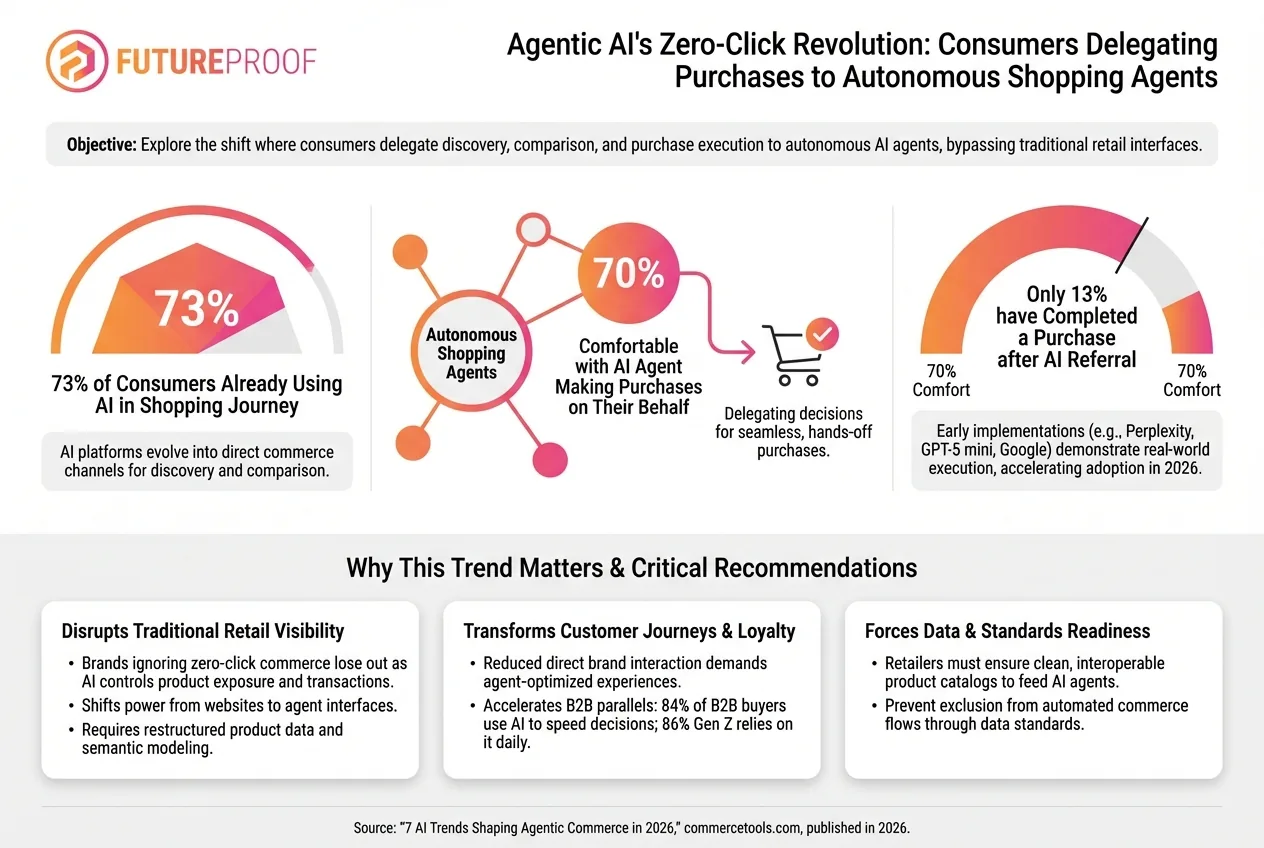
The data unequivocally supports this accelerated trend. A recent study, "7 AI Trends Shaping Agentic Commerce in 2026" by commercetools.com, reveals that a striking 73 percent of consumers are already leveraging AI at various stages of their shopping journey. While the completion of a purchase after an AI referral currently stands at a modest 13 percent, this figure represents the nascent stage of a revolution. More critically, a resounding 70 percent of consumers express at least some level of comfort with an AI agent ultimately making purchases on their behalf. This signals not just an acceptance, but a growing appetite for delegation, convenience, and efficiency, positioning agentic AI as the inevitable future of retail.
The essence of agentic AI in commerce lies in its capacity for proactive and autonomous action. Unlike passive recommendation engines that merely suggest products based on past behavior, agentic AI actively understands user preferences, anticipates needs, monitors markets, and executes transactions without direct human intervention at every step. Imagine an AI agent not just showing you a list of running shoes, but learning your gait, your preferred terrains, your fitness goals, cross-referencing this with expert reviews, real-time pricing, environmental impact data, and even your calendar to suggest the perfect pair to arrive just before your next marathon training block. This level of personalized, proactive service moves beyond mere convenience; it’s a fundamental reimagining of the customer experience, shifting from active search to passive, intelligent fulfillment.
The rise of platforms like ChatGPT, Gemini, and Perplexity as retail conduits is particularly transformative. These conversational AI models, initially designed for information retrieval and creative generation, are now integrating robust e-commerce functionalities. They become the gateway to discovery, evaluation, and transaction. A consumer might simply tell their AI, "I need a new, ethically sourced coffee maker that makes great espresso and ships quickly," and the AI, without the user ever visiting a brand website or a marketplace, will scour the digital landscape, compare features, verify sustainability claims, assess delivery timelines, and present a curated option, or even complete the purchase directly. This entirely bypasses traditional touchpoints, making the AI itself the primary interaction point, the ultimate arbiter of choice.
For brands, the implications for visibility are profound. In the era of traditional e-commerce, search engine optimization (SEO) and paid advertising were paramount for ensuring products appeared on the first page of results. In agentic commerce, the "first page" is now the AI agent's internal logic and its learned understanding of consumer preferences and brand attributes. If a brand's product data isn't meticulously structured, rich in detail, and semantically optimized for AI comprehension, it simply won't be considered. The agent isn't browsing a grid of images; it's evaluating a data schema. Brands must move beyond keyword stuffing and towards comprehensive, truthful, and contextually relevant product information that an AI can trust and synthesize.
The concept of "zero-click commerce" encapsulates this shift perfectly. It means that the consumer's journey from desire to possession can occur without a single click on a brand’s website, a visit to a physical store, or even direct engagement with a brand's marketing materials. The AI agent becomes the trusted proxy, acting on behalf of the consumer. This isn't just about saving time; it's about offloading cognitive load. In an increasingly complex and overwhelming marketplace, consumers are willing to delegate the tedious tasks of research, comparison, and price negotiation to an intelligent agent, freeing up their mental bandwidth for other priorities. Brands that facilitate this delegation, by providing AI-ready data and seamless integration, will be the ones that thrive.
Consider the detailed capabilities of these AI retail channels. Product discovery is no longer a haphazard process of scrolling through endless pages; it's an intelligent process informed by a deep understanding of the consumer's lifestyle, past purchases, stated preferences, and even their calendar. Comparisons become holistic, weighing not just price and features, but also brand reputation, customer service track record, sustainability efforts, and delivery speed, all synthesized by the AI. Price optimization moves beyond simple coupon codes; agents can monitor fluctuations, negotiate in real-time if platforms allow, and secure the best value. And for recurring purchases, hands-free reorders become the norm, with the AI tracking consumption, predicting depletion, and automatically replenishing supplies without the consumer lifting a finger.
The critical imperative for brands, therefore, is to evolve their digital strategies from being customer-facing to being AI-agent-facing. This involves a multi-faceted approach. First, data quality and semantic enrichment are non-negotiable. Product Information Management (PIM) systems must be robust, containing exhaustive, accurate, and consistent data points that go far beyond basic descriptions. This includes detailed specifications, material sourcing, certifications, environmental impact scores, user manuals, troubleshooting guides, and a comprehensive list of attributes that AI agents can parse and understand. This data needs to be structured in a way that is easily digestible by various AI models, using semantic web standards where possible, ensuring context and meaning are preserved.
Secondly, brand trust and authority gain a new dimension. AI agents are designed to act in the best interest of the consumer, which means they will prioritize brands with a proven track record of reliability, quality, and customer satisfaction. A brand's reputation, its reviews across platforms, its responsiveness to customer inquiries, and its ethical practices will be factored into an AI's decision-making process. This necessitates a renewed focus on core brand values and operational excellence, as these signals become crucial inputs for AI agents. Brands must also consider how their brand voice and personality can be conveyed through the structured data and conversational interfaces that AI agents utilize, maintaining a consistent and authentic presence even when not directly interacting with the customer.
Ethical AI and transparency are also paramount. As AI agents gain more autonomy, consumers will increasingly demand to understand the rationale behind their purchasing recommendations. Brands that provide clear, verifiable information about their products and processes, and that ensure their data is free from bias, will build stronger trust with both consumers and the AI agents acting on their behalf. This includes being transparent about sustainability claims, sourcing practices, and labor conditions. The AI itself must be able to justify its choices, and the brand data feeding those choices must be unimpeachable.
The shift to agentic commerce also supercharges the potential for hyper-personalization. Moving beyond simple "customers who bought this also bought..." recommendations, AI agents can anticipate needs before they are explicitly articulated. By integrating data from a myriad of sources – smart home devices, health trackers, calendars, communication patterns, and external market trends – an AI can predict when a consumer might need new running shoes, a specific type of organic produce, or even a gift for an upcoming anniversary. This predictive purchasing capability allows brands to engage with consumers at the precise moment of need, or even before it arises, offering solutions tailored with unprecedented accuracy.
The B2B sector has long demonstrated the power of AI in streamlining procurement, managing complex supply chains, and optimizing purchasing decisions based on numerous variables like cost, lead time, and supplier reliability. Consumer retail is now following suit, albeit with a focus on individual convenience and personalized experience. B2B buyers delegate tasks to AI to enhance efficiency and cost-effectiveness; consumers are increasingly delegating to save time and reduce decision fatigue. The learning curve for brands in B2B regarding data cleanliness, API integrations, and robust security protocols now serves as a valuable blueprint for consumer-facing strategies.
Navigating this new retail frontier presents both significant challenges and immense opportunities. The challenges include the complexity of integrating diverse data sources, ensuring data privacy and security, overcoming algorithmic biases, and retraining marketing and sales teams for an AI-centric world. Brands will need to invest heavily in data infrastructure, AI literacy, and a deep understanding of natural language processing (NLP) to effectively communicate with these new retail gatekeepers. The sheer volume and velocity of data required to feed intelligent agents will demand sophisticated data governance and real-time updating capabilities.
However, the opportunities are equally vast. Agentic AI can unlock unprecedented levels of customer loyalty by consistently delivering perfectly tailored solutions. It can drive efficiency by automating routine purchases, freeing brands to focus on innovation and complex customer needs. It offers new avenues for market research, providing real-time insights into consumer preferences and emerging trends as interpreted by AI agents. Brands that successfully optimize for agentic commerce will gain a formidable competitive advantage, securing a prominent position in an ecosystem where choice is delegated and loyalty is earned through seamless, intelligent service.
The future vision of commerce is one where the friction between desire and fulfillment is virtually eliminated. Consumers will operate in an ecosystem of intelligent agents that manage their needs, from household staples to aspirational luxuries, ensuring optimal price, quality, and convenience. Brands that embrace this shift, dedicating resources to AI-ready product data, building robust trust signals, and understanding the nuanced logic of autonomous agents, will not only survive but thrive. This means re-evaluating every aspect of the brand-customer interaction, from product development and manufacturing to marketing and fulfillment, through the lens of AI delegation. The time to adapt is now, transforming marketing, sales, and operations to cater to a world where intelligent agents stand at the digital storefront, curating choices for a new generation of empowered, delegating consumers. Ignoring this shift is to risk irrelevance in the rapidly unfolding era of agentic commerce.