The Silent AI Shift Reshaping B2B Discovery and Brand Visibility
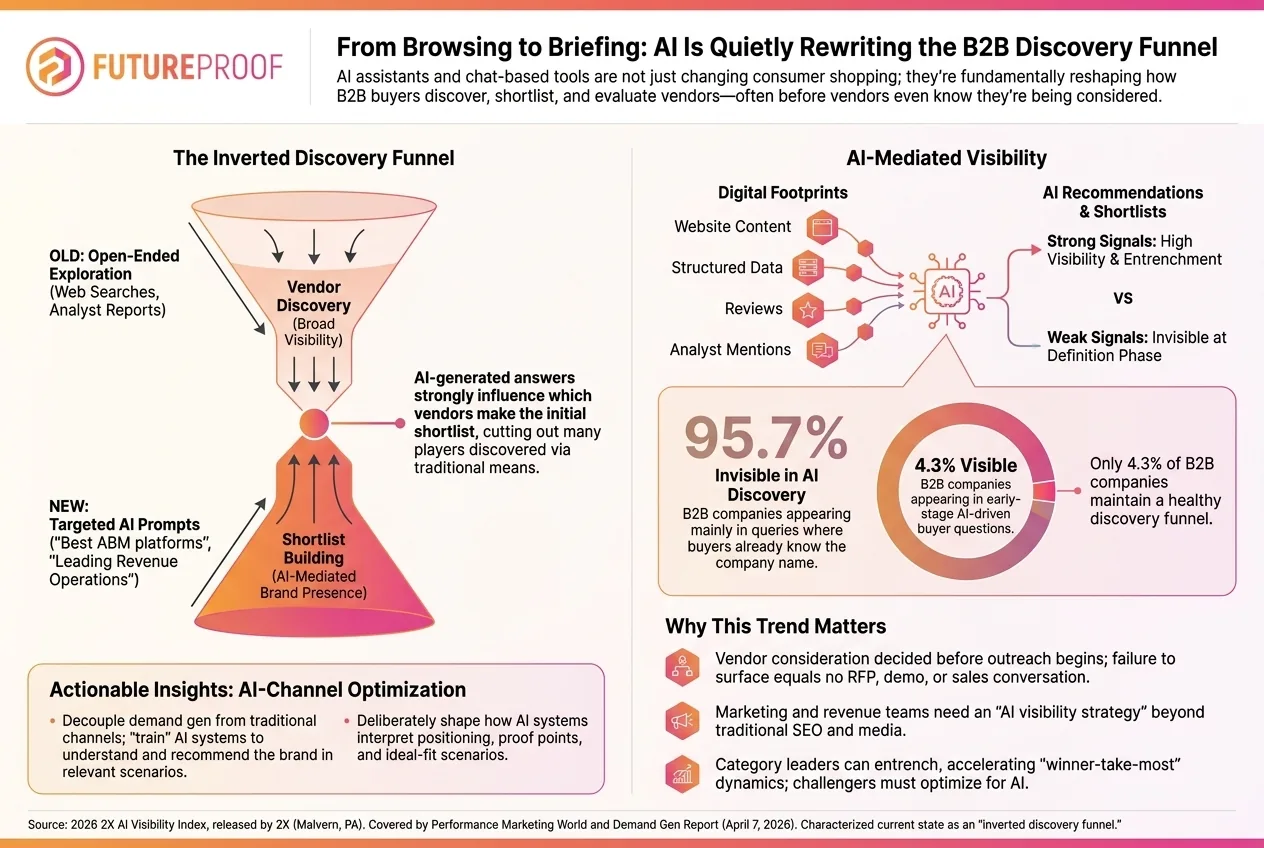
The landscape of B2B discovery is undergoing a silent, yet profound, transformation, one that is quietly rewriting the very fabric of how buyers find and shortlist vendors. This revolution isn't being heralded by fanfare or dramatic announcements; instead, it's unfolding in the quiet hum of artificial intelligence, reshaping the B2B discovery funnel from browsing to briefing in ways many organizations are only just beginning to comprehend. The traditional pathways—a labyrinth of Google searches, deep dives into analyst reports, and the often-slow trickle of referrals—are being consolidated, compressed, and redefined by the powerful capabilities of AI assistants.
Today, a B2B buyer embarking on their early exploration phase is less likely to spend hours trawling through websites and whitepapers. Instead, they are increasingly turning to sophisticated AI tools, leveraging a few targeted prompts to rapidly synthesize information, compare solutions, and identify potential partners. This isn't just about efficiency; it's about an entirely new paradigm of information retrieval and vendor evaluation. The critical implication for B2B companies is stark: your brand now appears on the buyer's radar only if its digital signals are robust enough, coherent enough, and precisely aligned enough to be recognized, interpreted, and ultimately recommended by these intelligent systems. This means a seismic shift in how brand visibility is conceived and achieved. It’s no longer solely about achieving top search rankings or publishing a high volume of content; it's fundamentally about how well AI systems can accurately and favorably interpret your company’s core positioning, validate your unique proof points, and determine your genuine fit for a buyer's complex needs. For the vast majority of organizations, this presents an urgent and undeniable imperative: the need to develop and implement a sophisticated AI visibility strategy that directly influences how these powerful tools surface their brand during the critical early stages of buyer research.
Consider the sobering reality: According to the 2026 2X AI Visibility Index, a pivotal study covered by Performance Marketing World and Demand Gen Report, a mere 4.3 percent of B2B companies effectively appear in early-stage, AI-driven buyer questions. This staggering statistic means that an overwhelming 95.7 percent of businesses remain virtually invisible during the crucial initial phase of AI discovery, surfacing only when buyers already know their name. This indicates a profound disconnect, a chasm between traditional marketing efforts and the emergent reality of AI-mediated discovery. While many companies pour resources into conventional SEO and content marketing, they are inadvertently missing the new front door to buyer engagement—a door guarded and guided by AI.
The AI-powered discovery funnel fundamentally redefines the concept of "early stage." What was once a protracted period of independent research, often characterized by exploratory queries and a broad information-gathering approach, is now streamlined into moments of AI interaction. Buyers articulate their challenges, describe their desired outcomes, and perhaps even outline specific requirements to an AI assistant. The AI then acts as an intelligent intermediary, sifting through vast troves of data – websites, industry reports, case studies, reviews, and more – to synthesize recommendations. This process compresses the buyer's initial journey, allowing them to move from problem identification to a qualified shortlist of vendors with unprecedented speed. The "ghost funnel" phenomenon, where buyers complete a significant portion of their research independently before engaging with any vendor, is now amplified exponentially. AI takes this self-serve exploration to new heights, empowering buyers to reach highly informed decisions long before a salesperson ever knows they exist.
What exactly constitutes these crucial "digital signals" that AI systems are seeking? It's far more nuanced than simple keyword density. AI operates on semantic understanding, contextual relevance, and the ability to infer intent. It's looking for structured data that clearly articulates your offerings, compelling narratives that illustrate value, and verified proof points that demonstrate credibility. An AI assistant is, in essence, building a sophisticated knowledge graph of your company, connecting your services to specific problems, your solutions to quantifiable outcomes, and your brand to a reputation for expertise. If your digital footprint is fragmented, ambiguous, or lacks the necessary semantic markers, AI will struggle to accurately interpret your value proposition, much less recommend you.
This leads us to the silent gatekeepers themselves: the AI systems that interpret your brand. They don't just read words; they infer meaning, assess relevance, and evaluate trustworthiness. Their understanding goes beyond basic keyword matching, delving into the very essence of your brand's narrative. Firstly, positioning is paramount. Is your company's unique value proposition crystal clear and consistently articulated across all digital touchpoints? AI systems, much like discerning human buyers, seek clarity. Ambiguous language or a shifting brand narrative will confuse an AI, leading to miscategorization or, worse, omission from relevant recommendations. Your positioning needs to be precise, differentiated, and easily digestible, allowing AI to slot you into the correct solution category with confidence.
Secondly, proof points must be AI-ready. This means transforming your case studies, testimonials, and data-backed claims into formats that AI can easily parse, understand, and validate. Quantifiable results, clear problem-solution narratives, and specific industry applications are gold. An AI isn't impressed by flowery language; it seeks concrete evidence of impact. Are your success stories structured with clear inputs, outputs, and demonstrable ROI that an AI can extract and present to a buyer?
Finally, fit is about how well AI can infer if your company perfectly matches a buyer's implied needs, not just their explicitly stated ones. This requires a deeper level of semantic understanding from the AI and a more holistic digital presence from the vendor. It's about demonstrating your capacity to solve not just the surface-level problem but also the underlying strategic challenges. This is where rich, contextual content, clearly defined ideal customer profiles, and a strong track record across various use cases become invaluable. The better an AI understands who you serve best and the problems you excel at solving, the more accurately it can recommend you to a truly fitting prospect.
The stark reality revealed by the 2X AI Visibility Index cannot be overstated: 95.7 percent of B2B companies are near invisible in early-stage AI discovery. This isn't merely a missed opportunity; it's a profound competitive disadvantage. What does it mean for a company to appear "mainly when buyers already know their name" in an AI-driven world? It means that if a buyer is using an AI assistant to discover new solutions for a generic problem ("Find software to automate marketing workflows for mid-market SaaS companies"), the vast majority of vendors will simply not be suggested. They enter the conversation only when the buyer explicitly asks for them ("Tell me about Salesforce's marketing automation features"). This relegates these companies to a reactive role, forever chasing leads rather than being proactively surfaced as solutions.
The cost of this invisibility is immense. It translates directly into lost market share, reduced opportunities for new customer acquisition, and an uphill battle to expand beyond existing brand recognition. Traditional SEO, while still vital for human search, is insufficient for this new paradigm. It's often optimized for keyword matching and link authority within a human-readable web, whereas AI systems require a deeper semantic understanding, contextual relevance, and verifiable factual accuracy. Many businesses are investing heavily in content that serves their existing human search funnel but utterly fails to resonate with or be interpreted by AI discovery tools. Common pitfalls include generic content that lacks specificity, an absence of easily digestible proof points, and information silos that prevent AI from building a comprehensive and coherent understanding of the brand's capabilities. Without a dedicated strategy, these companies risk being perpetually behind the curve, fighting for crumbs in an increasingly AI-dominated market.
Crafting an AI visibility strategy is no longer optional; it is an urgent imperative for any B2B organization aiming for sustained growth and relevance. This new strategy demands a fundamental rethinking of digital presence, moving beyond traditional SEO tactics to embrace an AI-first approach.
Pillar 1: Semantic Content & Structured Data. This is the bedrock. Move beyond merely stuffing keywords into your content. Instead, focus on creating content that speaks to concepts, answers direct questions, and provides comprehensive information around specific topics. This involves:
- Semantic SEO: Building topical authority by creating interconnected content clusters that demonstrate deep expertise across relevant subjects. This allows AI to understand your domain mastery.
- Schema Markup: Implementing schema.org markup (e.g., Organization, Product, Service, FAQPage, HowTo) on your website. This provides explicit signals to AI about the nature of your content, making it easier for systems to categorize, interpret, and present factual information.
- Knowledge Panels & Graph Optimization: Ensuring that information about your company (foundational facts, leadership, products, services, locations) is consistent and accurate across all authoritative sources that AI draws upon, contributing to a robust knowledge graph entry for your brand.
- AI-Ready FAQs: Designing your FAQ sections not just for human readers but for AI assistants looking for direct answers to common buyer questions.
Pillar 2: Authority & Trust Signals for AI. While backlinks remain important, AI's assessment of authority is more sophisticated. It looks for genuine expertise, authoritativeness, and trustworthiness (E-E-A-T, as emphasized by Google).
- Topical Authority: Consistently publishing high-quality, in-depth content that demonstrates your expertise in specific niches. AI systems can discern genuine thought leadership from superficial content.
- Expert Authorship: Highlighting the credentials and expertise of your content creators. AI can increasingly identify and value content written by recognized experts.
- Verifiable Information: Ensuring all claims, statistics, and data points are sourced, accurate, and verifiable. AI is designed to fact-check and prioritize reliable information.
- Industry Recognition & Partnerships: Showcasing awards, certifications, and partnerships with reputable organizations. These act as strong trust signals for AI.
Pillar 3: AI-Ready Proof Points & Use Cases. Your success stories need to be crafted in a way that AI can easily understand, extract, and present as compelling evidence.
- Structured Case Studies: Standardize your case study format with clear sections for challenge, solution, quantifiable results, and specific industry context. Make these elements easy for AI to parse.
- Data-Driven Narratives: Emphasize measurable outcomes and concrete ROI in your proof points. AI excels at processing and comparing data.
- Client Testimonials & Reviews: Actively solicit and manage online reviews on reputable platforms. AI considers these crucial social proof points. Ensure they are keyword-rich and descriptive.
- Interactive Tools & Calculators: Develop tools that can demonstrate value and results (e.g., ROI calculators, configurators). AI can potentially interact with or reference the output of these tools.
Pillar 4: Persona-Driven AI Optimization. Understanding your ideal customer's pain points and how they might articulate them to an AI assistant is critical.
- Anticipate AI Prompts: Research and brainstorm the specific questions and prompts your target buyers would likely use when interacting with an AI at different stages of their journey.
- Map Content to Intent: Align your content strategy directly with these anticipated AI prompts, ensuring you have clear, concise answers and solutions readily available for AI to discover.
- Early-Stage Content: Create dedicated content for buyers in the very first stages of problem awareness and solution exploration, specifically optimized for AI-driven discovery, focusing on educational, vendor-agnostic information that subtly positions your brand as a credible expert.
The future is not coming; it is already here, and it is powered by AI. Embracing the AI-driven B2B landscape is not merely a tactical adjustment; it is a strategic imperative that will define the winners and losers in the coming years. Companies that proactively invest in understanding and optimizing for AI visibility will gain an undeniable competitive advantage. They will be the 4.3 percent who are consistently surfaced and recommended during early buyer research, positioning themselves as indispensable partners from the very first spark of discovery. Those who cling to outdated models, neglecting the profound implications of AI in the discovery funnel, risk being relegated to the vast majority – the 95.7 percent who remain largely invisible until it's often too late.
The B2B discovery funnel is no longer just evolving; it is undergoing a silent, yet profound, revolution. AI is not just rewriting the rules; it is creating entirely new playbooks. The time for deliberation is over; the time for strategic action to secure your AI visibility is now. Companies must swiftly assess their current digital footprint through an AI lens, identify gaps, and implement a comprehensive AI visibility strategy. This isn't about chasing the latest trend; it's about fundamentally understanding where and how modern B2B buyers are finding their solutions. Those who adapt will thrive, solidifying their position as leaders in an increasingly intelligent marketplace, while those who don't risk being left behind, struggling for relevance in a world that has moved on. Ensure your brand is not just seen, but understood and recommended by the silent architects of the new B2B discovery.