The Rise of AI Shopping Agents and the New Battle for Consumer Choice
The landscape of consumer purchasing is undergoing a monumental transformation, quietly yet rapidly shifting power from the human shopper to intelligent algorithms. What was once the sole domain of human decision-making, influenced by advertising, personal preferences, and word-of-mouth, is increasingly being outsourced to AI shopping agents. This isn't a futuristic concept; it's the present reality, and new data underscores its profound impact on retail, e-commerce, and brand strategy.
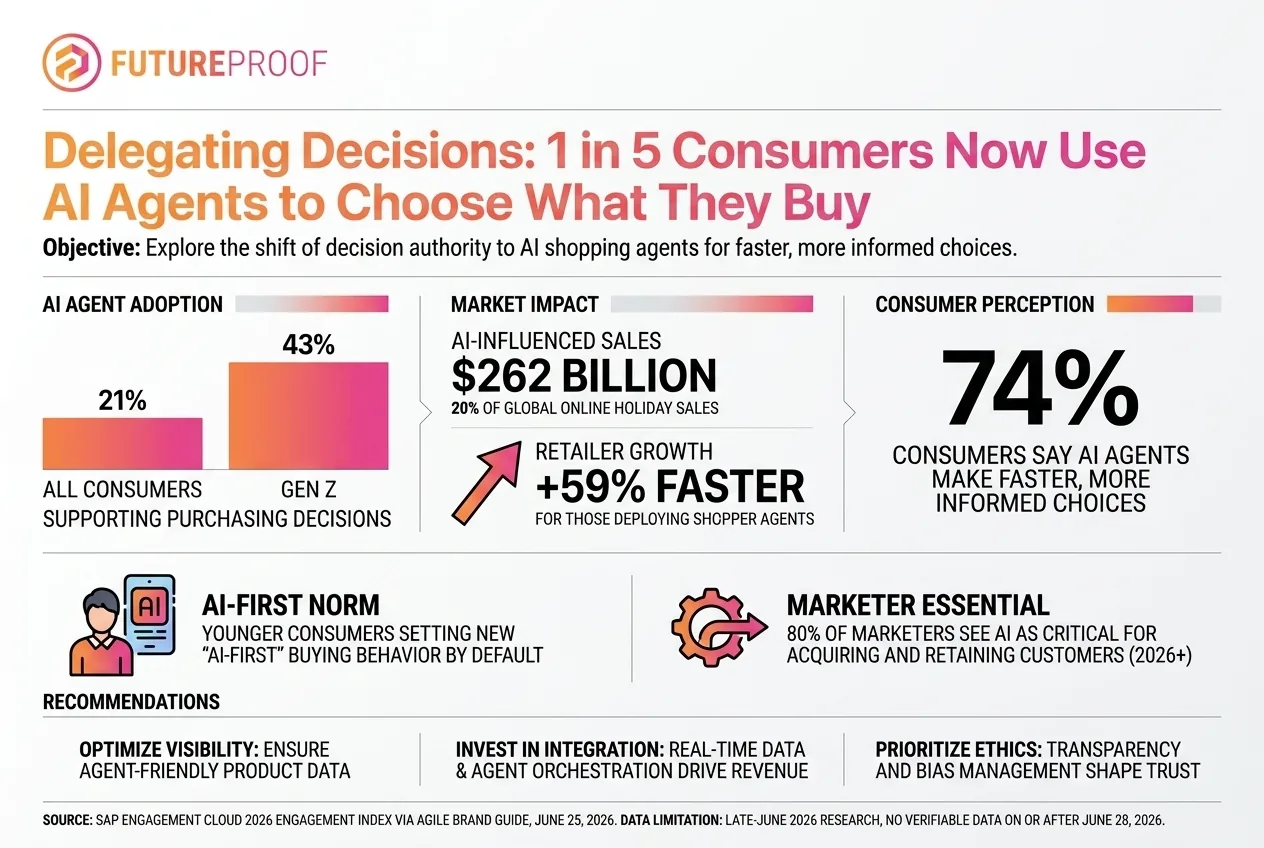
According to the SAP Engagement Cloud 2026 Engagement Index, reported by Agile Brand Guide on June 25, 2026, a significant 21 percent of consumers are already leveraging AI agents to support their purchasing decisions. This figure skyrockets to an astonishing 43 percent among Gen Z, signaling a clear generational embrace of AI commerce that is poised to redefine digital interaction. The influence of AI agents isn't just theoretical; the same research found that AI impacted a staggering 20 percent of global online holiday sales, translating to an colossal $262 billion in revenue. Furthermore, retailers who have proactively integrated their own shopper agents are experiencing a substantial competitive edge, growing their sales an impressive 59 percent faster than their counterparts. These statistics paint an undeniable picture: AI is no longer a peripheral tool but a central, indispensable force in the purchasing journey. Brands must urgently adapt to this new paradigm, understanding that winning the customer increasingly means being chosen by the agent. The critical imperative for every brand today is to ensure their product data is clear, structured, and, above all, agent-ready.
The Accelerating Ascendancy of AI Shopping Agents in Consumer Decisions
The rapid adoption of AI shopping agents is not merely a technological fad; it represents a fundamental shift in how consumers discover, evaluate, and ultimately acquire products and services. For many, especially the digitally native Gen Z, AI has become the default first stop for decision support. These intelligent agents, whether embedded in smart home devices, integrated into messaging platforms, or operating as standalone applications, offer unparalleled convenience and efficiency. They can sift through vast quantities of product information, compare prices across countless retailers, read reviews, and even anticipate needs based on past behavior and declared preferences, all in a fraction of the time it would take a human. The 21% of consumers already using AI agents – a figure that will undoubtedly continue its upward trajectory – demonstrates a growing trust and reliance on these automated assistants. The generational divide, with Gen Z’s adoption rate soaring to 43%, is particularly telling. This demographic, set to be the dominant consumer force in the coming years, is intuitively comfortable delegating complex shopping tasks to AI. They seek personalized recommendations, instant gratification, and frictionless experiences, all of which AI shopping agents are uniquely positioned to deliver. This dramatic shift means that brands can no longer solely focus on direct consumer engagement; they must now cultivate a strong relationship with the AI intermediaries that increasingly guide their customers' choices.
AI's Undeniable Economic Impact: A Multi-Billion Dollar Reality
The economic implications of AI's integration into consumer purchasing are already staggering. The SAP Engagement Cloud data highlights that AI influenced 20 percent of global online holiday sales, amounting to an colossal $262 billion. This figure is not just a statistic; it’s a tangible representation of AI agents driving real-world revenue and shaping market dynamics. For brands and retailers, this means that a significant portion of their online sales is already mediated or directly influenced by AI. Ignoring this reality is akin to ignoring the rise of e-commerce decades ago. The competitive landscape is also rapidly evolving. The research revealed that retailers leveraging their own proprietary shopper agents experienced a remarkable 59 percent faster sales growth. This is a game-changer. It suggests that brands that invest in developing or integrating AI agents directly into their customer journey are not just keeping pace; they are actively outmaneuvering competitors. These proprietary agents can offer a more tailored, brand-specific experience, guiding customers through a curated product selection and reinforcing brand loyalty. This substantial growth differential underscores the strategic necessity for brands to not only understand how third-party AI agents operate but also to explore the benefits of developing their own AI-powered engagement tools. The revenue potential is clear, and the cost of inaction is becoming increasingly high.
The Paradigm Shift: From Customer to Agent as the Primary Gatekeeper
In the traditional marketing funnel, brands aimed to capture the attention and loyalty of human customers directly. Messaging was crafted for human emotion, desires, and pain points. While these elements remain vital, an entirely new layer has been introduced: the AI shopping agent as a primary gatekeeper. Before a product even reaches the human eye for final consideration, it must first be chosen, recommended, or even pre-filtered by an AI. This represents a profound paradigm shift where the "customer" in the initial decision-making phase is often an algorithm. Brands are now, in essence, selling to the agent. This means that the conventional metrics of marketing success—catchy slogans, compelling imagery, emotional storytelling—though still important, are no longer sufficient on their own. The agent doesn't "feel" emotion; it processes data. It evaluates clarity, completeness, structure, and relevance. For a brand to win the ultimate customer, its products must first resonate with the logic and parameters of the AI agent. This requires a re-evaluation of content strategy, product information management, and overall digital presence. The battle for customer acquisition is now fought on two fronts: the human mind and the algorithmic logic. Neglecting the latter means being invisible in an increasingly AI-driven marketplace.
Understanding "Agent-Ready Product Data": The New Mandate for Brands
The core takeaway from this transformative shift is the urgent need for "agent-ready product data." But what exactly does this entail? It goes far beyond simply listing product specifications. Agent-ready data is meticulously crafted, semantically rich, and comprehensively structured to be easily discoverable, understandable, and actionable by AI.
- Clarity and Conciseness: AI agents thrive on unambiguous information. Product descriptions must be free of jargon, vague language, and unnecessary fluff. Every piece of data should be direct and to the point, clearly articulating features, benefits, and use cases. This allows the AI to accurately parse and categorize information without misinterpretation.
- Structured Data and Schema Markup: This is perhaps the most critical component. Product data needs to be organized in a standardized, machine-readable format using schema markup (e.g., Schema.org for product listings). This includes clear attributes for product name, SKU, price, availability, brand, category, ratings, reviews, specifications (dimensions, materials, compatibility), and variants. Well-structured data acts as a direct language for AI agents, enabling them to efficiently extract and compare relevant information.
- Completeness and Granularity: A partial data set is a detrimental data set in the eyes of an AI. Agents need comprehensive information to make informed recommendations. This means providing every possible detail a human might consider, from warranty information and return policies to environmental impact and origin of materials. The more granular the data, the better an AI can match a product to specific, nuanced user queries and preferences.
- Accuracy and Consistency: Outdated or conflicting information will lead to agents discarding a product or providing erroneous recommendations, eroding trust. Product data must be rigorously maintained for accuracy across all channels and updated in real-time for price changes, inventory levels, and product modifications. Consistency in naming conventions, units of measure, and attribute values across the entire product catalog is paramount.
- Semantic Richness and Keyword Optimization: While agents process structured data, they also understand context and natural language. Product descriptions and attributes should incorporate relevant keywords, synonyms, and long-tail search terms that human users (and thus, agents interpreting human queries) might use. Think beyond basic product names to include use cases, benefits, and emotional resonance where appropriate, translated into AI-digestible terms. For example, instead of just "smartphone," include "best camera phone for travel" or "long-battery life smartphone for remote work."
- Multimedia Data Optimization: AI agents are not limited to text. They can increasingly process and interpret visual and audio information. Images need to be high-resolution, well-tagged with descriptive alt text, and showcase the product from multiple angles and in various use contexts. Videos demonstrating product features or assembly instructions should be transcribed and captioned to make their content accessible to AI analysis. Even 3D models or augmented reality experiences, when linked to structured data, can enhance an agent's understanding of a product.
- Reviews and Social Proof Integration: AI agents often incorporate sentiment analysis from customer reviews and ratings to gauge product satisfaction and reliability. Brands must actively solicit and manage reviews, ensuring they are accessible and linked to structured product data. An agent ready product data strategy includes making this social proof easily digestible for algorithmic evaluation.
- Contextual Data: Beyond core product specs, agents benefit from data that explains when and why a product is relevant. This could include seasonal applicability, complementary products, or specific lifestyle uses. Providing contextual tags and associations helps agents make more sophisticated, personalized recommendations.
In essence, agent-ready product data is about precision, comprehensiveness, and machine-readability. It’s about building a digital twin of your product that is so detailed and logically structured that an AI can understand it as intimately as a human expert.
Actionable Strategies for Brands to Win with AI Agents
The transition to an AI-first commerce environment demands a proactive and strategic approach from brands. Here are actionable steps to ensure your products are chosen by the agents, and consequently, by the customers.
- Conduct a Comprehensive Product Data Audit: Begin by evaluating your existing product information. Identify gaps, inconsistencies, outdated details, and areas lacking structure. Where is data ambiguous? Where are attributes missing? Understand the current state of your product data hygiene across all platforms. This audit is the foundation for improvement.
- Invest in Robust Product Information Management (PIM) and Digital Asset Management (DAM) Systems: These systems are no longer optional; they are critical infrastructure. A PIM system centralizes all product data, ensuring consistency and accuracy across every touchpoint. A DAM system manages multimedia assets, linking them seamlessly to product data. Together, they create a single source of truth for agent-ready information.
- Develop Rich, Descriptive Product Content: Go beyond basic bullet points. Craft compelling, yet factual, product descriptions that are optimized for both human readability and AI comprehension. Use natural language processing (NLP) friendly language, incorporating a wide range of relevant keywords and phrases without keyword stuffing. Highlight unique selling propositions and specific use cases.
- Implement and Optimize Schema Markup: Work with your web development and content teams to ensure all product pages are properly marked up with Schema.org vocabulary. This includes Product, Offer, AggregateRating, and Review schemas. This structured data acts as explicit instructions for AI agents, allowing them to instantly understand and categorize your products.
- Standardize Product Attributes and Taxonomies: Create a consistent taxonomy across your entire product catalog. Define clear, standardized attributes (e.g., "Color" instead of "Hue" or "Shade"). This consistency is crucial for AI agents to accurately compare products from different brands and make reliable recommendations. Think about how an agent would categorize and filter products.
- Prioritize Data Accuracy and Real-time Updates: Establish processes for continuous data maintenance. Integrate your PIM with inventory, pricing, and order management systems to ensure product availability, pricing, and other critical details are always current. Inaccurate data is a fast track to being disregarded by AI agents.
- Leverage AI for Data Enhancement and Quality Control: Utilize AI-powered tools to identify data discrepancies, suggest missing attributes, and enrich product descriptions. AI can help with semantic tagging, image recognition for attribute extraction, and even generate variant descriptions based on core product data. These tools can drastically improve the efficiency and effectiveness of data preparation.
- Optimize for Semantic Search and Intent: Shift your SEO strategy beyond simple keyword matching to understanding search intent. What problems are users trying to solve? What questions are they asking their AI agents? Optimize your content to answer these questions comprehensively, using language that aligns with natural human query patterns that AI agents are designed to interpret.
- Cultivate and Integrate Customer Reviews and Ratings: Positive social proof is a powerful signal for both humans and AI agents. Actively encourage customer reviews, ensure they are moderated, and integrate them into your structured product data. High ratings and detailed reviews can significantly boost an agent's confidence in recommending your product.
- Monitor Agent Behavior and Analytics: While direct feedback from AI agents is nascent, monitor your analytics for traffic sources from AI-driven platforms, conversion rates from AI-influenced journeys, and how your products are ranking in AI-generated recommendations. This nascent field will require brands to develop new metrics for "agent visibility" and "agent conversion."
- Explore Building Your Own AI Agent: Given the 59% faster growth seen by retailers with proprietary agents, consider the strategic advantage of developing an AI-powered conversational agent for your own website or app. This allows you to control the narrative, offer hyper-personalized experiences, and ensure your products are presented optimally within your ecosystem.
The time for deliberation is over. Brands that embrace these strategies will not only survive but thrive in the age of AI-driven commerce, securing their place in an increasingly automated purchasing landscape.
The Future Landscape: Beyond 2026 and the Evolution of AI Commerce
The current data from SAP Engagement Cloud and Agile Brand Guide serves as a potent snapshot, but the trajectory of AI in commerce extends far beyond 2026. We are on the cusp of an era where AI shopping agents will evolve from responsive assistants to proactive partners, deeply integrated into every facet of the consumer's life.
Imagine a future where your AI agent not only recommends products but anticipates your needs before you even realize them. Proactive purchasing, driven by AI monitoring your inventory (e.g., smart fridge detecting low milk), lifestyle changes (e.g., recommending warmer clothes as autumn approaches, factoring in your planned travel), and even your biometric data, will become commonplace. Personalization will reach hyper-granular levels, with AI agents curating entire lifestyles, not just individual products. This hyper-personalization, while convenient, presents a new set of challenges and opportunities for brand loyalty. Will consumers be loyal to a brand, or to the AI agent that consistently finds them the "best" solutions, regardless of brand? This could commoditize certain products, while elevating brands that build trust directly with the AI through superior, agent-ready data and transparent practices.
The ethical dimensions of AI-influenced purchasing will also come to the forefront. Issues of data privacy, algorithmic bias, and transparency in AI recommendations will require careful consideration and regulation. Brands that prioritize ethical AI development and data usage will build greater trust with both consumers and the AI agents that serve them. Furthermore, the interplay between different AI agents – personal agents communicating with retailer agents – will create a complex ecosystem of automated negotiation and transaction. Brands must prepare for an environment where their "sales pitch" is less about direct consumer persuasion and more about optimizing their data for inter-AI communication and decision-making.
The role of human creativity and brand storytelling will not disappear but will transform. Brands will need to think about how their unique narrative, values, and emotional connection can be communicated through the data that AI agents process. It will be about encoding brand essence into structured attributes, compelling multimedia, and transparent information. The future of retail is dynamic, intelligent, and deeply intertwined with AI. Those who adapt now will shape it.
Conclusion: The Imperative of Agent-Readiness in the AI-First Era
The message from the SAP Engagement Cloud 2026 Engagement Index is unequivocally clear: AI shopping agents are not a distant threat or a fleeting trend, but a dominant force reshaping consumer purchasing decisions right now. With 21 percent of consumers, and nearly half of Gen Z, already entrusting their buying choices to AI, and with AI influencing $262 billion in global online holiday sales, brands can no longer afford to hesitate. The remarkable 59 percent faster growth experienced by retailers leveraging their own shopper agents underscores the competitive urgency.
The critical imperative for every brand is to move beyond traditional digital strategies and embrace a proactive approach to "agent-ready product data." This means investing in clarity, structure, completeness, accuracy, and semantic richness across all product information. It involves auditing existing data, implementing robust PIM/DAM systems, optimizing for schema markup, and continuously enriching content for both human and algorithmic understanding. Winning the customer in this new era means winning the agent first. Brands that recognize and act on this fundamental shift will not only capture market share but will also redefine what it means to be successful in the AI-first era of commerce. The future of your brand's visibility and sales hinges on your ability to speak the language of AI. The time to optimize is now.