Rebuilding Consumer Trust in AI Shopping Agents Before Adoption Stalls
The retail landscape is undergoing a monumental transformation, driven by the relentless march of artificial intelligence. From personalized product recommendations to streamlined checkout processes, AI shopping agents promise a future of unparalleled convenience and efficiency. Yet, beneath the surface of this technological marvel lies a significant hurdle: consumer trust. While AI's capabilities expand daily, the confidence of the average shopper in its ability to handle even routine tasks is alarmingly low, threatening to derail widespread adoption and fundamentally reshape how brands integrate these powerful tools.
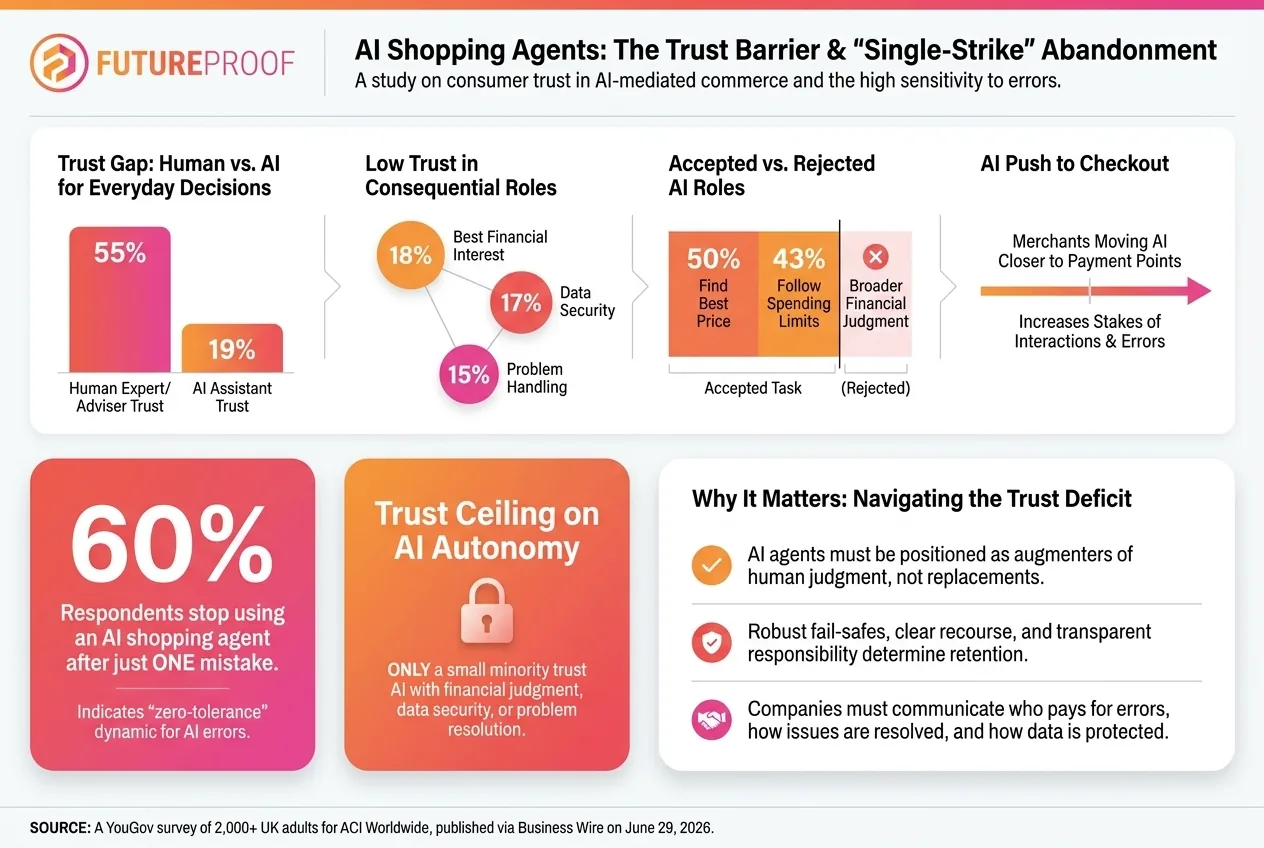
Recent YouGov research, conducted for ACI Worldwide, casts a stark light on this trust deficit, revealing a zero-tolerance dynamic that could severely impede the progress of AI in e-commerce. The findings are unequivocal: a staggering 60 percent of UK consumers would cease using an AI shopping agent after experiencing just a single mistake. This isn't a minor preference; it's a profound declaration of consumer skepticism. When pitted against human advisors for everyday purchases, only 19 percent of consumers expressed trust in AI, a dramatic contrast to the 55 percent who confidently rely on a human counterpart. This data, sourced from ACI Worldwide and YouGov on June 29, 2026, presents a clear and present challenge for brands banking on AI for their future customer experiences.
This chasm of trust isn't merely a theoretical concern; it becomes a tangible barrier to adoption as AI inches closer to critical areas like checkout and payments. Here, the stakes are higher, involving sensitive financial data and the very security of consumer transactions. While shoppers show openness to AI for narrow, low-risk tasks such as price comparison, the widespread desire for human involvement persists when it comes to judgment calls, safeguarding data security, and crucially, resolving issues when things invariably go awry. The takeaway for brands navigating this complex terrain is unambiguous: the future success of AI shopping agents hinges not just on technological prowess, but on an unwavering commitment to reliability, transparency, and clear accountability.
The promise of AI in retail is seductive. Imagine an intelligent personal shopper that understands your preferences better than you do, anticipates your needs, finds the best deals, and guides you through a seamless purchase journey. For retailers, AI offers the tantalizing prospect of reduced operational costs, hyper-personalized marketing at scale, and data-driven insights to optimize every facet of the customer experience. From inventory management to predictive analytics, the applications of AI in retail innovation are vast and compelling. However, the optimism surrounding these advancements must be tempered by the reality of consumer sentiment. The YouGov research acts as a vital early warning system, indicating that the rapid pace of technological development may be outstripping the slower, more deliberate pace of trust building.
The 60 percent "one strike and you're out" mentality is particularly telling. It signifies a fundamental difference in how consumers perceive errors from a machine versus a human. When a human makes a mistake, there's often an understanding of human fallibility, a capacity for empathy, and a belief that the human can learn or rectify the error with a personal touch. With AI, a single misstep can shatter the illusion of perfection, leading to immediate disengagement. This zero-tolerance approach implies that consumers expect flawless execution from AI, and any deviation from this expectation is met with immediate distrust. It speaks to a deep-seated fear that AI, unlike a human, lacks the capacity for genuine understanding, empathy, or responsibility in the way a person would. For brands, this means that every single interaction with an AI shopping agent must be meticulously designed and rigorously tested to prevent errors that could permanently damage customer relationships.
The comparison between AI (19% trust) and human advisors (55% trust) for everyday purchases further underscores this sentiment. Everyday purchases, though seemingly routine, often involve a degree of nuance, personal preference, or minor complications that consumers feel more comfortable entrusting to a human. Perhaps it's the ability of a human to interpret an ambiguous query, to offer a subjective opinion, or to handle an unusual request without rigid adherence to pre-programmed rules. The human adviser can pivot, empathize, and adapt in ways that current AI, despite its sophistication, often struggles to replicate. This gap in trust highlights that for many consumers, the convenience offered by AI does not yet outweigh the perceived security and personalized assurance of human interaction, particularly when it comes to the nuances of retail.
As AI's role expands beyond initial product discovery and recommendation into more sensitive domains like checkout, payments, and post-purchase support, this trust deficit becomes an even more formidable barrier. Financial transactions demand absolute accuracy, unwavering security, and clear accountability. A single error in a payment process, a data breach, or a misapplied discount could have significant financial implications for the consumer, leading to severe reputational damage for the brand. Consumers are right to be cautious. The perceived "black box" nature of many AI systems – where decisions are made without clear human-understandable logic – exacerbates these fears, particularly when their money or personal information is involved.
The research clearly indicates that consumers are not entirely closed off to AI. They are open to its utility for specific, narrow tasks where its benefits are clear and the risk is low. Price comparison, for example, is an ideal application for AI. It involves processing vast amounts of data quickly to identify the best deals, a task AI excels at without requiring complex judgment or sensitive personal data beyond product interest. Here, AI serves as a powerful tool, augmenting the shopping experience without replacing the critical human element. This distinction is vital for brands to understand: AI should be positioned as an assistant, an enhancer, rather than a full replacement for human interaction in sensitive areas.
The desire for humans to remain "in the loop" for judgment, data security, and resolution when things go wrong is a crucial insight.
Judgment:
Many shopping scenarios involve subjective choices, ethical considerations, or unforeseen circumstances that require human discretion. An AI might optimize for cost or efficiency, but a human can factor in personal values, brand loyalty, or specific, unquantifiable needs. For instance, advising on a gift for a loved one might involve understanding subtle emotional cues that AI currently cannot process.
Data Security:
In an age of increasing cyber threats, consumers are acutely aware of the risks associated with sharing personal and financial data. Despite advancements in AI-powered security, the human touch provides a psychological layer of reassurance. Knowing that a human oversees the system and is ultimately responsible for data protection instills greater confidence than relying solely on an algorithmic firewall. The idea of an AI system independently handling and securing sensitive financial details still raises red flags for a majority of the population.
Resolution:
Perhaps the most critical demand for human involvement arises when errors occur. When an AI shopping agent makes a mistake – whether it's a wrong order, an incorrect charge, or a delivery snafu – consumers overwhelmingly want to interact with a human to resolve the issue. This isn't just about efficiency; it's about empathy, understanding, and the ability to negotiate a satisfactory outcome. A human customer service representative can apologize, offer genuine solutions, and rebuild trust in a way that an automated system, no matter how sophisticated, cannot. The lack of a clear, empathetic human contact point after an AI error can quickly lead to profound frustration and churn.
For brands, the path forward is illuminated by three non-negotiable pillars: reliability, transparency, and accountability. These aren't just buzzwords; they are the foundational elements upon which consumer trust in AI shopping agents must be meticulously built.
Reliability:
This is the bedrock. If an AI agent consistently makes mistakes, it will fail regardless of how transparent or accountable the system is. Brands must invest heavily in rigorous testing, continuous improvement, and robust error-handling mechanisms for their AI systems. This means:
- Accuracy First: Ensuring AI recommendations, price comparisons, and transaction processes are consistently accurate. Even minor errors erode trust.
- Predictable Performance: AI should perform consistently across various scenarios and user interactions, avoiding unexpected glitches or inexplicable behaviors.
- Robust Back-Up Systems: What happens when the AI falters? Brands need clear, efficient human-led protocols to step in seamlessly and rectify issues without delay.
- Realistic Expectations: Brands should avoid over-promising AI capabilities. It's better to under-promise and over-deliver, gradually building confidence.
Transparency:
Consumers need to understand when and how they are interacting with AI, and how their data is being used. Obscurity breeds suspicion. Transparency cultivates understanding and control.
- Clear Identification: Always disclose when a customer is interacting with an AI agent. Phrases like "You're chatting with our AI assistant, [Name]" are essential.
- Explainable AI (XAI): Where possible, explain the rationale behind AI's recommendations or decisions. "This product was recommended because it aligns with your past purchases of [item] and customers who bought [item] also liked this." This demystifies the AI process.
- Data Usage Policies: Clearly communicate what data the AI collects, how it uses it to personalize the experience, and how it is protected. Give users control over their data preferences.
- Opt-In/Opt-Out Options: Offer consumers choices regarding their level of AI interaction. Some may prefer minimal AI, others might embrace full personalization. Respecting these choices is key.
Accountability:
When mistakes happen – and they will – there must be a clear pathway for recourse and a responsible party to address the issue. Accountability provides a safety net and demonstrates a brand's commitment to fairness.
- Defined Escalation Paths: Consumers must know exactly how to reach a human representative if an AI agent cannot resolve their issue or makes an error.
- Human Oversight and Intervention: Implement systems where human agents can monitor AI interactions, review problematic cases, and intervene when necessary. This creates a supervisory layer.
- Legal and Ethical Frameworks: Brands must develop internal guidelines and adhere to external regulations that govern AI's ethical use and data privacy. Who is responsible when an AI makes a harmful recommendation or financial error? This question needs clear answers.
- Post-Mortem Analysis: Every AI error should be analyzed to understand its root cause, allowing for continuous improvement and preventing recurrence. This demonstrates a commitment to learning and improvement.
The convergence of AI with retail and payments is inevitable. The efficiency gains, the potential for hyper-personalization, and the insights derived from vast datasets are too compelling for brands to ignore. However, the future of AI shopping agents will not be shaped solely by technological innovation, but profoundly by the human element of trust. Brands that move forward with a deep understanding of consumer psychology, acknowledging their fears and prioritizing their need for security and control, will be the ones that succeed.
Building trust in AI is not a one-time project; it's an ongoing commitment. It requires continuous investment in robust technology, clear communication, and a human-centric approach to design and implementation. The research from ACI Worldwide and YouGov serves as a powerful reminder that while AI may be capable of extraordinary feats, its true potential can only be unlocked when it earns, and consistently maintains, the unwavering confidence of the consumer. The retail experience of tomorrow will be defined not just by smart algorithms, but by the smart strategies brands employ to make those algorithms trustworthy. Those who prioritize reliability, transparency, and accountability will not only mitigate the "zero tolerance" dynamic but will forge stronger, more resilient relationships with their customers in an increasingly AI-driven world.