
The Rise of AI Agents and the End of the Classic Purchase Funnel
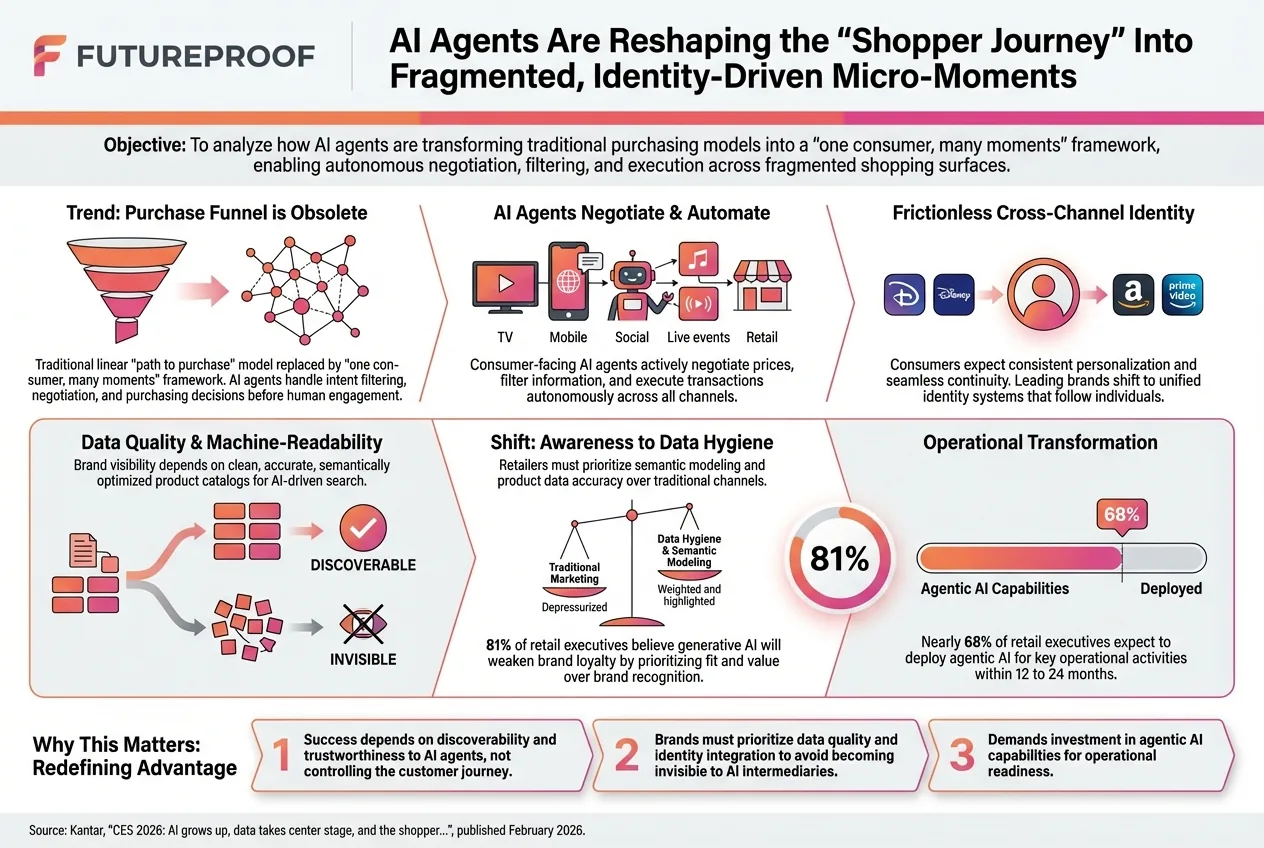
The landscape of consumer shopping is undergoing a profound and irreversible transformation, a shift driven by the rapid ascent of AI agents. The once-familiar, linear purchase funnel, a cornerstone of marketing strategy for decades, is no longer relevant. In its place, we now navigate a complex web of fragmented, identity-driven micro moments, where artificial intelligence has usurped the role of human initiation and discovery. This isn't merely an evolution; it's a revolution, fundamentally altering how consumers find, evaluate, and acquire products and services, and it demands an immediate and decisive response from brands seeking to remain visible and competitive.
AI agents are no longer a futuristic concept; they are actively reshaping the present. These sophisticated algorithms are infiltrating every stage of the consumer journey, from the nascent glimmer of intent to the final click of purchase. They meticulously filter user intent, sifting through vast oceans of information to present hyper-relevant options. They negotiate prices on behalf of consumers, leveraging real-time data and market dynamics. Crucially, they even execute purchases autonomously, operating across an increasingly diverse array of surfaces—from interactive TV experiences and mobile apps to smart home devices and physical retail touchpoints. This paradigm shift means that discovery is no longer solely initiated by a human typing a query or browsing a store aisle. Instead, AI agents are the primary gatekeepers, proactively identifying needs and solutions, thereby bypassing traditional marketing channels and demanding a new approach to brand visibility.
For brands, this transformation presents both an existential threat and an unprecedented opportunity. The competitive landscape has been irrevocably flipped. Visibility, the ultimate currency in commerce, is no longer predicated on traditional advertising spend or even organic search rankings in the human-facing web. It now hinges almost entirely on the cleanliness, structure, and machine-readability of product data. If your product information is not meticulously organized, semantically enriched, and easily digestible by AI agents, it simply will not be found. In an era where AI agents act as intelligent concierges, guiding consumers to optimal choices based on intricate criteria, being invisible to these digital intermediaries is tantamount to commercial oblivion. This isn't a future concern; it's the pressing reality that brands must confront today to secure their place in the burgeoning AI-driven economy.
The urgency of this shift is underscored by compelling industry insights. Retail executives, those at the vanguard of consumer interaction, are acutely aware of the disruptive power of generative AI. A staggering 81 percent of these leaders anticipate that generative AI will actively weaken brand loyalty. This isn't a casual observation; it's a strategic forecast born from understanding how AI fundamentally reorients consumer priorities. Generative AI, with its capacity to synthesize, compare, and recommend, elevates objective fit and intrinsic value above mere name recognition. When an AI agent can objectively determine the best product for a user's specific needs, budget, and preferences, the emotional pull of a familiar brand name diminishes considerably. The focus shifts from "what brand do I know?" to "what solution best fits my needs?"—a question AI agents are uniquely positioned to answer with unprecedented precision.
Furthermore, the operational implications of agentic AI are rapidly becoming a strategic imperative. A significant 68 percent of retail executives expect to deploy agentic AI across their operations within the next two years. This signals that the impact of AI agents extends far beyond the consumer-facing front end; it will permeate and redefine the very fabric of business operations, from supply chain optimization and inventory management to personalized customer service and automated product development. Brands that fail to integrate agentic AI into their internal workflows will likely struggle with efficiency, responsiveness, and ultimately, competitiveness against those that embrace this operational evolution. This holistic transformation demands a strategic overhaul, not just a tactical adjustment to marketing efforts.
The definitive pronouncement on the demise of the classic funnel came at CES 2026, where leaders from industry giants like Disney, Amazon, and Prime Video collectively underscored this epochal change. They unequivocally stated that "the classic funnel is gone," replaced by sophisticated "identity systems designed to follow a single consumer across every touchpoint." This vision paints a picture of a continuous, personalized customer journey where AI agents take on the crucial upstream tasks of handling intent identification and negotiation. This means that by the time a consumer is ready to make a purchase, much of the research, comparison, and even bargaining has already been seamlessly orchestrated by AI, tailoring the experience to their precise, evolving identity across every device and platform they engage with.
Understanding the "classic funnel is gone" means acknowledging that consumers no longer passively move through awareness, interest, desire, and action in a predictable sequence. Instead, their journey is a fluid, often instantaneous interaction with AI agents that anticipate and fulfill needs. These identity systems are not just about tracking; they are about understanding the nuanced preferences, behaviors, and contextual situations of an individual in real-time. This comprehensive, always-on understanding allows AI agents to act as highly intelligent personal shoppers, guiding consumers through a hyper-personalized ecosystem where relevance is king. The implication for brands is profound: you are no longer marketing to a demographic; you are engaging with a continuously evolving digital identity, mediated by powerful AI.
The shift towards identity systems fundamentally redefines the role of marketing. Instead of broadcasting messages to broad segments, brands must now focus on contributing valuable, context-aware information to these intricate identity systems. This demands a granular understanding of how AI agents perceive and interpret product attributes, how they factor in user preferences, and how they weigh different criteria during negotiation. The brand's presence is no longer about shouting the loudest; it's about being the most relevant, the most trustworthy, and the most seamlessly integrated into the AI-driven recommendation engine.
In this agent-driven economy, product data is the new content. It needs to be rich, accurate, consistent, and structured using universally recognized standards like schema.org markup. Think of it not just as product descriptions for human readers, but as instruction manuals for AI agents. Each attribute—color, size, material, sustainability credentials, compatibility, user reviews, pricing history, warranty details—must be meticulously defined and linked. Brands must invest heavily in Product Information Management (PIM) systems and master data management to ensure that their digital assets are AI-ready. This also includes optimizing for semantic search, ensuring that natural language queries posed to AI assistants can be accurately matched with relevant product information, regardless of the phrasing.
The weakening of brand loyalty, as predicted by retail executives, is a direct consequence of this shift towards objective evaluation by AI. Historically, brand loyalty was built on emotional connections, aspirational messaging, and consistent brand experiences. While these elements will not entirely vanish, their influence is being mitigated by AI's relentless pursuit of optimal fit and value. An AI agent cares little for a brand's legacy or its marketing jingle; it prioritizes user reviews, comparative pricing, specifications, and how well a product aligns with the explicit and implicit needs of the consumer it serves. This means brands must double down on the intrinsic quality, performance, and demonstrable value of their offerings. Transparency, authenticity, and verifiable claims will become more critical than ever. Marketing efforts will need to pivot from solely brand building to demonstrating superior value proposition and fit, articulated in ways that resonate with AI's analytical capabilities.
Furthermore, the deployment of agentic AI across operations signals a wholesale digital transformation that extends beyond the customer interface. Agentic AI, characterized by its ability to act autonomously to achieve goals, will revolutionize supply chains by predicting demand with greater accuracy, optimizing logistics, and even automating procurement. In customer service, AI agents will handle complex queries, offer personalized support, and proactively resolve issues, freeing human agents for more intricate tasks. Product development can leverage agentic AI to analyze market trends, consumer feedback, and even iterate on designs, accelerating innovation cycles. This internal operational efficiency directly impacts the external value proposition, enabling brands to offer better products, faster delivery, and more responsive service, which in turn reinforces the objective "fit and value" sought by consumer-facing AI agents.
The core challenge and opportunity, as highlighted by the CES 2026 discussion, is the establishment of robust identity systems. These systems are designed to create a persistent, holistic view of a single consumer across every single touchpoint, from browsing a product on a smart TV to adding it to a cart on a mobile device, or even interacting with it in a metaverse environment. This longitudinal data allows AI agents to build incredibly rich profiles, understanding not just past purchases but evolving preferences, lifestyle changes, and contextual needs. For brands, integrating into these identity systems, respecting data privacy, and contributing to this unified consumer understanding will be paramount. It means developing strategies for first-party data collection, ethically leveraging consented data, and ensuring that all customer interactions—whether online or offline—contribute to a richer, more accurate identity profile that AI agents can utilize.
To thrive in this AI-driven commerce era, brands must embark on a multi-faceted strategic overhaul. Firstly, they must prioritize data architecture and governance. This involves investing in robust Product Information Management (PIM) and Digital Asset Management (DAM) systems, ensuring data quality, consistency, and completeness across all SKUs and product variations. Secondly, brands need to adopt semantic web standards and implement rich structured data markup (like Schema.org) extensively across their digital properties. This is the language AI agents understand, crucial for discoverability. Thirdly, marketing strategies must evolve to emphasize demonstrably superior product features, value, and objective benefits, rather than relying solely on abstract brand appeal. This requires a deeper understanding of what AI agents value in recommendations. Fourthly, proactive investment in agentic AI for internal operations is not optional; it's a necessity for competitive efficiency and agility. Lastly, brands must develop sophisticated identity resolution strategies, enabling them to contribute to and leverage comprehensive customer profiles while adhering to stringent privacy standards. This means focusing on personalized experiences that are genuinely valuable and contextual, not intrusive.
In conclusion, the era of AI agents has irrevocably transformed consumer shopping, consigning the traditional purchase funnel to history and ushering in a new paradigm of fragmented, identity-driven micro moments. Visibility now hinges on structured, machine-readable product data, while brand loyalty bows to the objective assessment of fit and value. The operational blueprint of retail is being redrawn by agentic AI, and the future of customer engagement lies in sophisticated identity systems that follow consumers across every touchpoint. Brands that recognize this seismic shift and proactively adapt their data strategies, operational models, and marketing approaches will not merely survive but flourish, becoming integral, trusted components of the intelligent commerce ecosystem that is rapidly taking shape. The time to act is now, for the future of commerce is already here, and it is intelligent, autonomous, and profoundly data-driven.


