The One Answer AI Era Reshaping Brand Visibility and Digital Strategy
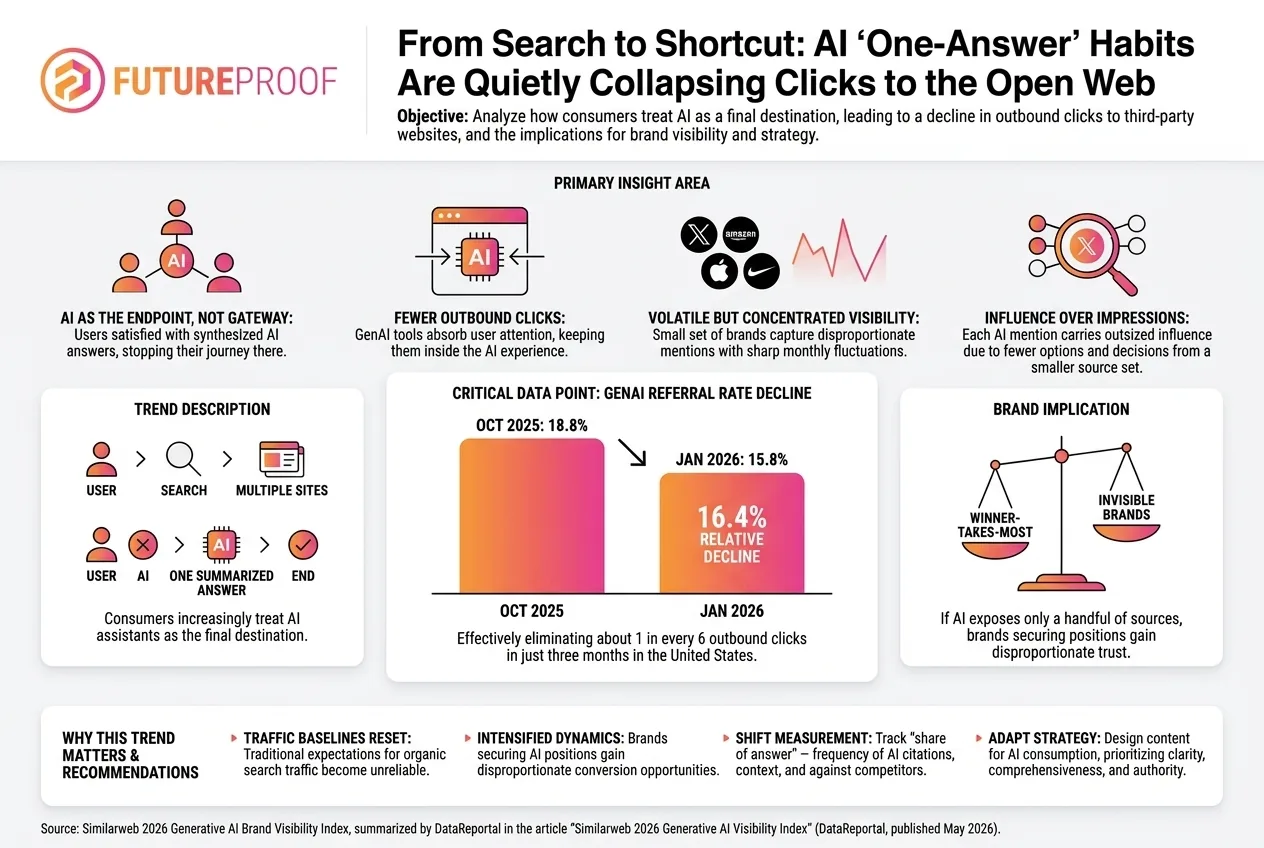
The digital landscape is undergoing a profound, yet often subtle, transformation as artificial intelligence redefines how users find information and interact with brands online. What was once a journey across multiple search results pages, a deliberate exploration of various websites, is rapidly collapsing into a singular, synthesized answer provided by AI assistants. Platforms like ChatGPT, Gemini, Perplexity, Google AI Mode, and Copilot are no longer just intelligent search extensions; they are becoming the definitive endpoints for consumer queries, fundamentally reshaping the very foundation of brand discovery and influence on the open web.
This seismic shift, characterized by the rise of AI’s “one answer” habit, is quietly but inexorably diminishing the traditional role of search engines as gateways to websites. Consumers are increasingly treating AI-generated responses as final destinations. Instead of clicking through to external domains, they accept the AI’s summary or direct recommendation as the complete solution to their query. This behavioral evolution has critical implications for every brand reliant on organic visibility and web traffic. The path from initial search to desired information or product is being rerouted, with AI absorbing more and more of the user journey, leaving fewer breadcrumbs leading back to the original source websites.
The consequences for brands are immediate and far-reaching. Brand visibility, traditionally spread across numerous organic search rankings, is becoming highly concentrated and, paradoxically, more volatile within AI answers. When an AI provides a single, authoritative response, the brands or sources cited within that response gain disproportionate influence. Users, presented with a curated, often singular set of options, perceive these cited entities with enhanced authority and credibility. This creates a "winner takes most" dynamic where being the chosen source by AI carries immense weight, while those not cited effectively become invisible to a growing segment of online users. The era of the direct click as the sole measure of digital engagement is waning, demanding a radical re-evaluation of content strategy, SEO, and performance measurement.
This isn't merely a speculative forecast; it's a measurable reality. A striking data point underscores the urgency of this transformation: the referral rate from generative AI platforms to third-party domains in the United States plummeted from 18.8 percent in October 2025 to 15.8 percent in January 2026. This represents a staggering 16.4 percent relative decline in just three months, effectively removing one out of every six outbound clicks in a blink of the digital eye. This critical insight, sourced from the Similarweb 2026 Generative AI Brand Visibility Index and summarized by DataReportal, serves as a stark warning: the structural reset of organic traffic baselines is not a distant threat but a present challenge that demands immediate adaptation.
The implications of this shift are profound, necessitating a fundamental rethinking of established digital marketing paradigms. Organic traffic baselines are being structurally reset, meaning that even when demand for a particular product, service, or piece of information remains stable or even grows, the volume of clicks flowing from search engines to websites will inevitably decrease. This isn't a temporary dip in traffic due to algorithm updates or seasonal trends; it's a permanent re-calibration driven by a fundamental change in how users interact with information. Brands must adjust their expectations, re-evaluate their traffic forecasts, and understand that success can no longer be solely measured by the volume of direct website visitors. The very definition of "organic success" is evolving beyond direct navigation to include the critical, often unseen, influence exerted within AI-generated answers.
The intensification of "winner takes most" dynamics is another critical consequence. In a traditional search engine results page (SERP), there are multiple opportunities for visibility—ten blue links, featured snippets, people also ask, images, videos. In the "one answer" AI paradigm, the opportunity shrinks dramatically. If an AI synthesizes an answer or recommends a single brand, that brand gains an extraordinary competitive advantage. This paradigm rewards deep expertise, unique data, and definitive answers. Brands can no longer afford to be merely good; they must strive to be the absolute authority in their niche to stand a chance of being selected and cited by advanced AI models. This necessitates a strategic shift from merely optimizing for keywords to optimizing for comprehensive, authoritative knowledge representation.
Perhaps the most challenging aspect for marketers is the requirement for measurement to expand significantly, moving beyond simple sessions and clicks to encompass "share of answer" within AI systems. How do you measure the impact of an AI answer that influences a user's decision without generating a direct click to your site? New metrics are urgently needed, such as AI visibility scores, citation rates, prominence in synthesized summaries, and the overall share of voice your brand commands within generative AI outputs. This demands innovative analytics tools and methodologies to track influence and attribution in a fragmented, AI-driven information ecosystem. Understanding the user's journey, even when it doesn't involve a direct click, becomes paramount for demonstrating ROI and justifying content investments.
Crucially, content itself must be fundamentally re-architected for AI consumption. This is no longer just about appealing to human readers and search engine crawlers; it's about structuring and presenting information in a way that AI models can efficiently process, understand, and select as a primary source. This means embracing clarity, conciseness, and definitive answers. AI values content that directly addresses specific questions without ambiguity or excessive jargon. Furthermore, robust implementation of structured data (schema markup) becomes indispensable. By explicitly tagging different types of information—products, services, reviews, FAQs, how-to guides—brands can make their content machine-readable, dramatically increasing the likelihood of it being accurately understood and selected by AI for synthesized answers.
The emphasis on Expertise, Experience, Authoritativeness, and Trustworthiness (E-E-A-T) intensifies. AI models are designed to prioritize credible and authoritative sources. Brands must not only produce high-quality content but also actively build and demonstrate their E-E-A-T through expert authorship, robust citations, peer recognition, and a strong online reputation. Content that offers unique insights, proprietary data, original research, or distinct perspectives will naturally stand out in a world where AI excels at synthesizing common knowledge. Brands that invest in becoming thought leaders and primary sources of information within their industries will be better positioned to be recognized and cited by AI. Moreover, anticipating the types of questions users ask AI and crafting content that directly answers these specific queries, often in a Q&A format, will be critical.
To thrive in this "one answer" era, brands must evolve their content strategy beyond traditional SEO. The goal is no longer just to rank high; it's to be the definitive source that AI selects. This means investing heavily in original research, proprietary data, expert interviews, and unique perspectives that differentiate your content. Semantic SEO becomes more critical than ever, shifting focus from individual keywords to understanding entities, relationships, and overarching concepts. Brands need to ensure their knowledge is accessible not just through web pages but also potentially through APIs, making it easier for AI models to consume and integrate their data. Optimizing for voice search, which is inherently AI-driven, also aligns with this strategy, as natural language queries are precisely what AI assistants are designed to handle. Cultivating a sterling online reputation and transparently demonstrating expertise will be non-negotiable, as AI places a premium on trusted sources.
Diversification of traffic sources is also paramount. While optimizing for AI visibility is crucial, brands cannot afford to put all their eggs in one AI-generated basket. Direct traffic, strong email marketing programs, active engagement on social media, strategic paid advertising, and community building will provide essential resilience. The goal is to build direct relationships with audiences, reducing reliance on intermediaries, whether traditional search engines or AI assistants.
Ultimately, the shift from search to shortcut, where AI provides the "one answer," represents a fundamental realignment of the digital ecosystem. The data is clear: outbound clicks are collapsing at an alarming rate, irrevocably changing how brands are discovered and how their influence is measured. This isn't just an evolution; it's a structural reset demanding a proactive, intelligent, and immediate response. Brands that embrace this transformation, re-engineer their content for AI consumption, expand their measurement frameworks, and prioritize becoming authoritative, trusted sources will not merely survive but will define the next chapter of digital visibility and success. The future of brand influence lies not in chasing clicks but in commanding the definitive answer.