Thriving in the Four Engine Future How Brands Win in the Age of Multi AI Search
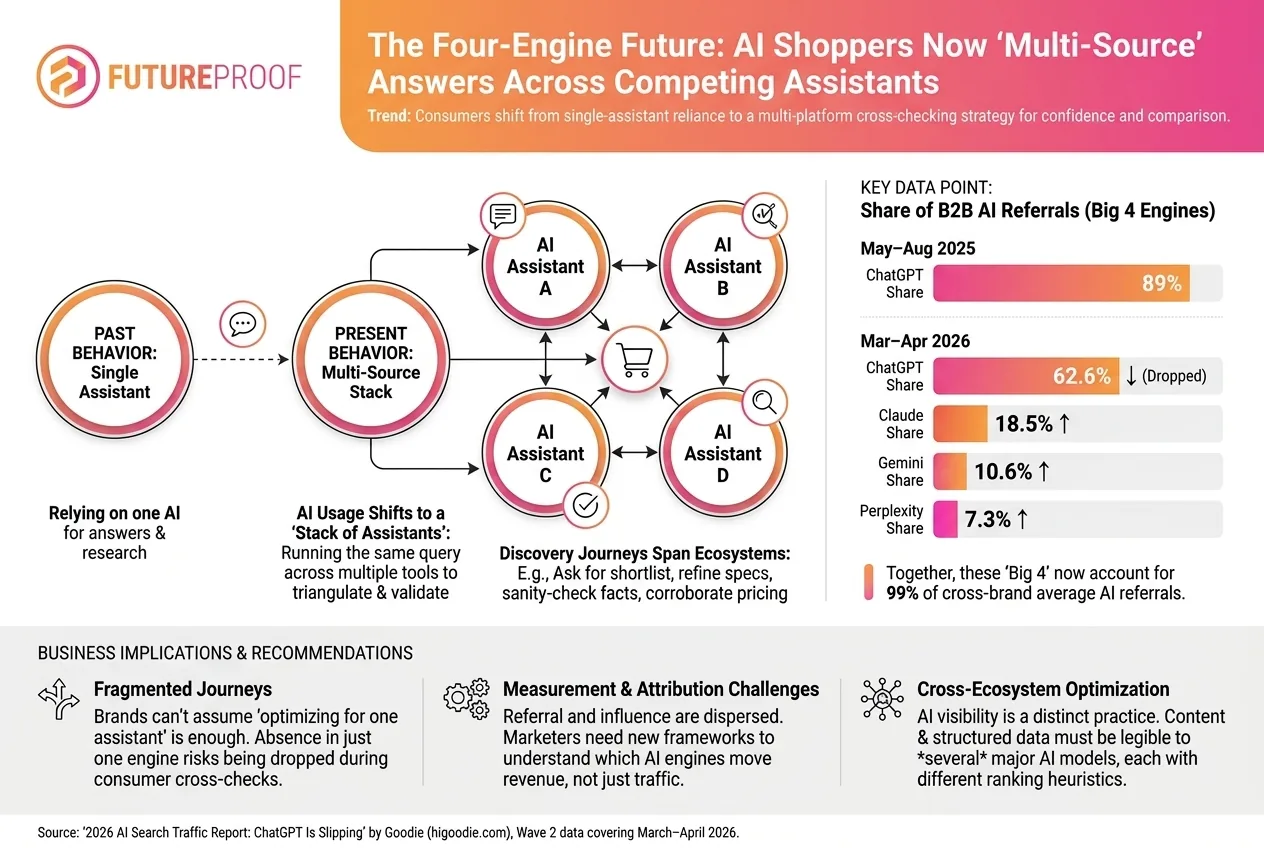
A profound transformation is reshaping how consumers interact with artificial intelligence, marking a pivotal shift in the digital landscape. The era of brand loyalty to a single AI assistant is rapidly dissolving, replaced by a sophisticated, multi-source approach to information gathering and decision-making. We are entering the "Four-Engine Future," where discerning users now routinely run the same queries across a diverse array of competing AI tools – from ChatGPT and Claude to Gemini and Perplexity – not out of mistrust, but out of a quest for comprehensive validation and nuanced understanding. This emergent behavior isn't just a trend; it's the dawn of a new comparison shopping layer, fundamentally altering the rules of engagement for brands seeking to capture attention and build trust in the AI-driven economy.
The underlying rationale for this multi-sourcing phenomenon is deeply rooted in the very nature of AI itself. While incredibly powerful, each AI assistant possesses unique training data, algorithms, and inherent biases, leading to variations in output. Users are acutely aware of these discrepancies and have learned that the most reliable insights emerge not from singular pronouncements, but from the consensus – or thoughtful divergence – across multiple intelligent agents. Trust, in this evolving ecosystem, is no longer bestowed upon a single AI's recommendation; it is forged through triangulation, where overlapping answers from diverse sources lend credibility, and differing perspectives encourage deeper critical analysis. This intelligent skepticism fuels a powerful drive for validation, making it indispensable for users to consult several "oracles" before committing to an opinion, product, or service.
Consider the practical implications for an individual researching a complex topic or vetting a significant purchase. A query about "the best sustainable running shoes for trail running" might yield a list from ChatGPT, focusing on popular brands and general features. Running the same query on Claude might return a more detailed analysis of material science and ethical manufacturing practices. Gemini, integrated with Google's vast ecosystem, could offer up-to-the-minute product availability and user reviews. Perplexity, known for its ability to cite sources, would provide a research-driven overview, linking directly to relevant articles and studies. By synthesizing these varied responses, the user gains a far richer, more reliable, and ultimately more actionable understanding than any single assistant could provide. This isn't just about finding an answer; it's about constructing a well-informed viewpoint, making the multi-source strategy an essential skill in the age of generative AI.
This shift isn't merely anecdotal; it's strongly supported by compelling data that paints a clear picture of an increasingly fragmented AI referral landscape. The 2026 AI Search Traffic Report by Goodie (higoodie.com) offers a stark illustration of this paradigm change. The report reveals that ChatGPT’s once-dominant share of measurable B2B AI referrals experienced a significant decline, plummeting from an overwhelming 89 percent between May and August 2025 to a still substantial, but notably reduced, 62.6 percent by March to April 2026. This substantial drop of nearly 27 percentage points in less than a year underscores a critical rebalancing of influence within the AI referral ecosystem.
Simultaneously, competing AI assistants have made substantial inroads, carving out significant portions of the referral pie. Claude, lauded for its nuanced understanding and creative capabilities, ascended to an 18.5 percent share. Google's Gemini, benefiting from its deep integration within the broader Google ecosystem and continuous improvements, secured a respectable 10.6 percent. Perplexity, distinguished by its focus on verifiable sources and research-oriented responses, captured 7.3 percent of referrals. Together, these "Big 4" – ChatGPT, Claude, Gemini, and Perplexity – now collectively drive an astonishing 99 percent of cross-brand AI referrals. This consolidation around a few dominant players, coupled with the erosion of single-assistant supremacy, presents both a challenge and an opportunity for brands navigating the complexities of AI-driven discovery.
For brands, this evolving consumer behavior and the data behind it carry profound implications. The days of optimizing solely for one dominant AI assistant are over. If your brand's presence, information, or recommendations disappear in even one of these major AI engines, you risk being summarily cut from the final shortlist of options a user considers. This isn't just about losing a potential click; it's about being entirely omitted from the initial discovery phase, a phase increasingly mediated by AI. Brands must now recognize that visibility across the entire spectrum of the Big 4 AI assistants is not merely an advantage; it is an absolute imperative for maintaining competitive relevance and ensuring consistent brand discovery.
The challenge lies in adapting traditional SEO and digital marketing strategies to this distributed AI environment. Historically, search engine optimization (SEO) focused heavily on Google's algorithms. While Google remains paramount, the definition of "search" has expanded dramatically to include these conversational AI interfaces. Brands need to develop an "AI-SEO" strategy that accounts for how each of these powerful assistants ingests, processes, and synthesizes information. This means moving beyond keyword stuffing and embracing semantic understanding, content authority, and diverse data sourcing. The goal is to ensure that when a user asks any of the Big 4 AI assistants about your product, service, or industry, your brand is not only present but presented favorably, consistently, and accurately across the board.
The necessity for multi-AI optimization permeates every facet of a brand's digital presence. Your website content, product descriptions, FAQs, customer reviews, and even your social media interactions are all potential data points for these AI models. A comprehensive AI marketing strategy must therefore focus on delivering consistently high-quality, verifiable, and semantically rich information across all digital touchpoints. If an AI assistant encounters conflicting information about your brand across different sources, or if your brand lacks sufficient digital signals, its confidence in recommending or even mentioning your brand will diminish, pushing you further down (or off) the AI-generated shortlist.
To thrive in this four-engine future, brands must implement a multi-faceted approach centered on pervasive digital excellence and adaptive content strategy.
Firstly, Content Quality and Verifiability become paramount. AI assistants, particularly those focused on factual accuracy like Perplexity, prioritize reliable, well-sourced information. Brands must ensure their content is not only informative and engaging but also factually robust, transparent, and consistent across all platforms. Every claim should be supported, and data should be easily verifiable. This reduces the likelihood of an AI hallucinating information or misrepresenting your brand, which could be disastrous in a multi-source validation scenario. Investing in comprehensive, authoritative long-form content, detailed product specifications, and robust FAQ sections is more crucial than ever.
Secondly, Structured Data and Semantic SEO are no longer optional but foundational. Implementing schema markup (e.g., product schema, organization schema, FAQ schema) helps AI assistants understand the context, relationships, and meaning of your content more effectively. By providing structured data, brands make it easier for all AI models to parse, categorize, and present your information accurately, regardless of their specific training data or interpretation algorithms. This semantic optimization ensures that your brand's core messages and offerings are unambiguously understood by the machines that increasingly mediate consumer discovery.
Thirdly, brands need a Diversified AI Content Strategy that acknowledges the strengths and weaknesses of each major AI. For instance, while factual accuracy is key for all, a creative product description might resonate better with ChatGPT or Claude, known for their imaginative text generation. For Gemini, leveraging your Google Business Profile and ensuring consistent information across all Google properties (Maps, reviews, etc.) is vital. Perplexity thrives on comprehensive, source-rich content, so maintaining a blog with well-researched articles and external links can be highly beneficial. Instead of a "one-size-fits-all" approach, brands should consider how to tailor their content or at least ensure their foundational content is robust enough to be interpreted optimally by each AI's unique characteristics.
Fourthly, Monitoring and Analytics must evolve. Brands need to actively track not just overall AI referral traffic but also differentiate referrals coming from ChatGPT, Claude, Gemini, and Perplexity. Understanding which queries lead to your brand's mention on each platform, how your brand is being described, and the sentiment surrounding those mentions will provide invaluable insights. This requires advanced analytics tools that can dissect AI-driven traffic and brand mentions, allowing for continuous refinement of strategies based on actual performance across the "Big 4."
Fifthly, Building a Strong Digital Footprint Beyond Your Website is more critical than ever. AI assistants draw information from a vast array of sources beyond a brand's owned properties. This includes industry directories, review sites (Google Reviews, Yelp, Trustpilot), news articles, press releases, social media discussions, and even Wikipedia entries. Ensuring consistent, accurate, and positive information about your brand across these diverse third-party platforms is essential. A robust digital PR strategy, active reputation management, and consistent engagement across social channels contribute significantly to the rich informational tapestry that AIs use to form their understanding of your brand.
Finally, Experimentation and Adaptation must be core tenets of any AI-driven marketing strategy. The AI landscape is incredibly dynamic, with new models, capabilities, and user behaviors emerging regularly. Brands that are agile, willing to experiment with new content formats, prompt engineering techniques (if applicable for direct AI interaction), and continually refine their AI-SEO tactics will be best positioned to succeed. This means dedicating resources to understanding the nuances of each AI assistant, participating in relevant beta programs, and staying abreast of the latest developments in generative AI.
The data from Goodie's 2026 AI Search Traffic Report is a clarion call. The era of unilateral AI dominance is over, replaced by a multi-faceted ecosystem where consumer trust is earned through consensus across powerful, competing intelligence. The "Four-Engine Future" demands that brands transcend single-platform optimization and embrace a holistic approach to digital visibility and content strategy. Those who adapt to this new reality, ensuring their brand resonates across ChatGPT, Claude, Gemini, and Perplexity, will not only survive but thrive, securing their place on the coveted shortlists of the next generation of AI-powered shoppers. The future of brand discovery is here, and it’s being validated by multiple AI engines. The time to optimize for all of them is now.