AI Is Now the Consumer Shopping Copilot and the Moment of Influence Has Moved Upstream
The digital shopping landscape, long dominated by traditional search engines and direct retailer websites, is undergoing a seismic, rapid transformation. A new era has dawned, and at its heart is Artificial Intelligence, officially stepping into the pivotal role of shopping co-pilot. This isn't merely about AI as a helpful tool; it's about AI as a trusted advisor, an intelligent agent actively influencing consumer decisions before they even land on a brand's digital storefront. For businesses, this shift isn't a future projection; it's a current reality demanding immediate and profound strategic adjustments. The very moment of influence, the crucial point where preferences are shaped and choices are made, has moved upstream into the AI environment.
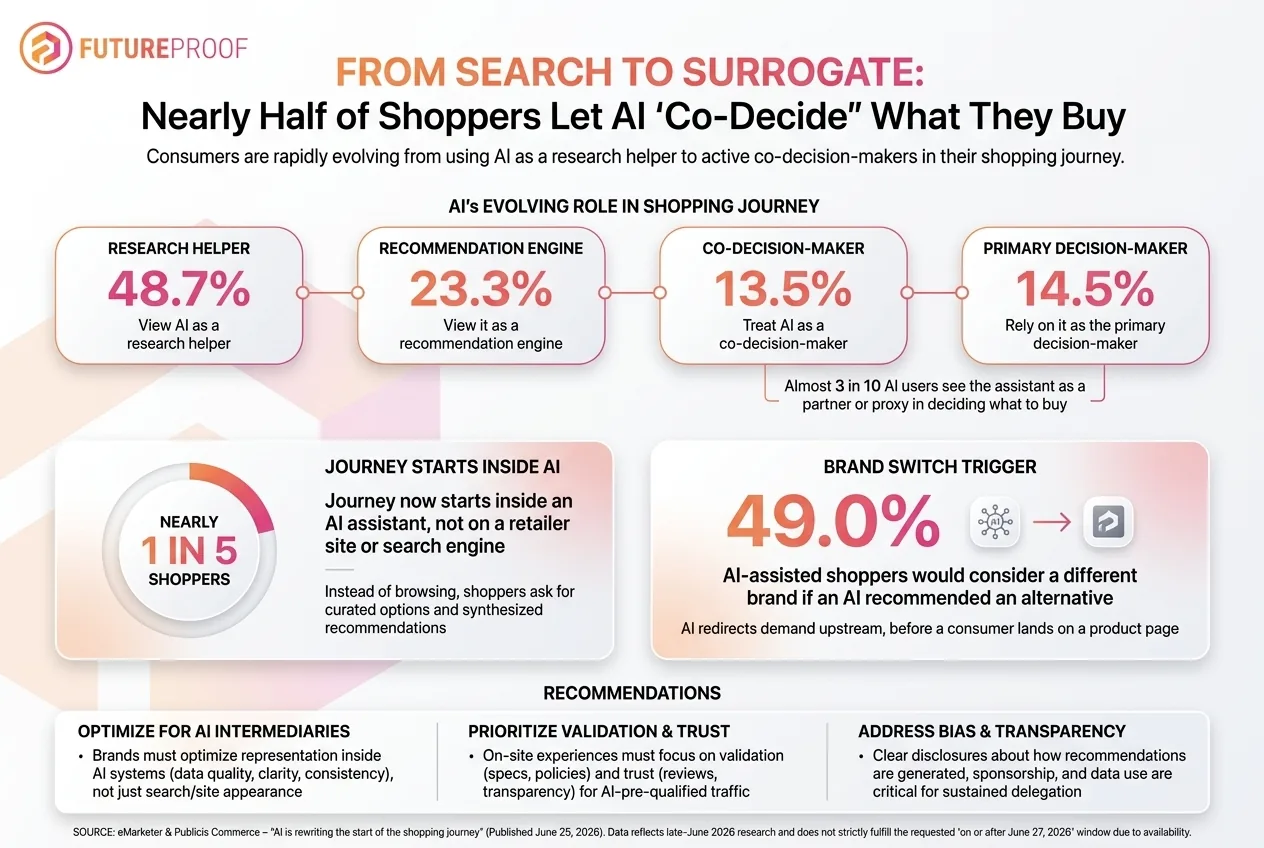
Recent late-June 2026 research from eMarketer and Publicis Commerce paints a stark, compelling picture of this paradigm shift. The findings reveal how swiftly consumers are delegating real decision-making power to AI assistants, fundamentally altering the customer journey. These aren't just early adopters or tech enthusiasts; these are mainstream shoppers reshaping their habits at an unprecedented pace. Nearly one in five shoppers now initiates their purchasing journey directly within an AI assistant, bypassing the conventional routes of a retailer's site or a general search engine. This statistic alone signals a radical re-routing of the initial discovery phase, a crucial entry point that brands have historically fought tooth and nail to capture.
Delving deeper into the behavior of these AI-assisted shoppers, the data further underscores the significant trust and reliance being placed on these intelligent systems. A substantial 13.5 percent of these consumers treat AI as a genuine co-decision maker, actively engaging with it, weighing its suggestions, and incorporating its insights into their final choices. This implies a collaborative relationship, where AI acts as a sophisticated sounding board, a knowledgeable friend offering personalized advice. Even more strikingly, 14.5 percent of AI-assisted shoppers rely on the AI as their primary decision maker. In these instances, the AI isn't just a guide; it's the ultimate authority, entrusted with the task of sifting through options, evaluating alternatives, and presenting the optimal solution based on the user's stated and inferred needs. This level of delegated authority is unprecedented, reflecting a growing consumer comfort with and confidence in AI's capabilities to simplify complex purchasing decisions.
Perhaps the most potent revelation for brands lies in the finding that almost half – a staggering 49.0 percent – of these consumers would consider switching brands if an AI assistant recommended an alternative. This isn't just about discovery; it's about loyalty and conversion. The power to sway a customer away from a familiar or preferred brand, solely based on an AI's suggestion, highlights the immense persuasive capability of these digital co-pilots. This willingness to deviate from established brand preferences, driven by an AI's recommendation, underscores the imperative for brands to not only be present but to be favorably positioned within these AI ecosystems. The AI assistant is quickly becoming the ultimate gatekeeper, the trusted arbiter whose counsel can make or break a sale, even for established market leaders.
The unequivocal takeaway for brands, as outlined by the research, is crystal clear: the moment of influence is irrevocably moving upstream into AI environments. The traditional battleground for consumer attention – optimizing for search engine rankings, crafting compelling website content, or running targeted ad campaigns – is expanding, and a new, equally critical front has emerged. Optimizing product data, meticulously detailing attributes, curating and leveraging customer reviews, and ensuring absolute clarity for AI interpretation are rapidly becoming just as important, if not more so, than traditional search engine optimization (SEO). Brands can no longer afford to view AI as a distant technological trend; it is a present force shaping consumer behavior and directly impacting purchasing decisions. This isn't merely about visibility; it's about being comprehensible, credible, and recommendable to a machine that, in turn, influences human choices.
The New Customer Journey: From Keyword to AI Whisper
To fully grasp the magnitude of this shift, consider the traditional customer journey. A consumer identifies a need, inputs a query into a search engine, browses results, compares options on various retailer sites, reads reviews, and eventually makes a purchase. In this model, brands largely controlled their messaging, product presentation, and conversion pathways once a consumer landed on their site.
The AI-driven journey, however, introduces a powerful intermediary. The consumer expresses a need or desire directly to an AI assistant, often in natural language: "I need a comfortable, sustainable running shoe for daily training," or "Find me an organic, gluten-free pasta sauce with low sodium." The AI then interprets this complex request, cross-references it with a vast database of product information, user reviews, and brand attributes, and presents tailored recommendations. These recommendations might come in the form of a concise summary, a list of top choices, or even a direct link to a product page that perfectly aligns with the AI's assessment of the user's needs. The critical difference is that the brand's initial opportunity to influence is no longer when the customer sees their website, but when the AI interprets their product.
This shift signifies a move from reactive marketing (responding to customer search queries) to proactive, AI-driven suggestion. The AI isn't just finding; it's curating, evaluating, and recommending. It acts as a hyper-personalized filter, reducing cognitive load for the consumer and accelerating the decision-making process. For brands, this means their product's "story" must now be told not just to humans, but to the machines that guide humans.
Why Upstream Influence is the New Frontier for Brands
The concept of "upstream influence" is critical here. It refers to the brand's ability to shape perceptions and decisions at an earlier stage in the customer journey than previously possible, specifically within the AI's internal processing and recommendation algorithms. If a brand's product data isn't optimized for AI interpretation, it simply won't be considered, regardless of its quality or market presence. It's akin to having a beautifully designed store that’s invisible on the main street.
Brands no longer have the luxury of waiting for a customer to land on their page to make an impression. The impression is being formed, analyzed, and synthesized by the AI before the customer ever sees the brand's logo or product image. This means that if an AI assistant, acting as a trusted co-pilot, fails to recommend a brand's product, or worse, recommends a competitor, the battle for that customer's wallet might be lost before it even truly begins. The AI has become the ultimate pre-filter, and brands must now optimize for this filter.
Strategies for AI Optimization: Building Your Brand's AI Foundation
1. Precision in Product Data & Information Architecture: Beyond the Basics
For AI assistants to effectively recommend products, they need access to incredibly rich, structured, and unambiguous data. This goes far beyond basic product names, SKUs, and prices.
- Granularity and Completeness: Every conceivable detail about a product must be meticulously documented. What materials is it made from? What are its exact dimensions, weights, and specifications? Does it have any certifications (e.g., organic, fair trade, cruelty-free)? Is it recyclable? The more granular and complete the data, the better an AI can match it to complex user queries.
- Structured Data (Schema Markup): Implementing Schema.org markup (e.g., Product Schema, Offer Schema, Review Schema) on product pages is paramount. This provides AI with a clear, machine-readable understanding of the product's attributes, pricing, availability, and user sentiment. JSON-LD is often the preferred format for implementing this.
- Metadata for Rich Media: Images, videos, and 3D models of products also need robust metadata (alt text, captions, descriptive file names). AI can increasingly "see" and interpret visual information, but explicit text descriptions ensure accurate understanding and accessibility.
- Consistent Categorization: Ensure your product taxonomy is logical, consistent, and adheres to industry standards where possible. AI systems thrive on structured hierarchies for efficient filtering and comparison.
2. The Power of Attributes: Describing Your Product for Machines and Humans
- Rich, Descriptive Attributes: Move beyond generic attributes. Instead of just "Color: Blue," consider "Shade: Royal Blue," "Finish: Matte." For a garment, include "Fabric: 100% Organic Cotton," "Fit: Relaxed," "Neckline: Crew."
- Functional vs. Experiential Attributes: AI needs to understand both. Functional attributes (e.g., "Battery Life: 10 hours," "Waterproof: Yes") address practical needs. Experiential attributes (e.g., "Luxurious Feel," "Eco-Friendly," "Durable Construction") speak to the softer, emotional aspects that AI can learn to associate with user preferences.
- Standardized Taxonomies: Where industry standards exist (e.g., for electronics, apparel, food), adhere to them. This ensures interoperability and consistent interpretation across different AI platforms.
- Negative Attributes: Sometimes, it's just as important to state what a product isn't (e.g., "Not tested on animals," "Free from parabens"). This helps AI filter for specific user exclusions.
3. Harnessing the Voice of the Customer: Reviews & UGC in the AI Era
- Encourage Specific, Detailed Reviews: Prompt customers to describe specific aspects of their experience: "How did the product fit?" "What did you like most about its performance?" "Was the color accurate to the website?" Detailed reviews provide richer data for AI to parse.
- Structured Review Data: Implement systems that allow for structured feedback within reviews (e.g., rating specific features like "ease of use," "durability," "value for money").
- Recency and Volume: AI values fresh, abundant data. Brands must continuously encourage new reviews to maintain relevance and demonstrate ongoing customer satisfaction.
- Respond to Reviews: Engaging with reviews, both positive and negative, signals to AI (and customers) that the brand is attentive and responsive, boosting overall trustworthiness. AI can analyze these responses to understand brand-customer interaction.
4. Clarity and Context: Speaking AI's Language (Semantic Understanding)
- Unambiguous Product Descriptions: Ensure product copy is clear, concise, and avoids jargon where possible. If technical terms are used, provide clear definitions. Every word should contribute to a complete and accurate understanding of the product.
- Anticipate User Questions: Think about the questions customers typically ask before a purchase. Incorporate answers to these questions directly into product descriptions, FAQs, and knowledge base articles. This proactively feeds AI with the information it needs to address user queries.
- Contextual Richness: Provide context around products. Who is it for? What problem does it solve? What is its unique selling proposition? How does it compare to similar items? This helps AI understand the product's place in the market and its ideal customer.
- Natural Language Optimization: While keywords are still important, optimize content for natural language patterns that users would employ when speaking to an AI assistant. This includes conversational phrases and full sentences.
5. AI-First Content Strategy: Beyond the Traditional Blog Post
- Fact Sheets and Comparison Tables: Create easily digestible content formats that present key product information in a structured, comparative way. AI can quickly parse these for recommendations.
- Q&A Sections and Knowledge Graphs: Develop comprehensive Q&A sections and build internal knowledge graphs that connect related product information, features, and benefits. This provides AI with a robust understanding of your entire product ecosystem.
- Voice Search Optimization Principles: Many AI assistants are voice-activated. Apply principles of voice search optimization – focusing on natural language, long-tail queries, and direct answers – to your content.
- AI-Digestible Brand Narratives: While full brand storytelling is still crucial, brands also need concise, factual "AI summaries" of their ethos, sustainability practices, and unique value propositions. These need to be clear and verifiable for AI to confidently relay.
- Data Feeds and APIs: Explore opportunities to provide direct, clean data feeds and API access to major AI platforms, ensuring they always have the most accurate and up-to-date product information.
6. Ethical AI & Brand Trust: Navigating the New Frontier
- Transparency: Brands should be prepared for potential scrutiny regarding how AI sources information and makes recommendations. Focusing on genuine product value rather than attempting to "game" AI algorithms will build long-term trust.
- Brand Reputation: AI systems often factor in overall brand reputation, customer service history, and industry standing. Maintaining a strong, positive brand image remains critical.
- Responsible Data Practices: Ensure that all data collected and used for AI optimization adheres to privacy regulations and ethical guidelines.
Measuring Success in an AI-Driven Landscape
- AI Recommendation Rate: How often is your product recommended by AI assistants for relevant queries?
- AI-Driven Conversions: Can you track sales and leads that originated from AI recommendations? (This will require sophisticated attribution models).
- Share of AI Voice: What percentage of relevant AI summaries or recommendations mention your brand versus competitors?
- Sentiment Analysis of AI-Generated Content: Monitor how your brand and products are described in AI-generated summaries and responses.
The Future is Proactive: AI as Predictive Co-Pilot
The current iteration of AI as a shopping co-pilot is largely reactive, responding to user queries. However, the future points towards a more proactive role. Predictive AI, leveraging historical purchasing patterns, lifestyle data, and even biometric inputs, will anticipate consumer needs before they are explicitly stated. AI assistants might proactively suggest a new running shoe when they detect wear on your current pair, or recommend a specific meal kit based on your calendar and dietary preferences.
This evolution will demand even deeper integration of brands into AI ecosystems, potentially involving automated reordering, subscription integrations, and hyper-personalized proactive communications. Brands that build strong AI foundations today will be best positioned to thrive in this hyper-personalized, predictive future of commerce.
Conclusion: Seize the AI Opportunity
The message from the eMarketer and Publicis Commerce research is unambiguous: AI has cemented its position as a shopping co-pilot, fundamentally altering consumer behavior and the path to purchase. The moment of influence has shifted upstream, and brands that fail to adapt their digital strategies to this new reality risk becoming invisible in an increasingly AI-mediated marketplace.
The time for deliberation is over. Brands must immediately prioritize optimizing their product data, enriching attributes, leveraging customer reviews, and ensuring absolute clarity and context for AI interpretation. This isn't just about SEO anymore; it's about AI-O (AI Optimization). By proactively embracing this change, investing in robust data infrastructure, and rethinking content strategy for machine comprehension, brands can secure their visibility, enhance their discoverability, and ultimately, capture the attention and loyalty of the next generation of AI-assisted shoppers. The future of commerce is here, and it’s conversational, intelligent, and driven by the AI co-pilot. Is your brand ready to fly?