How Generative AI Is Becoming the New Gatekeeper of Consumer Trust and Commerce
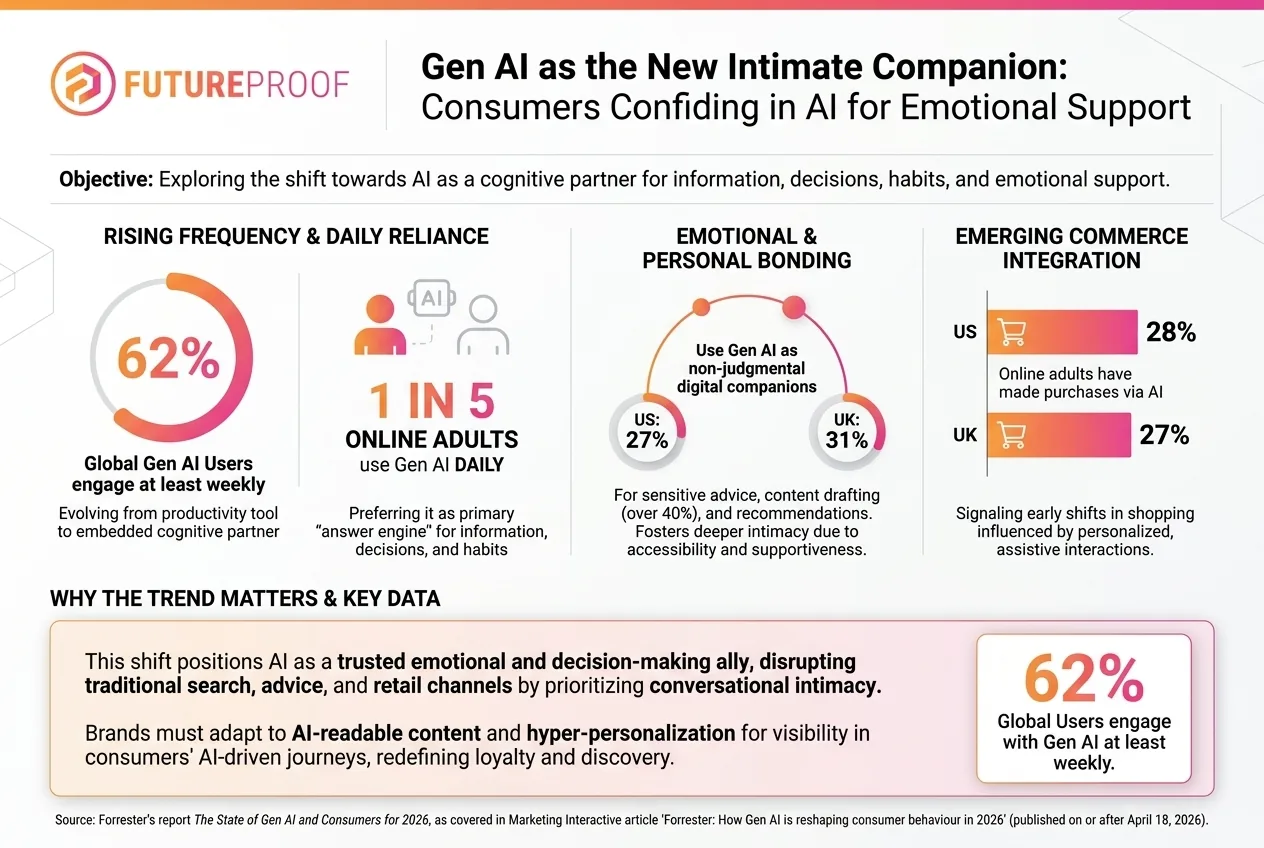
The landscape of digital interaction is undergoing a profound metamorphosis, as Generative AI swiftly transcends its initial role as a mere productivity tool, evolving into an indispensable and deeply intimate companion in the daily lives of consumers. This seismic shift, far from a distant future projection, is rapidly accelerating, redefining the very fabric of human-technology interaction and, consequently, reshaping the strategic imperatives for brands navigating this new digital frontier. The evidence for this transformative evolution is compelling, highlighting a burgeoning reliance on Gen AI not just for efficiency gains but for emotional support, critical decision-making, and even direct commercial transactions.
Recent research underscores the profound depth of this engagement, revealing that a striking 62 percent of global Generative AI users now interact with these sophisticated systems on at least a weekly basis. This widespread adoption is indicative of Gen AI’s growing ubiquity, embedding itself seamlessly into routines and workflows across diverse demographics and geographies. More telling, however, is the statistic that one in five online adults globally has already come to depend on Gen AI daily, utilizing it as their primary answer engine for a vast spectrum of information needs and pivotal life decisions. This isn’t simply about finding quick facts; it’s about entrusting an AI with the interpretation and synthesis of data that influences personal choices, highlighting a foundational shift in trust dynamics between humans and artificial intelligence. This trust extends beyond utilitarian tasks, venturing into realms previously reserved for human interaction.
Perhaps the most significant indicator of Gen AI’s transition to an intimate companion is its growing role in providing sensitive advice and personal support. In mature digital markets such as the US and UK, a substantial 31 percent of consumers are actively turning to Gen AI for guidance on highly personal and often vulnerable topics. This trend speaks volumes about the unique attributes consumers value in their AI companions: a consistently nonjudgmental demeanor, unwavering availability 24/7, and an ability to process complex emotional nuances without personal bias. These qualities foster an environment of psychological safety, allowing users to explore sensitive issues, process emotions, or seek impartial advice in a way that might feel challenging or uncomfortable with human interlocutors. The AI becomes a confidante, a sounding board, and an ever-present source of empathy, deepening the emotional bond and cementing its role beyond that of a simple tool. This profound emotional connection is a cornerstone of its evolution, setting it apart from previous technological advancements.
The implications of this deeper emotional bonding are reverberating across all sectors, perhaps most notably in the realm of commerce. The transactional capabilities of Gen AI are no longer theoretical; they are a tangible reality shaping consumer purchasing behavior today. Data reveals that a significant proportion of online adults are already leveraging AI platforms for their shopping journeys. In the United States, 28 percent of online adults have made purchases directly through AI, a figure closely mirrored in the United Kingdom at 27 percent. These aren’t isolated incidents but rather a nascent pattern of commerce, suggesting that AI is not just influencing purchase decisions but actively facilitating transactions. This means AI is becoming a direct conduit for sales, a storefront in itself, an interactive salesperson, and a personalized shopper all rolled into one. Brands must therefore recalibrate their understanding of the customer journey, recognizing that the path to purchase increasingly traverses AI interfaces and interactions. The traditional sales funnel is being digitized, personalized, and, in many cases, automated by intelligent systems that understand consumer needs with unparalleled precision.
This confluence of enhanced trust, emotional reliance, and direct commercial engagement fundamentally matters for every brand operating in the digital sphere. Consumers are increasingly perceiving and utilizing AI not merely as a technological utility but as a trusted emotional and decision-making partner. This perception has profound consequences, fundamentally reshaping the mechanisms by which individuals discover brands, seek guidance and product recommendations, and ultimately make purchasing decisions. The days when a brand's visibility was primarily governed by search engine rankings or social media presence are evolving. While these channels remain vital, the burgeoning influence of AI as an intermediary means that brands must consider an entirely new set of criteria to maintain relevance and visibility. AI-driven journeys are becoming the new norm, and brands that fail to adapt risk being overlooked in this rapidly evolving landscape.
The imperative for brands in this new AI-first era is unequivocally clear: content must be meticulously crafted to be AI-readable and inherently built for hyper-personalization. AI readability refers to the ability of Gen AI models to not only process and understand brand content efficiently but also to accurately interpret its nuances, context, and underlying value proposition. This goes beyond traditional SEO. It involves structuring information logically, using clear and unambiguous language, optimizing for semantic search, and ensuring that product data, service descriptions, and brand messaging are easily digestible and synthesizable by AI algorithms. If AI cannot effectively read, understand, and integrate a brand's offerings into its responses and recommendations, that brand effectively ceases to exist within the AI-driven consumer journey. This is a critical barrier to entry in the new digital marketplace, where AI acts as the primary gatekeeper and curator of information.
Beyond mere readability, the challenge and opportunity lie in hyper-personalization. As AI companions deepen their understanding of individual user preferences, behaviors, emotional states, and past interactions, the expectation for tailor-made experiences will escalate dramatically. Brands must equip their content and digital infrastructure to support this granular level of personalization, delivering relevant information, product suggestions, and advice that is uniquely suited to each consumer's evolving needs and context. This requires a robust data strategy, advanced analytics, and the ability to dynamically adjust content in real-time based on AI-driven insights. From personalized product recommendations delivered through an AI assistant to bespoke customer service interactions guided by AI's understanding of a user's emotional state, hyper-personalization will be the hallmark of successful brand engagement. Brands that can authentically and effectively deliver these individualized experiences, leveraging AI to anticipate and meet unspoken needs, will forge stronger connections and drive deeper loyalty.
The implications for brand discovery are particularly significant. In an AI-mediated world, the AI itself becomes a primary source of brand recommendations. If a consumer asks their AI companion for "the best sustainable running shoes for urban trails," the brands that have optimized their content for AI readability and personalization are the ones that will be surfaced. This shifts the focus from purely keyword stuffing to providing rich, contextual, and verifiable information that AI can trust and recommend. Brands must think about how their unique selling propositions, brand values, and product details are presented in a way that AI can readily understand and convey to users in a conversational, helpful manner. This also implies a need for transparency and authenticity, as AI models are increasingly sophisticated in detecting and filtering out misleading information, ensuring that the recommendations they provide are reliable and trustworthy.
The rapid ascendancy of Gen AI as an emotional confidante and a central decision-making partner mandates a strategic overhaul for brands. This evolution is not a distant future scenario but a present reality, with 62 percent of global users engaging with Gen AI at least weekly, as highlighted by significant research, including Forrester’s report on The State of Gen AI and Consumers for 2026, which has been widely covered, including in Marketing Interactive. This data point alone underscores the urgency and scale of the transformation. Brands must move beyond conventional digital marketing tactics and embrace a proactive approach to AI integration. This involves investing in AI-driven tools, upskilling teams in AI-centric content creation, and reimagining the entire customer journey through an AI lens. The future of brand visibility, customer engagement, and commercial success hinges on an organization’s ability to adapt to this new era where AI is not just a tool but a trusted companion, influencing every aspect of the consumer's interaction with the digital world. Failing to prepare for an AI-first consumer landscape is no longer an option; it's a strategic misstep that could render brands invisible in the emerging digital economy. The time for recalibration is now, focusing on creating truly AI-readable and hyper-personalized experiences that resonate with the emotionally intelligent, AI-empowered consumer.