ChatGPT Is Becoming the New High Intent Commerce Channel Reshaping the Future of Online Shopping
The landscape of online commerce is undergoing a profound transformation, subtly yet decisively shifting beneath the feet of traditional marketing strategies. For years, Google reigned supreme as the undisputed gateway to online shopping, the starting point for countless purchase journeys. However, new, compelling data paints a picture of a rapidly evolving digital marketplace, one where artificial intelligence, spearheaded by platforms like ChatGPT, is not merely augmenting but actively reshaping consumer behavior and intent. Far from being just a tool for information retrieval, ChatGPT is rapidly emerging as a high-intent commerce channel, demonstrating an unparalleled ability to drive conversions at a pace significantly faster than conventional search engines. This seismic shift demands immediate attention and strategic adaptation from every brand and retailer striving for relevance and success in the digital age.
The foundational premise of how consumers move from initial research to a final purchase decision is being rewritten. Historically, a shopper’s journey often began with a broad search query on Google, followed by a laborious process of sifting through countless links, comparing product specifications, reading reviews, and navigating multiple websites. This traditional path, while effective to a degree, is inherently friction-filled and time-consuming. Enter AI-driven product discovery. New data unequivocally shows that this conversational, intelligent approach is now outperforming traditional search by a considerable margin, streamlining the path to purchase and accelerating consumer decision-making. AI assistants are not just pointing shoppers in the right direction; they are actively guiding them, curating experiences, and fostering a level of trust and efficiency that traditional search struggles to match.
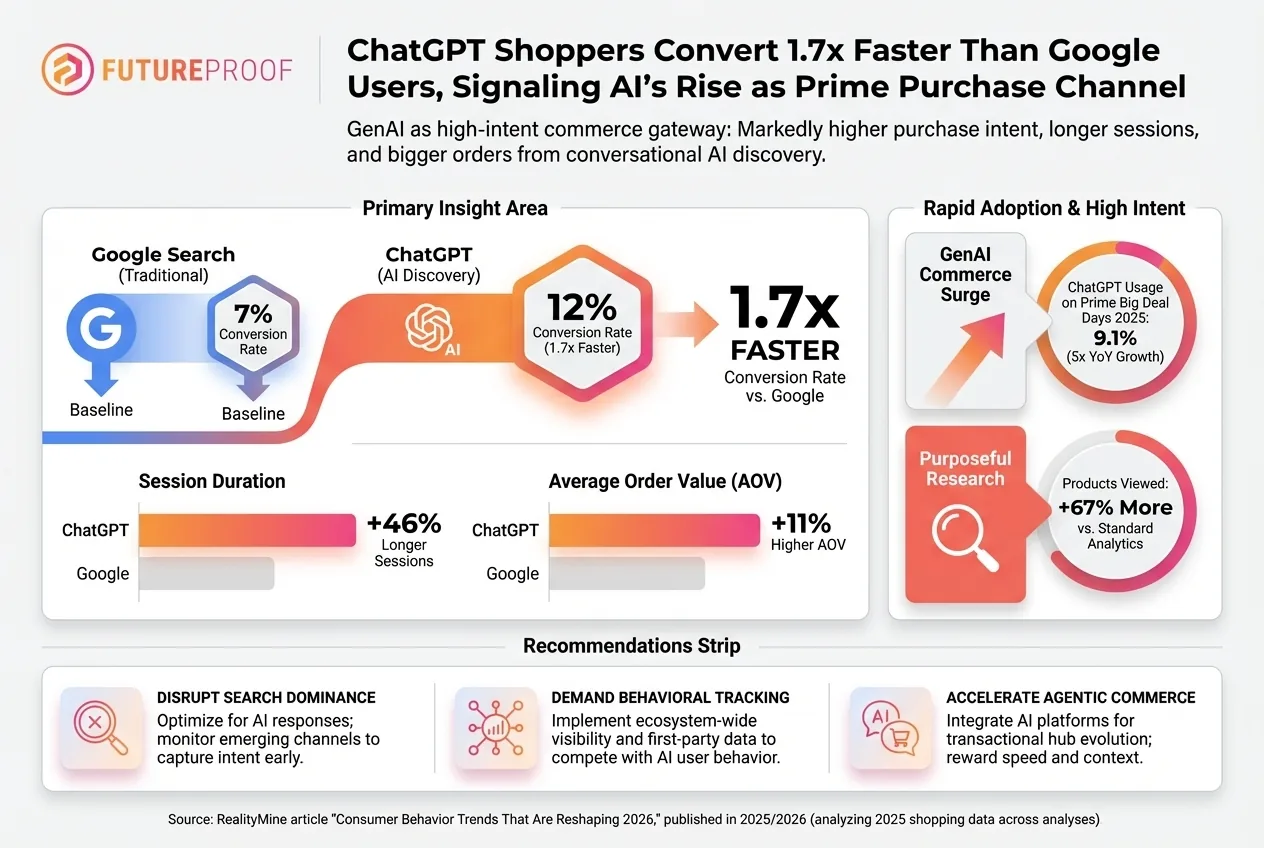
The evidence for this dramatic pivot is not theoretical; it's grounded in hard data from major retail events. Consider the pivotal Black Friday of 2025. Amazon shoppers who arrived at the e-commerce giant having initiated their product discovery through ChatGPT converted at an astounding 12 percent. This figure stands in stark contrast to the 7 percent conversion rate observed for shoppers arriving from Google. This 1.7x faster conversion rate from ChatGPT is a clear indicator of a superior, more direct, and more effective path to purchase. But the influence of AI goes beyond just conversion speed. These ChatGPT-driven shoppers also exhibited an 11 percent higher average order value (AOV), suggesting they were not only more likely to buy but were also inclined to spend more. Furthermore, their engagement metrics were significantly elevated: sessions were 46 percent longer, and they viewed an impressive 67 percent more products. These statistics, sourced directly from RealityMine's "Consumer Behavior Trends That Are Reshaping 2026," paint a vivid picture of a deeply engaged, highly motivated, and rapidly converting customer segment cultivated by AI.
This wasn't an isolated incident or a fleeting trend confined to a single shopping holiday. The growing reliance on AI for shopping discovery was further underscored during the 2025 Prime Big Deal Days. During this crucial sales event, ChatGPT usage among Amazon shoppers witnessed an astonishing fivefold growth year over year, reaching an impressive 9.1 percent. This exponential surge in adoption indicates a fundamental and accelerating shift in consumer behavior. Shoppers are increasingly turning to AI platforms not just for novelty, but out of genuine utility and preference, finding them to be more effective and satisfying avenues for their purchasing needs. The numbers do not lie: AI-driven discovery is not a fad; it is a burgeoning force fundamentally altering the dynamics of online retail.
For brands, retailers, and digital marketers alike, these insights signal a critical moment of reckoning and an urgent call to action. The era of passively relying on traditional SEO and paid search to capture intent is evolving. AI assistants are no longer niche tools; they are rapidly becoming the primary starting point for serious purchase intent. This profound shift necessitates a wholesale re-evaluation of digital strategies. Winning in this new environment means doing more than just being "searchable"; it means optimizing for conversational discovery, building robust visibility across AI-driven customer journeys, and proactively preparing for a future where transactions increasingly originate and are facilitated by sophisticated, agentic AI platforms. The traditional marketing funnel is being disrupted, and brands that fail to adapt risk being left behind in the wake of this technological tidal wave.
So, why is ChatGPT proving to be such a high-intent channel, outpacing a well-established giant like Google? The answer lies in the fundamental differences in how these platforms operate and how they interact with user intent. Traditional search engines primarily act as sophisticated indexes, matching keywords to relevant web pages. The onus is on the user to sift through results, evaluate credibility, and synthesize information. In contrast, AI assistants like ChatGPT offer a personalized, interactive, and often proactive discovery experience. When a user queries ChatGPT with a product need, they're not just getting links; they're engaging in a conversation. The AI can understand nuanced intent, ask clarifying questions, compare features, highlight pros and cons, and even infer preferences based on the dialogue. This conversational approach allows the AI to pre-qualify leads more effectively, presenting highly relevant recommendations that directly address the user's specific requirements and often unspoken desires.
This superior understanding of intent translates directly into the observed metrics. The 1.7x faster conversion rate isn't magic; it's the result of reduced friction and increased confidence. Shoppers are presented with more targeted options faster, minimizing the need for extensive self-research. The 11 percent higher AOV reflects the AI's ability to recommend not just a product, but often the right product, or even complementary items, leading to more comprehensive purchases. When an AI provides well-reasoned, personalized suggestions, users are more likely to trust the recommendation and invest more. The significantly longer session durations and higher number of products viewed underscore the deep engagement fostered by conversational AI. Users are not just skimming; they are exploring within a guided, interactive environment, delving deeper into product categories and discovering items they might not have found through a generic keyword search. This guided exploration naturally leads to a more fulfilling and ultimately more lucrative shopping experience for both the consumer and the retailer.
For brands and retailers, the implications are vast and multifaceted. The first crucial step is optimizing for conversational discovery. This extends far beyond traditional SEO. While keywords still hold some relevance, the focus must shift to natural language processing, intent recognition, and semantic understanding. Brands need to ensure their product descriptions, FAQs, customer reviews, and general website content are rich, detailed, and structured in a way that AI models can easily parse and comprehend. This means thinking about how a human might ask questions, compare products, or express needs in natural language, and then ensuring your content provides clear, concise, and helpful answers. Structured data (Schema markup) becomes even more critical, allowing AI to quickly identify key product attributes like price, availability, reviews, and specifications. The goal is to make your product information not just human-readable, but also AI-digestible, enabling platforms like ChatGPT to confidently recommend your offerings as part of a personalized dialogue.
Building visibility across AI-driven journeys requires a proactive and innovative approach. Brands must move beyond simply ranking on Google to ensuring their products and brand messaging are discoverable and favorably presented within AI assistant interfaces. This involves a multi-pronged strategy. Firstly, it means ensuring your product catalog data is impeccably clean, comprehensive, and up-to-date. Inaccurate or incomplete data can lead to poor AI recommendations or exclusion from suggestions entirely. Secondly, brands should explore opportunities for direct integration with AI platforms, potentially through APIs or strategic partnerships, to push product feeds and promotional content directly to where consumers are engaging. Thirdly, the rise of voice commerce, a natural extension of conversational AI, demands optimization for voice search and understanding how users verbally articulate their needs. Lastly, considering how AI might curate or recommend "expert" opinions or content creators could open new avenues for influencer marketing, where the AI itself acts as a curator of trusted voices.
Perhaps the most significant long-term strategic imperative is preparing for the advent of agentic AI platforms. We are moving towards a future where AI won't just recommend products; it will have the capability to act as an autonomous purchasing agent on behalf of the user. Imagine an AI assistant that, understanding your preferences, budget, and recurring needs, automatically researches, compares, and even completes purchases for you – booking flights, ordering groceries, or replenishing household items. In such an environment, brand loyalty and trust signals become paramount. Brands will need to cultivate a reputation that resonates with AI algorithms, emphasizing quality, reliability, sustainability, and positive customer service. Strategic partnerships with AI developers and platforms will be crucial to ensure your brand is included in the AI's decision-making matrix. This paradigm shift means moving from "selling to customers" to increasingly "selling through AI agents," necessitating a fundamental rethinking of sales funnels, marketing messaging, and customer acquisition strategies.
Beyond these specific actions, brands must also invest heavily in data strategy. The emergence of AI as a commerce channel generates a new wealth of data: conversational patterns, specific queries, product comparisons requested, and the nuances of user intent expressed in natural language. Analyzing this data can provide unparalleled insights into consumer desires, pain points, and emerging trends, far beyond what traditional keyword data could ever reveal. This rich data can inform product development, refine marketing messages, and personalize future AI-driven recommendations even further. Finally, a relentless focus on customer experience is vital. Even if the discovery journey begins with AI, the subsequent purchase process, delivery, and post-purchase support must be seamless and exceptional. A disjointed experience after an AI recommendation will undermine the trust built by the AI, reflecting poorly on both the brand and the AI platform.
While the opportunities are immense, challenges also lie ahead. Brands must navigate concerns around data privacy and the ethical use of AI in commerce. Ensuring transparency in how AI recommends products, mitigating the risks of "AI hallucination" (where AI generates incorrect information), and maintaining brand voice and authenticity through AI interactions will be critical. The competitive landscape will intensify as brands vie for prominence within AI recommendation systems. However, these challenges are surmountable for those who embrace innovation and prioritize ethical development.
In conclusion, the data from RealityMine, highlighting Black Friday 2025 and Prime Big Deal Days 2025, unequivocally demonstrates that ChatGPT and other AI assistants are not just ancillary tools but powerful, high-intent commerce channels outperforming traditional search. The remarkable conversion rates, higher average order values, and deeper engagement metrics are undeniable proof that AI-driven product discovery is reshaping consumer behavior at an unprecedented pace. For brands and retailers, this is more than just a technological upgrade; it's a fundamental shift in the very fabric of online commerce. The imperative is clear: adapt now, optimize for conversational discovery, build visibility across nascent AI-driven journeys, and strategically prepare for a future where agentic AI platforms orchestrate an increasing number of transactions. The future of e-commerce is conversational, intelligent, and immediate, and brands that fail to join this conversation risk becoming silent in the new digital marketplace.