The Rise of the Assistant First Shopper and What It Means for Brands
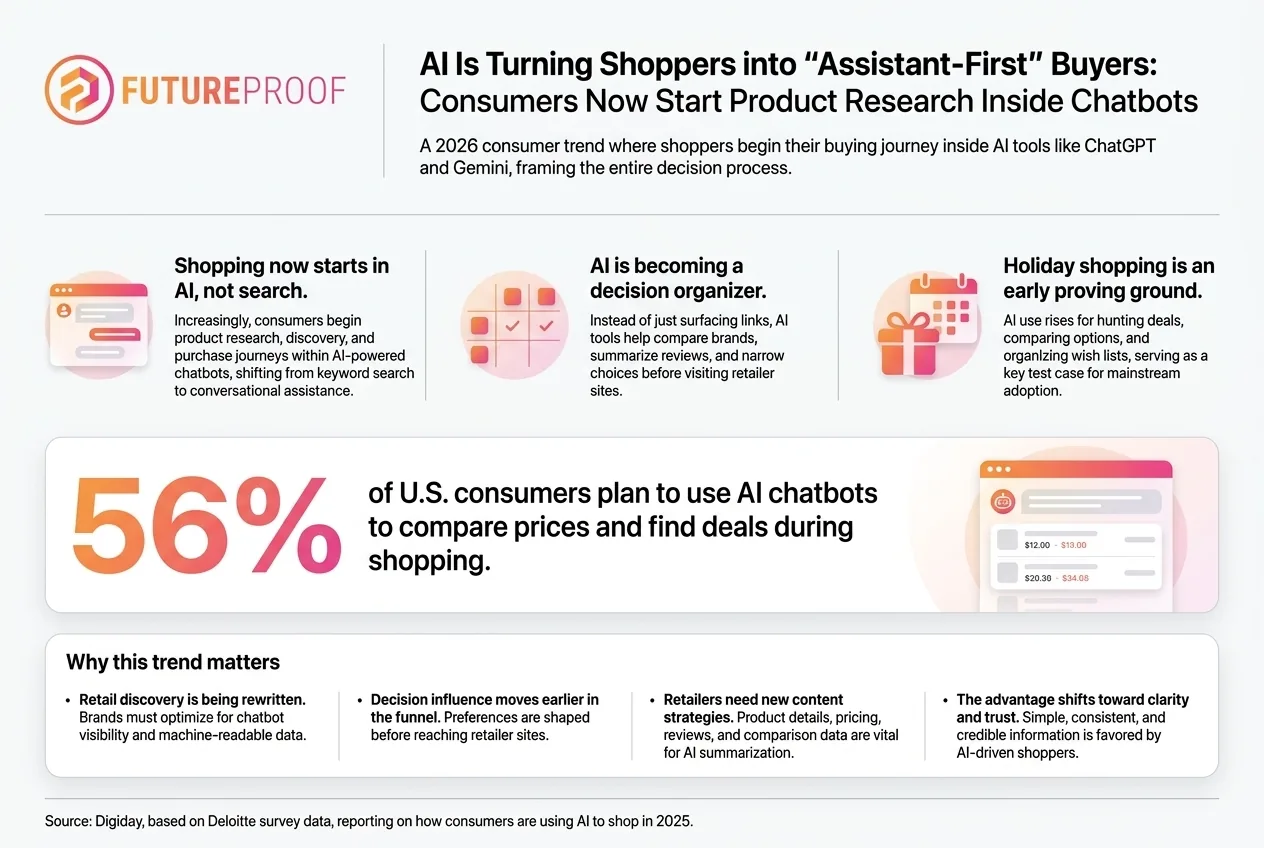
The landscape of retail is undergoing a seismic shift, powered by the ubiquitous rise of artificial intelligence. What was once the domain of keyword searches, endless scrolling, and brand-initiated discovery is rapidly evolving into an "assistant-first" paradigm. Consumers are no longer just using AI; they are delegating fundamental stages of their shopping journey to intelligent tools like ChatGPT, Gemini, and other burgeoning AI assistants. This isn't merely an incremental change; it's a fundamental re-architecture of consumer behavior and, consequently, an urgent call to action for every brand striving for visibility and relevance.
The traditional customer journey, often depicted as a funnel, is being fundamentally reshaped. Where consumers once began their quest for a product by typing specific keywords into a search engine or browsing category pages on e-commerce sites, a growing segment now starts within AI conversational tools. Digiday reports that more people are initiating product research, discovery, and comparison directly within these AI environments. This signals a profound shift from the explicit, often transactional nature of keyword search to the more nuanced, exploratory, and guided experience of conversational AI. Deloitte further underscores this transformation, noting that generative AI has moved beyond mere experimentation to become an everyday decision aid, seamlessly integrated into the fabric of daily life and, increasingly, into the critical act of purchasing.
The New Consumer Behavior: Delegating Decision-Making to AI
At the heart of this revolution is a change in how consumers interact with information and make choices. AI assistants aren't just fetching data; they're synthesizing it, drawing conclusions, and presenting curated options. This moves beyond simple information retrieval to genuine guidance, mimicking the advice one might receive from a trusted friend or an expert consultant.
Consider the depth of interaction: Instead of searching for "running shoes," an assistant-first buyer might prompt an AI with, "I'm training for a marathon, I have flat feet, need something with good cushioning, ideally under $150, and I prefer a sustainable brand. What are my best options?" The AI then sifts through vast amounts of product data, reviews, brand information, and user feedback to present a tailored list, complete with pros, cons, and direct links if available. This is a level of personalization and efficiency that traditional search engines simply cannot match out-of-the-box.
This delegation of early-stage decision-making is particularly evident in high-stakes shopping periods. Holiday shopping, for instance, has emerged as a major proving ground for AI's capabilities in consumer retail. Shoppers are increasingly leveraging these tools to track deals across multiple retailers, organize elaborate gift lists for various recipients, and narrow down an overwhelming array of choices based on intricate criteria. The AI becomes a personal shopping assistant, capable of cross-referencing prices, evaluating product features against specific needs, and even suggesting complementary items. This represents a deeper behavioral change where the shopper offloads the cognitive load of comparison and initial filtering to an AI, trusting it to present optimal choices.
A pivotal data point highlighting this trend comes from a Deloitte survey, reported by Digiday: a staggering 56 percent of U.S. consumers plan to use AI chatbots specifically to compare prices and find deals. This statistic is not merely indicative of a passing fad; it's a clear signal that AI has achieved a level of trust and utility that positions it as an indispensable tool for cost-conscious and efficiency-seeking buyers. This reliance on AI for price comparison and deal hunting fundamentally alters the competitive landscape, making brand visibility and accurate data within AI systems paramount. The AI doesn't just inform; it influences what consumers notice, what they prioritize, and ultimately, what they buy.
Redefining Brand Discovery in the AI Era
For brands, the implications of this shift are profound and necessitate a radical rethinking of their digital strategies. Discovery, once predominantly driven by direct searches and social media algorithms, is being rewritten by the logic of AI.
The Vanishing Brand Homepage & The Summarization Effect: In an assistant-first world, the brand's own website might not be the consumer's first, or even second, point of contact. If an AI assistant can summarize product features, compare options, and present a concise recommendation, the need for a consumer to navigate multiple brand sites diminishes. The AI acts as a powerful aggregator and summarizer, meaning brands must ensure their core value proposition and product details are digestible and highlightable by these systems. This puts an immense premium on clarity and conciseness, as AI will likely pull out key features, not entire marketing narratives.
Optimizing for Chatbot Visibility: Traditional SEO is no longer sufficient. While foundational SEO remains important for organic search, brands now need to optimize for "chatbot visibility." This involves understanding how AI assistants parse information, what data points they prioritize, and how they rank or recommend products in a conversational context. It means moving beyond keywords to embrace natural language processing, semantic understanding, and the ability to answer complex, multi-faceted questions about products. Brands need to think about how their product information would be presented in a concise, authoritative answer, not just a keyword-rich webpage.
The Ascendancy of Structured Product Data: This is arguably the most critical shift for brands. AI systems thrive on structured, unambiguous data. For an AI to accurately summarize, compare, and recommend products, it needs clear, consistent, and meticulously organized information. This includes, but is not limited to:
- Comprehensive Attributes: Every possible attribute – color, size, material, dimensions, weight, features, benefits, sustainability certifications, country of origin – must be detailed and standardized.
- High-Quality Descriptions: Product descriptions need to be informative, benefit-oriented, and free of ambiguity, written in a way that AI can easily interpret key selling points.
- Robust Product Feeds: While product feeds have long been crucial for platforms like Google Shopping and Amazon, their importance explodes in the AI era. These feeds must be immaculate, real-time, and contain all necessary metadata.
- Schema Markup (Schema.org): Implementing rich schema markup directly on websites provides AI assistants with a machine-readable roadmap to product details, prices, availability, reviews, and more. This is essential for AI to correctly understand and contextualize information.
- Image and Video Metadata: AI can analyze visual content, but explicit metadata (alt text, captions, descriptive file names) helps it categorize and understand product visuals more accurately.
Trust, Consistency, and Accuracy are King: AI systems are designed to provide trustworthy and reliable information. Inconsistent product data across different channels (e.g., website showing one price, a third-party retailer another, and an old product feed showing something else entirely) will confuse AI and lead to poor recommendations or, worse, being excluded from consideration. Brands must ensure absolute consistency in their product information across every digital touchpoint. Accuracy is paramount; misinformation or exaggeration will quickly be flagged by AI through user feedback or cross-referencing, damaging brand credibility.
Strategic Imperatives for Brands: Adapting to the Assistant-First Landscape
To thrive in this new environment, brands must proactively adapt their strategies, moving beyond reactive measures to embrace a forward-thinking, AI-centric approach to commerce.
1. Master Your Product Data with Uncompromising Precision: This is the foundational element. Brands must undertake a comprehensive audit of all existing product data. Identify gaps, inconsistencies, and areas for enrichment. Invest in or upgrade a robust Product Information Management (PIM) system that acts as the single source of truth for all product attributes. Standardize naming conventions, units of measure, and descriptive language across the entire product catalog. Ensure that data is not only rich but also readily accessible via APIs for AI systems to consume efficiently. Think of every product detail as a data point that an AI assistant might use to differentiate your offering.
2. Optimize for Conversational AI, Not Just Keywords: Beyond traditional SEO, brands need to develop "AI-ready" content. This means analyzing the types of natural language queries consumers might pose about their products. Create comprehensive FAQs that answer not just basic questions but also more complex, comparative ones ("Is Brand X better than Brand Y for sensitive skin?"). Craft product descriptions that anticipate user questions and provide detailed, benefit-oriented answers. Consider conversational SEO strategies, optimizing for long-tail queries and the semantic relationships between terms. Brands should also explore how their own content can be a training data source for AI models, ensuring their brand voice and product benefits are accurately reflected. This might involve generating internal summaries or specific knowledge graphs for AI consumption.
3. Build Unwavering Trust and Authority in the Digital Ecosystem: AI assistants often factor in user reviews, ratings, and overall brand sentiment when making recommendations. Brands must actively cultivate positive customer experiences that translate into high-quality reviews across various platforms. Transparency about product features, ingredients, ethical practices, and return policies is crucial. A strong, consistent brand presence and positive reputation across social media, review sites, and industry forums will serve as critical signals of authority for AI. Brands should also consider strategies for direct engagement with AI platforms, ensuring their official information is prioritized and accurately presented, potentially exploring verification programs or direct data feeds to major AI models where available and appropriate.
4. Embrace an Omnichannel AI Strategy That Connects Every Dot: AI interactions should not exist in a vacuum. Brands need to integrate AI insights into their broader omnichannel strategy. Information gleaned from AI assistant interactions (e.g., common questions, preferred product attributes) should flow back into CRM systems, informing product development, marketing campaigns, and customer service initiatives. Leverage AI within your own brand experiences, such as on-site chatbots, personalized product recommendations, and AI-driven content generation. The goal is a seamless, intelligent customer journey, whether initiated by an external AI assistant or a direct brand interaction. This means ensuring real-time inventory, pricing, and customer service capabilities are connected to any AI system that might represent your brand.
5. Innovate with AI-Powered Experiences to Enhance Value: Beyond mere optimization, brands should proactively explore innovative ways to leverage AI to enhance the customer experience. This could include developing custom AI tools like virtual try-on features for apparel and cosmetics, AI-powered style guides that recommend outfits based on individual preferences, or advanced recommendation engines that learn from past purchases and browsing behavior. Think about how AI can extend beyond the purchase, offering personalized post-purchase support, usage tips, or reorder reminders. Brands that proactively use AI to add value, rather than just react to its presence, will be best positioned to capture the loyalty of the assistant-first buyer.
The Future of Commerce: Beyond Transactional, Towards Consultative
The assistant-first buyer model signals a profound shift in the nature of commerce itself. It moves away from purely transactional relationships towards a more consultative and relationship-driven engagement. AI acts as a sophisticated filter and advisor, guiding consumers to the most suitable solutions rather than simply presenting a catalog of options. Brands, therefore, need to shift their mindset from simply "selling products" to "providing solutions" and "being the answer" to complex consumer needs.
This new paradigm doesn't diminish the role of human connection but redefines it. With AI handling the heavy lifting of information aggregation and initial comparison, human sales associates or customer service representatives can focus on more complex problem-solving, emotional connection, and truly personalized assistance when the AI reaches its limits.
However, this future also brings ethical considerations to the forefront. Brands must be acutely aware of data privacy, ensuring that consumer information used by AI is handled responsibly. They must also guard against bias in AI recommendations, ensuring fairness and equity in the presentation of products. Transparency about how AI influences recommendations will become increasingly important for maintaining consumer trust.
Conclusion: The Assistant-First Revolution Is Here
The AI revolution in shopping is not a distant future; it is the immediate present. Consumers are increasingly delegating their shopping journey to intelligent assistants, fundamentally altering how products are discovered, evaluated, and purchased. This shift from keyword search to conversational guidance, exemplified by the 56% of U.S. consumers planning to use AI chatbots for deal comparison, demands an urgent and strategic response from brands.
For brands, success in this new era hinges on a willingness to adapt. It means meticulously mastering product data, optimizing for conversational visibility, building an unassailable foundation of trust, implementing an integrated omnichannel AI strategy, and daring to innovate with AI-powered experiences. Those who embrace these imperatives will not only survive but thrive, becoming the trusted advisors in a world where the shopper’s journey begins not with a search bar, but with a conversation. The assistant-first revolution is here, and brands must be ready to converse their way to success.