The Rise of AI Summaries and the Battle for One Screen Brand Visibility
A fundamental transformation is reshaping the digital landscape, altering how individuals seek, discover, and interact with information. We are witnessing a monumental shift from the traditional labyrinth of endless scrolling to a more immediate, distilled experience: the era of one-screen content consumption, spearheaded by artificial intelligence. AI summaries are rapidly evolving from mere gateways to comprehensive destinations, fundamentally redefining the user journey and demanding an urgent re-evaluation of established digital marketing strategies.
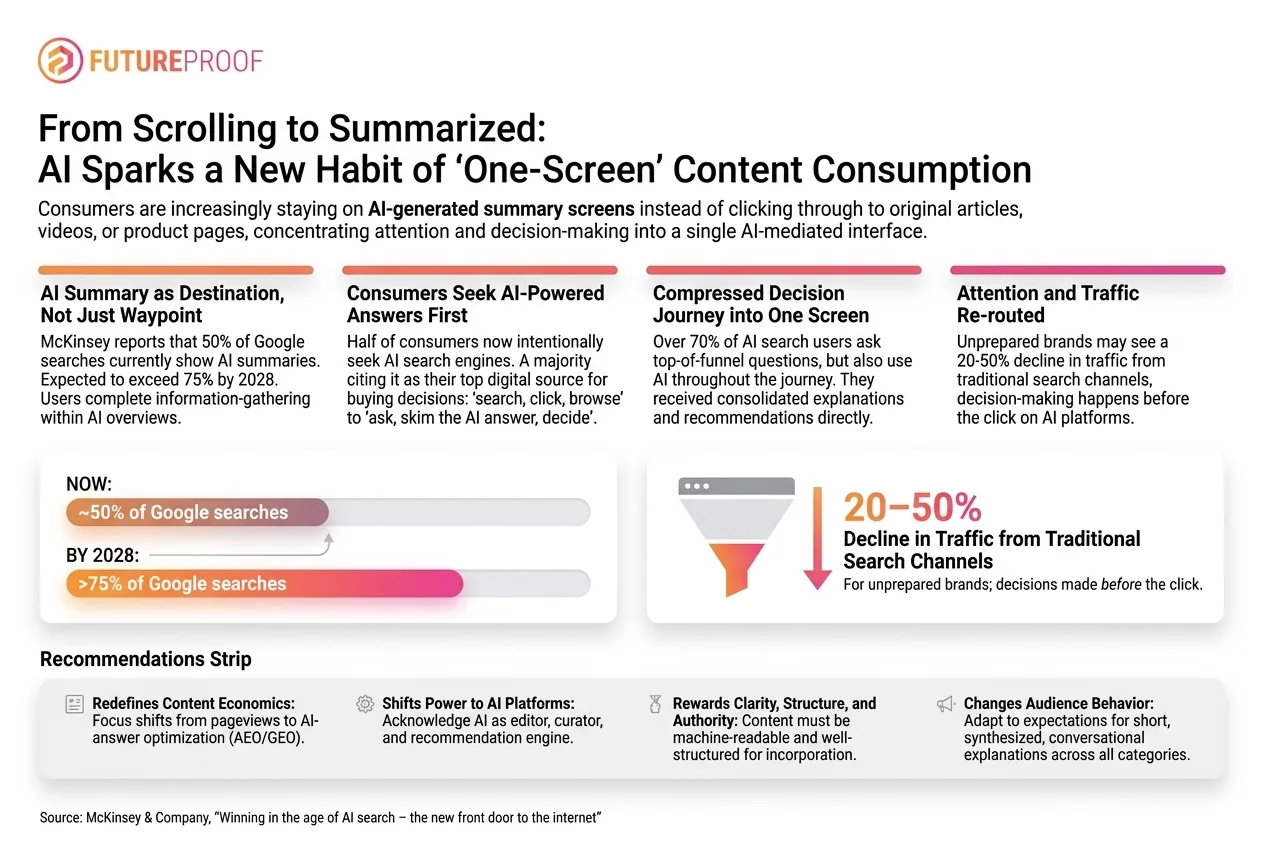
This paradigm shift is not a distant future concept; it is happening now. According to a critical report from McKinsey & Company, approximately 50 percent of Google searches already feature AI summaries. This figure is projected to skyrocket, exceeding 75 percent by the year 2028. As AI-powered overviews become increasingly prevalent and sophisticated, users are demonstrating a clear preference for these concise answers, leading to a significant decrease in click-through rates to articles, product pages, or videos. The implications of this behavioral change are profound and far-reaching, particularly for businesses and content creators who have traditionally relied on organic search traffic for visibility and engagement.
The core challenge for brands is that attention and, critically, decision-making are moving upstream, directly into the AI layer. Consumers are increasingly adopting a "ask, skim the AI answer, and decide" pattern without ever needing to navigate away from the initial search results screen. McKinsey issues a stark warning: brands unprepared for this tectonic shift could experience a dramatic 20 to 50 percent drop in traffic from traditional search channels. This potential decline represents not just a loss of page views but a direct hit to brand discoverability, lead generation, sales funnels, and ultimately, market share. The very essence of how consumers encounter and evaluate products, services, and information is being compressed into a single, highly efficient interaction.
This emergent reality renders classic SEO, in its traditional form, insufficient. The meticulously crafted keywords, optimized meta descriptions, and backlink strategies that once guaranteed visibility are no longer the sole arbiters of success. A new imperative has emerged: AI answer optimization. For brands to remain discoverable and influential, their expertise must not only be present on their websites but must be structured and presented in a way that AI systems can accurately extract, understand, and prominently surface within these crucial summaries. Content must be clear, concise, highly structured, and imbued with indisputable authority, allowing AI to confidently present it as the definitive answer. The consumer journey is accelerating and compacting, and only the brands that adapt swiftly and strategically will continue to be discovered and chosen in this evolving digital ecosystem.
The Genesis of the One-Screen Phenomenon: Why Users Embrace Summaries
Understanding the "why" behind this shift is paramount. Modern life is characterized by information overload and a perpetual demand for speed. Users are constantly bombarded with data, and their attention spans are fragmenting. AI summaries offer a compelling solution to this challenge by providing immediate gratification and reducing cognitive load. Instead of sifting through multiple search results, clicking through articles, and synthesizing information, users receive a pre-digested, often contextualized, answer directly on the search page. This efficiency is a powerful driver of behavior change.
For informational queries, an AI summary can instantly deliver facts, definitions, or step-by-step instructions. For transactional queries, it might summarize product features, compare options, or highlight key benefits, enabling quicker purchase decisions. This convenience aligns perfectly with the fast-paced nature of digital interactions, where every millisecond counts. The perceived value lies in saving time and effort, making the AI overview the preferred starting and often ending point of the information-seeking journey. It's a testament to the ongoing evolution of user expectations: convenience is king, and AI is its most powerful enabler.
The Economic Impact: Unprepared Brands Face a Disappearing Act
The potential 20 to 50 percent decline in traditional search traffic is not merely a statistical anomaly; it represents a significant economic threat to businesses across all sectors. For e-commerce brands, reduced clicks mean fewer product page views, lower conversion rates, and a direct impact on revenue. For content publishers, it signifies a drastic drop in ad impressions, subscriptions, and affiliate income. B2B companies face a dwindling pipeline of organic leads, as potential clients get their initial answers from AI summaries without ever visiting the company's educational resources or service pages.
Consider a consumer researching a specific product, say, a "noise-canceling headphone." In the past, they might click on several review sites, manufacturer pages, and comparison articles. Today, an AI summary could aggregate the top features, pros and cons, price ranges, and even direct buying advice from multiple sources into a single, concise block. If a brand's specific unique selling proposition (USP) or authoritative review is not explicitly captured and surfaced within that summary, it effectively ceases to exist in the user's immediate consideration set. The brand becomes invisible in the crucial "pre-click" decision-making phase. This loss of touchpoints upstream means brands have fewer opportunities to build awareness, demonstrate expertise, and influence purchasing decisions through their owned media.
Beyond Classic SEO: The Rise of AI Answer Optimization (AIO)
The era of merely "ranking high" is evolving. While traditional SEO remains foundational for content visibility to search engines, AI answer optimization (AIO) is about optimizing content for visibility within AI summaries. This requires a nuanced understanding of how AI models extract, synthesize, and present information. AIO is not a replacement for SEO, but rather an essential evolution, building upon existing best practices while adding new layers of strategic consideration.
At its core, AIO demands content that is:
- Direct and Definitive: AI seeks clear, unambiguous answers to specific questions. Your content should anticipate these questions and provide immediate, authoritative responses.
- Highly Structured: AI thrives on structure. Clear headings, subheadings, bullet points, numbered lists, tables, and short, focused paragraphs make it easier for AI to identify and extract key pieces of information.
- Semantically Rich: Beyond exact keyword matching, AIO requires understanding the broader semantic context and related concepts. Using latent semantic indexing (LSI) keywords and a comprehensive vocabulary around a topic helps AI grasp the full meaning and relevance of your content.
- Authoritative and Trustworthy (E-E-A-T): Google's emphasis on Experience, Expertise, Authoritativeness, and Trustworthiness (E-E-A-T) becomes even more critical for AI. AI models are designed to prioritize highly credible sources. Brands must showcase their legitimate expertise, backing claims with data, citations, and clear authorial credentials.
- Concise yet Comprehensive: While summaries are brief, the underlying source content must be thorough enough to genuinely earn the AI's trust and provide a comprehensive answer should the user click through.
Crafting Content for the AI Layer: Strategic Imperatives
To thrive in this new landscape, content strategy must fundamentally shift. Here are key imperatives for optimizing content for AI summaries:
- Anticipate Direct Questions: Research common user questions related to your products, services, or industry. Tools like "People Also Ask" sections in Google search results, keyword research tools, and customer service inquiries can provide valuable insights. Structure your content to directly answer these questions prominently.
- Prioritize Clarity and Brevity in Key Sections: The first sentence of a paragraph, the introduction of a section, or the summary statement of a concept is often what AI will pull. Make these exceptionally clear, concise, and impactful. Avoid jargon where possible, or clearly define it.
- Implement Robust Schema Markup: Structured data (Schema.org) explicitly tells search engines and AI models what your content is about. Use relevant schema types (e.g., FAQPage, HowTo, Product, Review, Article) to highlight key information and make it machine-readable. This is a direct signal to AI about the nature and purpose of your content.
- Leverage FAQs and Q&A Formats: Dedicated FAQ sections, with clear questions and concise answers, are ideal for AI extraction. Each question-and-answer pair is a self-contained unit that AI can easily identify and surface.
- Create Definitive "Answer Blocks": For critical questions, create dedicated paragraphs or sections designed to function as self-contained "answer blocks." These should be able to stand alone and provide a complete answer without requiring further context from the surrounding text.
- Focus on Numerical Data, Lists, and Comparisons: AI loves structured data. If you're comparing products, provide clear tables. If you're listing benefits, use bullet points. Quantifiable information is highly extractable.
- Maintain Content Freshness and Accuracy: AI models are designed to provide the most current and correct information. Regularly review and update your content to ensure it remains accurate, relevant, and reflects the latest developments. Outdated information is unlikely to be prioritized by AI.
- Build Unquestionable Authority (E-E-A-T): This means showcasing the credentials of authors, referencing credible sources, conducting original research, and ensuring your brand is recognized as a leader in your niche. AI algorithms are constantly being refined to identify and prioritize content from highly trustworthy entities.
- Optimize for Voice Search: Many AI summaries are direct precursors to voice assistant answers. Content that is easily digestible and spoken aloud without awkward phrasing will perform better in the context of both AI summaries and voice search.
- Monitor and Adapt: The AI landscape is dynamic. Brands must continuously monitor how their content is being summarized, what questions are being answered, and adapt their strategies based on performance data and evolving AI capabilities. Tools for tracking AI summary appearance and content attribution will become indispensable.
Re-imagining the Customer Journey in a Single Screen World
The traditional multi-touchpoint customer journey is being radically reconfigured. Where does brand discovery happen when the user doesn't click through? It shifts to the AI layer. The challenge now is to ensure that even within a summarized answer, your brand's essence, value proposition, and authority are implicitly or explicitly conveyed.
For example, if an AI summary answers "What are the best CRM systems for small businesses?" and includes a feature comparison, your CRM system needs to have its key differentiators summarized effectively alongside competitors. The goal isn't necessarily a click for every interaction, but rather building brand awareness and trust within the summary itself. The "conversion" might move from a click to an immediate brand impression or consideration.
Brands must think about "pre-click conversions" – where the AI summary itself helps shape a user's perception and decision, even if the user never directly lands on your site. This places immense pressure on the clarity and persuasive power of the content that AI is most likely to extract. While a click might still be desirable for deeper engagement, the initial decision-making bias is now heavily influenced by the AI's distillation. Strong, persuasive, and unique value propositions need to be front-and-center, not buried deep within an article.
Future Implications and Proactive Strategies
The trajectory towards AI-driven content consumption is irreversible. As AI models become more sophisticated, they will not only summarize but also generate content, engage in multi-turn conversations, and personalize answers based on individual user history and preferences. Brands must proactively consider:
- Proprietary Data and Knowledge Graphs: Investing in building comprehensive internal knowledge graphs and proprietary datasets can give brands a unique advantage, allowing AI to draw directly from their authoritative information.
- Multimodal AI: As AI evolves beyond text to incorporate images, video, and audio, content strategies must broaden to optimize these formats for AI understanding and summarization. How will AI summarize a video tutorial or extract key information from an infographic?
- Brand Voice and Tone in Summaries: While AI aims for neutrality, there will be increasing pressure to ensure that summarized content retains elements of a brand's unique voice and messaging, even if indirectly. This involves consistently clear and distinct brand messaging across all content.
- Ethical Considerations and Bias: Brands must be aware of the ethical implications of AI summaries, including potential biases in data selection or presentation. Ensuring content is fair, accurate, and inclusive is paramount to maintaining trust.
- Investing in AI Expertise: Digital marketing teams will need to incorporate AI specialists who understand the mechanics of large language models (LLMs) and how to optimize content for them. This includes a blend of technical SEO, content strategy, and data science.
- Experimentation and Agility: The AI landscape is rapidly changing. Brands must adopt a mindset of continuous experimentation, testing different content structures, schema implementations, and summarization techniques to identify what resonates best with AI models and users.
Conclusion
The shift from scrolling to summarized content consumption, driven by the omnipresence of AI summaries, marks a pivotal moment in the digital age. The McKinsey report's projections are not merely statistics; they are a siren call for immediate strategic action. With 50 percent of Google searches already featuring AI summaries, and this figure set to exceed 75 percent by 2028, the imperative for brands to adapt is undeniable. The risk of a 20 to 50 percent decline in traditional traffic is a stark reminder that complacency is no longer an option.
The brands that will thrive are those that swiftly move beyond traditional SEO to embrace AI answer optimization. This involves a profound rethinking of content creation, focusing on clarity, structure, authority, and directness, ensuring that their expertise is not just discoverable on a webpage, but prominently surfaced within the critical AI summary layer. The consumer journey is now largely compressed into a single screen, and attention and decision-making have moved upstream. Those who master the art of concise, authoritative, and AI-optimized content will continue to capture attention, influence decisions, and ultimately, remain discoverable and relevant in this exhilarating, yet challenging, new era of digital engagement. The future of brand visibility is now deeply intertwined with the intelligence of AI, and proactive adaptation is the only path to sustained success.