Consumers Embrace AI for Research but Refuse to Surrender Decision Making
The landscape of consumer behavior is undergoing a profound transformation, subtly yet significantly reshaped by the burgeoning influence of Artificial Intelligence. Far from a distant futuristic concept, AI has woven itself into the fabric of daily life, particularly within the realm of online research and information gathering. However, as AI's capabilities expand, a critical distinction is emerging in how consumers choose to engage with it, especially concerning their purchasing decisions. The prevailing sentiment is clear: consumers are enthusiastically embracing AI as a powerful research partner, a highly efficient assistant in their quest for information, but they are firmly drawing the line at surrendering their ultimate decision-making autonomy.
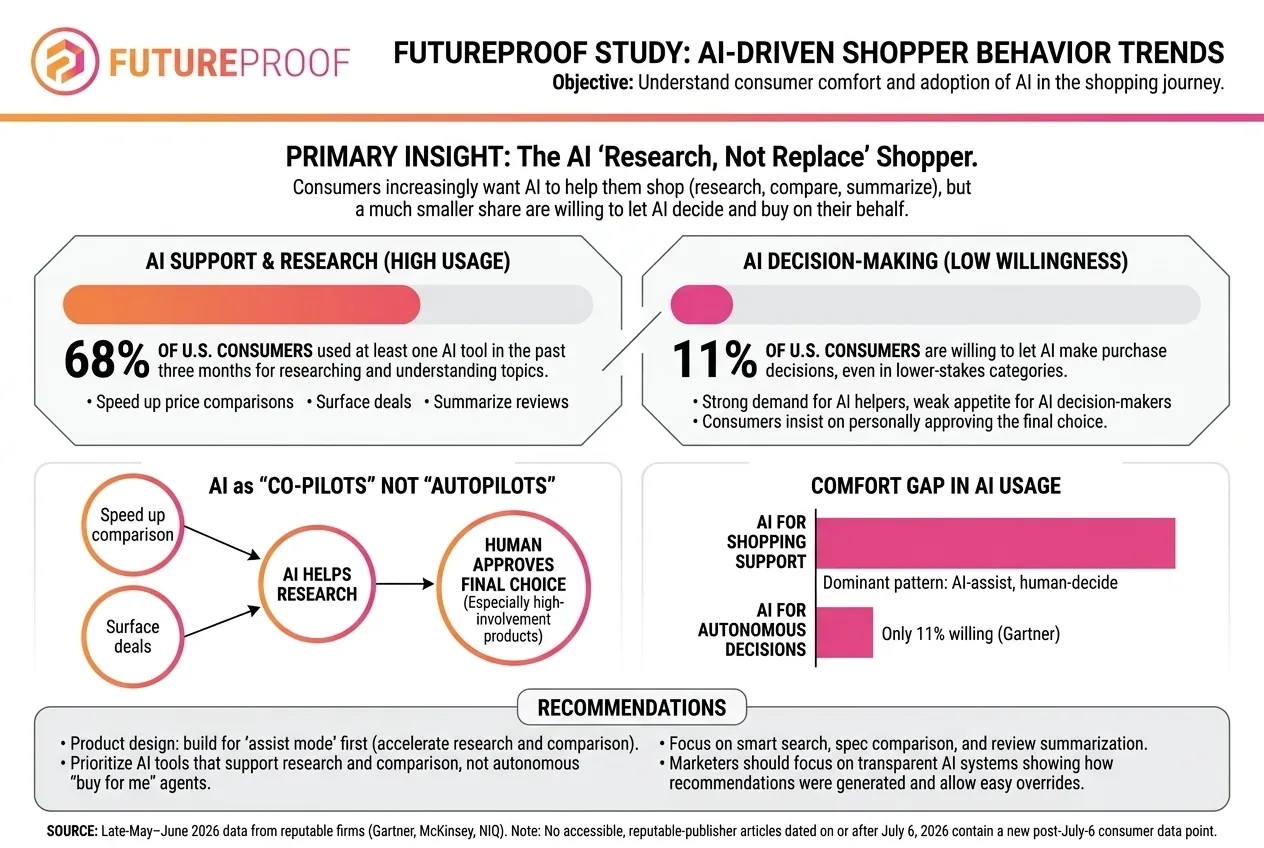
This nuanced relationship is illuminated by recent data from leading research firms. Gartner's May 2026 findings reveal a striking statistic: only a mere 11 percent of U.S. consumers express a willingness to allow AI to make purchase decisions for them. This reluctance extends even to seemingly low-stakes categories such as personal care products and household supplies, items one might expect consumers to delegate with less hesitation. This figure underscores a deep-seated human need for control, even when faced with the potential convenience and efficiency AI offers. The act of choosing, of making a personal selection, remains a core tenet of the consumer experience, imbued with personal preference, brand loyalty, and the satisfaction of informed agency.
Simultaneously, a contrasting but complementary trend is highlighted by McKinsey ConsumerWise in June 2026. Their research indicates that a substantial 68 percent of U.S. consumers have utilized at least one AI tool within the past three months. Among the most prevalent shopping-related applications are research and understanding. This widespread adoption points to AI's undeniable utility in streamlining the initial stages of the buying journey. Consumers are actively leveraging AI to sift through vast amounts of data, compare options, and synthesize complex information, tasks that were once time-consuming and often overwhelming.
The takeaway from these converging insights is unequivocal: shoppers want AI to accelerate discovery, compare options with granular detail, and summarize intricate information into digestible formats. They desire AI to augment their intelligence, to provide insights and clarity, but they emphatically wish to retain final control over their choices. For brands, this presents not a challenge, but a significant opportunity. The path to success in this evolving digital ecosystem lies in building AI solutions that assist and empower, rather than replace, the human decision in the buying journey. Understanding this critical distinction is paramount for brands looking to forge stronger connections and drive conversions in the age of AI-powered commerce.
The Human Element: Why Consumers Hold the Reins on Decision-Making
The Gartner data, showcasing only 11% willingness for AI-driven purchase decisions, even in low-stakes categories, speaks volumes about the enduring human desire for agency. Why are consumers so hesitant to cede control, even to an intelligent system designed for efficiency? The reasons are multifaceted and deeply rooted in human psychology.
Firstly, trust is a monumental barrier. Despite the widespread use of AI for research, there's a significant leap from trusting a tool to provide information to trusting it to make a choice that directly impacts one's life or wallet. Consumers often harbor concerns about AI bias, questioning whether the algorithms are truly impartial or if they're subtly influenced by external factors, brand partnerships, or even historical data that doesn't reflect their current preferences. The "black box" nature of many AI systems, where the decision-making process isn't transparent, further erodes confidence. Without understanding why an AI recommends a particular product, consumers are naturally wary of accepting its decree.
Secondly, purchasing decisions, regardless of how mundane they might seem from an objective standpoint, often carry a subjective, emotional weight. A shampoo isn't just a cleaning agent; it's about fragrance preference, hair type compatibility, ethical sourcing, or a specific brand experience. A household cleaner might be chosen based on environmental concerns, sensitivity to certain chemicals, or a long-standing family habit. These personal, often subtle, factors are incredibly difficult for current AI models to fully grasp or prioritize in a way that truly resonates with an individual. Consumers believe that they know their own preferences, values, and contextual needs better than any algorithm ever could. The process of selection itself, the act of exercising one's taste and judgment, is a gratifying part of the consumer experience.
Moreover, the fear of buyer's remorse is a powerful deterrent. If an AI makes a poor decision, who is accountable? The user feels less ownership over the outcome, and the potential for dissatisfaction is amplified if they didn't actively participate in the choice. Retaining control means retaining responsibility, but also the satisfaction of a well-made, informed choice. This human need for autonomy ensures that while AI can be an invaluable guide, the ultimate steer of the shopping cart remains firmly in human hands. Brands that acknowledge and respect this fundamental aspect of consumer psychology will be better positioned to integrate AI effectively.
The AI-Powered Shopper: Accelerating Discovery and Understanding
While consumers may be hesitant to hand over the decision-making keys to AI, their enthusiastic adoption of AI tools for research paints a vivid picture of its transformative potential in the early stages of the buying journey. The McKinsey report's finding – that 68% of U.S. consumers have used AI in the last three months, predominantly for research and understanding – highlights a paradigm shift in how information is accessed and processed.
Today's consumers are drowning in data. The internet offers an overwhelming deluge of product listings, reviews, specifications, articles, and comparisons. Navigating this sea of information to find exactly what’s needed can be an arduous, time-consuming task. This is precisely where AI shines as an indispensable research partner.
Consider the role of AI in product discovery. Instead of laboriously sifting through hundreds of products on an e-commerce site, a consumer might ask an AI chatbot, "What are the best noise-canceling headphones for long-haul flights with excellent battery life and a budget under $300?" The AI can instantly cross-reference product databases, reviews, and specifications to generate a concise list of relevant options, complete with key features and price points. This accelerates the discovery phase exponentially, presenting tailored results that would take hours of manual searching.
Comparison of options is another prime area where AI excels. Once a consumer has a few potential products in mind, AI tools can quickly summarize the pros and cons of each, highlight differentiating features, and even compare prices across various retailers. Imagine asking an AI, "Compare the XYZ Smartwatch with the ABC Fitness Tracker, focusing on health monitoring features and battery life." The AI can instantly synthesize review data and product specs, providing a side-by-side analysis that would traditionally require meticulous manual research. This capability empowers consumers to make truly informed comparisons, unearthing subtle differences that might otherwise be overlooked.
Perhaps one of AI's most valuable contributions is information summarization. The sheer volume of user reviews for a popular product can be overwhelming, running into thousands. An AI can parse through these reviews, identify recurring themes, extract common complaints and praises, and present a succinct summary of consumer sentiment. This means shoppers can quickly grasp the overall consensus on a product's durability, ease of use, or customer support without reading every single comment. Similarly, AI can distill complex product manuals or technical specifications into simple, understandable language, making intricate products more accessible to the average user.
Beyond these core uses, AI is also being employed for idea generation ("What eco-friendly kitchen gadgets are trending?"), troubleshooting ("Why is my new coffee machine making a strange noise?"), and even learning about new concepts ("Explain what 'biohacking' means in the context of wellness products"). These applications demonstrate AI's power to not only find information but also to help consumers understand it and apply it to their specific needs. For brands, recognizing and facilitating these AI-powered research behaviors is crucial. It’s about being present, transparent, and helpful in the spaces where consumers are already turning for intelligent assistance.
Bridging the Gap: The "Assist, Don't Replace" Imperative for Brands
The clear message from consumers—they want AI as a powerful research partner, not an autonomous decision-maker—presents a monumental opportunity for brands. The biggest win for businesses lies in developing and deploying AI solutions that gracefully assist the human decision-making process, rather than attempting to usurp it. This means integrating AI in ways that empower, inform, and streamline, always ensuring the customer retains ultimate control and agency.
One of the most immediate and impactful applications is hyper-personalized recommendations with human override. Instead of AI simply dictating "Buy this," brands can leverage AI to suggest products or services based on browsing history, past purchases, and expressed preferences, but present these as intelligent suggestions. For example, a fashion retailer's AI might propose outfit combinations or complementary accessories, explaining why these items were chosen based on the user's style profile, allowing the customer to accept, modify, or reject any part of the recommendation. This keeps the customer in the driver’s seat, using AI to spark ideas and simplify choice, not to enforce it.
Enhanced customer service through intelligent chatbots and virtual assistants is another critical area. While AI can't replace the empathy of a human, it can dramatically improve the efficiency of initial interactions. AI-powered chatbots can handle FAQs, provide instant order status updates, guide users through product assembly, or troubleshoot common issues. When a query becomes too complex or emotionally charged, the AI should seamlessly escalate to a human agent, providing all the prior interaction context. This means faster resolutions for customers and freeing human agents to focus on more intricate, high-value interactions.
For products with multiple configurations, intelligent product configurators offer immense value. Think of custom-built computers, modular furniture, or personalized beauty products. An AI can guide users through the decision process, suggesting optimal components based on stated needs (e.g., "for gaming" or "for home office"), flagging incompatibilities, and visualizing the final product. However, at every step, the user makes the selection, approves the component, and retains the ability to backtrack and experiment with different options. The AI acts as an expert consultant, not an automated order-taker.
Brands can also utilize AI for dynamic, personalized content generation. Imagine AI crafting product descriptions that highlight specific features a user has previously shown interest in, or generating marketing copy that speaks directly to a user’s expressed pain points. An AI might summarize a product's sustainability features for an eco-conscious shopper, or its durability for someone who frequently mentions longevity in their search queries. This makes content more relevant and engaging, enhancing the research phase by delivering exactly what the consumer wants to know, tailored to their individual context.
Furthermore, AI can transform interactive guides and tutorials. For complex products, AI can serve as a dynamic learning companion, answering specific questions about features, usage, or maintenance in real-time. This moves beyond static manuals to a personalized, adaptive learning experience that empowers users to fully understand and utilize their purchases.
Finally, leveraging AI for sentiment analysis of customer reviews and feedback can provide brands with invaluable insights to refine their products and services. By summarizing themes from vast amounts of unstructured data, AI helps brands understand what customers love, what frustrates them, and what improvements are most desired. This closed-loop feedback mechanism ensures that products evolve in line with true consumer needs, building trust and loyalty.
In essence, the "assist, don't replace" mantra necessitates a design philosophy rooted in transparency, control, and utility. Brands must clearly communicate when AI is at play, give users easy ways to override or refine AI suggestions, and ensure that AI tools genuinely simplify and enrich the customer journey. This collaborative approach – human decision-making augmented by AI intelligence – is not just a strategic advantage; it is rapidly becoming an expectation for the modern consumer.
Strategies for Brands: Building Trust and Utility in the AI Era
For brands seeking to navigate this evolving consumer-AI landscape successfully, developing a robust strategy that prioritizes utility and trust is paramount. It’s not enough to simply deploy AI; the integration must be thoughtful, ethical, and demonstrably beneficial to the customer.
1. Focus on Solving Real Consumer Pain Points: Before implementing any AI tool, brands must identify specific friction points in the customer journey that AI can genuinely alleviate. Is it the overwhelming amount of information available? The difficulty in comparing complex products? The frustration of slow customer service? By targeting these precise challenges, brands ensure their AI solutions offer tangible value. For example, an AI tool that summarizes the pros and cons of competing products based on verified reviews directly addresses information overload and comparison difficulties.
2. Transparency and Explainability Are Non-Negotiable: Consumers are more likely to trust AI if they understand how it works and what its limitations are. Brands should be transparent about when an AI is powering an interaction ("You're chatting with our AI assistant!") and, where possible, explain the rationale behind AI-generated recommendations ("Based on your previous purchases and viewing history, we thought you'd like..."). Providing an "explain your recommendation" feature can build immense trust, allowing users to peek behind the curtain. This demystifies AI and empowers users to evaluate its suggestions critically.
3. Empower, Don't Dictate: The core principle of "assist, don't replace" must be embedded in the design of every AI interaction. This means giving users agency. If an AI provides a recommendation, ensure there are clear options to "refine," "see alternatives," or "tell us why this isn't right." An AI-powered product configurator should allow users to easily undo choices and experiment with different combinations. The interface should feel like a co-pilot, not an autopilot. This fosters a sense of collaboration rather than imposition, enhancing user satisfaction and perceived control.
4. Seamless Integration of Human Touchpoints: While AI can handle many routine tasks, there will always be scenarios where human empathy, nuanced understanding, or complex problem-solving are indispensable. Brands must design AI systems with clear, accessible pathways for escalation to human support. This means making it easy to "speak to a representative" during a chatbot interaction, or providing clear contact information for more complex inquiries. A well-designed AI system anticipates these needs, ensuring a smooth transition rather than a frustrating dead end.
5. Gather Feedback and Iterate Continuously: AI is not a set-it-and-forget-it technology. Consumer preferences and expectations evolve, and AI models need to evolve with them. Brands must establish robust feedback mechanisms to understand how customers are interacting with AI tools, what they find helpful, and where improvements are needed. A/B testing different AI responses or recommendation algorithms can provide valuable insights. Continuous learning and refinement based on real-world usage are vital for maintaining relevance and effectiveness. This iterative approach ensures that AI remains a true asset to the customer journey.
6. Prioritize Data Privacy and Security: With increased AI interaction comes increased data collection. Brands must be scrupulous about data privacy and security. Clearly communicate how customer data is being used to power AI experiences, ensure compliance with all relevant regulations (like GDPR and CCPA), and provide users with control over their data. Breaches of trust in this area can severely undermine the benefits of any AI innovation.
By adopting these strategies, brands can move beyond simply implementing AI technology to building intelligent, customer-centric experiences. This approach not only respects consumer autonomy but also leverages AI’s incredible power to enhance the journey from discovery to confident purchase, ultimately driving loyalty and long-term success.
The Future of Shopping: A Harmonious Human-AI Partnership
The insights from Gartner and McKinsey paint a compelling picture of the future of shopping: one where AI is not a replacement for human intelligence, but a powerful extension of it. The consumer landscape is evolving towards a harmonious partnership between humans and artificial intelligence, where each plays to its strengths. Humans bring intuition, emotion, personal values, and the ultimate power of decision-making. AI brings unparalleled speed, data processing capabilities, comprehensive memory, and the ability to cut through noise.
Winning brands in this new era will be those that master this delicate balance. They will understand that their role is not to simply push products, but to empower their customers to make the best, most informed choices possible. This means deploying AI tools that feel less like a sales pitch and more like a highly knowledgeable, unbiased personal assistant.
We can anticipate the development of even more sophisticated AI tools that seamlessly integrate into every facet of the research phase. Imagine AI-powered virtual stylists that not only suggest clothes but explain fabric properties, ethical sourcing details, and care instructions based on a user's stated values. Or AI financial advisors that summarize complex investment options, highlighting risks and benefits, while leaving the final portfolio construction to the individual. The possibilities are vast, but the underlying principle remains constant: AI will serve as an enhancer, a clarifier, and a simplifier, always with the human at the center of the decision loop.
The competitive advantage for brands will no longer solely rest on product quality or pricing, but increasingly on the sophistication and trustworthiness of their AI-powered assistance. Brands that foster environments where AI empowers discovery, clarifies options, and summarizes information, all while explicitly respecting and upholding human decision-making, will be the ones that build enduring customer loyalty and capture the future of commerce. Embracing AI as a partner to your customers, rather than a replacement for their judgment, is not just a strategy; it's the foundation for sustainable success in the intelligent age of retail.