AI Shopping Tools Become the New Trusted Guide for Modern Consumers
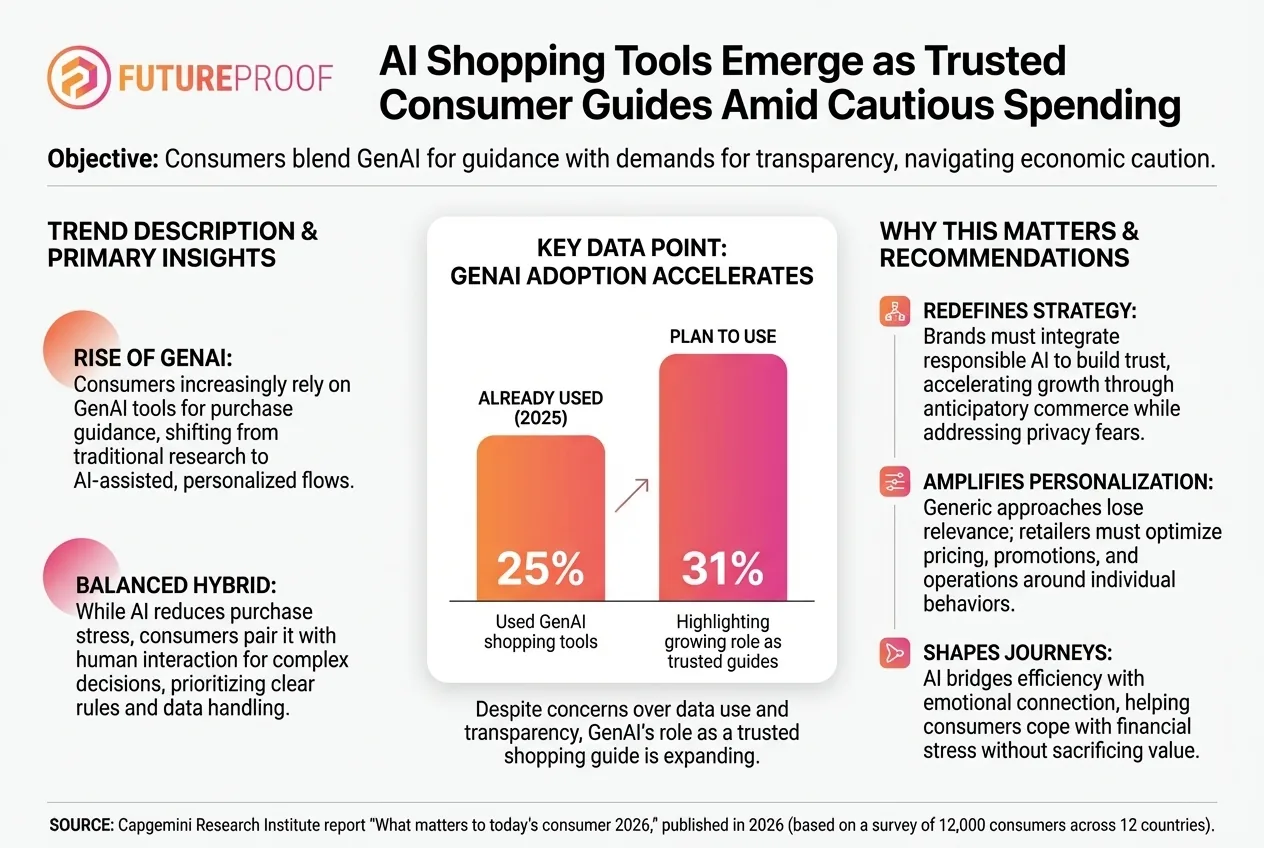
The landscape of consumer commerce is undergoing a profound transformation, driven by an confluence of economic pressures, evolving expectations, and technological innovation. In an era where every purchasing decision is weighed with greater care, consumers are actively seeking clarity, fairness, and control over their spending. Amidst this backdrop, Artificial Intelligence (AI) shopping tools are rapidly emerging as indispensable, trusted guides, shifting from intriguing novelties to an anticipated, even expected, component of the modern buying journey. New research from the Capgemini Research Institute underscores this seismic shift, revealing that a significant 25 percent of consumers have already leveraged Generative AI (GenAI) tools to inform their purchase decisions. Even more striking, an additional 31 percent are poised to adopt these sophisticated aids, signaling a critical inflection point for retailers worldwide. This data point alone – 25 percent current adoption and 31 percent planned adoption – should serve as a wake-up call, highlighting a consumer base increasingly reliant on intelligent assistance to navigate the complexities of the marketplace.
The rapid ascendancy of AI in the shopping sphere is not merely a technological fad; it is a direct response to fundamental consumer needs. Faced with an overwhelming abundance of choices, a torrent of product information, and the constant pressure of budgetary constraints, shoppers are looking for tools that can cut through the noise. AI, particularly GenAI, offers precisely this – the ability to process vast quantities of data, summarize reviews, compare specifications, personalize recommendations, and even simulate experiences, all at a speed and scale impossible for human cognition alone. Consumers are turning to these tools not just for convenience, but for perceived objectivity and empowerment. They seek a guide that is untainted by brand loyalty, unswayed by emotional appeals, and singularly focused on delivering the best possible outcome for their specific needs. This desire for an unbiased, efficient, and highly personalized shopping assistant is the primary catalyst behind the impressive adoption rates observed by Capgemini.
For retailers, this evolving dynamic presents both an immense opportunity and a pressing imperative. The days of simply having an online presence or a basic recommendation engine are swiftly fading. To remain competitive and relevant, businesses must now integrate responsible AI into every facet of the customer experience. This integration is not just about adopting new technologies; it’s about strategically re-envisioning the entire customer journey through an AI lens, balancing the inherent efficiencies of automation with the irreplaceable warmth and problem-solving capacity of human support, particularly for complex or emotionally charged purchasing decisions. The pressure to deliver hyper-personalization, tailored to individual preferences while meticulously respecting data boundaries, will only intensify as consumers grow accustomed to the precise, context-aware guidance offered by AI.
The "trusted guide" paradigm shift is rooted in several key dimensions that AI tools adeptly address. Firstly, Clarity: In an age of information overload, AI can distill complex product specifications, condense hundreds of customer reviews into key pros and cons, and present side-by-side comparisons with unparalleled conciseness. This enables consumers to grasp essential details quickly, making informed choices without feeling overwhelmed. Secondly, Fairness: While no AI is perfectly unbiased, the perception is that AI-driven recommendations are less influenced by aggressive marketing tactics or commission structures. Shoppers trust that an AI suggesting a product is doing so based on analytical matching of needs and features, rather than a hidden agenda. This perception of impartiality fosters a deeper sense of trust. Thirdly, Control: AI tools empower consumers by putting more decision-making power in their hands. They can refine searches with unprecedented granularity, simulate different scenarios (e.g., "What if I bought this specific model vs. that one on my budget?"), and receive immediate, actionable insights, giving them a greater sense of agency over their spending. These three pillars – clarity, fairness, and control – are precisely what today's careful consumer is looking for, and AI is proving remarkably adept at delivering them.
The Capgemini study’s finding that 25% of consumers already use GenAI tools for purchases and 31% plan to adopt them further validates the shift from "AI as a cool feature" to "AI as an expected utility." This isn't just about early adopters; it signals a mainstream movement. Retailers who fail to recognize this fundamental change in consumer behavior risk being left behind. The modern shopper expects their digital interactions to be intelligent, intuitive, and personally relevant. Generic experiences, irrelevant promotions, or cumbersome search processes will no longer suffice. Instead, AI must be employed to create seamless, proactive, and predictive interactions that anticipate needs and provide solutions before the customer even articulates them. From virtual try-ons for apparel to AI-powered configurators for custom products, and from intelligent chatbots offering instant support to predictive inventory management ensuring availability, AI’s footprint is expanding across the entire retail value chain.
Implementing AI, however, is not a simple plug-and-play operation. It demands a thoughtful, strategic approach centered on Responsible AI. What does responsible AI mean in the context of retail? It means:
- Transparency: Clearly communicating to consumers when they are interacting with AI, how their data is being used (with consent), and the logic behind recommendations.
- Fairness and Bias Mitigation: Actively working to prevent AI algorithms from perpetuating or amplifying existing societal biases related to race, gender, socioeconomic status, or other protected characteristics in recommendations, pricing, or product availability. Regular auditing of algorithms is crucial.
- Accountability: Establishing clear mechanisms for human oversight and intervention. When AI makes an error or a customer is dissatisfied with an AI-driven outcome, there must be a straightforward path to human support and redress.
- Data Privacy and Security: Adhering to the highest standards of data protection, complying with regulations like GDPR and CCPA, and empowering consumers with robust controls over their personal information. This builds trust, which is paramount in the AI-driven relationship.
- Ethical Design: Avoiding "dark patterns" or manipulative AI designs that subtly nudge consumers toward undesirable outcomes or exploit vulnerabilities. AI should empower, not trick.
The challenge of balancing automation with human support is particularly critical. While AI excels at processing data, identifying patterns, and executing repetitive tasks, human interaction remains irreplaceable for complex problem-solving, empathetic engagement, and fostering genuine customer loyalty. AI can power an initial product search, summarize options, and answer frequently asked questions. However, when a customer is making a high-value purchase, facing a unique problem, or simply needs reassurance and personalized advice that transcends algorithms, the human touch becomes invaluable. Retailers should envision AI not as a replacement for human staff, but as a powerful augmentation tool. AI can free up human employees from mundane tasks, allowing them to focus on high-touch interactions, relationship building, and solving the truly intricate challenges that require creativity and empathy. A hybrid model, where AI handles the routine and humans manage the unique and emotional, will likely define the most successful retail strategies. For instance, AI-powered chatbots can resolve 80% of customer queries instantly, directing the remaining 20% – the complex, nuanced, or emotionally charged ones – to human agents who are then better equipped and less fatigued to handle them effectively.
Furthermore, the surge in AI adoption is inexorably linked to heightened personalization pressures. Consumers, armed with AI tools that offer hyper-tailored experiences, will increasingly expect the same level of bespoke interaction from the retailers themselves. Generic marketing campaigns, one-size-fits-all product displays, and irrelevant suggestions will feel increasingly archaic and alienating. AI enables retailers to analyze individual browsing histories, purchase patterns, demographic data, and even real-time contextual information (like weather or current events) to deliver truly individualized recommendations, promotions, and content. This could range from dynamic pricing tailored to individual willingness to pay, to highly curated product discovery feeds, to personalized website layouts that adapt based on past behavior. The goal is to make every customer feel understood and uniquely catered to, enhancing engagement and conversion rates.
However, this elevated personalization must be navigated with extreme care around data boundaries. The paradox is clear: consumers crave personalization but are increasingly wary of how their personal data is collected, stored, and utilized. Trust is the ultimate currency in this new era. Retailers must earn and maintain this trust by being unequivocally transparent about their data practices, obtaining explicit consent, and providing consumers with granular control over their data preferences. Implementing privacy-enhancing technologies, such as federated learning (where AI models are trained on decentralized data without data ever leaving the user's device) or differential privacy (adding noise to data to protect individual privacy while allowing for group analysis), will become critical. Moreover, retailers must articulate a clear value exchange: what specific benefits does the consumer gain by sharing their data? If personalization leads to genuinely better experiences, exclusive offers, or significant time savings, consumers are more likely to opt-in. This respectful approach to data is not merely about compliance with regulations like GDPR or CCPA; it's about building a sustainable, trust-based relationship that underpins long-term customer loyalty in an AI-driven world.
For retailers looking to thrive in this rapidly evolving landscape, the roadmap involves several strategic imperatives. First, a comprehensive AI audit and strategy development phase is crucial. This involves assessing current technological capabilities, identifying key pain points in the customer journey that AI can alleviate, and defining a clear vision for how AI will enhance efficiency, personalization, and customer satisfaction. Second, retailers should embark on pilot programs with specific AI applications – perhaps an AI-powered product recommendation engine, a GenAI chatbot for customer service, or an inventory optimization tool – to learn, iterate, and demonstrate tangible ROI before scaling. Third, talent development and cultural transformation are paramount. Investing in training employees to work alongside AI, fostering an AI-first mindset, and perhaps even establishing ethical AI oversight committees, will ensure smooth adoption and responsible deployment. Finally, agility and continuous improvement are non-negotiable. AI models need constant monitoring, retraining, and refinement based on new data and evolving consumer behaviors. Partnering with specialized AI solution providers can also accelerate capabilities and provide access to cutting-edge research and development.
In conclusion, the data from the Capgemini Research Institute – 25 percent of consumers already using GenAI for purchases, with another 31 percent planning to – paints an undeniable picture: AI shopping tools are no longer a futuristic concept but a present-day reality and a future expectation. Consumers are increasingly relying on these intelligent assistants for clarity, fairness, and control in their purchasing decisions, transforming how they discover, evaluate, and acquire products. For retailers, this means an urgent mandate to embed responsible AI into the core of their customer experience, meticulously balancing the efficiency of automation with the empathetic nuance of human support. The future of retail belongs to those who embrace this transformation, investing in ethical AI that not only delivers unparalleled personalization but also steadfastly respects data boundaries, ultimately building deeper trust and enduring loyalty in an increasingly intelligent commerce ecosystem. The time to act is now, to ensure that as AI becomes the trusted guide for consumers, retailers are ready to lead them on that journey.