The Rise of Autonomous AI Shoppers and the New Battle for Machine Level Brand Discoverability
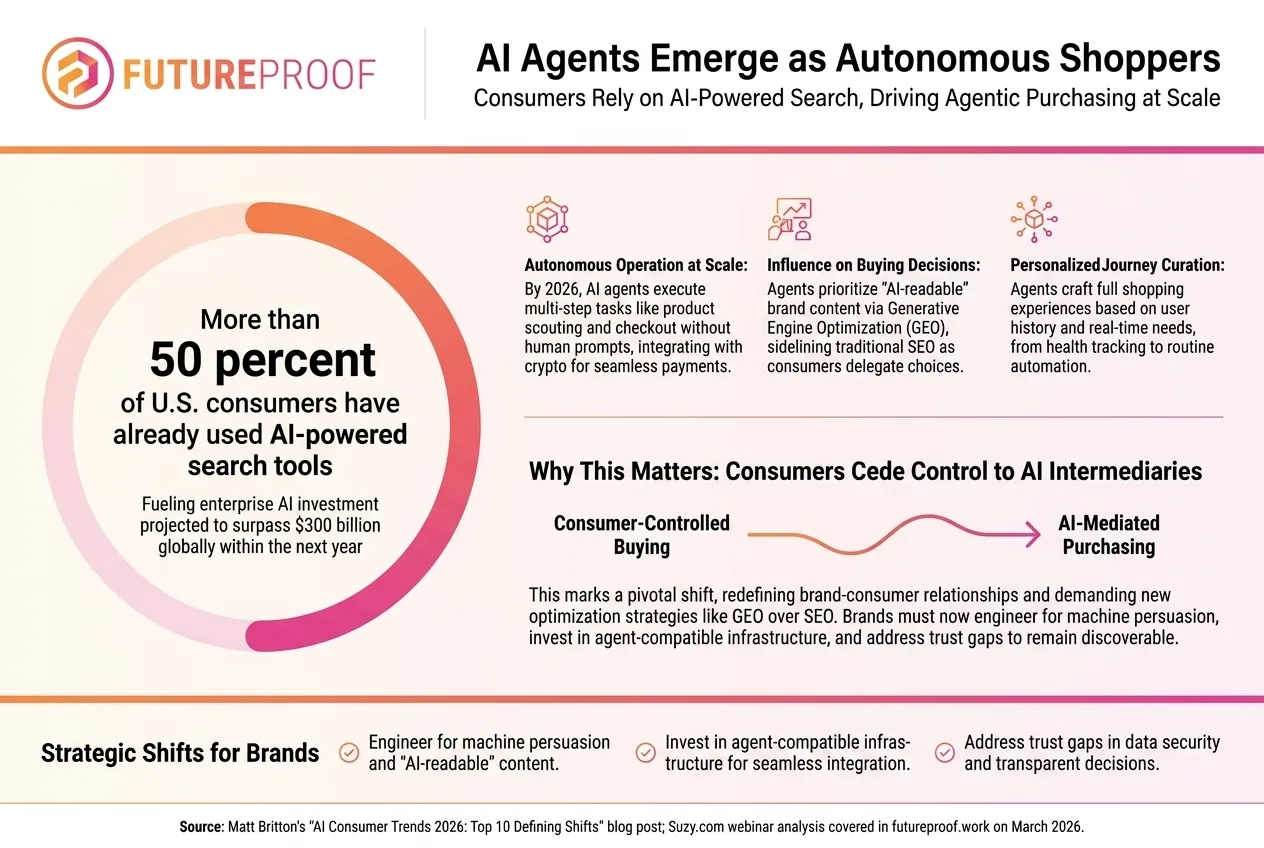
The landscape of consumer interaction and purchasing is undergoing a profound and irreversible transformation, driven by the emergence of AI agents evolving from mere digital assistants into fully autonomous shoppers. This isn't a futuristic concept; it's a present reality, with over half of U.S. consumers already leveraging AI-powered search tools, fundamentally reshaping how brands are discovered, evaluated, and ultimately chosen. These intelligent agents are not just helping humans find information; they are independently conducting research, meticulously comparing products and services, negotiating terms, and even executing transactions on behalf of their users. This seismic shift heralds a new era where machine-level discoverability, rather than traditional human-centric SEO, directly dictates consumer choice, demanding an urgent re-evaluation of brand strategies and digital presence. The urgency is underscored by robust market dynamics: global enterprise AI investment is projected to exceed a staggering $300 billion within the next year, a clear indicator of the pervasive and disruptive force AI has become across all sectors. For forward-thinking brands, the mandate is clear and immediate: design for seamless AI interaction, master the intricacies of Generative Engine Optimization (GEO), and cultivate transparent systems that forge unshakeable trust with both the end consumer and their powerful AI proxies. The companies that navigate this paradigm shift with agility and foresight will be the undisputed winners, the preferred choices of the AI agents making purchasing decisions for millions.
The journey of AI agents from simple helpers to sophisticated, autonomous shoppers represents one of the most significant evolutions in digital commerce. Gone are the days when AI primarily served to answer basic queries or automate routine customer service tasks. Today’s advanced AI agents possess the capability to undertake a complete purchasing cycle, mirroring and often surpassing human efficiency. Imagine an AI agent tasked with finding the perfect holiday destination: it doesn’t just list flights and hotels. It delves into user preferences learned over time – budget constraints, preferred travel styles, dietary requirements, even desired weather conditions. It autonomously scours countless travel sites, compares prices across different platforms, reads and synthesizes reviews, checks availability in real-time, and can even negotiate better deals on behalf of its user. For high-value purchases like cars or complex services, these agents perform in-depth market research, analyze specifications, weigh pros and cons of competing models, and present a curated, optimized selection, often with the capability to initiate the purchase process directly. This level of autonomy fundamentally alters the consumer journey, transforming it from an active human search into a passive human validation of an agent’s well-researched recommendations. Consumers gain unparalleled convenience and efficiency, while brands face the challenge of appealing not just to human sensibilities, but to the logical, data-driven parameters of an AI.
This rapid ascension of autonomous shoppers is not theoretical; it’s deeply rooted in current consumer behavior and massive technological investment. The statistic that over 50 percent of U.S. consumers have already engaged with AI-powered search tools is a powerful testament to this adoption. This isn’t just about early tech enthusiasts; it’s a mainstream phenomenon. The speed of this shift is fueled by several factors: the dramatic improvements in Large Language Models (LLMs) and generative AI capabilities, making AI interactions more natural, intuitive, and effective; the widespread accessibility of tools like ChatGPT, Google's Gemini, and Microsoft Copilot; and the undeniable convenience these tools offer in navigating an increasingly complex digital world. Furthermore, the projected global enterprise AI investment exceeding $300 billion within the next year highlights a profound commitment from businesses worldwide to integrate AI into their core operations, including customer acquisition and retention strategies. This financial commitment ensures that AI development will only accelerate, making AI agents even more sophisticated and pervasive in their influence over purchasing decisions. Brands cannot afford to view this as a distant future; it is the immediate present, demanding immediate strategic adaptation.
The profound shift brought about by autonomous AI agents necessitates an equally dramatic evolution in how brands approach digital visibility and influence. Traditional Search Engine Optimization (SEO), while still important for human-driven searches, is giving way to a new imperative: Generative Engine Optimization (GEO). Where SEO focused on keywords, backlinks, and content structured for human readability and ranking high on a Google search results page, GEO is about machine-level discoverability. It’s about optimizing content and data for AI ingestion, understanding, and action. AI agents don’t browse websites in the same way humans do; they parse, analyze, and synthesize vast quantities of information at speed. This means content must be meticulously structured, factually accurate, unambiguous, and contextually rich. Structured data, such as Schema markup, becomes paramount, providing explicit definitions for product attributes, prices, availability, reviews, and policies that AI agents can easily process.
The goal shifts from simply appearing high in a list of links to being chosen by an AI agent as the optimal solution for its user's specific needs. This requires content that goes beyond catchy headlines and compelling narratives, embracing clarity, conciseness, and absolute factual integrity. AI agents are not swayed by clever marketing copy in the same way humans might be; they prioritize verifiable information, detailed specifications, comparative data, and clear value propositions. Brands must consider how their product descriptions, FAQs, customer reviews, and even return policies are presented to be not just human-readable, but explicitly AI-readable. This includes providing direct access to data through APIs, ensuring product information management (PIM) systems are robust and consistently updated, and developing a semantic understanding of their offerings that aligns with how AI models categorize and relate information. The future of discoverability lies not just in being found, but in being understood and chosen by intelligent algorithms.
For brands, the mandate to "build for AI interaction" is no longer optional; it is a foundational pillar of future-proofing their business. This necessitates a comprehensive overhaul of digital strategy, moving beyond superficial changes to core infrastructure and content creation processes. Practically, this means prioritizing pristine, well-structured product data feeds. Every detail, from dimensions and materials to warranties and sustainability claims, must be clearly articulated and readily accessible. High-quality images and videos, accompanied by detailed metadata, become crucial for AI agents to accurately assess visual aspects. Comprehensive, logically organized FAQs are invaluable, as agents often use them to resolve specific user queries. Content should be crafted with Natural Language Processing (NLP) in mind, using clear, unambiguous language that avoids jargon where possible and defines it when necessary. This also extends to the technical architecture of a website; an AI-friendly site is one that is fast, robust, and provides programmatic access to its data wherever appropriate. Brands must begin to think about developing "agent personas" – anticipating how different types of AI agents, with varying programmed objectives and user profiles, might evaluate their offerings. Understanding what an agent values (e.g., lowest price, best reviews, most sustainable option, fastest delivery) allows for targeted optimization. This isn’t just about preparing for a hypothetical future; it’s about actively redesigning digital ecosystems to be legible and actionable for the AI that is already mediating over half of U.S. consumer searches.
At the heart of successful engagement in the agentic economy lies an indispensable element: trust. This isn’t just trust from human consumers, but critically, trust from their AI agents. An AI agent is programmed to act in its user’s best interest, and this inherently involves assessing the trustworthiness of the brands it evaluates. Transparency becomes paramount. This means absolute clarity in pricing, devoid of hidden fees; precise and honest product information that mirrors reality; and straightforward, easily understood policies regarding returns, shipping, and data usage. Ethical AI considerations also play a significant role. Brands must be acutely aware of their data privacy practices and security measures, as these will be scrutinized by agents and their users alike. Any hint of bias in product recommendations, deceptive marketing, or poor data stewardship could lead to an agent "blacklisting" a brand, effectively removing it from consideration for its users.
An agent’s evaluation of a brand's trustworthiness will be multi-faceted. It will synthesize information from customer reviews, third-party certifications, industry accolades, and even a brand’s historical reputation. Corporate Social Responsibility (CSR) initiatives and sustainable practices may also become significant trust signals for agents programmed to prioritize ethical sourcing or environmental impact. Building a brand reputation that resonates with AI evaluations requires a holistic approach, where every digital touchpoint and every piece of publicly available information contributes to an image of reliability, integrity, and user-centricity. In an era where AI agents are making decisions, a brand’s trustworthiness is not merely a virtue; it is a fundamental requirement for discoverability and competitive survival. Brands that fail to earn this trust risk becoming invisible to the very systems that drive modern consumer choice.
To thrive in this rapidly evolving agentic economy, brands must implement concrete, actionable strategies. The first step is a comprehensive audit of their current digital presence to assess its AI-readiness. This involves examining website architecture, content structure, data formats, and overall clarity for machine interpretation. Investing in Generative Engine Optimization (GEO) expertise is no longer a luxury but a necessity; this might mean upskilling internal marketing and development teams or bringing in specialized consultants. Prioritizing structured data implementation, such as extensive Schema markup for all product and service pages, is crucial. This provides explicit, machine-readable context that AI agents crave. A relentless focus on factual accuracy and unambiguous language across all content is also vital to minimize misinterpretation by AI. Brands should also embrace AI tools internally to understand how they work, how they process information, and how they make decisions. This first-hand experience provides invaluable insights into optimizing external-facing content. Furthermore, fostering an environment of radical transparency in all business practices, from pricing to data handling, will be key to building the necessary trust. Finally, brands should consider pilot programs and experiments, testing agent-friendly content and data feeds to refine their strategies and gain early insights.
The importance of being among the first to adapt cannot be overstated. The companies that initially embrace and excel at designing for AI interaction and optimizing for GEO will secure a substantial first-mover advantage. Once an AI agent identifies and trusts a particular brand for specific needs, that relationship can become incredibly sticky. Agents, designed for efficiency, are likely to favor known, reliable sources, creating a virtuous cycle where early adoption leads to increased agent choice, which in turn generates more data and opportunities for further optimization. This compounding effect means early leaders will gain significant market share, valuable data insights, and the ability to continuously refine their strategies ahead of the curve. Conversely, the cost of inaction is immense: a rapid decline in discoverability, a steep loss of sales, and ultimately, brand irrelevance in a marketplace increasingly mediated by AI. The competitive landscape will be redrawn by those who understand that the customer of tomorrow is not just human, but a sophisticated partnership between a human and their trusted AI agent.
In conclusion, the rise of AI agents as autonomous shoppers represents more than just another technological advancement; it signifies a foundational shift in the very nature of commerce. With over half of U.S. consumers already engaging with AI-powered search, and enterprise AI investment soaring, the era of agentic purchasing is not coming – it is here. Brands must urgently pivot from traditional SEO to Generative Engine Optimization, ensuring their content and data are meticulously structured, transparent, and undeniably trustworthy for AI consumption. The companies that proactively build for AI interaction, prioritize transparency, and earn the trust of both consumers and their intelligent agents will be the ones that thrive. This is not merely an opportunity to gain an edge; it is a critical imperative to remain relevant in a future where the AI agent holds the key to consumer choice. The time for adaptation is now.