How AI Is Becoming the New Starting Point for Shopping Research
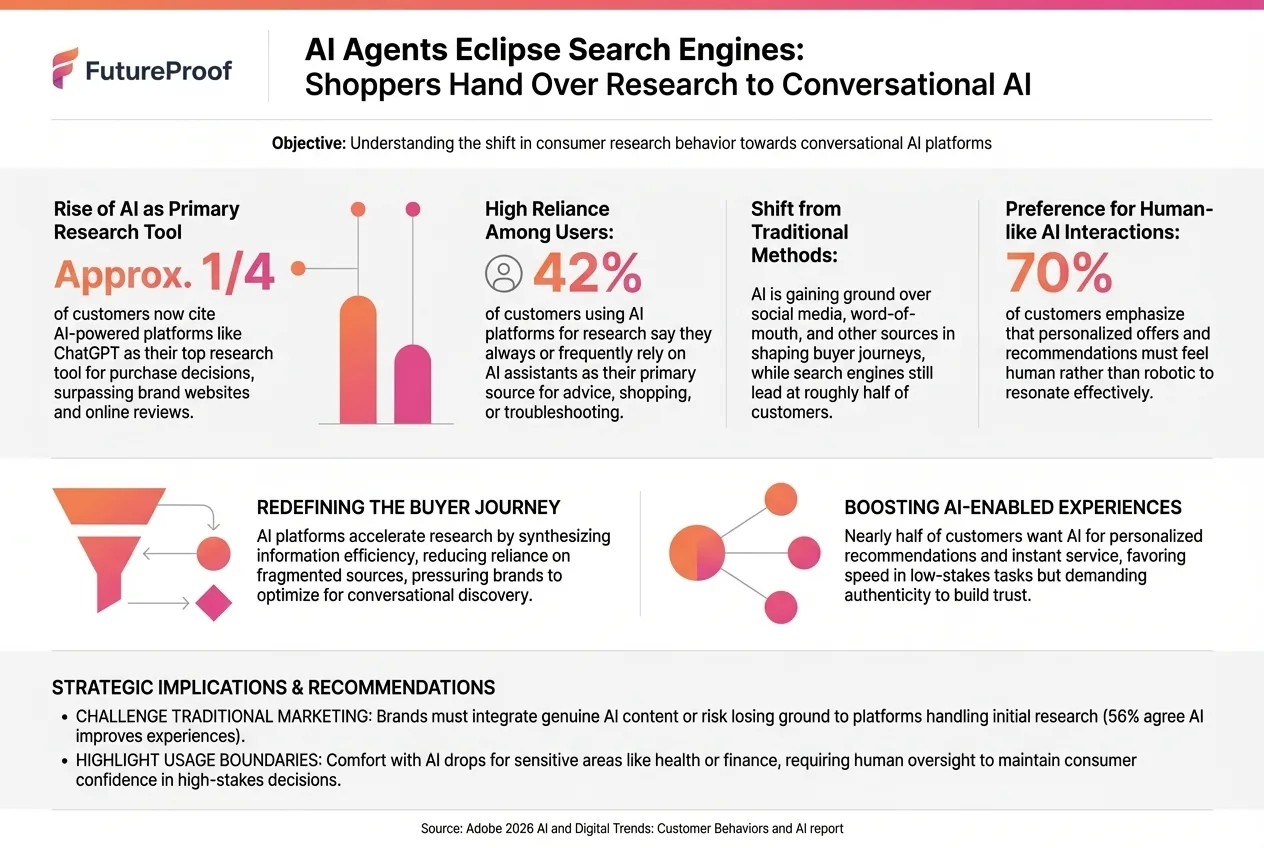
The landscape of consumer behavior is undergoing a seismic shift, fundamentally altering how customers initiate their shopping journeys. For decades, the path to purchase typically began with traditional search engines, brand websites, or a peer’s recommendation. Today, a new contender has emerged, rapidly claiming the top spot: artificial intelligence. According to Adobe’s pivotal 2026 AI and Digital Trends report, a significant quarter of customers now consider AI platforms like ChatGPT their primary research tool, a development that unequivocally places these intelligent agents ahead of established brand websites and even online reviews. This isn't a fleeting trend; it’s a profound recalibration of the buyer journey, with 42 percent of AI users frequently or always leaning on conversational platforms for shopping guidance. This escalating reliance on AI signals a critical juncture for marketers: if the genesis of shopping research has moved to AI, then the imperative for brands to optimize for AI discovery is no longer a strategic option but an immediate necessity.
The burgeoning preference for AI in shopping research isn't merely a matter of technological novelty; it’s a direct response to evolving consumer demands for efficiency, personalization, and insightful synthesis. In an increasingly information-saturated world, the traditional methods of sifting through countless search results or navigating dense brand websites can feel cumbersome and time-consuming. AI offers an antidote to this overload, providing swift, synthesized insights that cut through the noise. Customers no longer want to just find information; they want information curated, distilled, and presented in a way that directly addresses their needs and preferences. AI excels at this by processing vast quantities of data – product specifications, reviews, comparisons, trends – and delivering a concise, personalized answer within seconds. This capability to serve as a personal shopping assistant, capable of understanding complex queries and offering nuanced recommendations, surpasses the static experience of a brand website or the often-fragmented insights from individual reviews. The conversational interface of these platforms further enhances their appeal, mimicking a natural dialogue with a knowledgeable expert rather than a sterile database query. This intuitive interaction fosters a sense of ease and accessibility, making the research phase feel less like a chore and more like a helpful conversation. Moreover, AI’s capacity for comparative analysis allows shoppers to quickly weigh options across multiple brands and products, receiving an unbiased (or perceived as such) overview that simplifies complex purchasing decisions. Whether a customer begins with a specific product in mind or a broader problem to solve, AI’s ability to guide them through the options with contextual understanding makes it an invaluable starting point.
This seismic shift has profound implications, fundamentally redefining the pre-purchase phase and reshaping consumer expectations from brands. The traditional "Zero Moment of Truth," where consumers conduct initial research online before a purchase, has evolved. The new "first click" is increasingly a conversational prompt to an AI agent, which now serves as the primary filter and recommender. This doesn't necessarily diminish the importance of brand websites or reviews entirely, but it significantly alters their role; they become secondary validation points rather than primary discovery channels. For brands, this means that merely having a well-designed website or a strong social media presence is no longer sufficient for initial discovery. The brand's visibility at the AI-driven research stage becomes paramount. Customers now expect instant answers, not just product listings. They anticipate hyper-personalized recommendations that genuinely reflect their specific situation, budget, and taste. Crucially, the demand for authenticity is louder than ever, with 70 percent of consumers asserting that AI must "sound authentic to be effective." This extends beyond factual correctness to encompass tone, empathy, and a nuanced understanding of human preferences, signaling a need for AI interactions that feel genuinely helpful and human-like, rather than robotic or generic. This heightened expectation places immense pressure on brands to ensure their information is not only accurate and comprehensive but also accessible and interpretable by AI in a manner that aligns with their brand voice and values. The focus shifts from optimizing for keywords to optimizing for intent and contextual understanding, preparing brands for a world where their narrative might first be told by an algorithm.
To thrive in this AI-centric research ecosystem, brands must pivot their digital strategies, focusing on comprehensive data foundations, semantic content optimization, and a proactive approach to conversational readiness. The cornerstone of effective AI discovery lies in the quality and accessibility of a brand's data. AI models are only as good as the information they consume, meaning brands must ensure their product information is impeccably accurate, consistently updated, and remarkably comprehensive across all channels. This includes detailed specifications, high-quality images, pricing, availability, and customer service information. Beyond raw data, implementing robust structured data markup, such as Schema.org, becomes non-negotiable. This metadata provides AI with a clear, machine-readable understanding of product attributes, relationships, reviews, and offers, enabling it to parse and present information with greater accuracy and relevance. Furthermore, integrating first-party customer data, with appropriate privacy safeguards, can fuel AI with invaluable insights into individual preferences, allowing for the hyper-personalization that customers now demand.
Content strategy, too, requires a significant overhaul, moving beyond traditional keyword stuffing to embrace semantic optimization. Instead of merely targeting exact match keywords, brands must create rich, authoritative content that answers customer questions comprehensively, addresses their pain points, and provides contextual understanding. Think "why" content, "what if" scenarios, and detailed "how-to" guides. AI excels at extracting answers from well-structured Q&A sections, long-form articles that establish thought leadership, and comparative content that highlights unique selling propositions. This means developing content that naturally anticipates the kinds of questions a shopper might ask an AI – "What's the best eco-friendly laptop for students?" or "Compare features of XYZ brand coffee makers." By providing clear, concise, and nuanced answers within their owned content, brands make it easier for AI agents to accurately represent and recommend their offerings. Optimizing for voice search and general conversational AI readiness is another crucial facet. This involves crafting content that mirrors natural language patterns, often characterized by longer, more complex queries than traditional typed searches. Brands should aim for featured snippets and answer boxes on search engines, as these direct answers are often what AI agents leverage for their responses. Internally, brands should also invest in sophisticated chatbots and virtual assistants for their own websites, not just to serve customers directly but to continually refine their understanding of customer intent and conversational nuances.
Building a consistent brand identity within AI interactions is equally vital. When an AI recommends a product, it implicitly carries a reflection of the brand's voice. Brands must therefore ensure that their core messaging, tone, and values are discoverable and interpretable by AI, allowing the recommendations to feel genuinely aligned with the brand's persona. This requires a deliberate effort to embed brand authenticity into the data and content that AI consumes. Ethical AI use and transparency are also paramount; customers are increasingly wary of AI bias or manipulation. Brands that are transparent about their AI applications and committed to ethical data practices will build greater trust. Furthermore, ensuring that a brand’s positive social proof – customer reviews, awards, and testimonials – is readily available and well-structured will influence AI recommendations, as these platforms often factor in overall sentiment and reputation. Finally, brands must consider their engagement with AI platforms themselves. This might involve exploring partnerships with leading AI developers, providing direct API access to product catalogs, or ensuring their data feeds are optimized for seamless integration.
The future of shopping research is unequivocally intertwined with the evolution of AI. As these platforms become even more sophisticated, their influence will only deepen. For marketers, the question posed by the Adobe report remains simple yet urgent: Is your brand ready to be found where research is moving? The answer demands a proactive, comprehensive transformation of marketing strategies, pivoting from traditional discovery methods to embracing the intricacies of conversational AI. This requires a shift in mindset, viewing AI not as a competitor to brand engagement but as an essential facilitator, a new frontier for discovery and connection. The ultimate goal remains fostering meaningful human connections and facilitating informed decisions, with AI serving as an incredibly powerful assistant in that journey. Brands that invest in robust data foundations, intelligently structured and semantically optimized content, and a deep understanding of conversational dynamics will be the ones that not only survive but thrive in this rapidly evolving, AI-first shopping landscape, ensuring their presence in the very first moments of a customer's purchasing consideration.