The Rise of AI Search and the Collapse of Traditional Discovery
The digital landscape is undergoing a seismic transformation, a shift so profound and rapid that it is redefining the very essence of how consumers discover information and make purchasing decisions. Traditional search engines, long the undisputed gatekeepers of online discovery, are rapidly being supplanted by a new breed of AI-powered tools like ChatGPT. This isn't a slow, incremental evolution; it's an accelerating, sharp reversal that demands immediate attention from every business and marketer. The data is stark and compelling, painting a clear picture of an economy already deeply reshaped by artificial intelligence.
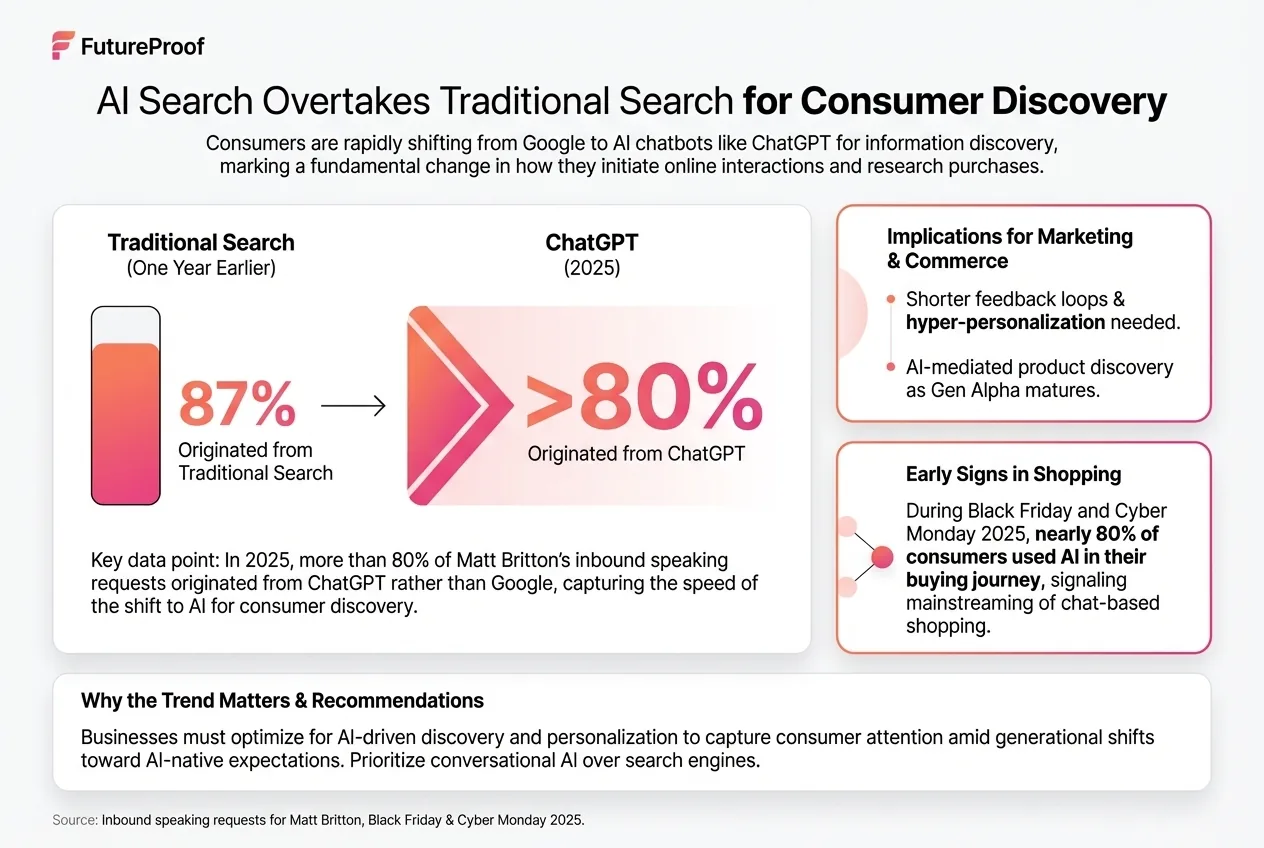
Consider the stark evidence provided by the Suzy 2025 Consumer Forecast. In a mere year, the primary source of inbound requests for high-profile individuals like Matt Britton, a recognized industry expert, completely flipped. In 2024, a dominant 87 percent of his speaking requests originated from traditional search engines. Fast forward to 2025, and that figure plummeted, with over 80 percent of his requests now stemming directly from ChatGPT. This dramatic reversal is not an anomaly; it's a potent indicator of a broader, fundamental change in consumer behavior across all sectors. People are no longer just typing keywords into a search bar; they are engaging in conversational interfaces, asking complex questions, seeking nuanced advice, and trusting AI to synthesize information and guide them toward relevant solutions, products, and services.
This profound reorientation from traditional query-based search to conversational AI-driven discovery carries immense implications for marketing and commerce. The foundational principles that have governed digital strategy for decades are being rewritten in real-time. Businesses are already experiencing a compression of the marketing funnel, leading to significantly shorter feedback loops. AI tools enable brands to gather insights, test hypotheses, and iterate on strategies with unprecedented speed and precision. This rapid responsiveness is not just a competitive advantage; it’s fast becoming a baseline expectation in a dynamic market.
Furthermore, the rise of AI search facilitates a level of personalization that was previously unimaginable at scale. Traditional marketing segments customers based on broad demographics or past purchasing behavior. AI, leveraging sophisticated algorithms and vast datasets, can analyze individual preferences, real-time intent, emotional cues, and even conversational nuances to deliver hyper-personalized experiences. This means custom-tailored product recommendations, dynamically generated content, and perfectly timed offers that resonate deeply with individual consumers, fostering stronger brand loyalty and driving conversion rates. It's moving beyond "people who bought this also bought..." to "based on your conversation about X and your expressed desire for Y, here are three highly specific options Z that meet your exact criteria, along with a personalized explanation of why."
Perhaps one of the most transformative impacts is the emergence of AI-mediated product discovery. The journey from initial awareness to final purchase is no longer a linear path through category pages and product listings. Instead, AI acts as a sophisticated digital concierge, guiding consumers through complex decision-making processes. This could manifest as AI chatbots assisting with product comparisons, virtual assistants answering detailed specifications questions, or generative AI summarizing reviews and highlighting key features relevant to a user's stated needs. For younger, AI-native generations like Gen Alpha, who are growing up with conversational interfaces as their primary mode of interaction, this isn't a novelty; it's the expected standard. They anticipate seamless, intuitive, and highly intelligent conversational experiences across all brand touchpoints, from initial product exploration to post-purchase support. Brands that fail to provide these engaging, AI-driven conversational interfaces risk becoming irrelevant to a demographic that will soon dominate consumer spending.
The influence of AI on purchasing behavior is not confined to the abstract; it's profoundly impacting the busiest shopping periods of the year. The Suzy 2025 Consumer Forecast further revealed that during the crucial Black Friday and Cyber Monday sales events in 2025, nearly 80 percent of consumers leveraged AI at some point in their buying journey. This statistic is a powerful testament to AI's pervasive integration into the core of the consumer decision-making process. Consumers weren't just casually experimenting with AI; they were actively using it as an indispensable tool to navigate the overwhelming volume of deals, products, and information characteristic of these peak shopping periods.
How exactly were consumers integrating AI into their Black Friday and Cyber Monday strategies? The applications are diverse and revealing. Many likely used AI to compare prices across multiple retailers instantly, identify the best deals for specific products, or even predict future price drops. Others employed AI to generate gift ideas based on a recipient's interests or past purchases, saving invaluable time and reducing decision fatigue. AI-powered chatbots provided instant answers to product specifications, shipping queries, and return policies, offering a level of customer service speed and accessibility that traditional human-staffed channels often struggle to match during high-volume periods. Some may have used generative AI to summarize hundreds of product reviews into concise pros and cons lists, helping them make informed choices faster. This widespread adoption signals that AI is no longer a peripheral technology but a central component of the modern shopper's toolkit, actively shaping their choices and expediting their path to purchase.
This paradigm shift unequivocally demonstrates that AI is rapidly becoming the starting point for discovery for a vast segment of the population. For businesses to merely survive, let alone thrive, in this rapidly evolving digital economy, they must fundamentally rethink their strategies. The old rules of SEO and digital marketing are insufficient. The new imperative is two-fold: optimize for AI-driven visibility and cultivate rich, conversational engagement.
Optimizing for AI-driven visibility goes far beyond traditional keyword stuffing or link building. While foundational SEO principles remain important, the focus must shift to understanding how AI models ingest, interpret, and synthesize information. This means prioritizing semantic relevance, contextual accuracy, and authoritativeness. Content needs to be structured in a way that is easily digestible by large language models (LLMs), featuring clear, concise answers to potential questions, comprehensive explanations, and well-organized data. Schema markup, which provides structured data to search engines and AI, becomes more critical than ever, allowing AI to quickly identify key entities, relationships, and attributes within your content. The E-E-A-T framework (Experience, Expertise, Authoritativeness, Trustworthiness) will be amplified by AI, as models are trained to prioritize information from reputable, expert sources. Building a strong brand presence across diverse platforms, ensuring factual accuracy, and demonstrating genuine expertise will be paramount to gaining AI’s trust and, consequently, appearing in its curated responses. This also means understanding that AI often generates summaries or direct answers, potentially reducing the click-through rate to original sources. Therefore, brands must focus on being the source that AI trusts and references, not just a page that ranks.
Beyond mere visibility, the emphasis on conversational engagement is equally crucial. If AI is the new interface for discovery, then businesses must be prepared to engage with consumers in a conversational manner. This involves implementing advanced AI chatbots and virtual assistants across websites, social media, and messaging platforms. These tools need to be sophisticated enough to handle complex queries, provide personalized recommendations, resolve issues efficiently, and even facilitate transactions directly within the conversational interface. The goal is to create seamless, intuitive, and helpful interactions that mirror the natural language exchanges consumers are having with AI tools like ChatGPT. This means moving beyond rudimentary rule-based chatbots to AI-powered conversational agents capable of understanding intent, maintaining context across multiple turns, and delivering genuinely valuable responses. Furthermore, brands should explore how generative AI can enhance personalized outreach, create dynamic content based on conversational cues, and even act as a proactive assistant, anticipating customer needs before they are explicitly articulated.
The speed of this shift is its most defining characteristic. The data from Suzy's 2025 Consumer Forecast illustrates not a gradual transition but a rapid, almost instantaneous redirection of consumer behavior. Businesses that cling to outdated strategies, ignoring the rising tide of AI search and conversational commerce, risk being left behind in a digital economy that moves at the speed of algorithms. The opportunity, however, is equally immense for those who embrace this transformation early. By optimizing for AI-driven visibility and cultivating deep conversational engagement, brands can secure their relevance, capture new market share, and build stronger, more personalized relationships with a new generation of AI-native consumers. The future of discovery is here, and it speaks in conversations. Businesses must learn to speak its language, or they will find themselves on the wrong side of history.