
How AI Personal Shoppers Are Redefining Brand Discovery and the Future of Commerce
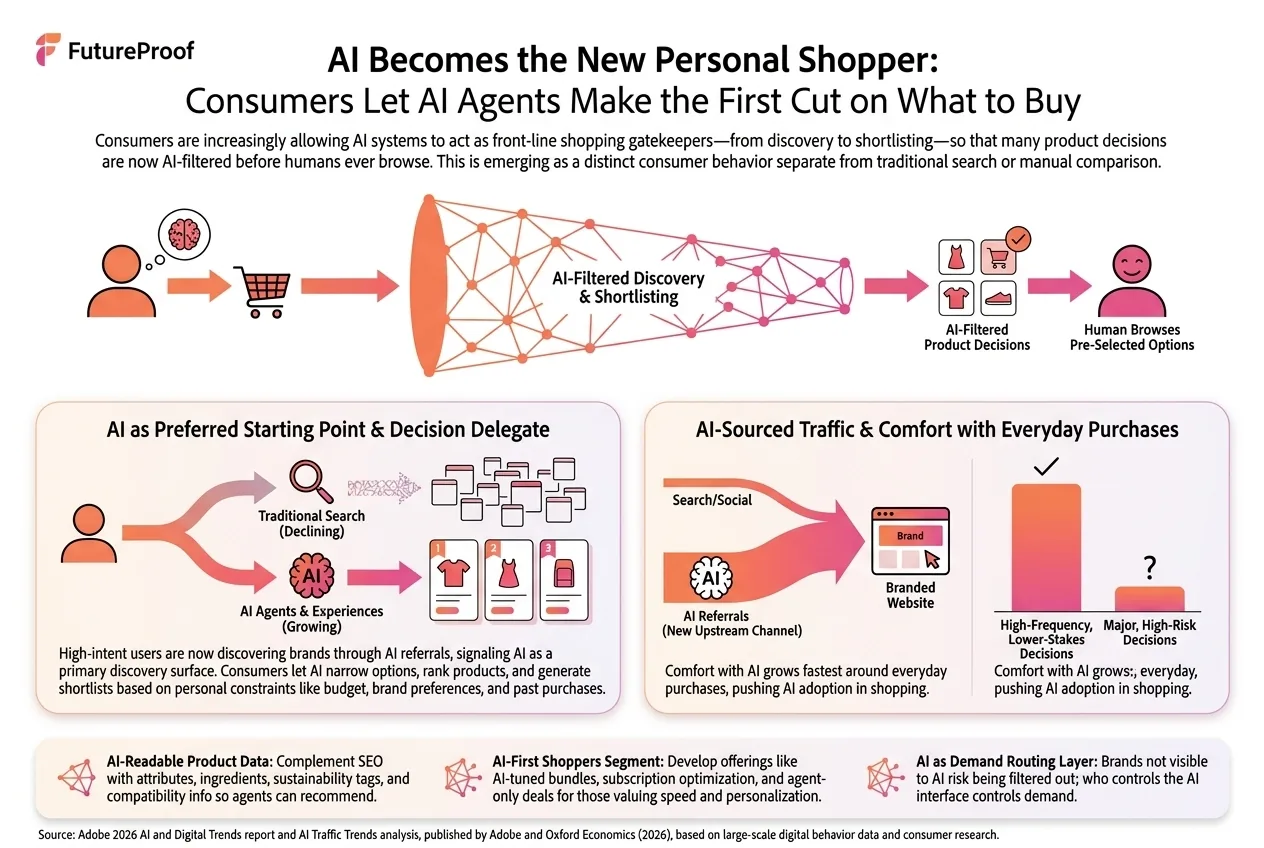
The landscape of consumer discovery and purchasing is undergoing a profound transformation, spearheaded by the ascendance of artificial intelligence as the primary gatekeeper in the buying journey. Shoppers are increasingly bypassing traditional search engines and direct browsing, opting instead to initiate their quest for products and services with sophisticated AI agents. These digital concierges excel at sifting through vast oceans of information, narrowing down options, intelligently ranking products based on complex criteria, and ultimately generating highly personalized shortlists. This revolutionary shift marks AI not merely as a supplementary tool, but as a true front line in the intricate dance of product discovery and decision-making, redefining the very first interaction between consumer intent and brand availability.
This evolution is not merely anecdotal; robust data underpins its significance. According to Adobe’s insightful 2026 AI and Digital Trends report, corroborated by Adobe AI Traffic Trends produced with Oxford Economics, a significant and growing number of high-intent users are now discovering brands directly through AI referrals. This pivotal finding positions AI as a distinct, burgeoning acquisition channel, standing shoulder-to-shoulder with established behemoths like traditional search engines and social media platforms. The implications are far-reaching: AI is no longer just optimizing existing channels; it is forging entirely new pathways for consumer engagement and brand visibility. As consumers become more comfortable and confident in sharing their personal context – their preferences, budget constraints, ethical considerations, and lifestyle needs – with these intelligent tools, AI systems evolve into genuine personal shoppers, equipped with an unprecedented understanding of individual desires and limitations.
The imperative for brands operating in this rapidly evolving environment is clear and urgent: visibility and success now hinge on being "AI readable." This demands a fundamental rethinking of how product data is structured, presented, and managed. Generic descriptions and siloed information are no longer sufficient. To be confidently recommended by an AI agent, product data, granular attributes, crucial sustainability tags, precise compatibility details, and even nuanced use-case scenarios must be meticulously structured and easily digestible by AI systems. The foundational question for marketers and product managers shifts dramatically from "How do we persuade the human buyer?" to "How do we equip the AI to select our product for the human buyer?" This paradigm shift necessitates a proactive approach to data architecture, a commitment to unparalleled data quality, and a deep understanding of how AI interprets and evaluates information. Brands that embrace this challenge will unlock unprecedented opportunities for discovery and conversion in the AI-driven future of commerce.
The AI personal shopper operates on a sophisticated blend of machine learning algorithms, natural language processing, and vast datasets of consumer behavior. When a user queries an AI agent – whether it's "Find me a sustainable, ethically sourced coffee machine under $200 that makes espresso and fits a small kitchen," or "Suggest a non-fiction book that explores the future of work and has excellent reviews" – the AI doesn't just perform a keyword match. Instead, it delves into a nuanced interpretation of intent. It considers implicit preferences gleaned from past interactions, explicit criteria provided in the prompt, and external factors like trending products, seasonal relevance, and even geopolitical events that might impact supply chains or ethical considerations. The AI's ability to cross-reference these diverse data points allows it to generate recommendations that feel remarkably intuitive and relevant, often surfacing products the consumer might not have found through conventional browsing or search. This deep level of personalization saves consumers invaluable time and shields them from decision fatigue, transforming a potentially overwhelming shopping experience into a streamlined, delightful journey.
This profound understanding of consumer preferences is what makes AI such a powerful new acquisition channel. Unlike a generic search result that requires the user to further evaluate and filter, an AI referral comes pre-vetted. The Adobe 2026 report emphasizes that these are high-intent users, meaning they are often closer to the point of purchase. When an AI agent recommends a product, it's not a mere suggestion; it's an informed endorsement based on a comprehensive understanding of the user's explicit and implicit needs. This pre-qualification drastically improves conversion rates for brands. The AI acts as a trusted filter, presenting only those options that align closely with the consumer's stated and inferred requirements. For brands, being present and prioritized within these AI-generated shortlists translates directly into reaching a highly receptive audience, significantly reducing the customer acquisition cost and improving the overall efficiency of marketing spend. The competitive edge will therefore increasingly belong to brands that can effectively communicate their value proposition not just to human minds, but to the sophisticated algorithms of AI agents.
To truly become "AI readable," brands must first understand the fundamental requirements of these intelligent systems. At its core, AI thrives on structured data. This means moving beyond free-text descriptions and embracing standardized formats like JSON-LD and schema markup, which provide explicit context about products, services, and brand information directly to AI crawlers. These digital labels don't just describe a product; they define its type, its attributes, its relationships to other products, and its place in the broader retail ecosystem in a machine-understandable way. A washing machine, for example, isn't just "a washer"; structured data tells the AI it's a "HouseholdAppliance," specifically a "WashingMachine," with attributes like "loadCapacity," "energyEfficiencyClass," "noiseLevel," "smartFeatures" (e.g., "wifiControlled"), "dimensions," and "warrantyInformation." Without this granular, structured context, AI agents cannot confidently compare, rank, or recommend products with precision.
Beyond basic schema, the richness of product attributes is paramount. AI agents can process and learn from an astonishing array of details. This includes not only the obvious characteristics like color, size, material, and price, but also deeper, more qualitative attributes that resonate with modern consumers. Consider sustainability tags: whether a product is organic, fair trade, recycled, carbon-neutral, locally sourced, or vegan. These are critical filters for a growing segment of environmentally and ethically conscious consumers, and AI agents are increasingly trained to prioritize them. Similarly, compatibility details are non-negotiable for complex products like electronics, automotive parts, or home integration systems. An AI personal shopper recommending a smart home device must know not just its features, but its compatibility with existing ecosystems (e.g., Apple HomeKit, Google Home, Amazon Alexa), voltage requirements, and integration capabilities. Every attribute becomes a potential decision point for the AI, and every missing or ambiguous detail is a lost opportunity for recommendation.
The quality and consistency of this data cannot be overstated. "Garbage in, garbage out" is a fundamental truth of AI. Inaccurate, outdated, or conflicting product information will lead to unreliable recommendations, damaging consumer trust and ultimately hindering brand visibility. This underscores the critical need for robust Product Information Management (PIM) systems. A PIM acts as a single source of truth for all product-related data, ensuring consistency across all channels – from e-commerce websites to social media feeds, and crucially, to the data feeds consumed by AI agents. Brands must invest in PIM solutions that allow for easy enrichment of data, support multiple attribute types, facilitate real-time updates, and enable automated syndication to various platforms. Furthermore, AI-optimized content goes beyond just structured data; it also involves crafting product descriptions that are clear, concise, factual, and designed for easy interpretation and summarization by AI, rather than just human readability alone. This might involve using bullet points for key features, active voice, and avoiding overly flowery language that could obscure critical product facts.
The shift in persuasion strategy from human to AI is perhaps the most profound implication for marketing and brand management. The traditional marketing funnel, while still relevant, now has an AI layer at its very top. Instead of directly trying to convince a human shopper through advertising copy or emotional appeals, the initial focus must be on convincing the AI that your product is the best fit for a given query. This means SEO strategies need to evolve beyond keyword stuffing for human search engines to include "AI search optimization" – ensuring that every facet of your product data, from meta-descriptions to image alt-tags, is structured and enriched for AI interpretation. Brand storytelling also needs to adapt; while emotional resonance is still important for the human, the values and narratives of a brand must now be translated into verifiable, structured data points that an AI can process. For instance, a brand's commitment to sustainability isn't just a marketing slogan; it must be backed by verifiable certifications, transparent supply chain data, and specific product attributes that an AI can use to filter and recommend. Measuring success in this AI-driven era will involve tracking not just traditional conversion metrics, but also AI referral rates, AI-generated shortlist placements, and the overall "AI discoverability score" of products.
For brands looking to thrive in this new environment, several practical steps are immediately actionable. First, conduct a comprehensive audit of existing product data. Identify gaps, inconsistencies, and areas where attributes are missing or poorly defined. This forensic analysis will highlight where the most immediate improvements can be made. Second, invest strategically in a robust PIM system if one is not already in place. This foundational technology is no longer a luxury but a necessity for managing the complexity of AI-ready data. Third, proactively implement schema markup (like Schema.org's Product or Offer types) across all product pages to explicitly signal key information to AI crawlers. Fourth, embark on a continuous process of enriching product catalogs. Go beyond the bare minimum; add every relevant attribute, certification, and detail that could potentially sway an AI recommendation. Fifth, actively monitor how AI agents perceive and recommend your products. Are you showing up in relevant shortlists? How are your competitors being positioned? This feedback loop is crucial for iterative improvement. Sixth, consider leveraging AI internally to optimize your own product data – AI tools can help identify missing attributes, suggest better descriptions, and even flag inconsistencies before they become problems. Finally, build trust not just with consumers, but with the AI systems themselves, by ensuring transparency, ethical data practices, and accuracy in all information provided. Exploring collaborations with AI developers and platforms can also offer a competitive advantage, potentially influencing how agents are trained and how recommendations are weighted.
However, the rise of the AI personal shopper also introduces a host of challenges and ethical considerations that must be addressed proactively. Data privacy is paramount; as consumers share more personal context with AI tools, the responsibility to protect that sensitive information escalates dramatically. Brands and AI developers must adhere to the highest standards of data security and transparency regarding how personal data is collected, stored, and utilized. Bias in AI is another significant concern. If AI systems are trained on biased datasets, they can perpetuate and even amplify discriminatory recommendations, leading to unfair outcomes for consumers and brands alike. Ensuring diverse, representative training data and implementing fairness-aware algorithms are critical. Transparency also extends to explaining why an AI recommended a particular product. Consumers may demand more insight into the factors that influenced a recommendation, moving away from a black-box approach. The potential for a "walled garden" effect, where dependence on a few dominant AI platforms could stifle competition and limit consumer choice, is also a consideration. Finally, while AI offers unparalleled efficiency, brands must balance this with maintaining the human touch in customer service and experience, ensuring that empathy and personal connection are not entirely lost in the pursuit of automation.
Looking towards the future, the integration of AI into retail will only deepen. We can anticipate even more proactive recommendations, where AI anticipates needs before the consumer explicitly expresses them, perhaps even leading to anticipatory shipping. Hyper-personalized storefronts, dynamically configured for each individual user based on their AI profile, will become commonplace. The role of human sales associates will evolve, shifting from basic product information providers to specialized consultants, focusing on complex problem-solving, emotional connection, and bespoke experiences that AI cannot yet replicate. Furthermore, AI could become a co-creator, analyzing vast consumer demand data to identify unmet needs and even generate specifications for entirely new products or services. The fusion of AI and human ingenuity promises a retail landscape that is more efficient, more personalized, and profoundly responsive to the ever-changing desires of the global consumer.
In conclusion, the era of the AI personal shopper is not a distant future but a present reality, fundamentally reshaping how consumers discover and decide what to buy. The data, particularly from reports like Adobe's 2026 AI and Digital Trends, unequivocally points to AI referrals as a powerful new acquisition channel, attracting high-intent users ready to convert. For brands, this represents an urgent call to action. Success will no longer solely depend on traditional marketing prowess but critically on becoming "AI readable" – structuring, enriching, and maintaining product data with an unprecedented level of precision and detail. The question has indeed shifted from persuading the human to equipping the AI to select you for the human. Brands that proactively embrace this paradigm shift, invest in robust data strategies, and understand the nuanced workings of AI agents will not only survive but thrive, unlocking unparalleled opportunities for discovery, engagement, and sustainable growth in the intelligent age of commerce. The time to adapt is now, for the first cut is increasingly made by AI.


