The Rise of AI Agents and the New Era of Product Discoverability
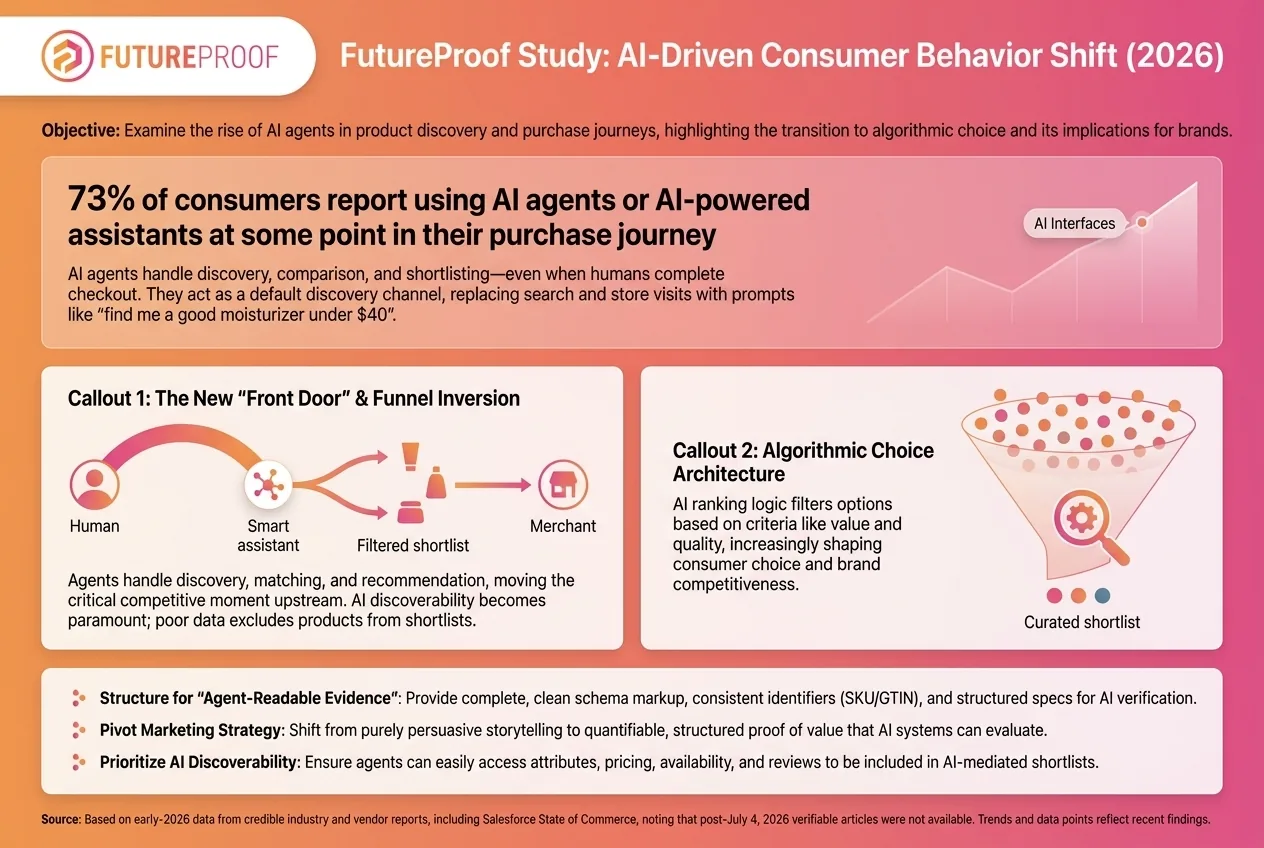
The landscape of consumer behavior is undergoing a seismic transformation, a shift so profound it redefines the very essence of product discovery. For decades, the consumer journey was largely characterized by active browsing, a meticulous, often time-consuming exploration across websites, marketplaces, and physical stores. Today, however, that era is rapidly waning. We are witnessing a monumental migration from proactive browsing to sophisticated delegation, with artificial intelligence agents emerging as the undisputed new gatekeepers of product discovery. This isn't merely an incremental evolution; it's a fundamental recalibration of how demand meets supply, where brands must now contend with an intermediary layer of intelligent systems that filter, evaluate, and recommend.
The evidence for this shift is not anecdotal but data-driven and compelling. According to insights summarized in early 2026 industry reports, leveraging Salesforce State of Commerce data, a staggering 73 percent of consumers now engage with AI agents or AI-powered assistants at some pivotal point in their shopping journey. This figure, a dramatic leap from previous years, underscores the undeniable reality that AI is no longer a futuristic concept but an intrinsic, indispensable component of contemporary commerce. Consumers are actively embracing the efficiency, personalization, and curated experience that AI agents offer, effectively outsourcing the laborious tasks of research, comparison, and shortlisting. For brands, this represents both an existential challenge and an unparalleled opportunity.
When AI agents assume the primary role in discovery, comparison, and shortlisting, the visibility of a product becomes entirely contingent on its digital readiness for machine interpretation. The traditional metrics of digital shelf optimization, while still relevant to an extent, are now being augmented, if not superseded, by the imperative of machine-readable data. In this new paradigm, a product is not simply found by a human scrolling through search results; it is actively evaluated, understood, and recommended by an AI. This necessitates a radical re-evaluation of how product information is structured, presented, and maintained. The competition for consumer attention has unequivocally moved upstream, into the intricate, algorithmic realm of the agent layer. Brands that proactively recognize and optimize for AI discoverability will secure an indelible advantage, separating themselves from those left behind in the wake of this technological tidal wave.
The implications of this shift are far-reaching and multifaceted, touching every aspect of a brand's digital strategy. No longer is it sufficient to have an aesthetically pleasing website or compelling human-readable product descriptions alone. While these elements remain important for conversion once an AI agent has presented a shortlist, the initial hurdle is now entirely different. AI agents operate on logic, data points, and quantifiable attributes. They don't infer meaning from prose or appreciate clever marketing taglines in the same way a human does. Their recommendation engine relies on the precision, consistency, and completeness of the underlying data.
Clean Attributes:
Imagine an AI agent tasked with finding "sustainable, waterproof running shoes with neutral support for trail running, size 9, under $150." For your product to even be considered, its attributes must precisely match these criteria. Vague descriptions like "eco-friendly footwear" or "great for outdoor activities" are insufficient. AI agents demand granular, standardized, and unambiguous attributes. This means:
- Specificity: Instead of "Color: Blue," specify "Color: Sky Blue (Pantone 283 C)."
- Standardization: Use universally recognized terms and units. If you sell apparel, adhere to standard sizing charts (e.g., US, UK, EU). For materials, use common industry classifications (e.g., Recycled Polyester, Organic Cotton).
- Accuracy: Any discrepancies in product attributes can lead to miscategorization or exclusion. An AI agent will not recommend a shoe listed as "water-resistant" when the consumer specifically requested "waterproof."
- Completeness: The more relevant attributes you provide, the richer the context for the AI agent. Think about every possible filter a consumer or AI might apply: material composition, specific features (e.g., "arch support type," "fastening type," "power source"), certifications (e.g., "Fair Trade," "Organic Certified"), compatibility details, and usage scenarios.
Structured Content:
This refers to the way your product data is organized and presented so that machines can easily parse and understand it. It goes beyond simple flat text files.
- Schema.org Markup: This is arguably the most critical component. Implementing detailed Schema.org markup (specifically Product and Offer schema, along with related types like AggregateRating, Brand, Review, etc.) directly tells search engines and AI agents the precise nature of your product, its price, availability, reviews, and more. This semantic layer provides context that plain HTML lacks.
- Product Data Feeds: For marketplaces, comparison shopping engines, and increasingly, AI agent platforms, well-structured product data feeds (XML, JSON, CSV) are essential. These feeds must be continuously updated, accurate, and adhere to the specific requirements of each platform. They are the conduits through which AI agents access the raw data about your offerings.
- APIs (Application Programming Interfaces): As AI agents become more sophisticated, they will increasingly rely on direct API access to pull real-time product information, inventory levels, pricing adjustments, and personalized recommendations. Brands that offer robust, well-documented APIs will provide AI agents with the freshest and most comprehensive data, leading to more accurate and timely recommendations.
Consistent Identifiers:
In a vast digital ecosystem, unique and consistent identifiers are crucial for an AI agent to accurately track, compare, and recommend products.
- GTINs (Global Trade Item Numbers) / UPCs / EANs / ISBNs: These universal product codes are non-negotiable. They provide a unique global identity for each product variation. Without them, AI agents struggle to compare your product against identical or similar items from competitors.
- SKUs (Stock Keeping Units): While internal to your business, consistent SKU management ensures that your internal systems align with external data feeds and agent requests.
- Brand Names: Ensure your brand name is consistently spelled and capitalized across all platforms. Inconsistencies can lead to fragmentation of your brand identity in the eyes of an AI.
- MPNs (Manufacturer Part Numbers): For certain product categories (e.g., electronics, automotive parts), MPNs are critical for AI agents to understand compatibility and specific model variations.
The competition for consumer attention is no longer solely played out on the visually rich battlegrounds of search engine results pages or social media feeds. It has moved upstream, into the intricate, often invisible, agent layer. This means that merely ranking high for a keyword is insufficient if your underlying product data is not machine-readable. An AI agent might identify your product as relevant, but if it cannot extract and understand its attributes, it will bypass it in favor of a competitor's product that offers cleaner, more structured data, even if that competitor's "human-facing" SEO is weaker.
Brands that embrace this new reality and actively optimize for AI discoverability will gain a clear, defensible advantage. This advantage manifests in several critical ways:
- Enhanced Visibility and Market Share: By ensuring their products are machine-readable, brands dramatically increase their chances of being shortlisted and recommended by AI agents. This translates directly into higher impressions, clicks, and ultimately, conversions, capturing a disproportionate share of the new, AI-driven demand.
- Reduced Customer Acquisition Costs: AI agents, by their nature, filter and pre-qualify products based on consumer preferences. When an AI recommends a product, it's often a highly relevant match, leading to higher conversion rates and lower expenditure on attracting unqualified leads.
- Future-Proofing E-commerce Strategy: The trend towards AI delegation is irreversible and accelerating. Brands that invest in AI discoverability now are building a resilient, future-proof foundation for their digital commerce operations, positioning themselves to thrive in an increasingly automated retail landscape.
- Data-Driven Insights: The process of optimizing for AI discoverability forces brands to meticulously audit and refine their product data. This rigorous data governance provides invaluable insights into product performance, consumer preferences, and market gaps, enabling more informed product development and marketing decisions.
- Competitive Differentiation: In a crowded marketplace, robust AI discoverability becomes a potent differentiator. While competitors may still be battling for visibility through traditional SEO and advertising, leading brands will be leveraging AI agents to reach consumers directly at the point of need, often before the consumer even consciously "searches."
For brands, the roadmap to AI discoverability necessitates a multi-pronged strategic approach. It's not a one-time fix but an ongoing commitment to data excellence.
- Invest in a Robust PIM (Product Information Management) System: A centralized PIM system is no longer a luxury but a necessity. It serves as the single source of truth for all product data, ensuring consistency, accuracy, and completeness across all channels and agent touchpoints.
- Develop a Comprehensive Data Taxonomy and Governance Strategy: Define clear standards for attributes, categories, and identifiers. Establish processes for data entry, validation, and enrichment to maintain high-quality data over time.
- Prioritize Structured Data Implementation: Work with your development teams to implement Schema.org markup across all product pages. Ensure it's correctly nested, comprehensive, and updated regularly.
- Optimize Product Feeds for AI Agents: Tailor your product feeds not just for traditional marketplaces but specifically for the requirements of various AI agent platforms. This might involve additional fields or specific formatting.
- Embrace API-First Thinking: Design your product data infrastructure with API accessibility in mind. This allows AI agents to dynamically query your product catalog for the most up-to-date information.
- Educate and Align Internal Teams: Marketing, product development, IT, and sales teams must understand the importance of machine-readable data and work collaboratively to ensure its integrity. This represents a significant cultural shift for many organizations.
- Monitor and Adapt: The AI landscape is dynamic. Brands must continuously monitor how AI agents are interpreting their data, what products are being recommended, and how consumer behavior is evolving. This iterative feedback loop is crucial for staying ahead.
The shift from browsing to delegating, powered by increasingly sophisticated AI agents, marks a definitive turning point in commerce. The days of consumers laboriously sifting through countless options are fading, replaced by an era where AI intelligently curates, compares, and shortlists. Salesforce State of Commerce data, illuminated by 2026 industry analyses, clearly illustrates this profound change, with AI agents already integral to a vast majority of shopping journeys. For brands, the message is unequivocal: product visibility is now inextricably linked to machine readability. Clean attributes, structured content, and consistent identifiers are not mere suggestions; they are the non-negotiable prerequisites for thriving in this new, AI-dominated world. The competition for consumer attention has moved beyond the direct gaze of the consumer into the intelligent algorithms that precede it. Those brands that prioritize and execute a robust AI discoverability strategy today will not just survive but will flourish, securing a decisive competitive edge and shaping the future of commerce itself. The time to optimize for the agent layer is now, for the future of product discovery has already arrived.