AI Driven Shopping Has Entered the Mainstream and Is Reshaping the Future of Commerce
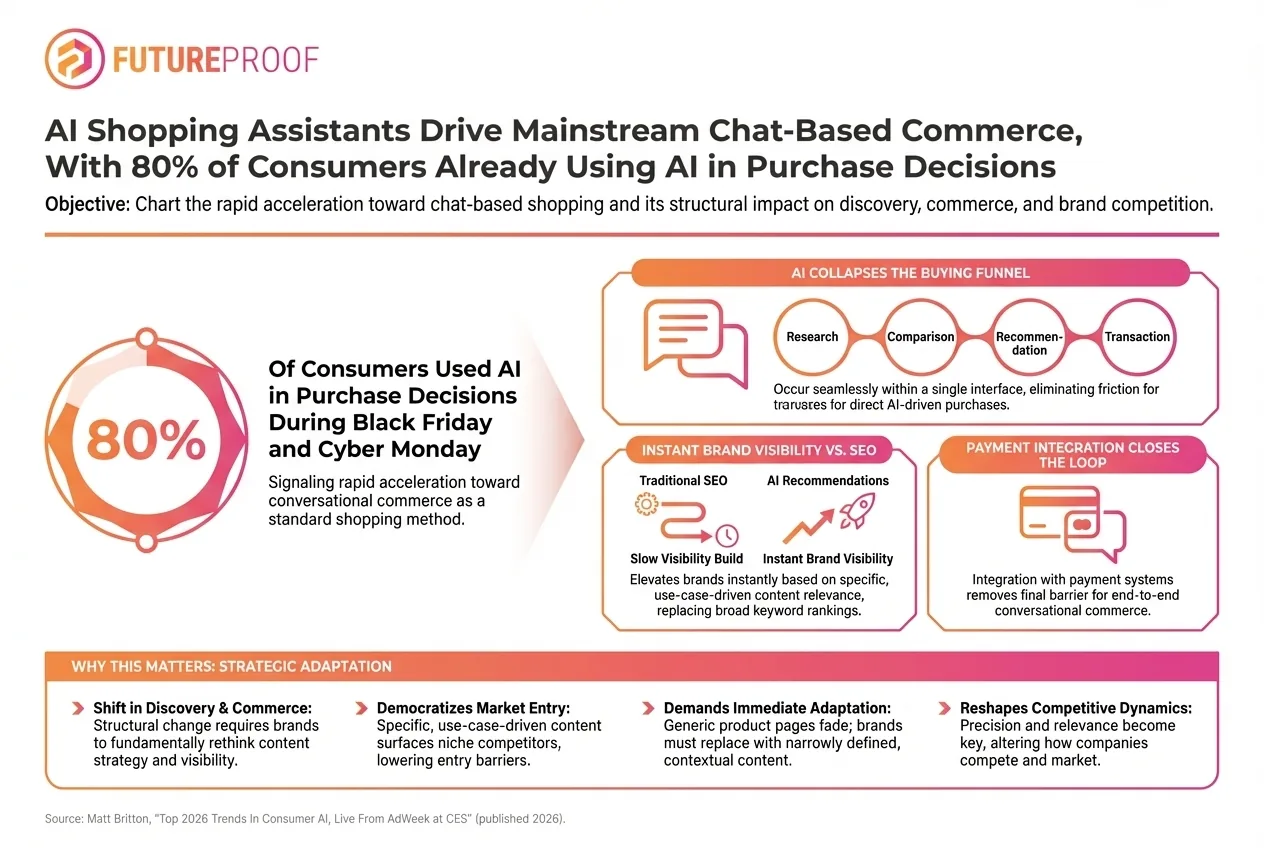
The landscape of consumer commerce has undeniably shifted, and the statistics from Black Friday and Cyber Monday 2023 stand as irrefutable proof. Matt Britton's insights from AdWeek at CES reveal a monumental turning point: nearly 80 percent of consumers leveraged artificial intelligence at some juncture in their buying journey during these peak shopping days. This isn't merely an incremental increase; it signifies a definitive crossing of a major threshold, propelling AI-powered shopping assistants and chat-based commerce squarely into the mainstream. For brands, marketers, and e-commerce strategists, this is not a trend to observe but a seismic shift demanding immediate, proactive adaptation.
This profound integration of AI is fundamentally reshaping the very mechanics of product discovery, evaluation, and purchase. The venerable, multi-stage consumer funnel, once the bedrock of marketing strategy, is no longer merely evolving; it is rapidly collapsing. The distinct phases of research, comparison, recommendations, and the final transaction, traditionally disparate and often protracted, are now converging within a single, dynamic conversational interface. This frictionless convergence means that the journey from initial inquiry to final purchase can occur in mere moments, driven by sophisticated AI algorithms that understand intent, context, and individual preferences at an unprecedented level.
The implications for brand visibility and content strategy are nothing short of revolutionary. We are witnessing the dawn of "instant AI-driven visibility," a phenomenon poised to eclipse the slow, painstaking gains of traditional search engine optimization (SEO). Where legacy SEO relied on carefully cultivated keywords, backlinks, and a gradual climb through organic rankings, the new paradigm prioritizes precision, relevance, and immediate utility for AI-driven assistants. Brands that master the art of crafting precise, use-case focused content are now armed with a powerful, real-time advantage. Their products become immediately discoverable and recommendable by AI at the exact moment a consumer expresses specific intent, bypassing the traditional gatekeepers of search results pages.
The acceleration of payment integrations within these conversational platforms, exemplified by pioneers like Amazon Rufus, is further cementing this seamless path from inquiry to purchase. The days of navigating away from a chat to a separate checkout page are rapidly drawing to a close. For the contemporary consumer, the expectation is a single, uninterrupted flow where a question about a product can instantly lead to a personalized recommendation, a direct comparison, and a secure transaction, all within the same AI-powered dialogue. This level of transactional fluidity is no longer a futuristic concept; it is the present reality, and it mandates an immediate re-evaluation of how brands present and sell their offerings. Generic product pages, once foundational, are losing their relevance in an ecosystem where context-rich, narrowly defined content is the undisputed key to being chosen by AI at the critical moment of intent. Chat-based commerce is not an emerging technology; it has arrived, and it is actively redefining the competitive dynamics for 2026 and every year thereafter.
The traditional consumer buying journey, meticulously mapped out by marketers for decades, is being radically compressed and redefined by AI. In the pre-AI era, a consumer's path typically involved multiple touchpoints: an initial awareness sparked by advertising or social media, followed by interest and consideration fueled by blog posts, review sites, and comparison articles. The intent phase might involve visiting multiple product pages, reading specifications, and comparing prices, culminating in a purchase. This linear, multi-step process offered numerous opportunities for brands to intercept consumers at different stages with tailored content.
However, AI shopping assistants are collapsing this funnel into a hyper-efficient, often single-interaction experience. Imagine a consumer asking their AI assistant, "Find me a durable, waterproof jacket for winter hiking under $200 that's also eco-friendly." The AI, tapping into vast databases of product information, reviews, and current inventory, can instantly surface a curated selection, provide concise feature comparisons, highlight sustainability certifications, and even facilitate the purchase directly within the chat interface. This dramatically reduces friction, accelerates decision-making, and shifts the brand's imperative from guiding consumers through a long journey to being instantly relevant and selectable at the moment of precise need. For brands, this means every piece of content, every product attribute, and every customer interaction must be optimized for immediate AI comprehension and recommendation.
This shift underscores a critical evolution in how brands achieve visibility. For years, traditional SEO has been the cornerstone of digital marketing, a strategic game of keywords, content volume, and domain authority designed to improve organic rankings over time. It was a long-term play, often yielding results months after implementation. Now, "instant AI-driven visibility" is taking precedence. This new paradigm is less about broad keyword coverage and more about deep contextual understanding. AI doesn't just match keywords; it comprehends intent, nuance, and the specific application of a product.
Consider the difference: traditional SEO might optimize a product page for "running shoes." AI-driven visibility requires optimization for "running shoes for pronators training for a marathon on pavement" or "lightweight trail running shoes for daily use in wet conditions." The AI assistant, acting on behalf of the consumer, will prioritize brands whose content precisely answers these specific, nuanced queries. This necessitates a strategic pivot from general, high-volume content to highly specific, use-case focused content. Brands must anticipate the granular questions consumers will pose to their AI assistants and craft content that directly and comprehensively addresses them. This isn't just about being found; it's about being chosen by the AI as the optimal solution for a particular, highly defined scenario.
The implications for content strategy are profound. Generic product pages, with their boilerplate descriptions and broad feature lists, are rapidly losing their efficacy. In an AI-first shopping environment, these pages fail to provide the granular, context-rich information that AI assistants require to make intelligent recommendations. Instead, the focus must shift from merely describing "what" a product is to articulating "why" it's the perfect fit for a specific problem or scenario, and "how" it enhances the user's life.
This demands a content approach built on precision and use-case focus. Brands should develop:
- Detailed FAQs: Not just general questions, but highly specific queries that mimic how consumers interact with AI (e.g., "Is this coffee maker compatible with smart home systems?" "Can this backpack fit a 17-inch laptop and a full change of clothes?").
- Scenario-Based Product Descriptions: Instead of "a versatile blender," think "the ideal blender for busy parents making quick smoothies" or "the perfect blender for athletes requiring high-protein shakes."
- Comparative Content for AI: Structure comparisons not just for human readers but for AI to easily extract differentiators (e.g., "Product X vs. Product Y for budget travelers," clearly outlining advantages for each specific user segment).
- Leverage User-Generated Content (UGC): Real customer reviews and testimonials often contain the precise, real-world use-case examples and problem-solving narratives that AI assistants seek. Brands should actively curate and integrate UGC that highlights these specific applications.
- Semantic Markup and Structured Data: Going beyond basic schema, brands must invest in rich structured data that meticulously defines product attributes, compatibilities, intended uses, and ideal user profiles. This machine-readable data is the fuel for intelligent AI recommendations.
Moreover, content extends beyond text. Visuals and videos must also convey use-case specificity. A product video showcasing a tent being set up in challenging weather conditions or a jacket being tested in a specific outdoor activity speaks volumes to AI's contextual understanding. The future of content is not just about keywords; it's about semantic richness, contextual depth, and demonstrative proof, all designed for AI consumption and interpretation.
The pathway from inquiry to purchase is becoming fully seamless, largely due to accelerated payment integrations and the relentless push by industry leaders. The era where a consumer would find a product through a chat, then have to navigate to a separate website, fill out lengthy forms, and manually enter payment details is rapidly fading. Today, major players are integrating payment solutions directly into conversational interfaces, making the buying process instantaneous.
Amazon's Rufus, for instance, is a prime example of this seamless experience. When a customer interacts with Rufus to discover a product, the AI can not only recommend options but also provide direct links to purchase, often leveraging pre-saved payment information for a one-click checkout within the Amazon ecosystem. Similarly, Apple Pay, Google Pay, and other wallet integrations within brand-specific chatbots mean that once a consumer decides on a product, the transaction can be completed with minimal friction – a fingerprint scan or facial recognition, and the purchase is made.
This frictionless checkout is no longer a competitive differentiator; it is a fundamental expectation. Brands that fail to integrate seamless payment options within their conversational channels risk losing customers at the final, critical stage of the buying journey. The "Amazon Effect" is pervasive: consumers expect the same level of convenience and speed from every brand, regardless of its size. For brands, this demands immediate action to not only integrate diverse payment options but also ensure they are seamlessly accessible within any AI-powered interaction points, from initial product discovery to final confirmation.
To thrive in this AI-first commerce environment, brands must embark on an urgent and comprehensive adaptation strategy. This isn't about minor tweaks; it's about a fundamental reimagining of digital strategy:
- Re-evaluate Content Strategy for AI: Shift away from broad keyword stuffing. Instead, invest in creating granular, context-rich content that anticipates specific consumer queries and use cases. Think "micro-content" – detailed answers to very specific problems.
- Embrace Semantic SEO and Structured Data: Go beyond basic schema. Implement robust structured data that meticulously defines product attributes, target demographics, intended applications, and comparative advantages. This machine-readable data is crucial for AI assistants to accurately interpret and recommend products.
- Develop Conversational AI Interfaces: Brands should invest in their own intelligent chatbots and virtual assistants for their websites and social channels. These tools can capture valuable consumer intent data, provide instant support, and guide customers through personalized product discovery and purchase.
- Integrate Seamless Payment Solutions: Ensure that payment options are deeply embedded within conversational flows. Minimize the steps from recommendation to checkout, leveraging mobile wallets and one-click purchase capabilities.
- Prioritize Customer Experience (CX) and Personalization: AI allows for hyper-personalization at scale. Use AI to understand individual preferences, past purchases, and browsing behavior to deliver truly tailored recommendations and experiences, fostering loyalty.
- Monitor, Analyze, and Iterate: The AI landscape is dynamic. Brands must continuously monitor the performance of their AI-optimized content, analyze customer interactions with AI assistants, and iterate their strategies based on real-time insights.
- Leverage User-Generated Content (UGC) Strategically: Actively encourage and curate UGC that highlights specific product uses, benefits, and problem-solving scenarios. Authentic user voices often provide the granular detail and social proof that AI assistants find valuable.
This proactive adaptation is not merely about staying competitive; it's about survival and growth. The brands that embrace these changes now will be the leaders of tomorrow.
The mainstreaming of chat-based commerce marks a fundamental redefinition of competitive dynamics for 2026 and beyond. This isn't a passing fad; it's a structural transformation of how consumers interact with brands and make purchasing decisions.
A significant first-mover advantage awaits brands that act decisively. Those that quickly adapt their content strategies, integrate seamless conversational interfaces, and optimize for AI-driven visibility will capture early market share and establish strong positions. They will become the default recommendations for AI assistants, making it increasingly difficult for slower-moving competitors to catch up.
This shift also holds the potential to democratize product discovery. While larger brands might have historically dominated search results through sheer SEO budgets, AI-driven visibility rewards precision and relevance. Smaller, niche brands with highly specialized products and meticulously crafted, use-case-focused content can now compete on an equal footing, bypassing the traditional gatekeepers of broad keyword competition. Their unique offerings can be instantly surfaced to consumers with specific needs, fostering greater diversity in the marketplace.
Furthermore, AI commerce offers unprecedented data-driven insights. Every interaction with an AI assistant, every question asked, every recommendation accepted or rejected, provides a wealth of granular data on consumer intent, preferences, and pain points. Brands can leverage this data to refine their product offerings, personalize marketing messages, and continuously optimize their AI-centric content for maximum effectiveness. This iterative feedback loop will drive continuous innovation and customer-centricity.
However, this new era also brings ethical considerations to the forefront. Brands and AI developers must grapple with issues of bias in AI recommendations, transparency in how AI assistants operate, and the critical importance of data privacy. Building trust with consumers in an AI-driven environment will be paramount.
In conclusion, the message is clear and urgent. AI shopping assistants have crossed the major threshold into mainstream adoption, fundamentally altering the customer buying journey and collapsing the traditional sales funnel. The rise of instant AI-driven visibility demands a strategic pivot from broad, keyword-focused SEO to precise, use-case-focused content. With payment integrations accelerating and market leaders setting new standards for seamless transactions, brands must adapt immediately. Generic product pages are losing their battle against context-rich, narrowly defined content. Chat-based commerce is not merely emerging; it is here, redefining competitive dynamics and shaping the future of retail. For brands, the time for observation is over; the era of decisive action, strategic adaptation, and an AI-first mindset has definitively begun. The future of commerce is conversational, and those who speak its language will ultimately prevail.