The Invisible Crisis Reshaping B2B Buyer Discovery in the Age of AI
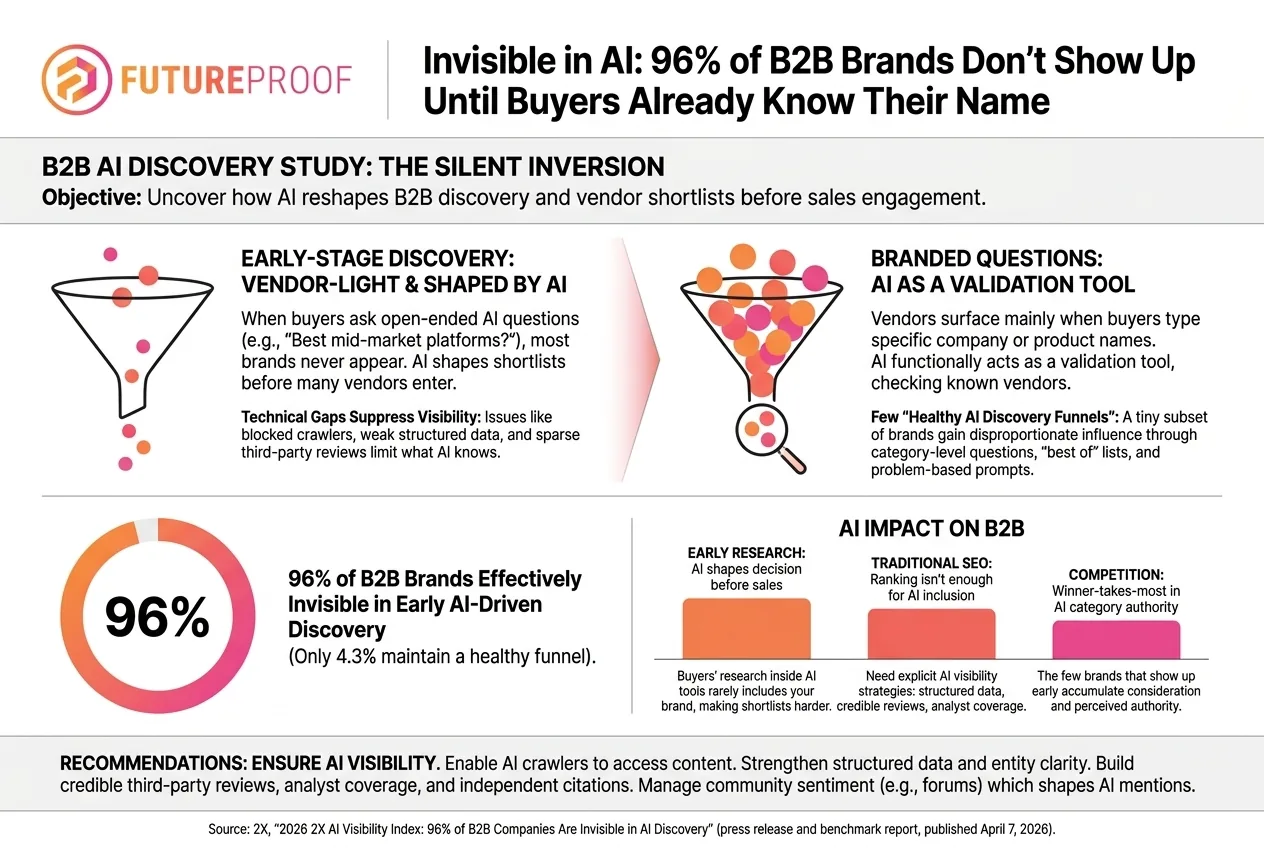
The landscape of B2B buyer discovery is undergoing a seismic, yet often unseen, transformation. While businesses have long honed their SEO strategies and invested heavily in brand recognition, a new, silent gatekeeper has emerged: Artificial Intelligence. As B2B buyers increasingly turn to AI tools for preliminary research, the stark reality is that a staggering 96% of B2B brands remain invisible until the buyer already knows their name. This profound shift, illuminated by the 2X AI Visibility Index 2026, reveals a widening chasm between traditional digital presence and effective AI-driven discovery, posing an existential threat to businesses unprepared for this new frontier.
The core of this disruption lies in how buyers are now building their shortlists. The days of solely relying on keyword-driven searches that lead to a predictable list of links are rapidly receding. Instead, B2B professionals, pressed for time and seeking synthesized intelligence, are engaging with AI tools through broad, open-ended questions. Imagine a mid-market executive asking, “What are the best platforms for mid-market companies seeking to optimize their supply chain?” or a marketing leader inquiring, “Explain AI-powered analytics tools for B2B lead generation.” These are not branded queries; they are problem-based, category-based, and inherently open to discovery. Yet, the data from the 2X AI Visibility Index is unequivocal: most vendors are conspicuously absent from these crucial early-stage conversations.
This absence is not merely a missed opportunity; it’s a fundamental disconnect. Brands typically only surface when a buyer already possesses a degree of familiarity, typing in queries like “Acme Corp CRM reviews” or “features of Innovate Solutions ERP.” This implies that the brand has already entered the buyer’s awareness through other, often traditional, channels. The AI is then used for validation, not initial discovery. This dynamic effectively relegates the vast majority of B2B companies to the sidelines during the critical phase when category understanding is being shaped, and initial vendor consideration sets are being formed. A small, elite minority, however, consistently appear in these broad, category, and problem-based prompts, garnering disproportionate visibility and influence right from the outset of the buyer’s journey. These are the 4.3% of B2B companies that are actively cultivating a healthy AI discovery funnel.
Understanding why 95.7% of businesses are failing to appear in these pivotal AI queries is crucial. The limitations are multi-faceted, stemming from an outdated approach to digital presence that overlooks the unique requirements of AI models. Foremost among these is the pervasive issue of missing structured data. Traditional websites are designed for human consumption, with visual hierarchies and textual content. AI, however, thrives on structured data – information organized in a machine-readable format that explicitly defines entities, relationships, and attributes. Think of Schema.org markup, which can tag a product’s features, pricing, reviews, an organization’s type, location, and contact information. Without this semantic layer, AI models struggle to accurately parse, understand, and synthesize information about a company, its offerings, or its industry standing. It’s like trying to read a book with all the paragraphs jumbled and no chapter titles; humans might eventually make sense of it, but a machine will find it immensely difficult to extract definitive facts. When an AI tool cannot confidently identify what a company does, what problems it solves, or its relevance to a broad query, it simply won't feature it in its responses.
Another insidious barrier to AI visibility often comes from blocked AI crawlers. In an effort to manage bandwidth, prevent scraping, or bolster security, many websites employ robots.txt directives, CDN configurations, or IP blocking rules that inadvertently restrict or completely deny access to the sophisticated crawlers used by large language models (LLMs) and generative AI systems. While these measures might be effective against malicious bots or for controlling traditional search engine indexing, they can tragically render a brand’s entire digital footprint invisible to AI. If AI systems cannot crawl and index a website's content, irrespective of its quality or relevance, that brand simply ceases to exist within the AI's universe of knowledge, directly impacting its ability to be cited or recommended. The intent behind blocking crawlers might be valid, but the unintended consequence in the age of AI is digital erasure.
Furthermore, weak third-party reviews significantly limit AI visibility. AI models are programmed to prioritize authoritative, unbiased, and widely corroborated information. For B2B products and services, third-party review platforms (like G2, Capterra, Gartner Peer Insights, TrustRadius) serve as crucial reservoirs of validated user experiences and industry perceptions. AI systems learn from these aggregations, using them to understand a solution's strengths, weaknesses, typical use cases, and overall reputation. A brand with sparse, outdated, or poorly managed reviews on these platforms projects an image of lower credibility or relevance to AI. Conversely, a robust presence with numerous, recent, and well-categorized positive reviews signals a trusted entity, significantly increasing the likelihood of being featured in AI-generated recommendations for category-based queries. The absence of this social proof in a machine-readable, aggregated format effectively mutes a brand's voice within the AI ecosystem.
Finally, sparse citations also contribute heavily to this invisibility. AI models, much like humans, gauge trustworthiness and authority through external validation. This means how often, and in what context, a brand is mentioned, linked to, and referenced across the wider web. These citations encompass backlinks from reputable industry publications, mentions in research papers, expert endorsements, and news coverage. They form a web of corroboration that tells AI, "This entity is legitimate, authoritative, and a recognized player in its field." Google’s E-E-A-T (Experience, Expertise, Authoritativeness, Trustworthiness) framework, while initially for traditional search, finds even greater resonance with AI. Without a strong network of external validations, a brand’s digital presence appears isolated, lacking the collective endorsement that AI systems use to weigh relevance and credibility. An AI will prioritize sources that are frequently cited by others, reinforcing the winner-takes-most dynamic.
The reasons for this invisibility lead directly to profound implications for B2B businesses. The most critical is that buyers are forming shortlists before a vendor ever enters the conversation directly. This marks a fundamental shift in the B2B buyer journey. The "dark funnel," where buyers conduct extensive research anonymously before engaging with any sales representative, is now amplified and accelerated by AI. Buyers are getting answers, comparisons, and even initial recommendations from AI tools, all without ever visiting a vendor's website or interacting with their sales team. By the time a buyer might type in a branded query or reach out for a demo, they may have already identified their top three contenders or, conversely, silently disqualified dozens of others who never appeared in their AI-driven research. This dramatically shortens the traditional sales cycle, compresses the window for influence, and renders traditional top-of-funnel marketing efforts obsolete if they don't cater to AI discovery. Businesses are losing the opportunity to shape initial perceptions, educate buyers on their unique value proposition, or even be considered as a viable option.
Furthermore, strong traditional SEO and brand recognition no longer guarantee presence in AI answers. This is a critical distinction often misunderstood. Achieving high rankings on Google’s traditional Search Engine Results Pages (SERPs) for specific keywords, or possessing widespread brand awareness, were once the pinnacles of digital marketing success. However, AI-generated answers operate on a different logic. AI doesn't just present a list of links; it synthesizes information from a multitude of sources to provide a direct, concise answer. A website might rank #1 on Google for a specific query, but if its content isn't structured for AI comprehension, or if the brand lacks external validation, the AI might bypass it entirely in favor of a less "ranked" but more AI-digestible source. Brand recognition is helpful for branded queries, but it won't magically inject a brand into a generic, problem-based AI answer if the underlying data and digital footprint aren't optimized for AI. The paradigm has shifted from "being found" to "being understood and trusted by AI."
This leads to the most alarming implication: AI is creating a winner-takes-most dynamic in each category. The 4.3% of companies that have mastered AI visibility are poised to gain a disproportionate share of early-stage mindshare and, consequently, market share. Once an AI model identifies and consistently trusts a few authoritative sources for a particular category or problem, it tends to favor those sources repeatedly. This creates a powerful feedback loop: visibility begets more visibility, trust begets more trust. It becomes exponentially harder for latecomers to break into this established AI answer set. The cost of entry, both in terms of strategic effort and digital restructuring, will only escalate. Early movers who proactively optimized for AI discovery will cement their position as the go-to solutions in the eyes of AI, effectively gatekeeping the early stages of the buyer journey for all others. This consolidation threatens to reshape competitive landscapes, leaving late adopters struggling for relevance and recognition.
The findings from the 2X AI Visibility Index 2026 serve as a stark warning and a clear call to action. The era of passive digital presence, where SEO and brand recognition alone were sufficient, is over. The new battleground for B2B discovery is within the algorithms and knowledge graphs of AI. Businesses that fail to address missing structured data, inadvertently blocked AI crawlers, weak third-party reviews, and sparse citations are effectively choosing to be invisible during the most formative stages of the buyer journey. They are ceding control of early discovery and category understanding to their more AI-savvy competitors. The path forward for the 95.7% is not merely to refine existing SEO, but to embark on a fundamental re-evaluation of their entire digital footprint, ensuring it is purpose-built for AI consumption. Only then can they hope to emerge from the shadows of AI invisibility and reclaim their voice in the increasingly AI-driven world of B2B commerce.