The AI Driven Spontaneous Shift Transforming the Future of Consumer Shopping
The landscape of consumer purchasing is undergoing a radical transformation, driven by the pervasive influence of artificial intelligence. AI shopping agents are not merely tools for convenience; they are fundamental architects of a new era in retail, an era defined by speed, spontaneity, and highly personalized experiences. This shift is fundamentally reshaping how consumers discover, evaluate, and ultimately acquire products, moving away from traditional, linear shopping paths towards more intuitive, conversational, and ultimately, impulse-driven decisions. The implications for e-commerce businesses are profound, necessitating a strategic re-evaluation of everything from product discovery to customer engagement and supply chain management.
At the heart of this revolution are AI shopping agents, sophisticated algorithms designed to mimic human interaction, understand individual preferences, and offer instant, contextually relevant recommendations. These agents are evolving beyond simple chatbots, acting as intelligent personal shoppers that learn from every interaction, every query, and every purchase. Their ability to process vast amounts of data, analyze consumer behavior patterns, and predict future needs is unparalleled, resulting in a shopping experience that feels almost telepathic. This proactive approach fundamentally alters the consumer journey, significantly compressing the decision-making cycle. Where once a customer might spend hours browsing multiple websites, comparing prices, and reading reviews, an AI agent can now distill that process into a matter of minutes, presenting optimal choices tailored precisely to their expressed and implied desires. This acceleration is a primary driver of the increasingly spontaneous purchase decisions observed across digital commerce.
Generative AI, in particular, stands out as a pivotal technology within this evolving framework. Its capabilities extend far beyond simple search queries, offering truly conversational discovery that mimics the natural flow of human conversation. Shoppers can articulate their needs, preferences, and even their moods in natural language, and GenAI responds with instant, curated recommendations. This might involve a user asking, "Show me stylish yet comfortable sneakers for long walks in a city, preferably eco-friendly and under $150," and the AI agent instantly compiling a personalized list of options, complete with visual references, brief descriptions, and direct purchase links. This is a significant departure from traditional keyword-based search, which often yields an overwhelming array of results that require further sifting. GenAI cuts through the noise, providing friction-free journeys where the path from intent to purchase is incredibly smooth and direct. The intelligence lies not just in understanding the words, but in grasping the underlying intent, the lifestyle implications, and the subtle nuances of the consumer's request. This level of personalized interaction fosters a sense of trust and efficiency that traditional interfaces struggle to match, further accelerating the purchase decision.
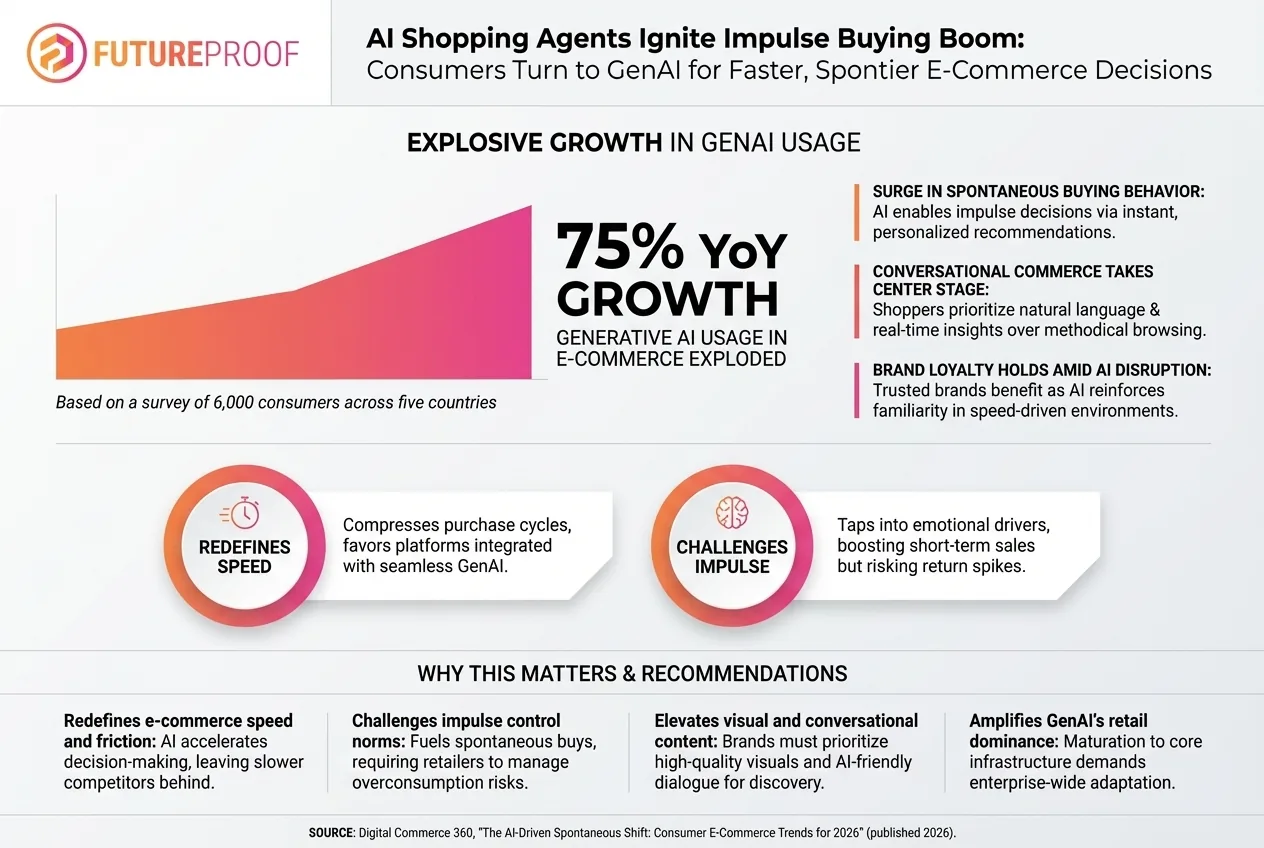
The consequence of this AI-driven efficiency is a dramatic shift away from traditional search engine reliance. Consumers are increasingly bypassing the general search bar, opting instead for direct engagement with AI agents embedded within retail platforms, social media, or even standalone smart devices. This paradigm shift effectively redefines the concept of "discovery." It's no longer about actively searching for information; it's about passively receiving highly relevant suggestions. The friction-free journey enabled by these agents minimizes cognitive load, making the entire shopping experience effortless. This ease of access and immediate gratification directly fuels an increase in impulse buying. When the perfect product appears instantaneously, requiring minimal effort to acquire, the psychological barrier to purchase significantly lowers. The immediacy of the recommendation, coupled with the confidence instilled by a seemingly intelligent and personalized suggestion, translates directly into faster conversion rates and more spontaneous purchases. New data powerfully underscores this trend: Generative AI usage in e-commerce experienced a remarkable 75 percent year-over-year growth in a recent survey encompassing 6,000 consumers across five countries. This surge is directly correlated with a rise in impulse buying and a preference for conversational shopping, as detailed in Digital Commerce 360's "The AI-Driven Spontaneous Shift Consumer E-Commerce Trends for 2026." This statistic is not merely a data point; it represents a fundamental reorientation of consumer behavior, signaling a permanent departure from past shopping norms.
The very essence of the digital storefront is also being redefined. Traditional e-commerce relied heavily on static product pages, detailed descriptions, and user reviews. While these elements still hold value, visual content and natural language interactions are rapidly becoming the primary modes of engagement. Imagine a consumer uploading an image of a celebrity's outfit and asking an AI agent, "Where can I find similar shoes to these?" The agent, leveraging advanced image recognition and product matching algorithms, instantly provides options. Or consider voice-activated shopping, where a consumer simply speaks their desires into a smart speaker or mobile device, initiating a conversational transaction. This intuitive interaction mimics real-world shopping experiences with a knowledgeable sales assistant, but with the added benefits of endless inventory and instant information retrieval. Rich media, including interactive 3D models, augmented reality try-ons, and personalized video recommendations generated by AI, transform passive viewing into active, immersive experiences. These dynamic, visually rich, and verbally interactive interfaces are more engaging, more persuasive, and ultimately, more effective at driving spontaneous purchases than static text and images ever could be. They provide a deeper, more immediate understanding of a product, reducing uncertainty and accelerating decision-making.
In this AI-driven environment, brand trust takes on even greater significance. While AI agents are designed to be objective, their recommendations are often influenced by historical data, user preferences, and explicit prompts. Critically, AI frequently reinforces familiar choices, guiding consumers towards brands they already recognize and trust. When an AI agent presents a highly personalized recommendation, the implicit endorsement of a trusted brand within that suggestion can be a powerful accelerator of purchase. Consumers are more likely to act on an impulse when the recommended product comes from a brand they know and have positive associations with. This dynamic creates a significant advantage for established brands that have cultivated strong reputations and customer loyalty. For lesser-known or emerging brands, the challenge intensifies; they must find innovative ways to build trust and recognition within an ecosystem where AI agents often prioritize familiarity and proven satisfaction. Strategies might include leveraging micro-influencers integrated with AI recommendations, focusing on transparent product information that AI can easily parse, or investing in highly unique product data that differentiates them in AI-driven discovery processes.
For e-commerce businesses, adapting to this spontaneous, AI-driven shift is not optional; it is imperative for sustained growth and relevance. The strategies for success must evolve significantly. First, embracing conversational commerce is paramount. This means designing user interfaces and backend systems that can seamlessly integrate natural language processing and generative AI capabilities. Businesses must think beyond simple keyword matching and focus on understanding user intent, context, and sentiment within conversational flows. This requires robust chatbot development, voice commerce optimization, and the ability to personalize interactions at scale.
Second, content strategy must undergo a fundamental transformation. The emphasis must shift from purely textual product descriptions to rich, interactive, and visually compelling content that AI agents can easily process and present. High-quality images, 3D models, video demonstrations, and even AI-generated personalized video snippets become crucial. This content not only engages consumers directly but also provides the necessary data for AI to make intelligent, informed recommendations. Investing in assets that allow for augmented reality (AR) try-ons or virtual product placements can significantly enhance the immersive experience and reduce purchase hesitancy.
Third, hyper-personalization, driven by AI, moves from a 'nice-to-have' to a 'must-have'. Businesses need to leverage AI to not only recommend products but to tailor the entire customer journey, from initial discovery to post-purchase support. This includes dynamic pricing, personalized promotions, and even custom product bundles based on individual behavioral patterns. The deeper the understanding of each customer, the more effective the AI agent can be in facilitating spontaneous, satisfying purchases. Data analytics and robust AI infrastructure are the backbone of this capability, requiring continuous investment and refinement.
Fourth, data analytics and insights become even more critical. AI shopping agents generate an unprecedented volume of granular data about consumer preferences, shopping patterns, and decision-making triggers. Businesses must develop sophisticated analytics capabilities to harness this data, extracting actionable insights that can inform product development, marketing strategies, and inventory management. Understanding why and when impulse purchases occur, and which product attributes are most frequently cited in conversational queries, provides a competitive edge. This feedback loop is essential for refining AI models and optimizing the customer experience continuously.
Fifth, operational agility is non-negotiable. The increased speed and spontaneity of purchases put immense pressure on supply chains and logistics. Businesses must be able to fulfill orders rapidly and efficiently to capitalize on impulse decisions. Real-time inventory management, predictive analytics for demand forecasting, and optimized delivery networks become critical components of a successful e-commerce operation in this new paradigm. A friction-free journey extends beyond the checkout button to prompt and reliable delivery.
Finally, while the convenience and efficiency of AI are undeniable, ethical considerations must remain at the forefront. Data privacy, transparency in AI recommendations, and avoiding algorithmic bias are crucial. Consumers need to trust that their data is handled responsibly and that AI agents are providing unbiased suggestions, rather than merely pushing sponsored products. Businesses must implement clear policies and build AI systems with ethical guidelines embedded at their core to maintain consumer confidence and ensure long-term success. The human element of customer service, while augmented by AI, will also remain vital for complex issues and emotional connections, requiring a careful balance between automated efficiency and empathetic human interaction.
Looking ahead to 2026 and beyond, the influence of AI on consumer buying will only intensify. Predictive AI will become even more sophisticated, anticipating needs before consumers even consciously realize them. Augmented and virtual reality will integrate more seamlessly with AI agents, offering fully immersive shopping experiences that blur the lines between digital and physical. The concept of "shopping" itself might evolve, becoming an ambient, always-on experience where products are suggested and acquired almost effortlessly as part of daily life. The "AI-Driven Spontaneous Shift" is not merely a trend; it is the new operational blueprint for digital commerce. Businesses that proactively embrace these changes, investing in AI capabilities, re-imagining their customer journeys, and prioritizing both efficiency and trust, will be best positioned to thrive in this rapidly evolving, exciting, and highly impulsive retail landscape. The future of commerce is conversational, visual, instantaneous, and undeniably intelligent.