AI Driven Local Search Is Now Essential For Business Visibility
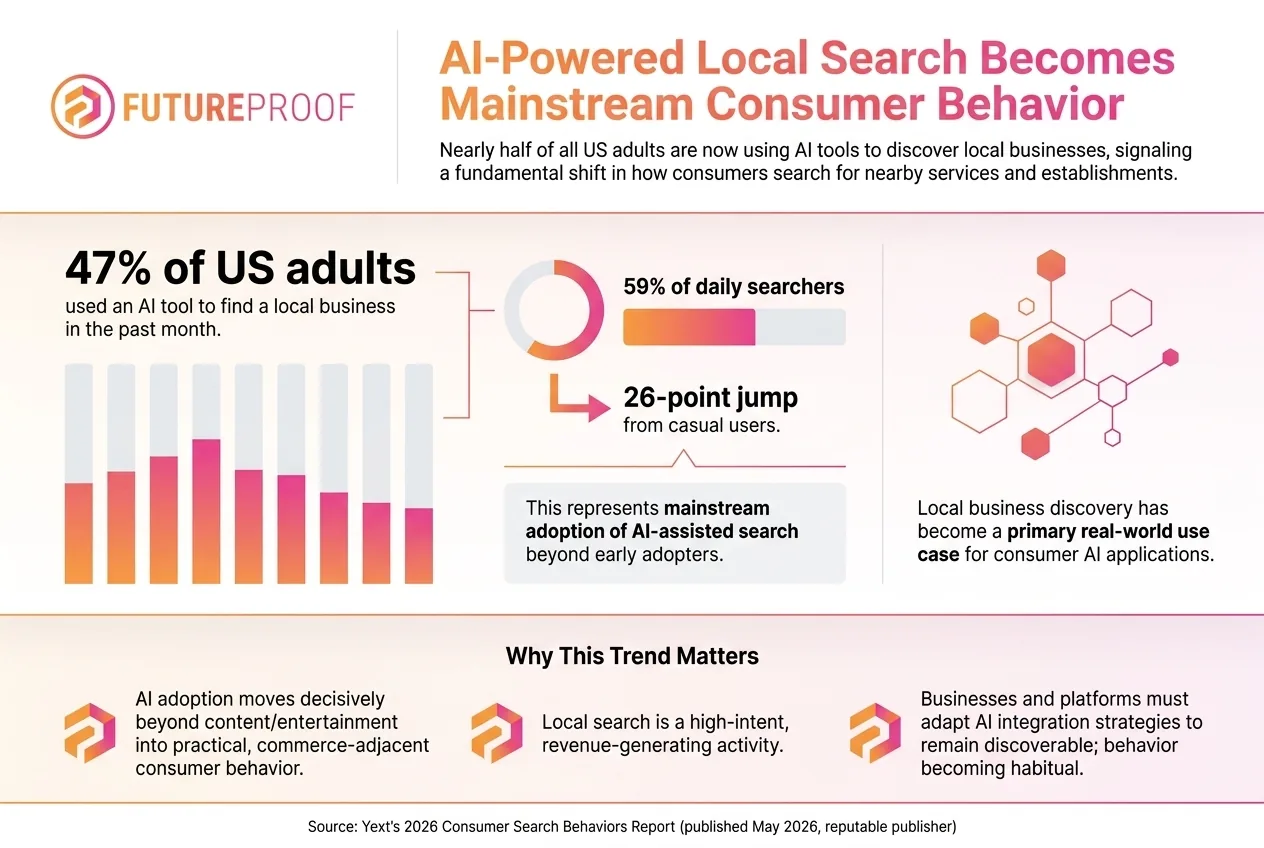
AI-powered local search is no longer a futuristic concept; it has firmly cemented itself as a mainstream consumer behavior, fundamentally reshaping how individuals discover and engage with businesses in their immediate vicinity. The data unequivocally supports this seismic shift: according to Yext's 2026 Consumer Search Behaviors Report, a staggering 47% of US adults utilized an AI tool within the past month specifically to locate a local business. This figure surges dramatically among daily searchers, reaching an even more compelling 59 percent. These statistics are not merely abstract numbers; they represent a profound transformation in the digital landscape, signaling a critical inflection point for every business operating within a local context.
This evolution signifies that the applications of artificial intelligence have expanded far beyond content generation or entertainment, transcending its earlier perceived boundaries. AI is now a primary conduit for high-intent discovery, directly influencing the tangible, real-world choices consumers make every single day. From deciding where to enjoy a meal to selecting a retailer for essential purchases, or finding a service provider to address an urgent need, AI is increasingly the trusted guide. For businesses, this paradigm shift carries an undeniable implication: AI visibility is no longer an optional add-on but has become absolutely central to effective customer acquisition strategies. The message is crystal clear: as consumers increasingly entrust AI to steer their real-world decisions, brands must proactively ensure their information is not only meticulously accurate but also intelligently structured and comprehensively optimized for this new era of AI-driven discovery.
The consumer’s reliance on AI for local searches stems from a deep-seated desire for efficiency, personalization, and convenience. Imagine a scenario where a user asks their AI assistant, "Find the best dog-friendly coffee shop near me with outdoor seating that's open until 7 PM." This isn't a simple keyword match; it's a complex query requiring an AI to understand multiple parameters, cross-reference diverse data points, and deliver a tailored, actionable recommendation. AI tools excel at this level of sophisticated query processing, sifting through vast amounts of information to present highly relevant, contextualized results. This capability fosters a sense of trust; consumers believe AI can cut through the noise and provide them with precisely what they need, often leading directly to a purchase or visit. The immediacy of these AI-powered recommendations translates directly into high-intent actions, making businesses that appear in these results incredibly valuable.
This shift also highlights the growing importance of the "last mile" search – queries that lead directly to a physical action or transaction. Consumers are using AI to find everything from the nearest pharmacy open late to a highly-rated auto mechanic or a specialty bakery that offers gluten-free options. The AI acts as a smart concierge, guiding users through the final stages of their decision-making process, often bypassing traditional search engine results pages in favor of direct, synthesized answers. This phenomenon underscores the need for businesses to move beyond simply having a website; they must now possess a robust, AI-intelligible digital presence across a multitude of platforms where AI assistants aggregate their data. Businesses that fail to grasp this distinction risk becoming invisible to a significant and growing segment of their potential customer base.
The imperative for businesses is to recognize that their "digital storefront" is rapidly evolving from a static website to a dynamic, AI-interpretable knowledge graph. This digital knowledge graph comprises all the factual information about a business, its offerings, location, hours, and reputation, structured in a way that AI systems can easily ingest and understand. When an AI tool provides a recommendation, it is drawing from this comprehensive digital understanding. Therefore, the foundational pillar of AI-driven discovery is accuracy. Inaccurate information is not just unhelpful; it's actively detrimental. An AI that directs a customer to a closed business, or provides an incorrect phone number, undermines trust and can lead to lost revenue and negative sentiment, both for the business and the AI itself. Businesses must meticulously verify and maintain consistency for core data points such as Name, Address, Phone (NAP), hours of operation, website URL, service lists, and product availability across all digital touchpoints—Google Business Profile (GBP), Apple Maps, Yelp, social media profiles, and their own website. This unwavering commitment to accuracy establishes the credibility that AI systems demand.
Beyond mere accuracy, structured information is the bedrock upon which AI systems build their understanding. AI thrives on data that is organized, categorized, and clearly defined. This is where technologies like Schema markup become indispensable. Schema.org vocabulary allows businesses to semantically label specific types of content on their websites (e.g., business hours, product prices, event dates, customer reviews) in a machine-readable format. While invisible to the human eye, this structured data acts as a Rosetta Stone for AI, enabling it to interpret the context and meaning of information with far greater precision than unstructured text alone. For local businesses, implementing local business Schema, product Schema, review Schema, and FAQ Schema can significantly enhance how AI tools discover and present their offerings. This structured approach helps AI answer complex, nuanced queries directly, improving the likelihood of a business being featured prominently in AI-driven local search results.
The third critical component is comprehensive optimization for AI-driven discovery, which extends beyond traditional SEO tactics. This involves a deep understanding of Natural Language Processing (NLP) – how AI interprets and understands human language. While keyword research remains relevant, it must evolve into "intent research" and "query pattern analysis," anticipating the conversational nature of AI interactions, especially in voice search. Consumers using AI often speak in full sentences, asking questions like "Where can I find a vegan bakery open late on a Tuesday?" Businesses need to optimize their content not just for keywords but for complete questions and conversational phrases. This includes developing robust FAQ sections on their websites that directly answer common local queries and creating blog content that addresses specific local needs and problems their business solves.
Semantic search is another vital aspect of AI optimization. AI isn't just looking for keyword matches; it's trying to understand the underlying meaning and context of a search query. This means building a strong digital knowledge graph for your business. An entity-based SEO approach focuses on defining your business as a distinct entity with clear attributes, relationships, and categories. For example, if you're a "farm-to-table restaurant," AI needs to understand not just "restaurant" but also the nuances of "farm-to-table" (sourcing, freshness, seasonal menu) and its relation to local producers. This holistic understanding allows AI to make more intelligent, contextually relevant recommendations, placing your business in front of customers who truly align with your unique selling propositions.
Review management also plays a profoundly influential role in AI visibility. AI systems are increasingly sophisticated in analyzing customer sentiment, extracting key themes from reviews, and using this information to inform recommendations. A business with numerous recent, positive reviews highlighting specific attributes (e.g., "friendly staff," "great ambiance," "fast service," "delicious food") will be favored by AI over one with sparse or negative feedback. Proactive solicitation of reviews, thoughtful responses to all feedback (positive and negative), and ensuring reviews are discoverable by AI through structured data are non-negotiable strategies for modern customer acquisition. AI systems can synthesize review data to answer questions like "What's a local Italian restaurant known for its homemade pasta and good service?" directly, making customer feedback a powerful AI optimization tool.
The consequences of ignoring this paradigm shift are dire. Businesses that do not prioritize AI visibility risk becoming effectively invisible to a significant and rapidly expanding segment of the consumer market. Losing out on AI-driven local search means relinquishing potential customers to competitors who are optimized. This isn't about adapting to a niche trend; it's about responding to a fundamental change in mainstream consumer behavior that directly impacts foot traffic, online orders, service appointments, and ultimately, revenue. The competitive advantage will increasingly belong to those who understand that their online presence needs to be not just human-readable, but also AI-intelligible and AI-recommendable.
For brands, this isn't merely an IT or marketing task; it's a strategic imperative that touches every aspect of customer engagement. It requires a unified approach to data management, digital content strategy, and online reputation. Businesses must perform regular audits of their digital information across all platforms, ensuring consistency and accuracy. They must invest in understanding and implementing structured data on their websites. They need to evolve their content strategy to anticipate AI-driven queries, creating rich, informative content that answers specific, high-intent local questions. And they must actively manage and encourage positive online reviews, recognizing their significant influence on AI recommendations.
The takeaway is indeed clear and urgent. As consumers increasingly rely on AI to guide their real-world decisions—whether it's finding a new coffee shop, a reliable plumber, or the perfect gift—brands must ensure their digital information is not just present but meticulously accurate, intelligently structured, and comprehensively optimized for AI-driven discovery. The statistic from Yext's report, revealing that nearly half of US adults have used an AI tool for local business discovery in the past month, and even more among daily searchers, serves as a powerful testament to the current reality. This isn't a future scenario; it's the present. Embracing AI optimization isn't just about adapting to new technology; it's about securing future customer acquisition and ensuring continued relevance in an increasingly AI-powered world. Businesses that prioritize this shift will thrive, while those that do not risk being left behind in the rapidly evolving landscape of local commerce. The time for proactive AI visibility is now, solidifying its place as a core component of sustainable business growth.