AI Driven Commerce Is Transforming the Future of Online Retail
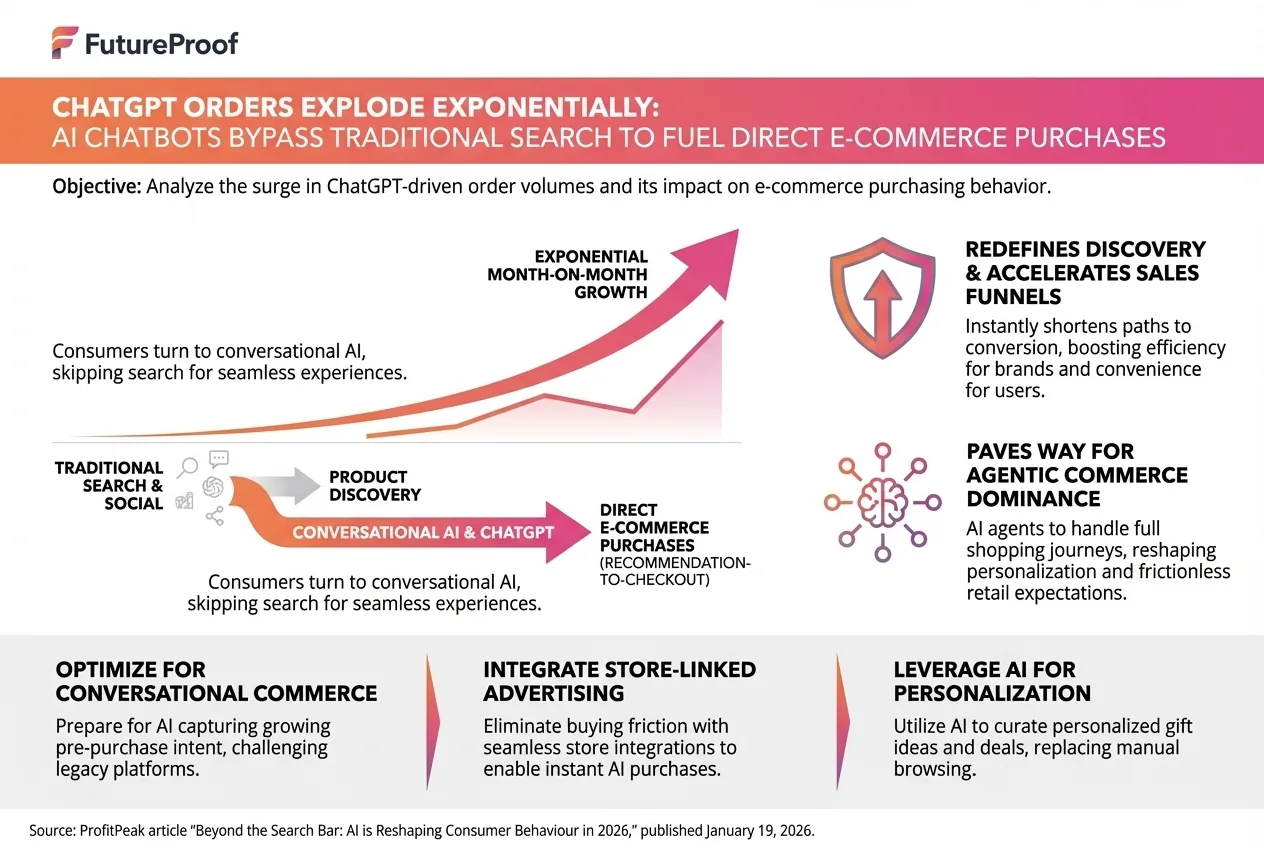
The landscape of online commerce is undergoing a profound and unprecedented transformation, driven by the rapid evolution and integration of AI chatbots into the very fabric of consumer discovery and purchasing. What began as a nascent technology for customer service has quickly blossomed into a powerful, agentic force, fundamentally reshaping how individuals interact with brands, find products, and ultimately make buying decisions. The data unequivocally supports this seismic shift: ChatGPT-attributed orders are increasing at an exponential month on month pace, a staggering revelation that underscores AI's growing dominion in the e-commerce sphere. This isn't merely a trend; it's a recalibration of the entire customer journey, signaling a pivotal moment for retailers globally.
This exponential growth in AI-driven purchases is not a happy accident but the result of meticulously engineered, frictionless integrations that bridge the conversational interface of AI with the transactional world of online retail. Platforms like Shopify are at the forefront of this revolution, enabling seamless, store-linked pathways that allow users to purchase directly within their AI conversations. Imagine discussing a new outfit with an AI assistant, receiving tailored recommendations based on your stated preferences, body type, and budget, and then, with a simple confirmation, completing the purchase without ever leaving the chat window. This level of immediacy and convenience is a game-changer, eliminating the traditional steps of navigating to a website, searching for products, adding to cart, and proceeding through a multi-stage checkout. For the consumer, it represents an unparalleled ease of buying, transforming a potentially arduous process into an effortless, intuitive dialogue. This conversational commerce paradigm is setting new benchmarks for efficiency and personalization in digital shopping.
The influence of AI, particularly advanced models like ChatGPT, extends far beyond direct, in-chat purchases. It is increasingly impacting the critical pre-purchase phase, subtly yet powerfully shaping consumer intent and decision-making long before a transaction occurs. Shoppers are now leveraging AI to generate highly curated wishlists, meticulously tailored gift ideas, and personalized product recommendations for significant retail moments such as Black Friday, holiday seasons, or personal celebrations. This intelligent assistance significantly reduces the reliance on traditional discovery channels like broad search engine queries, generic social media browsing, or even direct brand website exploration. Instead of sifting through countless product pages or sponsored posts, consumers can articulate their needs, preferences, and even emotional context to an AI, which then synthesizes this information to present highly relevant, actionable suggestions. This deep understanding of individual intent is what allows AI to craft perfect gift lists for a notoriously difficult relative or to compile a wishlist that genuinely reflects personal style, effectively bypassing the noise of conventional digital advertising.
For retailers, this burgeoning shift represents a critical turning point and an urgent call to action. AI-driven conversational commerce is dramatically shortening sales funnels, collapsing what was once a multi-step journey into a direct, often instantaneous, path from discovery to purchase. By capturing early-stage intent directly within conversational interfaces, brands can engage with potential customers at the very inception of their buying thought process, even before they might consider a specific product or brand. This bypasses much of the traditional customer journey mapping, challenging the long-standing dominance of conventional discovery channels that have relied on paid search, organic SEO, and social media advertising. Brands that fail to adapt their customer journey for this new era of AI-based product discovery and agentic buying risk being left behind, losing visibility and market share to more forward-thinking competitors. The future of ecommerce, as indicated by the rapid ascent of ChatGPT-attributed orders, lies in understanding and integrating with these intelligent agents.
To truly capitalize on this transformation, retailers must pivot their strategies to optimize for AI-based product discovery. This involves more than just ensuring product descriptions are keyword-rich for traditional search engines; it demands a deeper, more semantic understanding of product attributes, use cases, and benefits that an AI can interpret and present conversationally. Structured data, comprehensive product feeds, and rich, descriptive content become paramount, allowing AI models to accurately represent products and match them to complex consumer queries. Furthermore, embracing "agentic buying" means empowering AI systems to act on behalf of the consumer, making informed recommendations and facilitating purchases with minimal user intervention. This requires robust API integrations, secure payment gateways, and seamless backend connectivity to ensure inventory, pricing, and fulfillment can all be managed efficiently through an AI-driven interaction. The goal is to create an ecosystem where AI acts as a highly knowledgeable, infinitely patient personal shopper, guiding users from contemplation to confirmation with unparalleled efficiency.
The strategic imperative for brands is clear: adapt or face obsolescence in an increasingly AI-centric market. Those retailers who proactively redesign their customer journey to accommodate AI-based product discovery and agentic buying will secure a significant competitive advantage. This involves not just technological integration but also a fundamental rethinking of marketing, sales, and customer service. Instead of relying solely on customers to find them through traditional search or advertising, brands must ensure their products and services are discoverable and presentable within AI conversations. This could mean optimizing product data specifically for AI interpretation, developing conversational content strategies, and exploring partnerships with leading AI platforms. The early movers in this space will establish strong brand presence within these emerging AI discovery channels, fostering consumer loyalty and capturing market share before the mainstream fully grasps the scale of this shift. As the ProfitPeak report, "Beyond the Search Bar: AI is Reshaping Consumer Behaviour in 2026," published on January 19, 2026, so accurately states, the next phase of ecommerce is already here, and it’s powered by AI.
A deeper dive into the mechanics reveals the sophistication underpinning this shift. At its core, advanced AI chatbots leverage Natural Language Processing (NLP) to understand complex, nuanced consumer queries, moving beyond simple keyword matching to grasp intent, context, and even emotional subtext. This allows the AI to offer highly relevant suggestions, whether a user is asking for "a durable backpack for my active teen who loves hiking" or "a unique, meaningful gift for my eco-conscious sister's 30th birthday." Coupled with powerful personalization engines, these AI systems can cross-reference user profiles, past purchase history, stated preferences, and even inferred tastes to refine recommendations further. Real-time inventory checks integrated within the chat ensure that suggested products are actually available, preventing frustrating dead ends. Finally, secure payment integrations complete the loop, allowing users to finalize purchases with trust and confidence, all within the familiar conversational interface. The AI effectively becomes an intelligent agent, guiding, assisting, and transacting on behalf of the user, making the entire shopping experience feel effortless and highly personalized.
Measuring the success of these AI-driven initiatives requires evolving traditional attribution models. While direct, in-chat purchases are easily trackable, the indirect influence of AI on pre-purchase behavior is equally significant. How do we quantify the value of an AI-generated wishlist that later leads to a purchase via a traditional website visit? Retailers must develop sophisticated analytics to track AI's impact on brand engagement, repeat purchases, and overall customer lifetime value. Furthermore, the future holds even more profound integrations. Predictive AI will anticipate consumer needs before they are explicitly articulated, proactively suggesting products or services based on behavioral patterns and external factors. Imagine an AI suggesting rain gear based on a sudden change in local weather patterns or proposing travel accessories before a planned trip. The convergence of AI chatbots with augmented reality (AR) and virtual reality (VR) will create immersive shopping experiences, allowing users to virtually "try on" clothes or "place" furniture in their homes directly through an AI conversation. Voice commerce, already gaining traction, will become even more seamless as AI assistants understand complex spoken commands and facilitate transactions with natural ease.
The transformation heralded by AI chatbots is not merely an incremental improvement to existing ecommerce models; it is a fundamental redefinition of the entire consumer journey. The exponential rise in ChatGPT-attributed orders is a clear signal that consumers are embracing these new pathways to discovery and purchase with remarkable speed. This shift, profoundly detailed by ProfitPeak in their "Beyond the Search Bar: AI is Reshaping Consumer Behaviour in 2026" report, published on January 19, 2026, demands immediate and strategic adaptation from retailers. Brands that understand and proactively embed AI into their customer experience, optimizing for conversational discovery and agentic buying, will not only survive but thrive in this next, dynamic phase of digital commerce. The future of online retail is conversational, personalized, and undeniably intelligent, with AI serving as the indispensable conduit between consumer desire and product fulfillment.