AI Curated Carts Are Rewriting Brand Loyalty and Reshaping the Future of Consumer Commerce
The landscape of consumer commerce is undergoing a profound and silent revolution, driven not by flashy advertising campaigns or celebrity endorsements, but by the quiet power of artificial intelligence. For years, AI’s role in retail seemed to be primarily about expediting search, personalizing website layouts, or offering basic product suggestions. Yet, recent data from Locus’s Q2 2026 US Consumer Survey unveils a far more fundamental shift: AI is not merely a tool for navigation, but an active participant in shaping consumer purchasing decisions, directly influencing what ends up in the cart and, consequently, rewriting the very definition of brand loyalty. This transformation, spearheaded by AI-curated carts, marks a pivotal moment for both established brands and agile challengers, demanding a strategic re-evaluation of how products are presented, perceived, and purchased in the digital age.
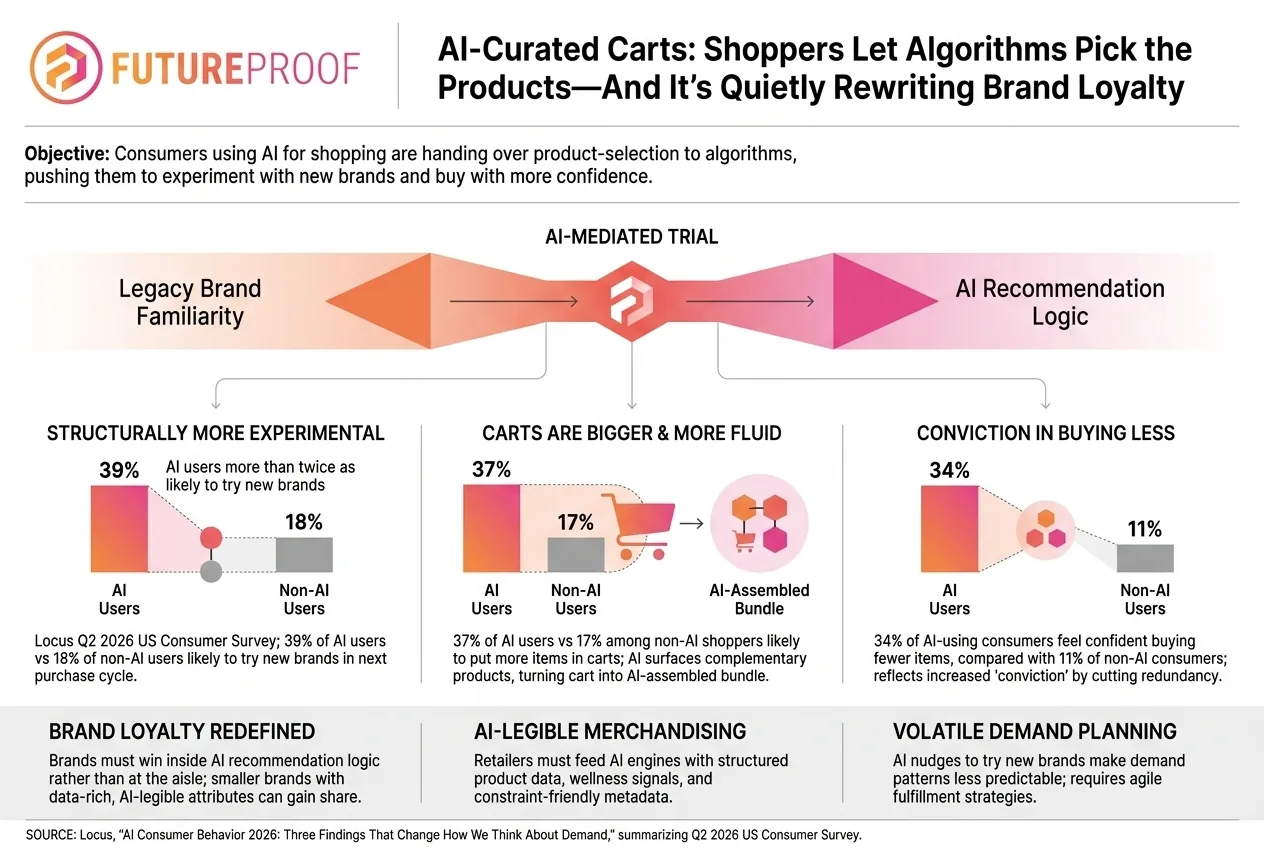
The Locus survey's findings are unequivocal, highlighting a stark divergence in behavior between AI-assisted shoppers and their non-AI counterparts. A staggering 39 percent of consumers leveraging AI for their shopping journeys expressed a willingness to try new brands in their next purchase cycle, a figure more than double the 18 percent of non-AI users. This willingness to venture beyond familiar names is a direct consequence of the trust consumers place in AI's recommendations. When an algorithm, perceived as impartial and highly informed, suggests a product, the inherent risk associated with trying something new diminishes significantly. AI acts as a digital curator, sifting through vast oceans of product data, reviews, and personal preferences to present options that align with a shopper's needs and values, even if those options come from previously unknown brands. For challenger brands, this represents an unprecedented opportunity to penetrate markets traditionally dominated by legacy players, provided they can optimize their product information for AI interpretation.
Beyond facilitating new brand discovery, AI is also fundamentally altering the quantity of items consumers place in their digital baskets. The survey reveals that 37 percent of AI users are likely to put more items in their carts, compared to a mere 17 percent of non-AI shoppers. This isn't just about impulse buying; it’s about intelligent curation. AI systems excel at identifying complementary products, suggesting bundles that enhance the primary purchase, or recommending items that logically fit into a consumer's broader lifestyle or project. Imagine shopping for a new coffee machine: an AI might not only recommend the perfect beans based on your taste profile but also suggest a descaling solution, a specialized grinder, or even a subscription service for artisan filters. These aren't random add-ons; they are contextually relevant, value-adding suggestions that an AI can identify with far greater precision and speed than a human shopper browsing independently. This capability translates directly into higher average order values and a more comprehensive, satisfying shopping experience for the consumer.
Perhaps one of the most intriguing findings, and one that speaks to AI’s sophisticated influence, is the paradox of confidence in buying fewer items. While AI encourages larger carts through intelligent bundling, it also empowers consumers to be more precise in their core purchases. The Locus data indicates that 34 percent of AI-assisted shoppers feel confident buying fewer items when making a specific decision, contrasting sharply with only 11 percent of non-AI consumers. This isn't a contradiction but rather a testament to AI's ability to reduce decision fatigue and optimize selection. When a shopper knows exactly what they need, AI helps them identify the single best-fit product quickly and confidently, eliminating the need to compare dozens of similar items or purchase multiple options "just in case." This precision reduces buyer's remorse, enhances satisfaction, and fundamentally streamlines the purchasing process for targeted needs. AI, in essence, becomes a highly informed personal shopper, ensuring that every item, whether part of a larger curated basket or a singular, precise purchase, is the right one.
The overarching takeaway from these findings is undeniably clear: AI is no longer merely ranking products; it is actively assembling baskets and shaping demand. This paradigm shift signifies that brand loyalty, traditionally cultivated through habit, emotional connection, and consistent marketing, is now increasingly influenced by the quality of algorithmic recommendations. Consumers are less tethered to familiar names and more open to intelligent suggestions from an AI they trust. This evolution fundamentally challenges the conventional wisdom of branding and marketing.
Historically, brand loyalty was a fortress built on repeat purchases, an emotional connection forged through storytelling, advertising, and a consistent user experience. Generations of shoppers were taught to "stick with what you know," leading to decades-long allegiances to specific brands of toothpaste, coffee, or electronics. This loyalty was a powerful barrier to entry for new players, requiring immense marketing spend and disruptive innovation to even chip away at established market share. The AI revolution, however, is dismantling these fortresses brick by algorithmic brick.
When an AI system, fed by vast datasets of user preferences, product attributes, market trends, and peer reviews, presents a "perfect match" recommendation, it carries a weight that can often override ingrained habits. The algorithm, in the consumer's mind, is an objective, hyper-intelligent expert that understands their needs better than they might articulate themselves. This perceived neutrality and data-driven insight allow AI to act as a highly effective, albeit invisible, brand advocate for products that might otherwise be overlooked. Brand loyalty is shifting from a passive habit to an active, data-driven endorsement. For brands, this means that while their history and legacy still matter, their immediate relevance within an AI-driven shopping journey now hinges on how effectively their products can be understood, categorized, and recommended by these sophisticated systems. The emotional connection might still exist, but the initial gateway to purchase is increasingly through an algorithm's suggestion.
For challenger brands, this shift represents an unparalleled opportunity to disrupt entrenched markets. The traditional barriers to entry – the need for massive advertising budgets, extensive distribution networks, and decades of brand building – are being reconfigured. In an AI-driven commerce ecosystem, a brand's ability to break through depends less on its age or legacy and more on the clarity, structure, and AI-friendliness of its product data. This means going far beyond basic product descriptions.
To be "AI friendly," product data must be meticulously crafted and comprehensive. This includes:
- Rich, Semantic Descriptions: Moving beyond keywords to provide detailed, context-rich narratives that describe not just what a product is, but what it does, who it's for, and the problems it solves. Semantic tagging, using industry-standard vocabularies, helps AI understand product attributes with greater accuracy.
- Structured Metadata: Implementing robust metadata schemas that categorize products accurately across numerous attributes (e.g., material, color, size, ethical sourcing, sustainability certifications, compatibility with other products). This allows AI to make highly granular and relevant recommendations.
- High-Quality Visuals and Multimedia: While AI primarily processes data, the integration of high-resolution images, 360-degree views, and video demonstrations provides crucial context for AI to understand product appearance, functionality, and aesthetic appeal, which it can then match to user preferences.
- Customer Reviews and Sentiment Analysis: AI thrives on social proof. Actively collecting and clearly presenting customer reviews, along with allowing AI systems to analyze sentiment, provides valuable, unbiased data points that boost a brand's credibility and inform recommendations.
- Accurate Categorization and Tagging: Ensuring products are correctly categorized within the retailer's system, and effectively tagged with relevant keywords and phrases that reflect how consumers search and describe products.
- API Accessibility: Brands that provide clean, accessible APIs for their product catalogs enable AI systems to easily ingest and interpret their data, facilitating seamless integration into recommendation engines.
A challenger brand that invests in this "AI-first" data strategy can effectively level the playing field against a legacy brand with a cluttered, poorly structured, or outdated digital catalog. An AI system, given two seemingly similar products, will favor the one with superior, more comprehensive, and easily interpretable data, regardless of the brand name attached to it. This provides a clear pathway for innovative, customer-centric challenger brands to gain visibility and trust through algorithmic endorsement.
The implications for retailers are equally profound, demanding a fundamental shift in how they view and manage their product catalogs. The traditional focus on visual merchandising, aesthetic appeal on a static web page, and intuitive human navigation is being overshadowed by the imperative of "catalog interpretation" by AI systems. Retailers must move beyond merely displaying products; they must ensure their entire inventory is structured and presented in a way that AI can understand, process, and effectively recommend.
This means retailers need to prioritize:
- Data Quality and Consistency: Implementing rigorous data governance practices to ensure that every product entry is complete, accurate, and consistent across all channels. Inaccurate or incomplete data can lead to poor AI recommendations, frustrating customers, and damaging trust.
- Semantic Search and Ontologies: Moving beyond keyword matching to adopt semantic search capabilities and build robust product ontologies. This allows AI to understand the relationships between products, synonyms, and consumer intent, leading to more intelligent and relevant search results and recommendations.
- API-First Approach: Retailers must design their systems with an API-first mindset, allowing various AI engines, both internal and external, to seamlessly access and interpret their product data. This facilitates dynamic pricing, personalized promotions, and real-time inventory management driven by AI.
- Contextual Understanding: Retailers need to enable their AI systems to understand not just product attributes but also the context of a purchase. This includes customer browsing history, previous purchases, stated preferences, real-time location, and even external factors like weather or current events, all of which can inform highly relevant AI recommendations.
- AI-Driven Merchandising: Shifting from manual merchandising to AI-driven strategies where algorithms dynamically arrange product displays, highlight promotions, and create bundles based on predictive analytics and real-time demand signals. The "look" of the catalog will increasingly be optimized for AI interpretation rather than purely human aesthetics.
- Feedback Loops: Integrating robust feedback mechanisms that allow AI systems to learn from customer interactions – what they click, what they ignore, what they return, and what they review. This continuous learning refines the algorithms and improves future recommendations.
The future of shopping, profoundly shaped by AI-curated carts, paints a picture where brand loyalty is not earned through mere repetition but through intelligent relevance. Consumers are increasingly open to an AI acting as a trusted co-pilot in their purchasing decisions, guiding them towards solutions they might not have discovered on their own. This paves the way for a more personalized, efficient, and ultimately more satisfying shopping experience.
However, this future also brings new considerations regarding transparency and ethics. As AI becomes more influential, the need for clear communication about why certain recommendations are made, and how consumer data is used, will become paramount. Building continued consumer trust in AI will require a commitment to ethical AI practices, ensuring fairness, privacy, and explainability in algorithmic decisions. New metrics for brand success will emerge, focusing not just on market share or top-of-mind awareness, but on "algorithmic discoverability" and "recommendation quality scores."
In conclusion, the data from Locus's Q2 2026 US Consumer Survey provides undeniable evidence: AI curated carts are fundamentally rewriting brand loyalty. This shift from habitual purchasing to algorithmic recommendation quality demands immediate and strategic adaptation from every player in the retail ecosystem. Challenger brands have an unprecedented opportunity to capture market share by prioritizing AI-friendly product data and embracing a new era of digital visibility. Retailers, in turn, must transform their focus from static catalog aesthetics to dynamic, AI-interpretable data structures. The brands and retailers that proactively embrace this AI revolution, understanding that algorithms are the new gatekeepers of consumer trust and demand, will be the ones that thrive in the evolving landscape of commerce, ensuring their relevance in a world where the AI-curated cart reigns supreme. The future of shopping is here, and it’s intelligent, personalized, and utterly transformative.