AI Has Become the New Creative Partner Shaping the Future of Human Innovation
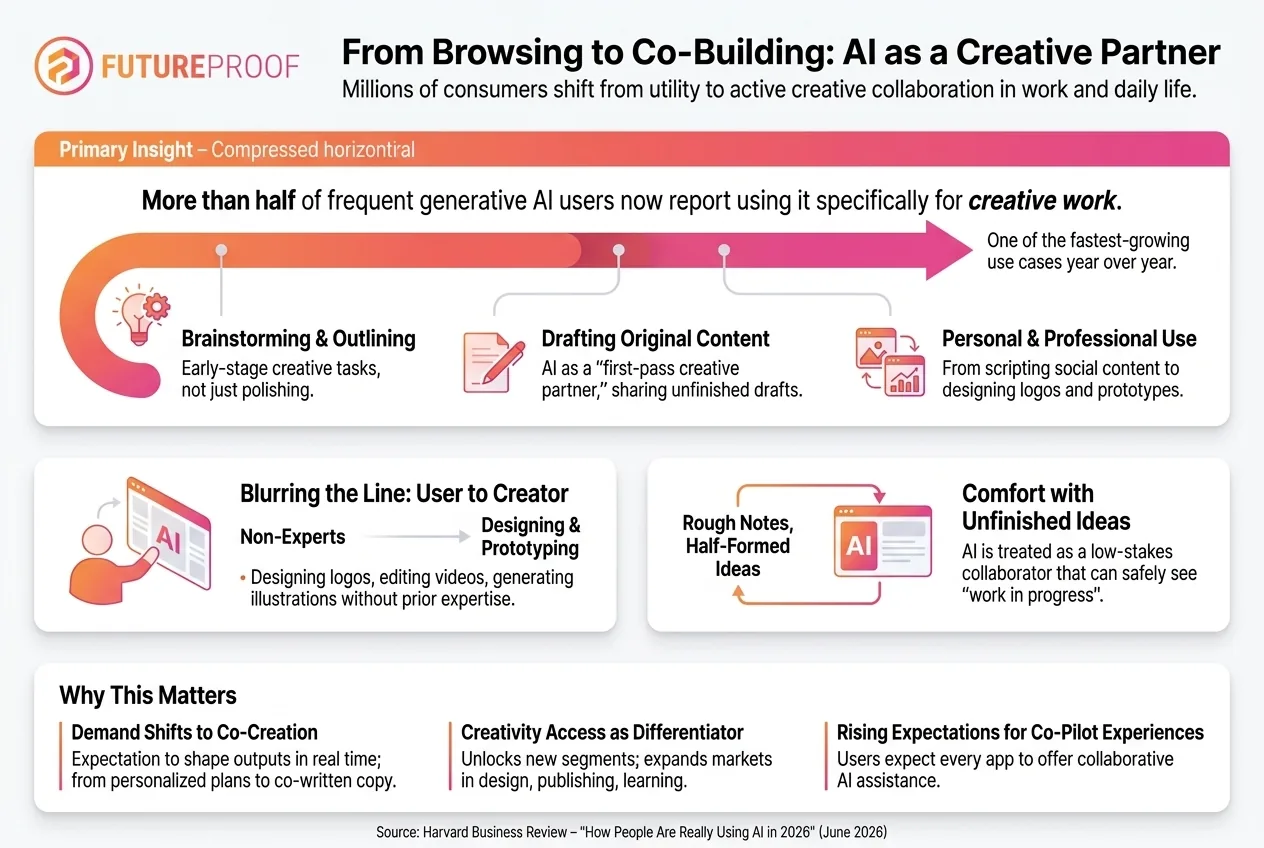
The landscape of human interaction with artificial intelligence has undergone a profound and undeniable transformation. No longer confined to the role of a mere functional utility, AI has graduated to become an indispensable creative partner for millions of consumers across the globe. This paradigm shift, from simply browsing for information or delegating mundane tasks to actively co-building original ideas, marks a pivotal moment in the evolution of technology and human ingenuity. The days when AI was primarily a tool for summarizing text, scheduling appointments, or providing quick answers are rapidly receding into the past, supplanted by a burgeoning era where individuals invite artificial intelligence into the earliest, most nascent stages of their creative endeavors.
Recent insights from the Harvard Business Review paint a vivid picture of this change, underscoring its widespread adoption and impact. Their report, "How People Are Really Using AI in 2026," published in June 2026, reveals a compelling statistic: more than half of frequent generative AI users now depend on these sophisticated systems for genuinely creative work. This isn't about minor adjustments or edits; it’s about leveraging AI for foundational creative processes such as brainstorming sessions, developing intricate outlines, and generating entirely original concepts from scratch. This data isn't just a trend; it's a definitive declaration of a new modus operandi for creativity in the digital age, a clear signal that consumers are embracing AI as an active participant in their imaginative journeys.
This burgeoning reliance on AI as a creative partner is fundamentally reshaping how individuals approach work, learning, and personal expression. The traditional barriers that once loomed large—the daunting emptiness of a blank page, the struggle to articulate an initial idea, or the intimidation of starting a complex project—are rapidly dissolving. AI steps in as a collaborative thought partner, offering prompts, suggesting directions, expanding upon nascent thoughts, and providing diverse perspectives that might otherwise remain undiscovered. From the intricate planning of comprehensive content strategies and the iterative design of visually striking graphics to the delicate art of drafting compelling fictional narratives and the strategic development of innovative side projects, AI is proving itself to be an invaluable ally. The act of creation, once often a solitary and sometimes arduous process, is now becoming a dynamic, interactive dialogue between human imagination and artificial intelligence.
For brands, product developers, and service providers, the implications of this seismic shift are not merely significant; they are direct and demand immediate attention. The contemporary audience no longer simply desires tools that facilitate consumption; they actively seek and expect platforms that empower them to co-create. Products that thoughtfully embed and seamlessly integrate collaborative AI features are discovering an unparalleled opportunity. These innovative tools are unlocking creative potential in users who may never have previously perceived themselves as "creative." With AI at their side, individuals are gaining the confidence to design, write, build, and innovate in ways they once thought impossible, transforming passive users into active contributors and creators. This isn't a futuristic concept; it is the present reality, where consumers are not just clicking through digital experiences but are actively shaping and building them alongside intelligent systems.
The underlying appeal of AI as a creative partner stems from its unique ability to transcend human limitations. It doesn't tire, it doesn't judge, and it can process vast amounts of information and generate ideas at speeds impossible for a human mind alone. For those grappling with writer's block, AI offers an immediate spark, a starting point from which ideas can flow. Faced with a complex design challenge, AI can instantly present a myriad of aesthetic options, allowing users to iterate and refine with unprecedented agility. This democratizing effect is profound, leveling the playing field and allowing individuals without formal training in design, writing, or programming to embark on creative ventures that once required specialized skills or significant financial investment. The ability to articulate a vague concept and have an AI instantly translate it into tangible text, imagery, or even code is nothing short of revolutionary for the average consumer.
This collaborative dynamic extends far beyond mere suggestion. Users are engaging in iterative conversations with generative AI creativity tools, refining initial outputs, pushing boundaries, and exploring tangential ideas. A user might prompt an AI to "write a short story about a detective in a futuristic city," receive an initial draft, and then follow up with "make the detective a cynical robot" or "introduce a plot twist involving time travel." This back-and-forth, where human direction guides AI's generative capabilities, epitomizes the "co-building" process. It’s not just about getting an answer, but about collaboratively exploring the vast landscape of possibilities until a truly unique and satisfying outcome is achieved. This shift means that the very definition of "original idea" is expanding, now often encompassing concepts born from this fertile human-AI interplay.
The implications for education and personal development are equally transformative. Learners can utilize AI to brainstorm essay topics, generate different arguments for a debate, or even create personalized learning materials tailored to their specific needs and learning styles. The act of using AI for brainstorming becomes a learning experience in itself, exposing users to new ways of thinking, structuring information, and approaching problems. This constant engagement fosters a growth mindset, encouraging experimentation and reducing the fear of failure, as AI can quickly iterate on ideas without significant personal cost. The traditional barriers to entry for creative fields are being lowered, fostering an environment where curiosity and willingness to experiment are paramount.
For professionals, too, this shift is redefining workflows and enhancing productivity. Marketers are leveraging AI for content creation, developing diverse ad copy variations, social media posts, and blog outlines at scale. Designers are using AI to rapidly prototype logos, website layouts, and user interface elements, accelerating their design cycles and allowing them to focus on high-level strategic decisions rather than tedious manual adjustments. Even software developers are finding AI to be a powerful co-pilot, assisting in generating code snippets, debugging, and exploring architectural patterns for new applications. The adoption of AI is not about replacing human creativity but amplifying it, freeing up valuable human capital to concentrate on strategic thinking, emotional intelligence, and complex problem-solving that remains uniquely human.
The challenge, and indeed the immense opportunity, for brands and product builders is to understand and cater to this new expectation of co-creation. Audiences are no longer content with passive consumption; they actively demand tools that empower them to participate in the creation process. Products that merely offer AI as a backend efficiency gain without exposing its collaborative potential to the user interface will struggle to compete. The most successful platforms will be those that integrate AI collaboration tools intuitively, making the human-AI partnership feel natural and seamless. Consider a photography app that not only enhances images but also uses AI to suggest creative compositions or even generate entirely new visual elements based on user input. Or a project management tool that uses AI to not only summarize meetings but also to brainstorm potential solutions for roadblocks, offering a dynamic and interactive problem-solving experience.
The future of consumer AI adoption is intrinsically linked to this co-building paradigm. Brands that fail to innovate in this space risk falling behind. Those that succeed will be the ones that embed AI as an empathetic, intelligent assistant capable of understanding nuanced user intent and translating it into tangible creative output. This means moving beyond generic prompt engineering and towards sophisticated AI models that can learn from user preferences, adapt to individual creative styles, and even anticipate needs, offering proactive suggestions that enhance the creative flow. The user experience becomes less about instructing a machine and more about engaging in a fluid, productive dialogue with an intelligent collaborator.
Furthermore, this shift heralds a new era for democratizing creativity with AI. It empowers individuals who might have felt creatively stifled or lacked the formal skills to pursue artistic or design endeavors. A small business owner can now generate a professional-looking marketing campaign with AI assistance, a budding writer can overcome writer's block with intelligent prompts, and a hobbyist can design intricate 3D models without years of specialized training. This widespread accessibility to powerful creative tools fosters an explosion of personal projects, small businesses, and entirely new forms of artistic expression. The economic and cultural ramifications are immense, paving the way for unprecedented innovation at the grassroots level.
The evolution of AI from a tool to a partner also necessitates a careful consideration of the ethical implications. While AI excels at generating content, the human element remains crucial for discernment, ethical oversight, and ensuring that the generated output aligns with human values and responsible practices. The co-building model inherently supports this, as the human user maintains ultimate control and decision-making authority over the AI's suggestions and creations. It emphasizes that AI is an augmentation of human capability, not a replacement for human judgment or moral reasoning. The human-AI collaboration flourishes precisely because of this synergistic relationship, where each brings their unique strengths to the creative table.
In conclusion, the transformation of AI's role in the consumer landscape is unequivocal and ongoing. The era where AI served merely as a utility for quick tasks or simple information retrieval has definitively concluded. We are now firmly planted in a new age, one where millions of individuals actively seek out and rely on AI as a dynamic, intelligent creative partner. From the very first spark of an idea to the detailed outline of a complex project, AI is increasingly interwoven into the fabric of the creative process. The data from Harvard Business Review unequivocally confirms this shift, highlighting that the majority of frequent generative AI users are embracing it for profound creative work. For product builders and brands, the message is clear: the future belongs to those who empower their audiences to co-create, to move beyond passive consumption and actively shape their digital worlds with the intelligent assistance of AI. The demand is not for more clicks, but for more creation, as consumers confidently step into their roles as co-builders alongside their AI companions. This is not just a trend; it is the fundamental redefinition of human-technology interaction and the dawn of a truly collaborative creative future.