The Rise of AI Chat as the New Front Door to Product Discovery
The landscape of online shopping is undergoing a profound transformation, moving beyond the familiar terrain of keyword searches and endless scrolling into a new era defined by conversational artificial intelligence. For generations, the quest for the perfect product began with a precise query typed into a search engine or a navigation through a bustling online marketplace. Now, a seismic shift is occurring: consumers are increasingly turning to AI chat as their primary destination for product research, effectively briefing intelligent systems on their nuanced needs rather than simply browsing static pages. This isn't merely an incremental change; it represents a fundamental redefinition of the buyer's journey, demanding that brands and retailers adapt with unprecedented agility and foresight.
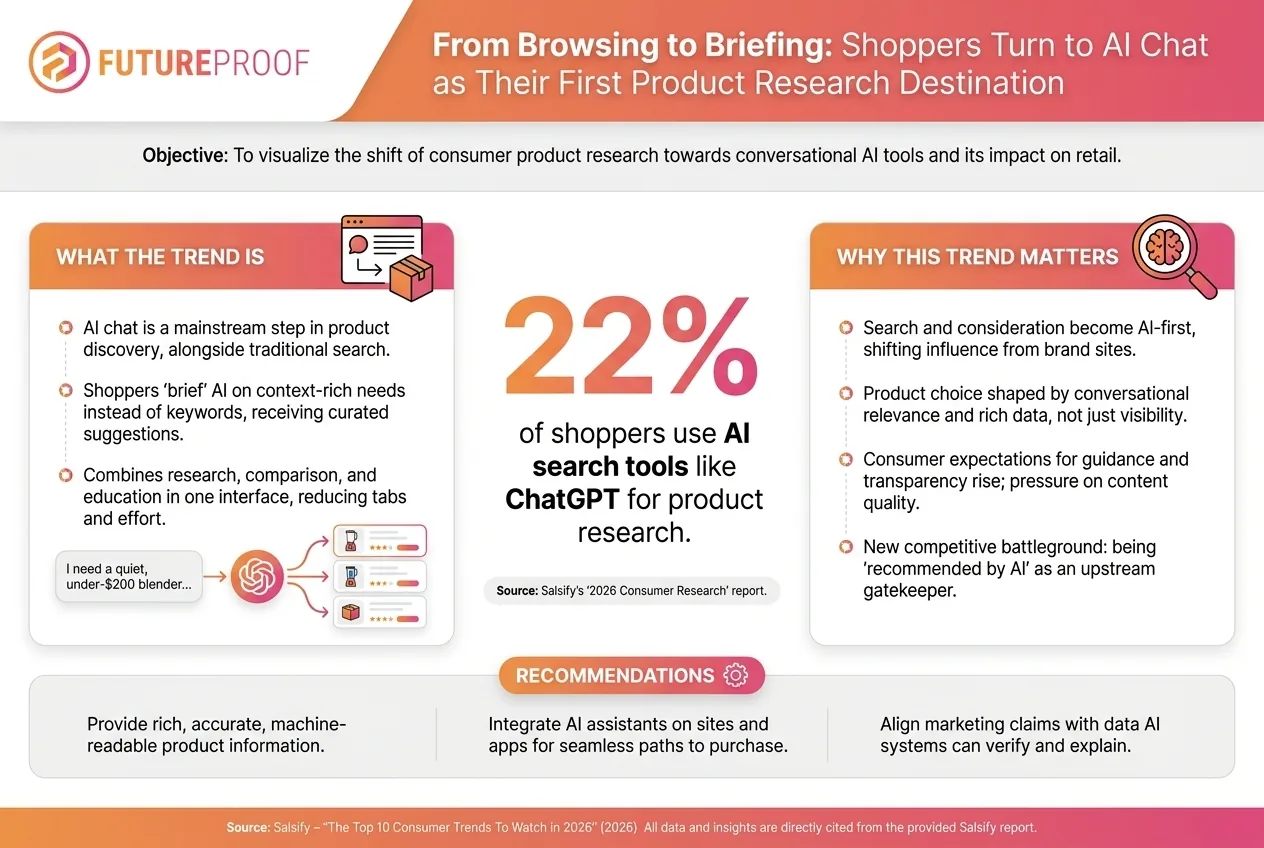
New data from Salsify, unveiled in their insightful report "The Top 10 Consumer Trends To Watch in 2026," starkly illustrates this accelerating trend. A significant 22 percent of shoppers now actively utilize AI search tools, such as the ubiquitous ChatGPT, for their product research endeavors. This critical statistic places conversational AI squarely alongside, and in some instances even ahead of, traditional search engines and established marketplaces as a foundational starting point for the modern shopper. This isn't a niche activity; it's a widespread behavioral pattern signaling a future where intelligent assistants play an indispensable role in influencing purchasing decisions, right from the initial spark of interest.
The essence of this paradigm shift lies in the fundamental difference between "browsing" and "briefing." Historically, product discovery was a largely self-directed, often iterative process. A shopper might type "best running shoes" and then sift through countless results, opening multiple tabs, comparing specifications, reading reviews, and slowly piecing together a comprehensive understanding. This approach, while effective, was inherently inefficient and often overwhelming. The advent of AI chat changes this dynamic entirely. Instead of broad, keyword-based searches that cast a wide net, shoppers are now engaging with AI by providing context-rich, detailed briefings. They articulate their specific requirements, preferences, and even emotional needs, receiving tailored recommendations in a matter of seconds.
Imagine a shopper not just searching for "espresso machine," but rather "a compact, user-friendly espresso machine under $300 that makes excellent lattes and has a milk frother, suitable for a small apartment kitchen." An AI chat tool can instantly parse this multi-faceted request, cross-reference it with vast databases of product information, and present a curated selection of options that precisely match the user's intricate criteria. This consolidates what was once a laborious process of research, comparison, and education into a single, seamless interface. The friction points of navigating disparate websites, applying multiple filters, and deciphering technical jargon are dramatically reduced, paving the way for a more intuitive, personalized, and satisfying pre-purchase experience.
From the consumer's vantage point, the appeal of AI chat as a product research destination is multi-layered. Firstly, there’s the undeniable advantage of efficiency. AI cuts through the digital clutter, delivering concise, relevant answers almost instantaneously. This saves invaluable time, allowing shoppers to move from need identification to product consideration at an accelerated pace. Secondly, and perhaps most powerfully, is the promise of hyper-personalization. Unlike traditional algorithms that might only consider basic keyword matches, AI chat excels at understanding the nuances of a user's intent. It can infer preferences based on the context of the conversation, adapt to budget constraints, factor in lifestyle considerations, and even incorporate value-driven criteria like sustainability or ethical sourcing. This leads to recommendations that feel genuinely bespoke, enhancing trust and perceived relevance.
The AI's ability to grasp contextual understanding is a game-changer. Complex queries, often riddled with subjective descriptors and interconnected requirements, are no longer a barrier. The AI processes these intricate prompts, disentangling intent from mere words, to deliver truly meaningful results. Furthermore, conversational AI acts as an instant comparison and education engine. It can effortlessly compare features across multiple products, demystify industry jargon, explain the pros and cons of different models or technologies, and even suggest complementary products. This level of comprehensive, on-demand information empowers consumers to make highly informed decisions with greater confidence, reducing buyer's remorse and enhancing overall satisfaction.
As this behavioral acceleration gains momentum, the onus falls heavily upon retailers and brands to adapt their strategies, moving beyond traditional e-commerce models to embrace the burgeoning AI-native path to purchase. The influence sphere is unequivocally shifting upstream. While product websites and marketplace listings will continue to hold importance, the initial point of discovery and influence is increasingly migrating to these AI interfaces. This fundamental shift means that simply having an attractive website or a well-indexed product page is no longer sufficient. The competitive battleground is no longer just on Google's first page or Amazon's top search results; it's now within the algorithms and conversational flows of AI assistants.
For brands and retailers, this necessitates a critical re-evaluation of how their products are represented and discovered. The paramount importance of machine-readable product data cannot be overstated. AI systems learn, understand, and recommend based on the quality and structure of the information they can access. This means product catalogs must be meticulously structured, comprehensive, and semantically rich. Every attribute, specification, dimension, material, certification, and even user-generated content like reviews needs to be readily accessible and understandable by artificial intelligence. Product Information Management (PIM) systems, already crucial for omnichannel consistency, become absolutely vital in this AI-first landscape, serving as the central nervous system for all product data.
Beyond mere data points, brands must master the art of explaining value to machines. Product descriptions can no longer be solely crafted for human readability or basic keyword inclusion. They must be optimized for natural language processing (NLP), clearly articulating benefits as much as features. How does a product solve a specific problem? What unique value does it offer a particular type of consumer? What are its primary use cases? What makes it stand out from competitors? These explanations need to be embedded within the product data in a way that AI models can readily comprehend and synthesize. Frequently asked questions, compatibility information, and detailed application scenarios become invaluable assets, allowing AI to build a holistic understanding of a product's essence and relevance.
Building AI-native paths to purchase involves several strategic imperatives. One critical aspect is the direct exposure of product catalogs to AI agents. This means retailers need to facilitate seamless API integrations, allowing their inventory and detailed product data to be directly queried and utilized by external AI platforms like ChatGPT, Google's Bard, or proprietary AI shopping assistants. Furthermore, retailers might develop their own "Shop with AI" features embedded within their websites or apps, offering customers a personalized, conversational shopping experience that mirrors the capabilities of broader AI tools. This allows them to control the narrative and recommendations directly.
Ethical considerations also play a crucial role. As AI becomes an intermediary in the shopping journey, questions of bias in AI and data privacy come to the forefront. Retailers must ensure that AI recommendations are fair, transparent, and free from algorithmic bias inherent in training data. Protecting consumer data during these conversational interactions is paramount to maintaining trust. Hybrid models, where AI-generated recommendations are seamlessly integrated with the option for human customer service for complex queries or post-purchase support, will likely emerge as best practices, balancing efficiency with the irreplaceable human touch.
The competitive battleground has irrevocably shifted. Visibility in AI becomes the new frontier of digital commerce. Being recommended by an AI assistant in response to a detailed query is akin to securing the coveted "first page" position in traditional search, but with far greater contextual relevance and persuasive power. Differentiation, therefore, takes on new dimensions. Brands can no longer rely solely on brand recognition or a catchy marketing campaign; their unique selling propositions (USPs) must be clearly and comprehensively articulated within their structured product data, enabling AI to identify and highlight their distinct advantages. First-mover advantage in adapting to this AI-first environment will be significant, allowing early adopters to capture substantial market share and establish dominant positions in the conversational commerce space.
This new reality also introduces an entirely novel facet of SEO: optimizing for AI. This goes beyond traditional keyword density and backlinks. It delves into semantic SEO, where content is optimized not just for human readers and search engine crawlers, but for the sophisticated natural language processing capabilities of conversational AI models. Contextual relevance, clarity, and comprehensive, structured data will trump keyword stuffing. Brands will need to think about how their content provides answers, explains concepts, and justifies recommendations in a way that AI can effectively leverage to serve its users.
Despite its immense potential, the transition to an AI-first product research ecosystem presents its own set of challenges. Data accuracy and consistency are paramount; "garbage in, garbage out" has never been more relevant. Misinformation or outdated product data fed into AI systems can quickly erode consumer trust and lead to widespread dissatisfaction. Ensuring algorithmic fairness and preventing bias in AI recommendations is another complex hurdle, requiring continuous monitoring and refinement of AI models. Data privacy and security protocols must be robust, protecting sensitive user information shared during conversations. Finally, new attribution models will be required to accurately track sales influenced by AI chat, providing brands with insights into the ROI of their AI optimization efforts. The question of where the human touch fits in remains pertinent; while AI excels at information retrieval and basic recommendations, complex problem-solving, emotional connection, and nuanced advice may still necessitate human interaction.
Looking ahead, the future of shopping is undoubtedly conversational. We can expect even deeper integration of AI into every facet of the shopping journey, from initial inspiration to post-purchase support. Voice commerce will likely become more sophisticated, leveraging multimodal AI to understand spoken queries and provide rich, audible responses. The concept of hyper-personalization will reach unprecedented levels, with AI potentially anticipating needs before consumers even consciously realize them, leading to an era of truly anticipatory shopping. AI is not merely a tool; it is rapidly evolving into an indispensable shopping companion, guiding, informing, and simplifying the complex process of product discovery and selection.
In conclusion, the shift from "browsing to briefing" signifies a watershed moment in digital commerce. The Salsify data point – indicating that 22 percent of shoppers now engage with AI search tools like ChatGPT for product research – is not just a statistic; it's a clarion call for brands and retailers to fundamentally reorient their strategies. The era of keyword-centric search is giving way to a more intelligent, intuitive, and personalized experience driven by conversational AI. Those who embrace this transformation, investing in rich, machine-readable product data, optimizing for AI understanding, and building seamless AI-native paths to purchase, will not only survive but thrive in this exciting new chapter of retail. The future of product research isn't just digital; it's conversational, and it's happening now.