AI Is the New Front Door for Brand Discovery
The landscape of brand discovery is undergoing a seismic shift, fundamentally reshaping how consumers find and engage with products and services. Once a journey navigated primarily through traditional search engines, social media feeds, and direct website visits, the new front door for brand discovery is increasingly powered by artificial intelligence. Generative AI platforms like ChatGPT, Gemini, Copilot, and Perplexity are not merely tools for information retrieval; they are becoming trusted companions for consumers, guiding them from initial curiosity to potential purchase with unprecedented efficiency. This pivotal transformation compresses the discovery journey, leading to a new dynamic where a select handful of AI-endorsed brands dominate consideration, challenging established marketing paradigms and demanding a radical re-evaluation of brand building strategies.
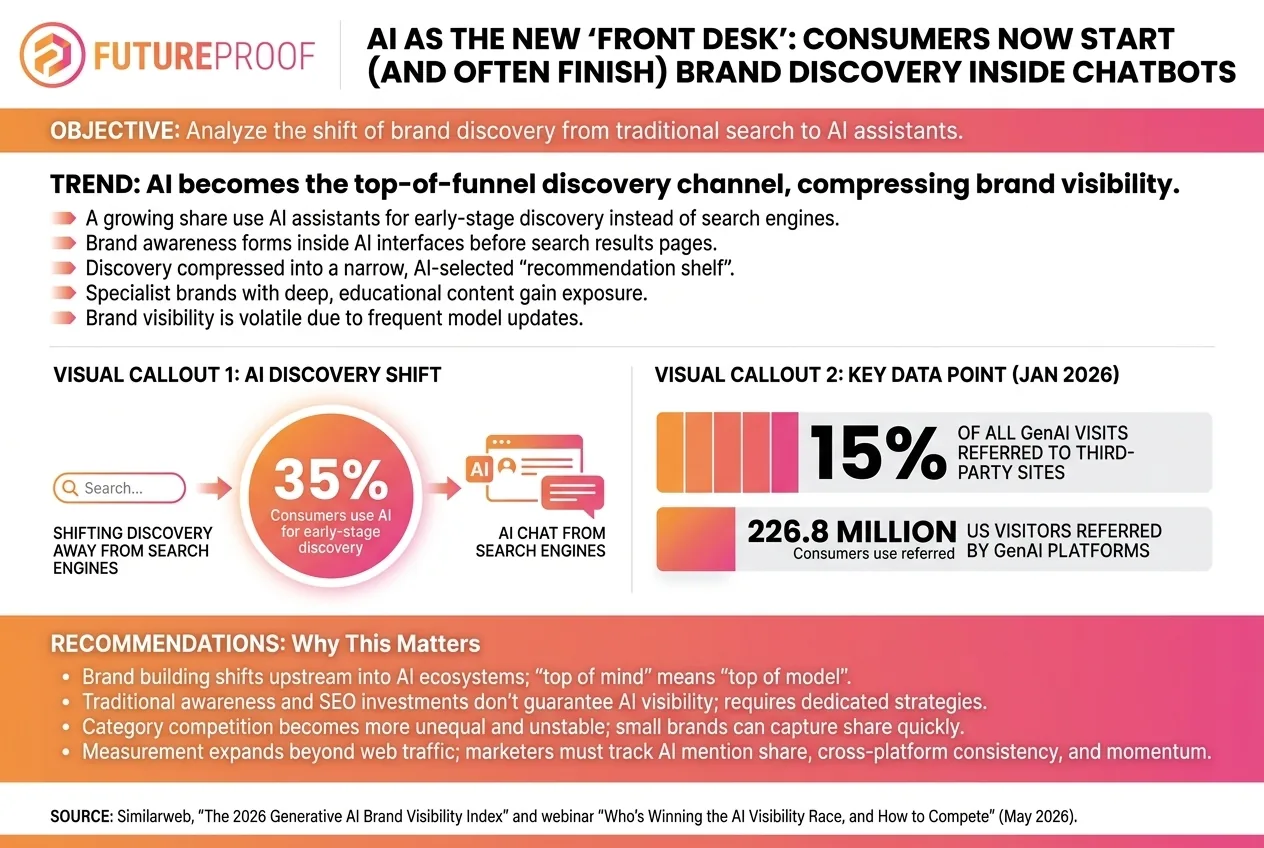
Consumers are now leveraging these powerful AI models for every stage of their research. Instead of sifting through pages of search results, they pose nuanced questions to conversational AI, seeking immediate, comprehensive, and tailored answers. Whether planning a trip, researching a new gadget, or exploring complex financial services, the AI assistant acts as a highly efficient filter, synthesizing vast amounts of information and presenting curated recommendations. This shift means that for a growing segment of the population, the brand discovery journey now often starts and finishes within these AI environments. The implications are profound: brands that are successfully surfaced by AI gain an immense advantage, appearing as authoritative, relevant solutions directly within the user's conversational flow, effectively bypassing much of the traditional funnel. This phenomenon is not speculative; it is quantifiable. According to Similarweb's "The 2026 Generative AI Brand Visibility Index," generative AI platforms referred an astounding 226.8 million US visitors to third-party sites in January 2026. This figure represents 15 percent of all GenAI visits, underscoring the substantial and growing direct impact of AI on website traffic and brand exposure. Furthermore, the report highlights that 35 percent of consumers now actively utilize AI for early-stage discovery, solidifying its role as a critical touchpoint in the modern consumer journey.
The crucial question then becomes: what criteria do AI systems use to select these dominant brands? The answer lies in a fundamental prioritization of depth and authority over sheer fame or promotional glitz. AI algorithms are designed to provide the most helpful, accurate, and comprehensive answers possible. To achieve this, they gravitate towards specialist and information-rich brands that can demonstrate genuine expertise, experience, authority, and trustworthiness (EEAT) on a given topic. This means content that delves deep into subjects, offers nuanced perspectives, backs claims with data, and genuinely educates the user will naturally fare better than superficial, keyword-stuffed, or overtly promotional material. For example, if a consumer asks an AI about the best sustainable athletic footwear, the AI will likely recommend brands that have detailed, transparent information about their supply chains, material sourcing, ethical manufacturing practices, and product durability, rather than simply listing the most advertised names. This preference for substantive content creates a significant opportunity for niche players and challenger brands that have historically invested in deep informational resources, allowing them to gain visibility against established leaders whose content might be thin, generic, or overly focused on sales pitches. Many legacy brands, accustomed to winning through brand recognition and broad marketing campaigns, find themselves underrepresented in AI answers precisely because their digital content strategy has not evolved to meet AI's rigorous demands for depth and verifiable authority.
Adding another layer of complexity to this new landscape is the inherent volatility of AI visibility. Unlike traditional search rankings, which can be influenced by consistent SEO efforts over time, AI recommendations are subject to rapid and often unpredictable shifts. Model updates, algorithm refinements, and changes in AI training data can dramatically alter which brands are recommended from month to month, or even week to week. This means that a brand enjoying high AI visibility today might find itself sidelined tomorrow if its content no longer aligns with the latest AI comprehension models or if a competitor enhances its authoritative footprint. This constant flux necessitates an agile and adaptive marketing approach, one that continuously monitors AI performance and is prepared to iterate content and technical structures to maintain relevance.
For marketers, this paradigm shift translates into a new and urgent strategic imperative: brand building now inherently includes becoming "top of model." This goes far beyond traditional SEO or mere brand awareness. Securing visibility inside AI answers requires a multi-faceted approach that addresses the unique mechanisms of generative AI. It demands a sophisticated understanding of how AI ingests, processes, and synthesizes information to generate recommendations. Brands can no longer simply aim for high rankings on a SERP; they must strive to be the preferred answer, the trusted recommendation, directly within the conversational interface of AI.
Achieving "top of model" status rests upon three critical pillars: authoritative content, accessible technical structures, and robust measurement frameworks.
The first and most foundational pillar is Authoritative Content. As established, AI systems prioritize content that demonstrates profound depth, expert insight, and verifiable trustworthiness. This necessitates a strategic move away from merely producing content for human readers or basic keyword matching, towards creating comprehensive, valuable resources that satisfy AI's need for granular, factual, and contextually rich information. Brands must invest in long-form guides, detailed whitepapers, original research, case studies, and expert interviews that thoroughly explore a topic from multiple angles. Content should not just answer a question but anticipate follow-up questions, providing a complete informational ecosystem. This means collaborating with genuine subject matter experts, conducting proprietary research, and leveraging internal data to create unique, undeniable insights. For a financial institution, this might mean developing exhaustive guides on complex investment strategies, backed by economists and financial advisors. For a B2B SaaS company, it could involve publishing detailed technical documentation, in-depth feature comparisons, and comprehensive problem-solution frameworks co-authored by product engineers and industry thought leaders. The goal is to build an unassailable content library that establishes the brand as the definitive source of truth in its domain, making it an irresistible choice for AI systems seeking to provide the most reliable answers. This deep content naturally feeds into AI's understanding of EEAT, signaling to the algorithms that the brand is a credible and reliable entity.
The second crucial pillar is Accessible Technical Structures. While authoritative content is the fuel, accessible technical structures are the optimized engine that allows AI to consume, understand, and leverage that fuel effectively. Traditional SEO focuses on crawlability and indexability; AI visibility demands much more. Brands must implement sophisticated schema markup (e.g., product schema, article schema, FAQ schema, organization schema) that explicitly defines the entities, relationships, and attributes within their content. This structured data acts as a translator, allowing AI to grasp the semantic meaning and context of information rather than just parsing raw text. Clean, logical site architecture, semantic HTML, and robust internal linking are also paramount, helping AI models navigate and understand the hierarchical relationships between different pieces of content, building a comprehensive knowledge graph of the brand's expertise. Furthermore, exploring opportunities for API integrations to allow direct, programmatic access to key data points or product catalogs can provide AI systems with real-time, highly structured information, significantly enhancing a brand's chances of being recommended. Beyond the traditional considerations of site speed and mobile-friendliness, which indirectly aid AI processing, the emphasis here is on making content inherently machine-readable and semantically understandable, ensuring that the brand’s knowledge is not just present but perfectly packaged for AI consumption.
Finally, the third pillar involves developing Measurement Frameworks that are specifically tailored to the AI era. Traditional analytics, while still valuable, do not fully capture a brand's performance within AI environments. Marketers need to establish new KPIs and methodologies to track "AI mention share" – how often, and in what context, their brand is recommended by generative AI platforms. This requires specialized monitoring tools that can track AI outputs across ChatGPT, Gemini, Copilot, and Perplexity, identifying when a brand is mentioned, the sentiment of the mention, and the surrounding context. It's not enough to simply know a brand was mentioned; understanding why it was mentioned, what specific queries triggered the recommendation, and the qualitative nature of the endorsement is vital. Moreover, tracking "cross-model consistency" is essential. Does the brand receive similar recommendations across different AI platforms, or are there discrepancies? Inconsistencies could indicate varied understanding of the brand’s content by different models, requiring targeted content or technical adjustments. Key metrics for this new framework should include: AI referral traffic, sentiment analysis of AI mentions, share of voice in AI recommendations (compared to competitors), and conversion rates from AI-driven discovery paths. Developing these frameworks will involve investing in new analytics tools, potentially leveraging AI to monitor AI, and collaborating with data science teams to interpret complex data patterns. This new measurement paradigm provides the feedback loop necessary to refine content strategies and technical implementations, ensuring continuous optimization for AI visibility.
The strategic implications for marketers are vast and immediate. Content strategy must fundamentally shift from being primarily awareness or conversion-driven to becoming deeply authoritative and informational. This often means investing significantly in subject matter experts, researchers, and technical writers who can produce the caliber of content AI demands. Internal teams across content, SEO, product, and data science must collaborate more closely than ever before, aligning on shared goals for AI visibility. Budgets may need to be reallocated, prioritizing deep content creation and specialized technical SEO over more traditional, broader awareness campaigns. The risk of inaction is significant; brands that fail to adapt risk becoming invisible in an increasingly AI-mediated discovery journey. They risk losing market share, brand relevance, and customer trust to more agile competitors who embrace the "top of model" imperative.
Overcoming these challenges will require continuous learning and adaptation. Marketers must stay abreast of rapid model updates and evolving AI capabilities, treating AI optimization as an ongoing, iterative process. Resource allocation will be a persistent challenge, necessitating strategic choices about where to invest for maximum impact. Demonstrating the ROI of AI visibility initiatives will be crucial for securing continued stakeholder buy-in, requiring a clear connection between AI mentions, traffic, and ultimately, business outcomes. Educating internal teams and leadership about this transformative shift is also vital to foster a culture of AI-centric brand building.
In conclusion, the era of AI-driven brand discovery is not a distant future; it is the present reality. Generative AI platforms have irrevocably altered the consumer journey, creating a compressed path where authoritative, information-rich brands are poised to win unprecedented visibility. For marketers, the imperative is clear: traditional brand building is no longer sufficient. Brands must actively pursue "top of model" status by cultivating a deep reservoir of authoritative content, optimizing their technical structures for AI comprehension, and implementing sophisticated measurement frameworks to track their AI mention share and cross-model consistency. The brands that embrace this new reality, understanding that AI is the new front door to consumer hearts and minds, will not only survive but thrive in this evolving digital landscape, securing their place as the trusted, AI-selected leaders of tomorrow.