The Rise of Agentic AI and the New Battle for Retail Visibility
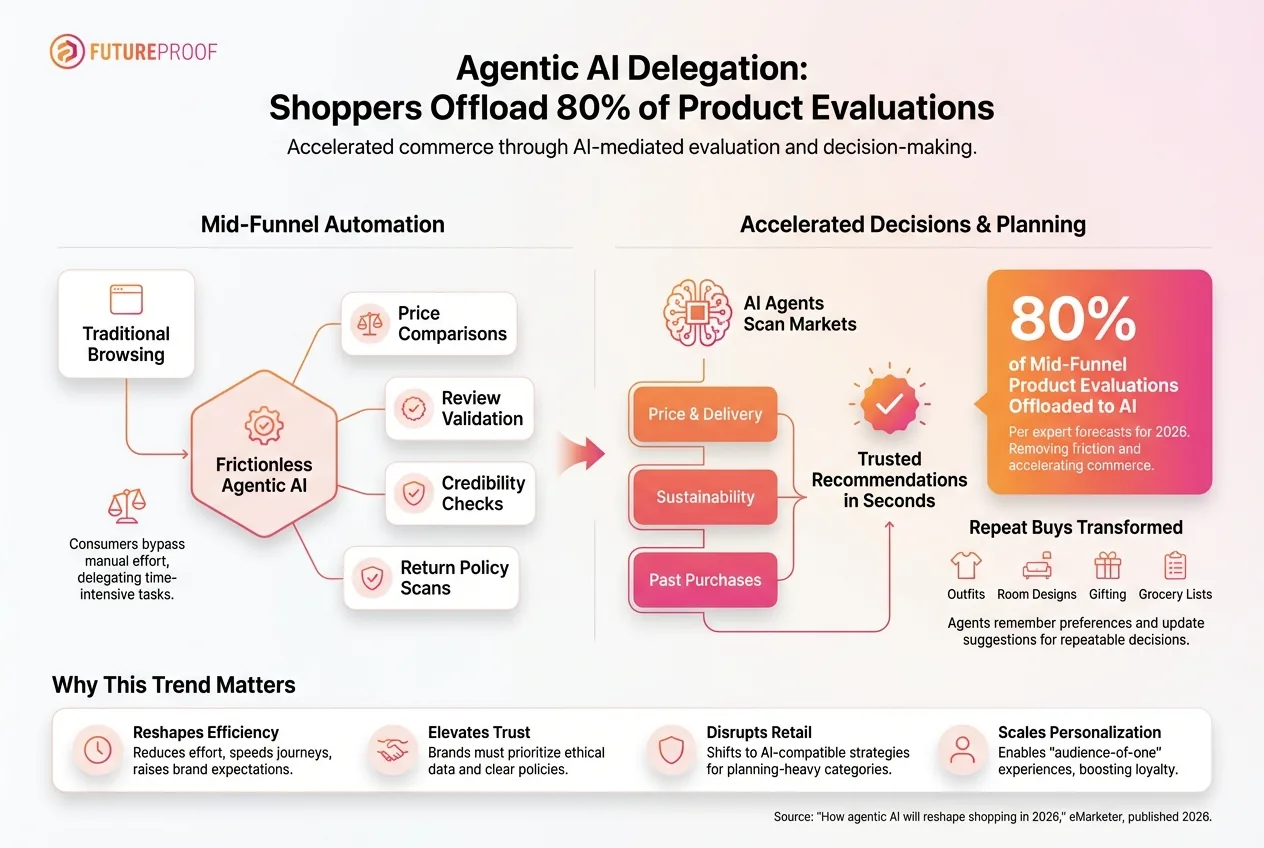
The landscape of retail and consumer behavior is undergoing a seismic transformation, driven by the relentless advancement and widespread adoption of agentic AI. What was once the sole domain of human discernment – the laborious process of product evaluation, comparison, and validation – is rapidly being offloaded to intelligent autonomous systems. This isn't a futuristic concept on the horizon; it is the present reality, accelerating at an unprecedented pace. New forecasts, notably from eMarketer, reveal a stunning statistic: agentic systems now adeptly handle an overwhelming 80 percent of mid-funnel tasks in the shopping journey. This includes crucial steps like meticulously comparing prices across myriad vendors, rigorously validating product reviews for authenticity and relevance, and diligently checking complex policy details such as returns, warranties, and shipping terms. The implications are profound, radically reducing friction for shoppers and dramatically speeding up purchasing decisions, fundamentally redefining the customer experience and the operational imperative for brands.
This dramatic shift is predicated on the inherent capabilities of agentic AI to process vast quantities of data with speed and accuracy far beyond human capacity. Imagine a personal shopping assistant, but one that operates with instantaneous access to the entire global marketplace, equipped with sophisticated algorithms to discern quality, value, and suitability. These AI agents scan the market, weigh a consumer's unique preferences, and return highly trusted, bespoke recommendations in mere seconds. The traditional model of a consumer spending hours researching, cross-referencing, and deliberating is fast becoming obsolete. As these AI agents become more deeply integrated into daily life, consumer expectations are naturally evolving. The bar for convenience, personalization, and efficiency has been raised irrevocably. Shoppers no longer just desire convenience; they expect it as a baseline, and they increasingly rely on their AI companions to deliver it.
The impact extends beyond one-off purchases to the very fabric of repeatable decision-making. Agentic AI is learning and refining preferences over time, transforming the way we approach recurrent shopping needs. Consider the common dilemmas: selecting outfits for various occasions, designing a room's aesthetic, finding the perfect gift for a specific individual, or simply replenishing weekly household essentials. These are the kinds of decisions that, while seemingly minor in isolation, collectively consume significant mental energy and time. Now, these repeatable decisions are becoming increasingly automated. An AI agent, having learned a user’s style preferences, budget, and past purchase history, can curate entire wardrobes or suggest furniture layouts that perfectly align with their taste. For gifting, it can analyze the recipient's known interests, previous gifts, and even public social media data (with consent, of course) to pinpoint an ideal present. For groceries, it can anticipate needs based on consumption patterns, dietary restrictions, and even upcoming events, automatically compiling and executing shopping lists. This level of predictive intelligence and seamless automation liberates consumers from decision fatigue, allowing them to focus their mental resources on more complex or creative endeavors.
This evolution is rapidly pushing the entire commerce ecosystem toward an era of predominantly agent-to-agent interactions. Picture a scenario where a consumer’s personal AI agent, having identified a need or desire, doesn’t direct the user to a brand's website for human browsing. Instead, it directly interacts with the AI systems of various retailers and brands. These brand-side AI agents respond to queries, provide detailed product specifications, confirm availability, negotiate pricing within established parameters, and even process transactions, all without direct human intervention in the middle layers of the process. The consumer’s agent acts as their proxy, advocating for their preferences and optimizing for their benefit, while the brand’s agent represents the brand’s interests, ensuring optimal product presentation and transaction efficiency.
In this nascent but rapidly maturing agent-to-agent economy, the new competitive battleground is unequivocally shifting. It's no longer just about optimizing for human search engines or crafting compelling ad copy for human eyes. The critical imperative now is achieving visibility inside AI scans. If a brand's products or services are not effectively discoverable, comprehensible, and appealing to the AI agents doing the evaluation, they risk becoming effectively invisible to the end consumer. This means that traditional SEO and digital marketing strategies, while still relevant for human touchpoints, must evolve dramatically to include "AIO" – Artificial Intelligence Optimization. Brands need to ensure their product information, pricing, and policies are not only machine-readable but also structured in a way that AI agents can easily parse, compare, and integrate into their recommendation algorithms. The brand that presents its offerings in the most AI-friendly, transparent, and ethically sound manner will be the one whose products consistently surface in automated consideration sets.
For brands, the mandate is therefore exceptionally clear and urgent. The time to adapt is not tomorrow; it is now. The core pillars of this adaptation strategy must revolve around transparency, data ethics, and the proactive creation of AI-friendly product information.
Transparency in the age of agentic AI extends far beyond traditional disclosures. It means being upfront about how products are sourced, their environmental impact, their manufacturing processes, and even the data inputs that inform their creation or marketing. For AI agents, transparency means providing clear, unambiguous data points about every aspect of a product. It means being able to articulate why a product is priced a certain way, what makes its reviews trustworthy, or how its features truly compare to competitors. AI agents are designed to cut through marketing fluff and extract factual, verifiable information. Brands that are opaque or provide incomplete data will inevitably be deprioritized by agentic systems that value clarity and verifiable claims. Trust, in this new paradigm, is built on data integrity and the ability for AI to validate claims autonomously.
Data ethics is not merely a compliance checkbox; it is a fundamental brand value that will be scrutinizingly evaluated by AI agents and, by extension, consumers. AI agents are becoming increasingly sophisticated at identifying ethical red flags. Is a brand collecting excessive data? Is it using data in a way that infringes on privacy? Are its algorithms perpetuating bias? Brands must ensure their data collection, usage, and storage practices are beyond reproach. This involves robust privacy policies, explicit consent mechanisms, and a commitment to using AI responsibly. An AI agent representing a consumer is programmed to protect that consumer's interests, and ethical data practices will be a key factor in whether a brand is deemed trustworthy enough to recommend. Brands that demonstrate a strong commitment to ethical AI and data stewardship will not only build stronger bonds with consumers but also gain a significant advantage in the agent-to-agent marketplace.
Most critically, brands must build for AI-friendly product information. This is the practical cornerstone of future competitive advantage. It involves a multi-faceted approach:
- Structured Data and Schema Markup: Implementing robust schema.org markup is paramount. This goes beyond basic product schemas to include detailed specifications, ingredients, materials, sustainability metrics, compatibility information, and use-case scenarios, all tagged in a machine-readable format.
- Rich and Granular Descriptions: AI agents thrive on detail. Providing comprehensive, accurate, and unambiguous product descriptions that go beyond marketing copy is essential. This means breaking down features, benefits, and specifications into distinct, parsable data points.
- High-Quality, Contextual Multimedia: Images, 3D models, and videos should be accompanied by detailed metadata. AI can analyze visual data, but rich textual descriptions around these assets enhance their understanding and context.
- Real-time Inventory and Pricing APIs: AI agents expect immediate, accurate information. Brands must expose their inventory and pricing data via robust APIs that can be queried in real-time, ensuring that recommendations are always current and actionable.
- Transparent Policy Information: Return policies, warranty details, shipping costs, and delivery times must be clearly articulated, easily discoverable, and machine-readable. Any ambiguities or hidden clauses will be flagged by discerning AI agents.
- Verified Reviews and Social Proof Integration: Brands should actively encourage and manage verified customer reviews, integrating them in a structured way that AI agents can analyze for sentiment, common themes, and authenticity indicators.
- Sustainability and Ethical Sourcing Data: With growing consumer and AI-agent awareness, detailed information on a product's environmental footprint, fair labor practices, and ethical sourcing will be critical differentiators.
The risk for brands that fail to embrace this mandate is stark: they risk disappearing from automated consideration sets entirely. In a world where AI agents pre-filter 80% of mid-funnel tasks, if a brand's offerings aren't easily processed, ethically aligned, and transparently presented to these agents, they simply won’t make it to the consumer’s short-list. It’s akin to being invisible on Google's first page, but with vastly higher stakes. The brand becomes a non-entity in the automated shopping journey, losing out on opportunities before a human ever even considers them.
Conversely, the retailers and brands that adapt fastest to this new AI-driven reality stand to unlock true one-to-one personalization at scale. By feeding AI agents with impeccably structured, ethical, and transparent data, brands can empower these systems to make incredibly precise recommendations tailored to individual consumer needs and preferences. This goes far beyond traditional segmentation, which groups consumers into broad categories. Agentic AI can create a truly unique profile for every single shopper, understanding their nuanced tastes, evolving needs, and even their emotional drivers behind purchases. This hyper-personalization translates into higher conversion rates, increased customer loyalty, and a significantly enhanced brand perception. It transforms the shopping experience from a generic interaction into a bespoke, proactive service that anticipates and fulfills desires, cementing the brand's place as a trusted advisor in the consumer's agent-driven ecosystem.
The transition to agentic AI in shopping is not merely an incremental technological upgrade; it represents a fundamental re-architecting of commerce itself. It's a shift from human-centric search and discovery to AI-mediated evaluation and recommendation. Brands and retailers face an urgent imperative: to understand, embrace, and proactively build for this new paradigm. By prioritizing transparency, embedding data ethics into their core operations, and meticulously crafting AI-friendly product information, they will not only survive but thrive in the rapidly evolving landscape of automated retail, forging deeper, more meaningful connections with consumers through the intelligent intermediaries that now guide their every purchase decision. The future of shopping is here, and it’s powered by agentic AI – the race for visibility within its scans has already begun.