Winning the Verify Before You Buy Era How AI Discovery and Human Trust Are Shaping the Future of Shopping
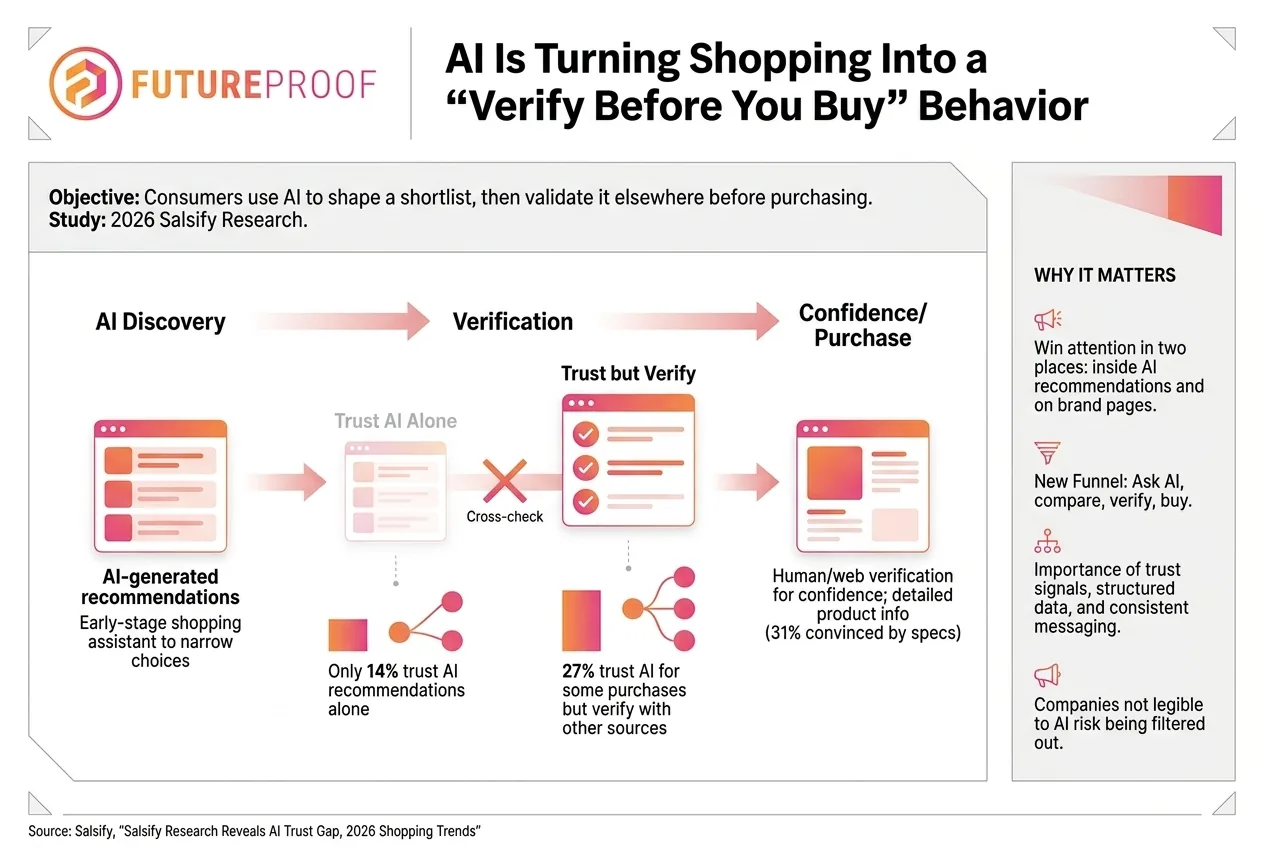
The modern shopping journey is undergoing a profound transformation, evolving from a simple search and purchase model into a sophisticated "verify before you buy" behavior, largely driven by the pervasive influence of artificial intelligence. Consumers are no longer passively accepting recommendations; instead, they are leveraging AI tools as powerful initial filters, then actively scrutinizing and validating information before committing to a purchase. This emerging dynamic, highlighted by a recent Salsify study, signals a critical shift in consumer expectations and demands a strategic recalibration from brands aiming to thrive on the digital shelf.
According to Salsify’s 2026 Shopping Trends research, a notable 22% of shoppers now actively incorporate AI tools into their initial search process. This indicates a growing comfort with AI as a starting point for product discovery, a testament to the technology's ability to quickly sift through vast amounts of data and present relevant options. AI, whether integrated into search engines, dedicated shopping assistants, conversational AI chatbots, or personalized recommendation engines, has become an invaluable first touchpoint for consumers overwhelmed by choice. It excels at understanding natural language queries, filtering noise, and presenting a curated shortlist that aligns with stated preferences or inferred needs. For busy individuals or those exploring complex product categories like electronics, home appliances, or health supplements, AI offers a streamlined entry into the purchasing funnel, effectively cutting through the clutter of countless listings and advertisements that might otherwise paralyze decision-making. This initial AI engagement marks the crucial first step in the evolving customer journey, where AI acts as the preliminary gatekeeper, determining which brands and products even make it onto a shopper’s radar. Brands neglecting their AI discoverability risk being entirely bypassed in this critical pre-consideration phase.
However, the Salsify study also reveals a significant "AI trust gap," underscoring the nuanced relationship consumers have with this powerful technology. Despite their willingness to use AI for discovery, only 14% of shoppers trust AI recommendations alone. This statistic is profoundly telling, underscoring a fundamental human need for validation. It suggests that while AI is excellent at narrowing down options based on algorithms and data points, it often lacks the human element of intuition, empathy, and firsthand experience that truly instills confidence. Consumers are inherently cautious; they understand that AI, while sophisticated, can be influenced by various factors, from data biases to monetization strategies. They seek assurance beyond an algorithm’s output, craving the certainty that comes from independent verification. This inherent skepticism isn't a rejection of AI, but rather a mature understanding of its current limitations and a desire for a more robust decision-making process that combines technological efficiency with human critical thought. The 14% figure vividly illustrates that AI is perceived as a valuable assistant, not an infallible oracle. Smart consumers are using AI as a guide, not a dictator, in their purchasing decisions.
Further compounding this trend, an additional 27% of shoppers rely on AI for some purchases but still make the conscious effort to verify information elsewhere. This segment represents the vast majority of consumers who engage with AI in a more measured, practical way. They appreciate AI's efficiency in surfacing relevant products but acknowledge its role as a tool, not a definitive authority. This "verify before you buy" mentality isn't just a fleeting trend; it's rapidly becoming a fundamental aspect of digital literacy and an established consumer behavior pattern in e-commerce. Shoppers are becoming savvier, understanding that a quick AI-generated list is a starting point, not the end destination. They're leveraging AI for its speed and processing power, but reserving their ultimate judgment for traditional, human-centric validation methods. This highlights a clear two-step cognitive process: an initial, AI-driven filtering followed by a critical, human-driven verification. For brands, this means ensuring not only AI-powered discoverability but also absolute factual accuracy, compelling authenticity, and a wealth of supplementary information at every subsequent touchpoint where a shopper might seek to confirm details.
The pattern is undeniably emerging: consumers utilize AI to efficiently narrow down a vast universe of choices, subsequently pivoting to validate product details, specifications, and crucial reviews on trusted retailer or marketplace pages, or even the brand's own direct-to-consumer (DTC) website. This sequential engagement defines the new AI-augmented shopping funnel. For example, a consumer might ask an AI assistant, "What are the best sustainable running shoes for pronators under $150?" and the AI provides a curated list of three to five options. The next action isn't an immediate purchase, but rather a deep dive into the specific product pages for each item on that list. Here, they scrutinize high-resolution images, pore over technical specifications (e.g., heel drop, weight, midsole material), compare dimensions, examine warranty details, and, most importantly, devour customer reviews for real-world insights into comfort, durability, and fit. This post-AI verification stage is where the real conversion battle is fought and won, or lost. It's where the abstract concept of a product suggested by an algorithm solidifies into a tangible item, evaluated through the lens of real-world application and user experience, directly impacting the brand’s digital shelf performance and overall e-commerce success.
The power of comprehensive and accurate product content in this verification phase cannot be overstated. When AI tools are capable of delivering detailed product descriptions and specifications, a significant 31% of shoppers report being convinced to buy. This statistic is a powerful indictment of generic or sparse product information and a resounding endorsement for rich, meticulously crafted product content. It’s not enough for AI to merely list a product or provide a generic summary; for it to genuinely influence purchase intent, the AI output itself must be robust and informative, closely mirroring the depth of information a human expert or a comprehensive product page would offer. This underscores that the underlying data feeds and Product Information Management (PIM) systems that feed AI must be exceptional. If an AI can eloquently articulate the unique features, benefits, specifications, and even common use cases of a product, effectively bridging the informational gap, it significantly accelerates the buyer's journey and builds initial trust. This means brands must prioritize not only being present where AI operates but also empowering AI with the highest quality, most comprehensive, and consistently updated data possible.
For brands navigating this evolving landscape, visibility is now unequivocally a two-step battle. The first step involves ensuring products appear prominently and accurately in AI-generated shortlists. This demands a proactive approach to search engine optimization (SEO) that extends beyond traditional keyword stuffing to encompass structured data, semantic relevance, and comprehensive product data feeds. Brands must "speak the language of AI," using clear, consistent, and categorized product attributes that AI algorithms can easily understand, process, and recommend. This means optimizing product titles, descriptions, categories, and specific attributes (color, size, material, usage, compatibility) with AI in mind, anticipating how these systems will interpret and present information to shoppers. Without this foundational AI-readiness, products risk being overlooked in the initial discovery phase, never even making it to the shopper's preliminary consideration set. The digital shelf is no longer just about human-readable content; it's about machine-readable data that fuels intelligent recommendations, making strong SEO and robust product data management central to discoverability.
The second, equally vital step in this two-pronged battle is ensuring products can withstand intense scrutiny when shoppers cross-check information on retailer or marketplace pages. This is the verification stage, where trust is either solidified or eroded, and where a brand's reputation for accuracy is truly tested. Once an AI has piqued a shopper's interest, they will inevitably navigate to a brand’s own site or a major e-commerce platform to delve deeper. Here, consistency of product information across all touchpoints becomes paramount. Discrepancies between what AI presented and what the product page shows—a different color name, a slightly varied specification, a conflicting price, or contradictory claims—can instantly shatter trust and lead to cart abandonment. Detailed product descriptions, high-resolution images and videos (including 360-degree views), comprehensive specification sheets, clear sizing guides, interactive content, and robust customer reviews are no longer just nice-to-haves; they are essential conversion drivers. Brands must view every product page as a trust-building exercise, anticipating every question a discerning shopper might have and proactively providing transparent, accurate, and comprehensive answers, ensuring a seamless journey from AI discovery to confident purchase.
Trust signals, in particular, are rapidly becoming essential components of a successful digital strategy. These go beyond mere product features to encompass social proof, authenticity, and brand reputation. Customer reviews and ratings, especially from verified purchases, serve as powerful testimonials that often outweigh AI recommendations, providing the human perspective that AI currently lacks. Certifications (e.g., organic, fair trade, energy star), industry awards, and third-party endorsements lend significant credibility. Transparent return policies, clear warranty information, responsive customer support contact options, and easily accessible FAQs also contribute significantly to building trust. In an era where information can be easily fabricated or manipulated, genuine trust signals act as anchors, reassuring shoppers that they are making an informed and safe purchase. Brands need to actively curate and promote these signals across all digital properties, ensuring they are easily discoverable during the crucial verification phase, enhancing the brand's credibility and fostering customer loyalty.
Structured data is no longer a niche SEO tactic but a foundational requirement for brand visibility and success in the AI-driven shopping landscape. This refers to organizing product information in a standardized, machine-readable format using schemas like Schema.org. Structured data provides explicit clues to AI algorithms about the nature of a product, its attributes, pricing, availability, and reviews. For instance, marking up a product with its 'name', 'description', 'image', 'brand', 'manufacturer', 'SKU', 'GTIN', 'price', 'priceCurrency', 'availability', and 'aggregateRating' ensures that AI tools can precisely understand and categorize the item, leading to more accurate, relevant, and comprehensive recommendations. Without well-implemented structured data, brands are essentially speaking a different language than AI, risking misinterpretation or, worse, complete invisibility in AI-generated shortlists. It's the digital equivalent of meticulously labeling every item in a physical store, allowing a smart assistant to instantly locate and describe any product with perfect accuracy, thereby optimizing for AI search and discovery. This foundational data layer is the bedrock upon which AI-powered commerce is built, directly influencing a brand's discoverability and performance on the digital shelf.
Consistent product content across all channels is another non-negotiable requirement. This means that the product information presented on a brand's own website must exactly match what appears on marketplace listings (Amazon, Walmart, etc.), social media advertisements, product comparison sites, and, crucially, what AI tools are being fed. Inconsistencies – a different color name, a slightly varied specification, a conflicting price, or even inconsistent imagery – immediately raise red flags for shoppers engaged in the "verify before you buy" process. These discrepancies erode trust and can lead to immediate abandonment, regardless of how compelling the initial AI recommendation was. A robust Product Information Management (PIM) system, coupled with a Digital Asset Management (DAM) system, is therefore not just an operational tool but a strategic imperative. A PIM ensures a single source of truth for all product data, enabling brands to efficiently manage, enrich, and syndicate consistent, high-quality content across every digital touchpoint. This unified approach to product information ensures that the validation stage of the customer journey is seamless and confidence-inspiring, reducing buyer’s remorse and enhancing overall brand perception.
Brands that are not easily understood by AI risk being filtered out before shoppers ever reach their sites. This is the existential threat posed by the "verify before you buy" phenomenon for unprepared businesses. If a brand's product data is messy, incomplete, unstructured, or simply not optimized for machine interpretation, it will struggle to make it into the AI-generated shortlists that increasingly initiate consumer discovery. AI systems are designed for efficiency and precision; they prioritize information that is clear, consistent, and logically organized. A brand that uses inconsistent terminology, lacks comprehensive specifications, or has fragmented data across its digital ecosystem effectively renders itself invisible to these powerful AI filters. This isn't just about missing out on a single sale; it's about being entirely bypassed in the initial stages of the shopping journey, a disadvantage that becomes increasingly difficult to overcome through later marketing efforts. The cost of AI-invisibility is direct and significant: lost discoverability, reduced brand awareness, missed sales opportunities, and ultimately, diminished market share in an increasingly competitive e-commerce landscape. Optimizing for AI is no longer a luxury, but a necessity for survival.
Beyond the technical aspects of data and content, building genuine brand trust in the AI era takes on new dimensions. While structured data and consistent content provide the factual foundation, emotional and ethical trust are equally vital for the modern consumer. Consumers are becoming more conscious of brand values, sustainability practices, corporate responsibility, and transparency in manufacturing processes. AI recommendations, even if factually accurate, can feel cold and impersonal. Brands must therefore continue to foster authentic connections, communicate their unique value proposition, and demonstrate transparency in their operations. This might involve showcasing user-generated content, engaging actively with customers on social media, or clearly articulating a brand's mission and ethos. When a shopper verifies an AI recommendation, they are not just checking specs; they are also implicitly evaluating the brand's reputation, ethical stance, and overall trustworthiness. A strong, positive brand image, built on authenticity and transparency, acts as a powerful trust signal, reinforcing the AI’s suggestion and pushing the shopper closer to conversion, creating lasting brand loyalty.
The evolution of e-commerce into this "verify before you buy" model represents a maturation of digital consumer behavior. It’s a powerful indication that consumers are becoming more discerning, more empowered, and more sophisticated in their use of technology. They recognize AI’s incredible potential for efficiency and personalization but are not relinquishing their critical faculties. Instead, they are integrating AI into a broader, more rigorous decision-making framework. This isn't a temporary trend; it’s a fundamental shift in the customer journey that will continue to evolve as AI capabilities advance. Brands must see this as an opportunity, not a threat, to deepen their relationship with customers by providing unparalleled transparency, accuracy, and richness of information. This new era demands a commitment to data quality and a customer-centric approach that anticipates the verification imperative.
The challenge for brands is multifaceted, requiring a holistic approach that integrates technology, content strategy, and customer experience. It begins with investing in robust Product Information Management (PIM) and Digital Asset Management (DAM) systems to centralize, enrich, and manage all product data and associated rich media. This data then needs to be meticulously structured and optimized for AI comprehension, utilizing schema markup, clear attribute definitions, and comprehensive metadata. Content teams must shift their focus to creating not just engaging narratives but also highly detailed, accurate, and comprehensive product descriptions that leave no room for ambiguity. Marketing efforts must extend beyond mere promotion to actively curating and showcasing trust signals, from verified customer reviews and compelling testimonials to ethical certifications and transparent brand stories. The entire digital ecosystem, from product pages to checkout flows and customer service interactions, must be designed to anticipate and answer every verification query a discerning shopper might have, creating a frictionless and trustworthy path to purchase.
Furthermore, brands need to actively monitor how their products are being represented by various AI tools and platforms. This involves understanding the algorithms that drive recommendations, tracking visibility in AI-generated results, and iteratively refining product data based on performance insights. It’s an ongoing process of optimization, ensuring that the brand’s digital footprint is consistently aligned with AI’s evolving understanding of product relevance and quality. This proactive monitoring allows brands to identify and rectify any misinformation or omissions that could derail the verification process, thereby safeguarding their position in the increasingly AI-mediated market and maintaining a competitive edge. Leveraging AI analytics to understand consumer verification patterns can also provide invaluable insights for continuous content refinement.
Ultimately, the era of "verify before you buy" demands a new paradigm of digital readiness. It’s no longer sufficient for brands to simply have an online presence; they must have an AI-intelligent presence. They must be discoverable by machines, comprehensible by algorithms, and trustworthy in the eyes of increasingly savvy human consumers. The brands that embrace this dual challenge – excelling at both AI-driven discovery and human-driven verification – will be the ones that capture market share, build lasting customer loyalty, and ultimately define the future of commerce in the age of artificial intelligence. The message is clear: optimize for AI, but build for human trust. This symbiotic relationship between advanced technology and human discretion is setting the stage for the next generation of e-commerce, where informed decision-making is paramount, and every purchase is a result of thorough validation. Brands that proactively adapt their strategies to meet these evolving consumer behaviors will not only survive but thrive in this exciting new chapter of retail, solidifying their position on the digital shelf.