The Rise of the Digital Confidant Transforming How We Make Lifes Most Sensitive Decisions
A profound, yet largely unheralded, transformation is underway in the way individuals approach the most critical junctures of their lives. Gone are the days when significant personal dilemmas were exclusively aired in the presence of trusted human advisors – doctors, therapists, mentors, or family members. A new, digital confidant has emerged, quietly assuming a pivotal role as a first stop for sensitive life decisions. This shift, driven by the increasing sophistication and accessibility of artificial intelligence, is not merely a technological novelty; it represents a fundamental reorientation in how people seek guidance, explore options, and prepare for the conversations that shape their futures.
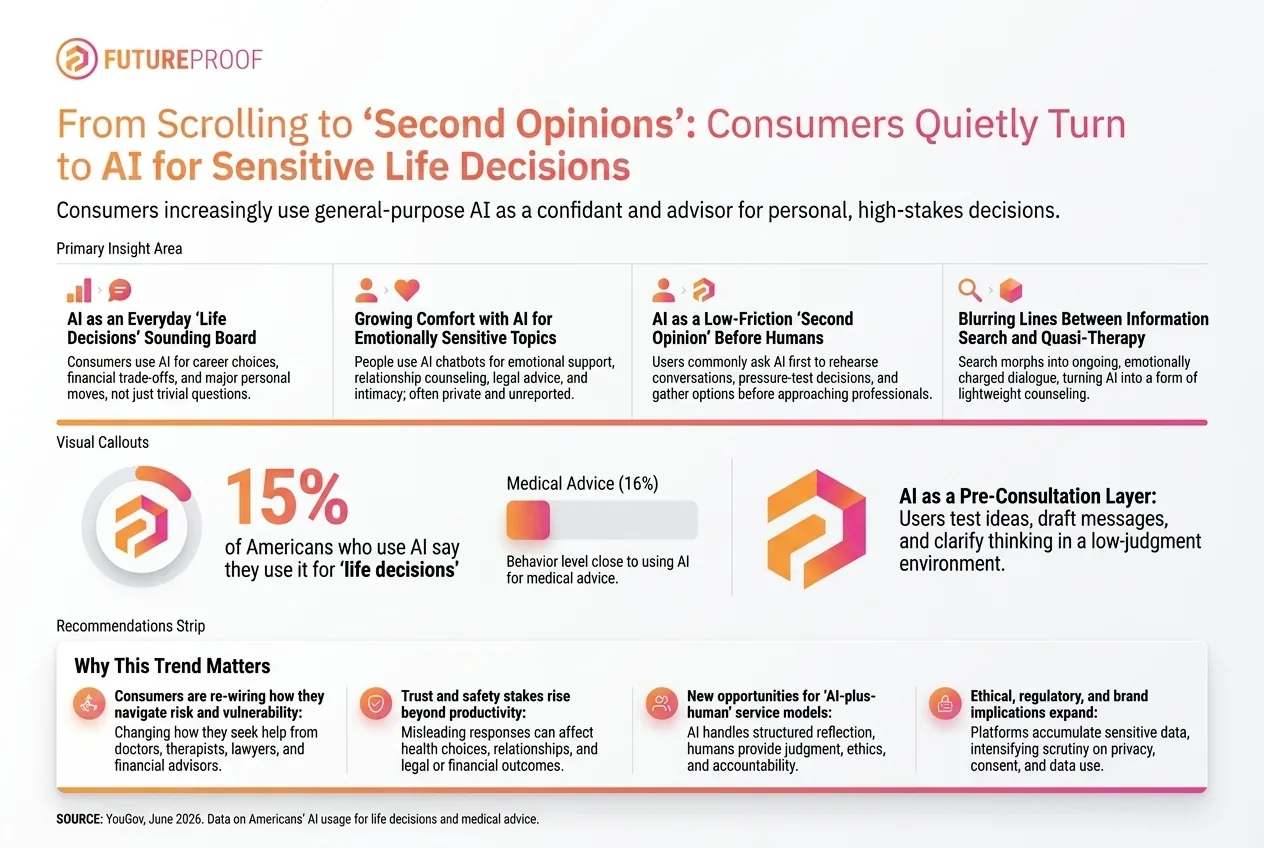
The data underscores the magnitude of this quiet revolution. According to a June 2026 YouGov report, a striking 15 percent of Americans who actively use AI now turn to it for life decisions. This figure is remarkably close to the 16 percent who engage AI for medical advice, highlighting a rapid and broad acceptance of AI in highly personal and impactful domains. This isn't just about simple information retrieval; it’s about individuals seeking a sounding board, a strategic partner, and an emotional processing space for the kind of choices that carry significant weight and consequence.
Why are consumers increasingly placing their trust in algorithms for matters as intricate as career trajectory, relationship dynamics, financial trade-offs, and even profound existential questions? The answer lies in a confluence of factors that position general AI tools as uniquely appealing for these sensitive explorations. Foremost among these is the promise of a judgment-free zone. Unlike human interactions, where concerns about being perceived negatively, receiving unsolicited opinions, or even feeling like a burden can deter open communication, AI offers an unblinking, neutral interface. Users can articulate their deepest anxieties, explore unconventional ideas, or confess vulnerabilities without fear of social repercussions or emotional fallout. This inherent anonymity provides a sanctuary for introspection, allowing individuals to truly unpack their thoughts in a safe and private digital space.
Beyond the absence of judgment, the accessibility and convenience of AI are unmatched. Life’s challenging decisions rarely adhere to business hours. A pressing career dilemma might strike late at night, or a relationship conflict could escalate over a weekend. AI is available 24/7, offering instantaneous responses and iterative dialogue whenever the need arises. This constant availability transforms AI into an ever-present resource, a reliable constant in a world of complex and often time-sensitive choices. Moreover, the iterative nature of AI allows users to refine their queries, explore multiple angles, and engage in extended thought experiments, a luxury often unavailable in limited, scheduled human consultations.
The scope of decisions for which people are turning to AI is impressively broad, extending far beyond initial expectations. Universities, for example, report a growing use of AI not just for academic assistance, but for emotional support, relationship counseling, spiritual reflection, and even preliminary legal questions. This expansion into domains once considered exclusively human signifies a profound shift, indicating that AI is now traversing boundaries previously thought sacrosanct for human connection and expertise.
Consider the realm of career moves. Before broaching a delicate conversation with a current employer about a resignation, or with a potential employer about salary negotiation, individuals are using AI to rehearse their arguments. They might input their current job description, their desired role, and their salary expectations, asking the AI to simulate interview questions, offer negotiation strategies, or even craft persuasive resignation letters. This allows them to test the waters, refine their messaging, and build confidence, transforming a potentially intimidating human interaction into a more predictable and manageable one.
In relationships, AI is acting as a virtual mediator and communication coach. Users might describe a conflict with a partner, friend, or family member, and the AI can help them reframe their perspective, suggest empathetic communication techniques, or even draft potential conversation starters. It provides a neutral lens through which to analyze interpersonal dynamics, helping individuals understand different viewpoints and strategize healthier interactions, all without the emotional bias or personal involvement a human friend might bring.
Financial trade-offs also see AI playing a significant role. While AI cannot provide regulated financial advice, it can help users explore scenarios. Someone contemplating a major purchase, weighing investment options, or considering a significant loan might input their financial data and ask the AI to project potential outcomes based on different choices. This allows for a deeper understanding of implications, budgeting strategies, and risk assessment, empowering individuals to arrive at their professional financial advisor meetings with well-articulated questions and a clearer grasp of their options.
Perhaps most notably, AI is entering the sensitive domain of emotional support and mental wellness. While it is crucial to emphasize that AI is not a substitute for professional therapy or psychological intervention, it serves as a valuable pre-consultation layer. Individuals grappling with stress, anxiety, or general emotional turbulence can use AI as a digital journal or a reflective partner. They might articulate their feelings, explore coping mechanisms, or seek calming techniques. This preliminary engagement can help individuals organize their thoughts and feelings, making subsequent conversations with human therapists more focused and productive. It acts as a bridge, allowing individuals to gently approach their emotional landscape before engaging with a professional.
This phenomenon underscores that AI is becoming a sophisticated pre-consultation layer. It's a space where people can rehearse conversations, test decisions, and clarify their thinking before speaking to professionals. Imagine a scenario where someone is preparing to discuss a sensitive medical condition with their doctor. They might use AI to understand the diagnosis better, formulate questions about treatment options, or even anticipate potential side effects. This not only empowers the patient with knowledge but also optimizes the limited time they have with their physician, leading to more informed and effective discussions. Similarly, before a legal consultation, AI can help individuals understand basic legal concepts relevant to their situation, organize their facts, and prepare a coherent narrative, making the subsequent meeting with a lawyer more efficient and productive.
As AI continues to evolve, becoming increasingly conversational, context-aware, and even empathetic in its textual and vocal interactions, the line between simple information search and lightweight counseling is irrevocably blurring. The sophisticated natural language processing capabilities allow AI to respond in ways that feel genuinely understanding and supportive, mimicking the nuances of human interaction. This perceived empathy, while synthetic, creates a compelling user experience that encourages deeper engagement and a willingness to share more personal details. The very design of these tools fosters a sense of being heard and understood, a powerful draw for individuals navigating isolating or complex choices.
This blurring of lines presents both immense opportunity and significant responsibility. The opportunity ahead lies in building responsible, AI-plus-human service models. Such models recognize AI's strengths as a preparatory tool—a robust data synthesizer, a scenario planner, and a judgment-free sounding board—while preserving the irreplaceable value of human expertise, empathy, and accountability in final decision-making. The goal is not to replace human professionals but to augment human capability, enabling individuals to arrive at expert consultations better informed, more articulate, and more confident in their agency.
Consider a future where a person struggling with a difficult ethical dilemma first uses an AI to explore various philosophical frameworks, understand potential consequences of different actions, and even challenge their own biases. Only then, armed with a clearer understanding of the complexities, do they bring their refined questions to a human ethicist, counselor, or spiritual guide. In this model, AI elevates the quality of the initial reflection, allowing human experts to focus on the nuanced, emotionally intelligent guidance that only another human can provide.
However, the widespread adoption of AI for sensitive decisions also brings forth critical challenges that demand thoughtful consideration and proactive solutions. Data privacy and security are paramount. The highly personal nature of the information shared with AI systems necessitates robust encryption, clear data usage policies, and an unwavering commitment from developers to protect user confidentiality. The potential for algorithmic bias is another significant concern. If AI models are trained on biased datasets, they could inadvertently perpetuate or amplify societal inequities in the guidance they offer, particularly in sensitive areas like career advice or relationship dynamics. Over-reliance on AI could also risk eroding critical thinking skills or diminishing the importance of genuine human connection and advice. It is crucial for users to maintain a healthy skepticism, verify information, and ultimately, exercise their own judgment, using AI as a tool for exploration rather than a definitive oracle.
The quiet shift we are witnessing is a testament to AI’s burgeoning capacity to integrate seamlessly into the fabric of human decision-making. It signals a future where technology plays an integral, albeit supportive, role in navigating life's most profound challenges. The journey from scrolling through social media to seeking second opinions from an AI is swift and often imperceptible to observers. Yet, its implications are vast. As we move forward, the imperative is clear: to cultivate AI systems that are not only intelligent and helpful but also ethical, transparent, and designed to empower individuals to make well-informed decisions, always in collaboration with, and never entirely replacing, the indispensable wisdom and empathy of human guidance. The era of the digital confidant has arrived, and how we responsibly integrate it into our most sensitive life choices will define a generation.