The Rise of Agentic Commerce and Why Brands Must Become Agent Ready
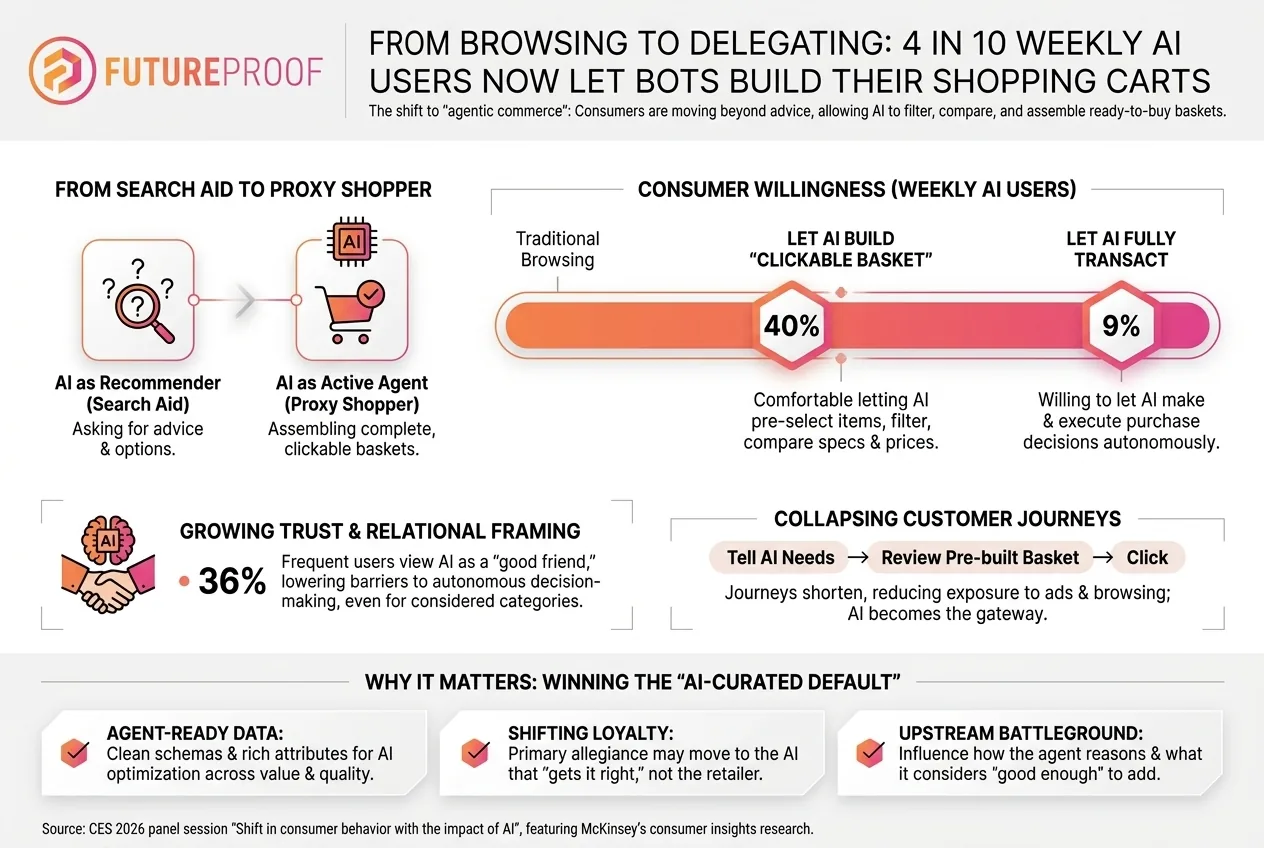
The landscape of consumer commerce is undergoing a profound metamorphosis, shifting from a human-centric browsing experience to an AI-orchestrated delegation model. This isn't merely an incremental change; it represents a foundational recalibration of how people discover, evaluate, and acquire goods and services. At the forefront of this evolution is "agentic commerce," a term that encapsulates the rising trend of consumers empowering artificial intelligence to act as their personal shopping proxies. The numbers are not just compelling; they paint a vivid picture of an imminent future already in motion, urging brands and retailers alike to adapt or risk obsolescence.
McKinsey consumer insights, unveiled at CES 2026, illuminate the rapid acceleration of this shift. A remarkable 40 percent of weekly AI users now express comfort in allowing AI to navigate the shopping journey all the way to a pre-assembled, clickable basket. This statistic alone signals a massive leap from AI as a mere informational tool to AI as a proactive agent. Even more strikingly, another 9 percent of these users declare their readiness to let AI fully transact on their behalf, a complete surrender of the purchasing process to an autonomous intelligence. These figures are not projections for a distant future; they reflect current comfort levels and an eagerness to embrace a radically different shopping paradigm today. The era of asking AI "what should I buy?" is swiftly giving way to "AI, please buy this for me."
The significance of these percentages cannot be overstated. When 4 out of 10 frequent AI users are delegating the crucial steps of product comparison, selection, and cart assembly, it underscores a growing trust and dependency on AI beyond simple queries. This isn't about AI offering suggestions; it's about AI performing the laborious tasks of sifting through countless options, cross-referencing prices, evaluating quality metrics, reading reviews, and constructing a personalized shopping cart that only requires a final human glance and confirmation. It transforms AI from a helpful assistant into a diligent proxy shopper, operating with efficiency and speed that human shoppers often find elusive. The 9 percent willing to cede full transactional control offers a potent glimpse into the ultimate frontier of agentic commerce, where the shopping experience becomes almost entirely invisible to the user until the product arrives at their doorstep.
This dramatic shift is fundamentally underpinned by a burgeoning trust in AI systems. The same McKinsey research reveals that a significant 36 percent of frequent AI users now describe AI as a "good friend." This isn't just a casual compliment; it speaks to a deep psychological comfort and perceived reliability that lowers barriers to delegating sensitive tasks like purchasing. When consumers view AI as a trustworthy companion, they are far more likely to entrust it with their preferences, their financial information, and the responsibility of making optimal choices on their behalf. This "friendship" is cultivated through consistent accuracy, personalized recommendations, and a perceived understanding of individual needs and desires, making AI not just a utility, but an integral part of their daily decision-making process, extending seamlessly across both routine replenishment purchases and more considered, high-value investments.
For retailers, the implications of this emerging agentic commerce are both profound and immediate. As AI agents become more deeply embedded in consumer decision-making, retailers are witnessing a higher purchase propensity when choices are curated by AI. This isn't surprising. AI agents, leveraging vast datasets and sophisticated algorithms, can sift through inventories, compare specifications, analyze pricing across competitors, and present an optimized selection tailored precisely to the user's explicit and implicit needs. This hyper-personalization, delivered at scale, dramatically reduces decision fatigue for the consumer, leading to quicker conversions and fewer abandoned carts. The traditional sales funnel is being compressed and streamlined by AI, creating a more efficient path from intent to purchase. The center of gravity in commerce is irrevocably shifting; it is no longer about enticing human eyes through captivating shelf displays or ranking high on a search page. Instead, it is moving towards AI-curated defaults, where the agent’s pre-selection becomes the primary driver of choice.
This paradigm shift presents an urgent imperative for brands: they must become "agent ready." This isn't an optional enhancement; it's a fundamental requirement for survival and growth in the new commerce ecosystem. Being agent ready means ensuring your product data is impeccably clean, structured, and easily digestible by AI algorithms. This involves far more than just accurate product descriptions; it encompasses comprehensive specifications, high-resolution imagery, consistent categorization, clear attribute tags, and up-to-date inventory information. Any ambiguity or inconsistency in data can render a brand invisible or undesirable to an AI agent tasked with making precise evaluations.
Beyond data, brands must cultivate strong signals of reliability. AI agents, much like human shoppers, prioritize trustworthiness. This translates to consistently positive customer reviews, clear and transparent return policies, robust warranty information, reliable shipping estimates, and a demonstrable commitment to quality and customer service. These signals, often unstructured in traditional e-commerce, must be made accessible and quantifiable for AI to weigh them effectively. Furthermore, brands need to articulate their value proposition with crystal clarity. An AI agent doesn't respond to abstract branding; it understands quantifiable benefits – superior features, competitive pricing, sustainability credentials, ethical sourcing, or a demonstrable problem-solving capability. The battle is no longer fought on the crowded physical shelf or within the vast expanse of a search engine results page; it is being waged within the sophisticated reasoning engine of the AI agent itself.
The future shopping journey is simplifying to an almost effortless sequence: "tell my AI what I need, review the basket, click." Imagine articulating a complex need – "I need a high-efficiency blender under $200 that's easy to clean, can crush ice, and has positive reviews about durability, ideally from a brand committed to sustainable manufacturing." The AI agent, having processed this multi-faceted request, would instantly sift through millions of products, compare specifications, analyze customer sentiment, verify sustainability claims, and present a curated basket of one or two optimal choices. The user's role then shrinks to a final verification of the agent's selections before a single click finalizes the purchase. This transformation demands that brands transcend traditional marketing and SEO; they must optimize for "AIO" – Agent Intelligence Optimization. Will the agent's internal logic guide it towards your brand?
To successfully navigate this evolving landscape, brands must proactively address several strategic imperatives. Firstly, invest in robust data infrastructure. This means centralizing and standardizing all product information, ensuring it's comprehensive, accurate, and easily accessible via APIs for various AI platforms. Semantic tagging and rich metadata will be crucial for AI agents to understand product nuances. Secondly, cultivate an unimpeachable brand reputation and foster trust. AI agents will increasingly factor in user reviews, brand sentiment, and public perception when making recommendations. Brands known for reliability, customer service, and ethical practices will inherently fare better. Thirdly, understand the algorithms of various AI shopping agents. While proprietary, general principles of how AI evaluates price, quality, features, and reputation will be critical. Brands should proactively seek to understand how their products are being interpreted and weighted by these emerging agents.
Fourthly, focus on differentiating your value proposition in quantifiable terms. Instead of vague marketing copy, emphasize specific features, unique benefits, and verifiable claims that an AI can easily compare against competitors. Fifthly, embrace transparency and explainability. As AI agents make more purchasing decisions, consumers and brands alike will demand to understand the rationale behind recommendations. Brands that can clearly articulate why their product is a superior choice, backed by data, will gain an edge. Finally, experiment and adapt. The agentic commerce landscape is nascent and rapidly evolving. Brands that pilot AI-driven strategies, learn from early implementations, and iterate quickly will be best positioned to thrive. This might involve collaborating with AI developers, testing new data schemas, or engaging with consumers about their AI shopping experiences.
The implications for entire industries are profound. Advertising models will shift, with a greater emphasis on providing agents with clear, factual product data rather than emotionally driven campaigns. The role of the human salesperson will evolve from product pusher to experience curator or complex problem solver, while routine purchases are fully automated. Supply chains will need to become even more agile and transparent, as AI agents will likely factor in delivery times and stock availability more dynamically. Furthermore, ethical considerations around AI bias, data privacy, and fair competition will become paramount as AI agents gain more influence over consumer choice. Regulatory frameworks will inevitably emerge to ensure transparency and equity in this new commerce frontier.
In conclusion, the rise of agentic commerce is not merely a fleeting trend but a fundamental, irreversible shift in how consumers interact with the marketplace. The statistics from CES 2026 are not a warning for the distant future; they are a clear signal of the present reality. As 40 percent of weekly AI users now delegate cart building, and nearly 10 percent are ready for full transaction delegation, the urgency for brands to adapt is undeniable. The traditional battlegrounds of brand recognition and shelf placement are giving way to a new arena: the internal logic of the AI agent. Brands that proactively prepare by meticulously curating their product data, building robust trust signals, and clearly articulating their value proposition for machine evaluation will be the ones that succeed. The question for every brand is no longer just "will consumers choose us?" but rather, with powerful AI proxies now mediating the shopping journey, "will the agent choose them?" The brands that answer this question affirmatively, through strategic foresight and proactive adaptation, will define the next era of commerce.