Millennials Are Transforming Product Discovery Through Scenario Based AI Shopping
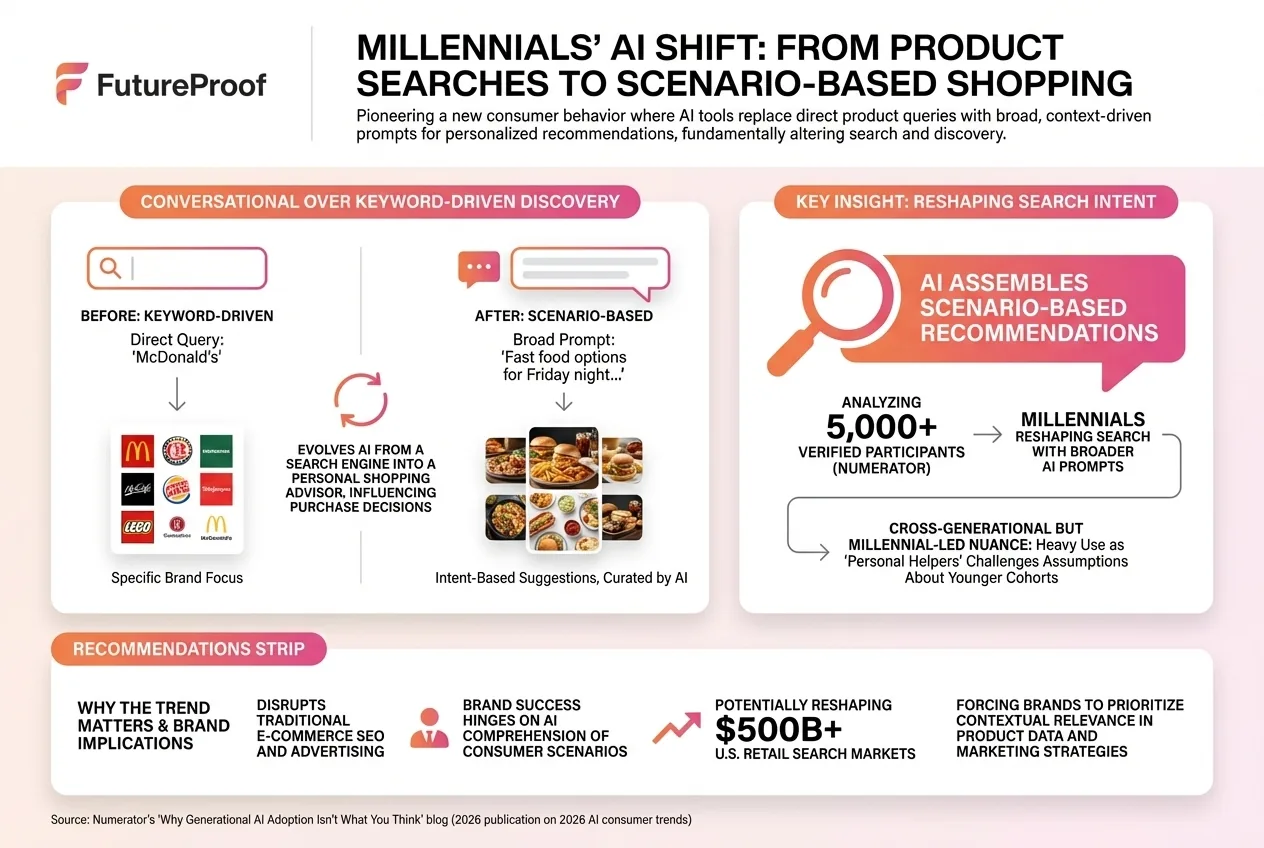
The landscape of consumer product discovery is undergoing a seismic transformation, fundamentally reshaped by the nuanced interaction between a new generation of shoppers and increasingly sophisticated artificial intelligence. At the vanguard of this revolution are millennials, a demographic often misunderstood in their technological adoption, who are now demonstrating a profound shift in how they unearth and evaluate products. They are moving decisively away from the traditional, brand-specific keyword searches that have long dominated e-commerce and search engines, opting instead for scenario-based guidance from AI. This isn't just an incremental change; it’s a redefinition of the entire purchase funnel, demanding that brands and retailers recalibrate their strategies to remain visible and relevant in a market worth over $500 billion.
Millennials, with their inherent digital fluency and a keen desire for convenience and personalization, are instinctively embracing AI not as a simple search engine, but as a genuine shopping advisor. Gone are the days when a shopper would type "Nike running shoes" into a search bar, hoping to sift through thousands of results. Instead, the millennial consumer is posing broader, more contextual queries such as "fast food options for a Friday night with the family" or "snacks for a football party." This subtle yet powerful linguistic shift signals a deeper intent: they're not looking for a specific product; they're looking for solutions tailored to a particular moment, a lifestyle need, or a specific occasion. AI, equipped with advanced natural language processing and contextual understanding, is uniquely positioned to fulfill this demand by curating personalized recommendations that resonate with the prompt's underlying scenario.
This evolving behavior blurs the previously distinct lines between search, browsing, and personal assistance. AI is no longer merely an information retrieval tool; it has ascended to the role of a trusted confidante, an intelligent guide that understands the nuances of a consumer's life. It processes complex prompts, infers intent, considers latent preferences, and then assembles a bespoke collection of product suggestions. Imagine asking an AI for "easy, healthy dinner recipes for two with ingredients available at my local grocery store" or "gift ideas for a friend who loves outdoor adventures and sustainable brands." The AI doesn't just list products; it crafts a narrative, weaving together products, services, and experiences into a coherent, relevant, and often unexpected solution. This level of personalized curation goes far beyond the capabilities of traditional keyword-based search, which often delivers generic results heavily influenced by advertising spend rather than true contextual fit.
The assumption that older generations invariably drive consumer tech change is being squarely challenged by this millennial-led adoption of AI for product discovery. While AI's prevalence is growing across all demographics, millennials are demonstrably leading the charge in this specific, scenario-based usage. Their comfort with conversational interfaces, their expectation of immediate and relevant results, and their desire for experiences over mere transactions make them ideal early adopters for AI's advisory capabilities. They seek to offload cognitive load, trusting AI to synthesize vast amounts of information and present them with highly relevant choices, freeing them from endless scrolling and comparison shopping. This proactive engagement from millennials signals a permanent shift in consumer behavior that all brands must acknowledge.
For brands and retailers, understanding this paradigm shift is not just advantageous; it's existential. Success in this new AI-driven market hinges not on how well a product is optimized for a handful of keywords, but on how thoroughly AI understands its context, utility, and relevance within specific scenarios. The era of keyword stuffing and generic product descriptions as a primary SEO strategy is rapidly waning. Instead, visibility will be granted to products whose data is rich enough, structured enough, and semantically dense enough for AI to comprehend its multifaceted value proposition within the context of a consumer's life moment. This demands a fundamental rethinking of product information architecture, content strategy, and digital marketing spend.
To thrive in this environment, brands must prioritize richer product data. This extends far beyond basic attributes like color, size, and price. AI needs to understand the story behind a product: its use cases, the problems it solves, the occasions it's suitable for, the lifestyle it supports, its compatibility with other products, its environmental footprint, its origin story, and even the emotional benefits it provides. For instance, a coffee maker isn't just a kitchen appliance; it’s an enabler for "starting your day with a perfect brew," a tool for "hosting brunch with friends," or a solution for "convenient morning routines for busy professionals." This deeper level of contextual metadata allows AI to accurately match a product to complex, scenario-based prompts.
Furthermore, brands must cultivate scenario relevance in their marketing and content strategies. Instead of merely describing product features, they need to illustrate how their products integrate seamlessly into various lifestyle moments. This could involve creating content that speaks to specific scenarios: blog posts featuring recipes for "family movie night" using branded snacks, social media campaigns showcasing apparel for "weekend hikes with friends," or product pages that highlight how a smart device simplifies "managing a busy household." The goal is to provide AI with a robust understanding of the product's role within different human experiences, making it discoverable when a consumer poses a broad, need-based query.
This transformation also underscores the growing importance of natural language processing (NLP) in consumer search. AI's ability to interpret conversational prompts and infer user intent means that content needs to be optimized for how people speak, not just how they type keywords. This includes anticipating long-tail queries, understanding synonyms and semantic relationships, and responding to nuanced emotional cues embedded in language. Brands should audit their existing content, product descriptions, and FAQ sections to ensure they are designed for conversational clarity and contextual richness, making them more digestible and relatable for AI algorithms.
The implications extend to how brands engage with AI platforms directly. As AI becomes an increasingly dominant gatekeeper of product discovery, brands will need to explore partnerships and direct data feeds with these platforms. Ensuring product information is structured and accessible in a format that AI can readily consume and leverage for recommendations will become a competitive differentiator. This might involve adopting specific data schemas, participating in AI-driven product catalogs, or even integrating AI-powered conversational commerce tools into their own digital ecosystems. The future of brand visibility lies in proactive engagement with the AI ecosystem, not passive reliance on outdated SEO tactics.
The Numerator study, which analyzed over 5000 verified participants, provides compelling evidence of this shift, observing that "millennials increasingly use broad AI prompts like what are fast food options on a Friday night with the family instead of direct searches such as McDonalds, with AI generating scenario based recommendations." This empirical data, sourced from "Numerator, Why Generational AI Adoption Isn't What You Think, 2026," is a stark reminder that this isn't a theoretical future; it's a present reality being driven by a powerful consumer segment.
In conclusion, the era of AI-driven product discovery, spearheaded by millennials and their embrace of scenario-based guidance, marks a profound evolution in consumer-brand interaction. The traditional pillars of keyword optimization are giving way to a new foundation built on contextual understanding, rich product data, and an intimate comprehension of lifestyle moments. Brands and retailers who wish to remain competitive and visible in a market where AI acts as the primary shopping advisor must pivot swiftly. The future success of product discovery hinges on a brand's ability to tell its product's story in a way that AI can not only understand but also eloquently articulate to a consumer seeking a solution for their unique life scenario. This necessitates an urgent investment in data enrichment, content strategy reorientation, and a deep embrace of AI's transformative potential as the ultimate curator of personalized commerce.