Generative AI Is Becoming the New Answer Engine and Brands Must Adapt Now
The digital landscape is undergoing a monumental transformation, profoundly altering how consumers seek and find information, and consequently, how brands are discovered. For decades, traditional search engines reigned supreme, serving as the gateway to the internet by ranking links based on complex algorithms. Brands meticulously optimized for keywords, backlinks, and page authority, understanding that a prime position on the search results page was synonymous with visibility. However, a new paradigm has emerged, one where generative AI is rapidly becoming the new answer engine, fundamentally reshaping consumer behavior and demanding an urgent re-evaluation of digital strategies.
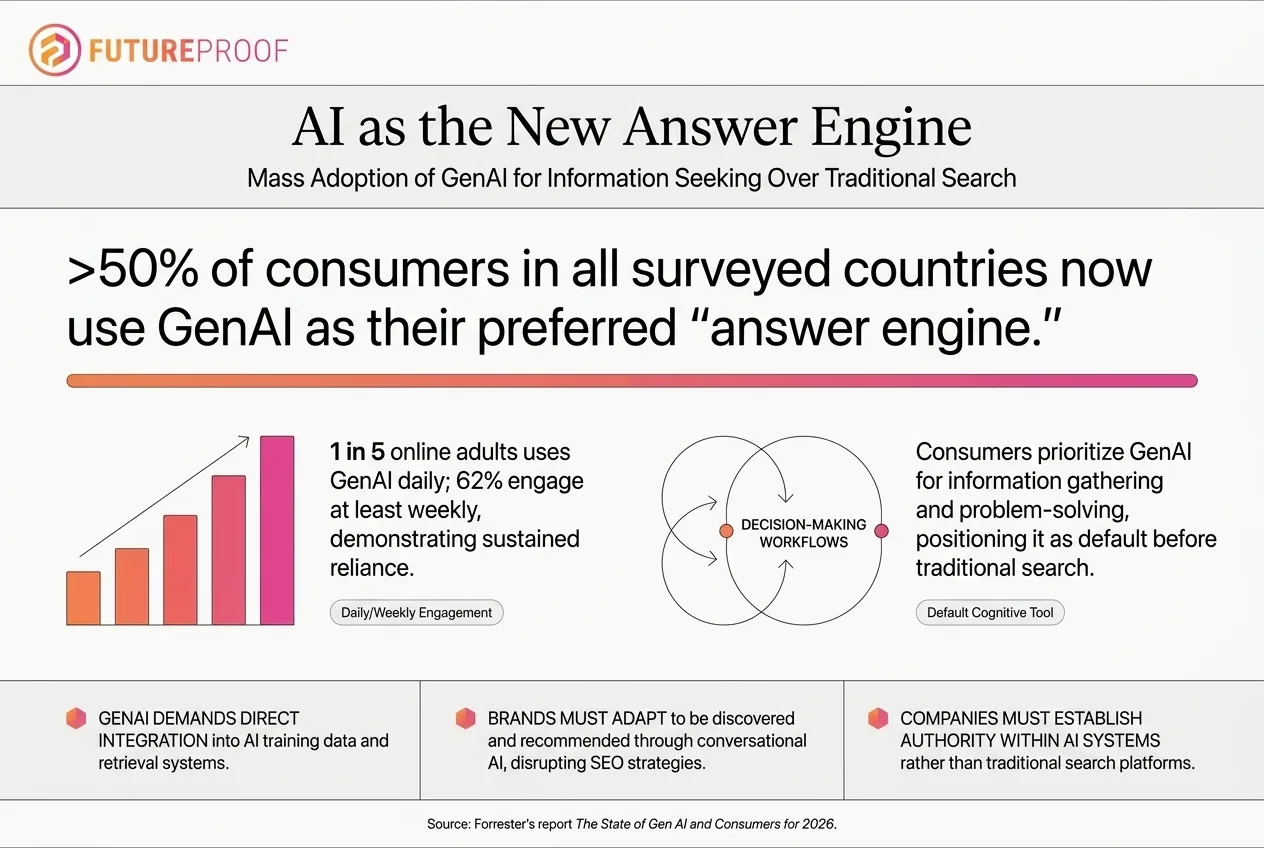
The shift is not subtle; it's a seismic event. Consumers are no longer content with a list of links to sift through. They want direct, synthesized, and immediate answers to their everyday information needs. This preference has propelled Generative AI from a technological marvel to an indispensable daily tool. Forrester's insightful report, "The State of Gen AI and Consumers for 2026," starkly illustrates this accelerating trend, revealing that more than 50 percent of consumers in every surveyed country now rely on GenAI as their primary way to get answers. This isn't a niche adoption; it's a mainstream embrace. The report further underscores the velocity of this change, noting that one in five online adults engages with GenAI every single day, with a staggering 62 percent using it at least weekly. Such pervasive and consistent usage moves GenAI beyond mere novelty, establishing it as a default, indispensable tool for decision-making, in-depth research, and complex problem-solving across all demographics.
This profound behavioral shift has immediate and far-reaching implications for brands. The established pathways to consumer attention – traditional SEO and paid search ads – are no longer the exclusive, or even primary, routes. While they retain some relevance, their dominance is waning as consumers bypass link-centric search results in favor of AI-generated summaries and direct responses. The new mandate for content creation is clear: it must be built not just for human readers or traditional search engine crawlers, but specifically for AI systems designed to synthesize comprehensive answers. Brands that aspire to thrive in this evolving environment must pivot swiftly, ensuring their expertise is not only accessible and trustworthy but also inherently machine-readable within the burgeoning GenAI ecosystems.
The essence of this transformation lies in the fundamental difference between how traditional search engines and GenAI systems operate. A traditional search engine acts as an indexer, pointing users to web pages that might contain the answer. Its output is a list of potential sources. Generative AI, conversely, aims to be the answer. It processes vast amounts of information, understands context, synthesizes insights, and generates a coherent, often conversational, response. This capability to provide direct answers, often with nuances and follow-up capabilities, is precisely why consumers are abandoning the arduous task of sifting through multiple blue links. They save time, reduce cognitive load, and often receive more comprehensive and tailored information instantly. This directness fosters a new kind of brand discovery, where the brand's expertise is presented not as a link to click, but as a verifiable component of the AI's synthesized answer.
The implications for brand discovery are profound. Imagine a consumer asking an AI assistant, "What's the best moisturizer for sensitive, oily skin?" In the traditional search paradigm, they might get a list of e-commerce sites, beauty blogs, and product reviews. With GenAI, they receive a synthesized answer that might include specific product recommendations, ingredients to look for, and expert tips, all integrated into a single, coherent response. If a brand's product information, expert reviews, and ingredient lists are optimized for AI consumption, that brand stands a far greater chance of being featured directly within that AI-generated answer, moving from indirect discovery via a click to direct recommendation via synthesis. This shifts the goal from achieving a high ranking to becoming a fundamental component of the authoritative answer itself.
For brands, this isn't just about adapting SEO; it's about re-imagining content strategy from the ground up. The content landscape is moving from a "pull" model (users actively searching for links) to a "push" model (AI actively synthesizing and presenting information). This necessitates a strategic focus on three critical pillars: accessibility, trustworthiness, and machine-readability.
Accessibility in the AI Era:
For GenAI to incorporate a brand's expertise into its answers, that expertise must first be accessible to the AI. This goes beyond basic crawlability. It involves structuring information in ways that AI models can easily parse, understand, and integrate. Think of knowledge graphs, semantic web technologies, and robust internal linking that clearly defines relationships between concepts and entities within a brand's digital footprint. Content needs to reside in formats and structures that AI models can readily consume, rather than being buried in opaque PDFs or complex, unstructured web pages. This means investing in well-organized, comprehensive knowledge bases, FAQs, and product documentation that serve as authoritative datasets for AI training and response generation. If your brand's data isn't easily ingestible, it simply won't be part of the AI's answer pool.
Trustworthiness as the Ultimate Currency:
In an environment where AI synthesizes answers, the inherent trustworthiness of the source material becomes paramount. AI models are only as reliable as the data they are trained on and the information they retrieve. Brands that establish themselves as authoritative, credible sources of information will be preferentially selected by AI systems seeking to provide accurate and verifiable answers. This means rigorous fact-checking, clear citation practices where applicable, transparent communication about products and services, and a consistent voice of expertise. Building and maintaining a reputation for factual accuracy and verifiable claims is no longer just good PR; it's a fundamental requirement for AI visibility. AI models are increasingly designed to identify and prioritize authoritative sources, and brands that consistently demonstrate expertise and integrity will find their insights naturally integrated into AI-generated responses. This also extends to brand reputation and sentiment – a negative brand perception can inadvertently influence AI's output about your products or services, highlighting the holistic nature of trustworthiness.
Machine-Readability: Speaking AI's Language:
This pillar addresses the technical and structural aspects of content creation. Machine-readability means content is designed in a way that AI models can easily understand its meaning, context, and key takeaways, not just its keywords. This involves:
- Structured Data (Schema.org): Implementing Schema markup to explicitly label and categorize information (e.g., product details, reviews, recipes, FAQs, how-to guides). This provides AI with a clear, unambiguous understanding of the content's components and their relationships.
- Clear, Concise Language: AI models benefit from direct, unambiguous language. Avoid jargon where possible, break down complex topics into digestible chunks, and provide definitive answers to common questions.
- Well-Organized Content: Use headings, subheadings, bullet points, and numbered lists to create a logical hierarchy of information. This helps AI models quickly identify key points and synthesize coherent summaries.
- Semantic Consistency: Ensure that concepts and terms are used consistently across all content, building a robust semantic foundation that AI can leverage.
- Answering Specific Questions: Instead of broad topics, create content that directly answers common consumer questions, anticipating what an AI prompt might ask. These question-answer pairs are gold for GenAI.
The strategic shift required is not merely an incremental update to existing SEO tactics; it demands a philosophical change in how content is conceived and executed. Brands must move away from solely optimizing for keywords to optimizing for concepts, relationships, and direct answers. Instead of aiming for a top-ranking link, the new goal is to have your brand's expertise directly integrated into an AI-generated response, effectively making your brand part of the answer itself.
Consider the potential for proactive content creation. Brands can identify common questions related to their industry, products, or services and proactively create definitive, AI-ready answers. This might involve creating dedicated "answer hubs" or "knowledge centers" on their websites, meticulously structured and semantically rich. These hubs would serve as reliable data sources for GenAI, increasing the likelihood that the brand's verified information is included in synthesized responses. Furthermore, brands should explore opportunities to directly feed their authoritative data into relevant AI models, either through APIs or partnerships, becoming foundational data providers for specific domains.
This also implies a new approach to competitor analysis. Instead of just analyzing competitor backlinks or keyword rankings, brands will need to assess how well their competitors' information is being synthesized by GenAI. Are their products being recommended? Are their expert opinions being cited? This shifts the competitive battleground from page one of Google to the core components of AI-generated answers.
Furthermore, the emphasis on trustworthy content places a heightened responsibility on brands to ensure the accuracy and currency of their information. Outdated or incorrect data can lead to an AI providing flawed answers, which reflects poorly not only on the AI but, crucially, on the source brand. Regular content audits, coupled with a commitment to continuous factual verification, will be essential for maintaining relevance and credibility in the GenAI landscape. The very integrity of the brand's digital presence hinges on its ability to be a reliable partner to AI systems.
In conclusion, the rise of Generative AI as the new answer engine represents a pivotal moment in digital strategy. The era where over half of consumers turn to GenAI for their primary information needs, as highlighted by Forrester's "The State of Gen AI and Consumers for 2026" report, signals a fundamental change in consumer behavior and brand discovery. Traditional SEO, while not obsolete, must evolve beyond link ranking to embrace an AI-first approach. Brands that adapt swiftly, prioritizing content that is accessible, trustworthy, and machine-readable, will be best positioned to embed their expertise directly into the synthesized answers that consumers increasingly rely on. This is not merely an optimization challenge; it's a strategic imperative that calls for a profound re-imagination of content creation, digital infrastructure, and brand visibility. The brands that win in this new frontier will be those that understand how to speak the language of AI, earning their place not just on a search results page, but directly within the answers shaping consumer decisions. The future of brand discovery is conversational, synthesized, and immediate, and the time to build for it is now.