Generative AI Adoption Surges Across All Generations Driven by Utility and Trust
The landscape of technological adoption is undergoing a profound and unexpected transformation, challenging long-held assumptions about generational divides and digital readiness. For decades, the narrative has been consistent: younger demographics are early adopters, quick to embrace new tools and platforms, while older generations follow a more cautious, often slower, path. This established pattern, however, is being dramatically rewritten by the advent of generative artificial intelligence (AI). Far from being a niche pursuit for digital natives, AI adoption is proving to be a truly cross-generational phenomenon, driven not by age, but by the universal appeal of practical value.
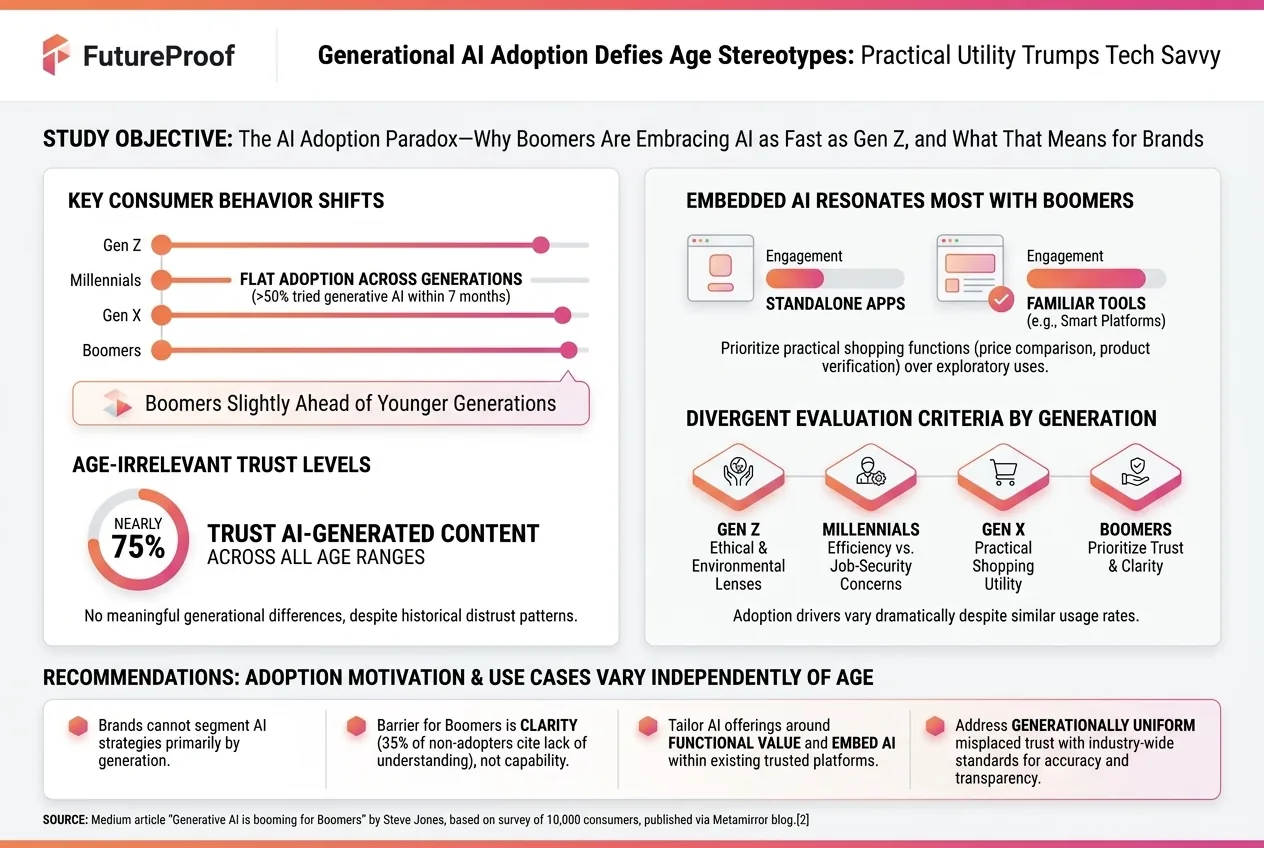
New data emphatically demonstrates that the generational lines typically expected to segment AI adoption are simply not materializing. Instead, a unifying factor of utility and tangible benefit is steering how quickly and widely people are embracing this transformative technology. A comprehensive survey of 10,000 consumers, detailed in Steve Jones’ Medium article “Generative AI is booming for Boomers” based on Metamirror data, reveals a compelling truth: consumers across all age groups are adopting generative AI tools at remarkably similar rates. Within a mere seven months of ChatGPT’s public launch, more than 50 percent of surveyed consumers had already experimented with these cutting-edge tools. What’s even more striking, and contrary to conventional wisdom, is that Boomers were found to be slightly ahead in this rapid adoption curve, a data point that reshapes our understanding of technological engagement.
This unprecedented cross-generational embrace of generative AI is a testament to its inherent utility. Unlike previous technological waves that often required significant learning curves or cultural shifts primarily appealing to younger, more adaptable demographics, generative AI offers immediate, demonstrable value that transcends age. It’s not about mastering complex interfaces or understanding intricate algorithms; it’s about experiencing direct benefits, such as enhanced productivity, simplified tasks, and accessible information. Whether it’s drafting an email, summarizing a lengthy article, brainstorming creative ideas, or even assisting with everyday problem-solving, AI’s practical applications resonate deeply with individuals from all walks of life, irrespective of their birth year. The core appeal lies in its ability to augment human capabilities, making complex tasks simpler and mundane tasks faster, thereby freeing up time and cognitive load for more meaningful pursuits.
Beyond mere adoption rates, another significant finding from the Metamirror survey challenges historical precedents: trust levels in AI-generated content are strikingly consistent across all age ranges. Nearly 75 percent of people report trusting AI-generated content, a figure that remains largely stable from Gen Z to Baby Boomers. This high level of trust breaks a long-standing pattern where older consumers traditionally exhibit greater skepticism and a slower willingness to trust new, disruptive technologies. Historically, new digital platforms, e-commerce, or social media initially faced cautious reception from older demographics, who often questioned their reliability, security, or authenticity. The current widespread trust in AI suggests that its utility is so self-evident and its outputs sufficiently robust that initial skepticism is quickly overcome by positive user experiences. This universal trust underscores AI's potential to become a foundational technology, integrating seamlessly into daily life without the usual generational friction points.
A closer look at how different generations engage with AI reveals nuances that are crucial for brands and developers. While overall adoption rates are similar, the preferred mode of interaction can vary. For Boomers, in particular, the data indicates a strong preference for AI features that are seamlessly integrated into tools they already use and trust. Embedded AI functions, such as automated price comparisons during online shopping or instant product verification within a banking app, significantly outperform standalone AI applications for this demographic. This preference highlights the importance of context and convenience. Rather than requiring users to download a new app or learn a new platform specifically for AI, integrating AI capabilities into existing workflows reduces friction, lowers the perceived barrier to entry, and allows users to experience AI's benefits without feeling like they are adopting a completely new technology. It's about enhancing familiar experiences, making them smarter and more efficient, without disrupting established habits. This "invisible AI" approach allows users to leverage powerful computational assistance without necessarily identifying it as "AI" in the abstract sense, thereby fostering adoption through utility rather than direct technological engagement.
The implications of these findings for brands, marketers, and product developers are profound and necessitate a fundamental recalibration of strategy. The old playbook, which often segmented audiences by age and tailored tech adoption messages accordingly, is now obsolete in the context of generative AI. Age alone is no longer a reliable predictor of AI readiness or willingness to adopt. Instead, brands must shift their focus to understanding the diverse motivations that drive engagement across different segments, even when overall adoption rates appear similar. The key differentiator is not who is adopting, but why they are adopting and how they prefer to interact with the technology.
For brands looking to effectively engage with the cross-generational AI consumer, two strategic pillars emerge as paramount: clarity and functional value.
Firstly, Clarity is critical, especially given that a significant barrier for many consumers, across all ages, is simply not understanding what AI can do for them. This lack of comprehension isn't limited to older demographics; it's a pervasive issue stemming from the abstract nature of AI and the technical jargon often associated with it. Brands must move beyond buzzwords and articulate AI's benefits in clear, concise, and relatable terms. This means focusing on the outcome rather than the underlying technology. Instead of saying, "Our platform uses advanced neural networks," a brand should communicate, "Our platform helps you draft perfect emails in seconds," or "Instantly compare prices from hundreds of retailers." Storytelling, simple language, and practical demonstrations that highlight tangible solutions to everyday problems are far more effective than technical specifications. Explaining how AI can solve a pain point, save time, reduce effort, or provide better insights will resonate more deeply than detailing its algorithmic sophistication. Interactive demos, short explanatory videos, and benefit-led content marketing can bridge this understanding gap, empowering consumers to see themselves using AI to improve their lives.
Secondly, Functional Value must be at the core of any AI integration strategy. As the Boomer preference for embedded AI demonstrates, seamless integration and direct utility are powerful drivers. Brands should prioritize embedding AI capabilities into existing products and services where they can genuinely enhance the user experience, streamline processes, or offer new, valuable functionalities. This could involve using AI for personalized product recommendations, optimizing search results, offering intelligent customer support chatbots, automating administrative tasks, or providing predictive analytics that empower better decision-making. The goal is to make AI an indispensable, almost invisible, assistant that enriches the user's interaction with the brand’s offerings. The focus should be on creating solutions that are intuitively useful, easy to access, and demonstrably beneficial, rather than launching standalone AI features that require users to significantly alter their habits or invest time in learning new interfaces. For instance, an e-commerce platform could integrate an AI-powered virtual assistant that guides users through complex purchase decisions, or a financial app could use AI to identify personalized savings opportunities.
The consistency of trust across age ranges also opens up significant opportunities for brands. With nearly 75 percent of consumers trusting AI-generated content, brands have a solid foundation upon which to build AI-powered content strategies, from personalized marketing messages to automated content creation. This trust, however, is not absolute and can be fragile. Transparency about when and how AI is used, coupled with robust human oversight and quality control, will be crucial for maintaining and strengthening this trust. Brands that are upfront about their AI usage and demonstrate a commitment to ethical AI practices will build stronger, more enduring relationships with their customers.
This new paradigm of AI adoption also suggests a future where AI becomes a fundamental utility, as pervasive and expected as electricity or internet connectivity. Its ubiquitous nature will mean that consumers, regardless of age, will increasingly expect AI-driven efficiencies and personalization in all their digital interactions. This elevates the standard for user experience: slow, clunky, or irrelevant digital interactions will become unacceptable. Brands that fail to integrate AI effectively risk falling behind, not just in terms of innovation, but in meeting fundamental customer expectations for convenience, relevance, and speed.
Looking ahead, the ongoing evolution of AI and its integration into daily life will continue to challenge traditional marketing and product development models. The insights gleaned from the Metamirror survey and Steve Jones' analysis provide a clear roadmap: the future of AI adoption is inclusive, driven by universal human desires for efficiency, personalization, and practical solutions. Brands that recognize this shift and proactively adapt their strategies—focusing on clarity in communication, delivering tangible functional value through seamless integration, and fostering trust through responsible AI use—will be best positioned to thrive in this new, AI-powered era. The narrative has irrevocably shifted: it's no longer about whether a generation will adopt AI, but how effectively AI can serve the practical needs of every generation. More than 50 percent of consumers across all ages have already tried generative AI tools, a statistic that powerfully underscores AI's universal appeal and its undeniable trajectory toward becoming an indispensable part of everyone’s digital life.