Bridging the AI Trust Gap to Win the Future of Digital Commerce
The landscape of digital commerce is undergoing a profound transformation, and at its heart lies a critical challenge: the AI trust gap. As we navigate towards 2026, new data unequivocally highlights that consumer trust, or the lack thereof, in artificial intelligence recommendations is rapidly becoming one of the most pivotal factors shaping shopping behavior. Brands, retailers, and marketers who fail to acknowledge and strategically address this chasm risk being left behind in an increasingly competitive marketplace where the consumer holds the ultimate power of discretion. The future of retail innovation, conversion rates, and sustainable growth hinges on a brand's ability to cultivate a transparent and trustworthy AI-powered customer experience.
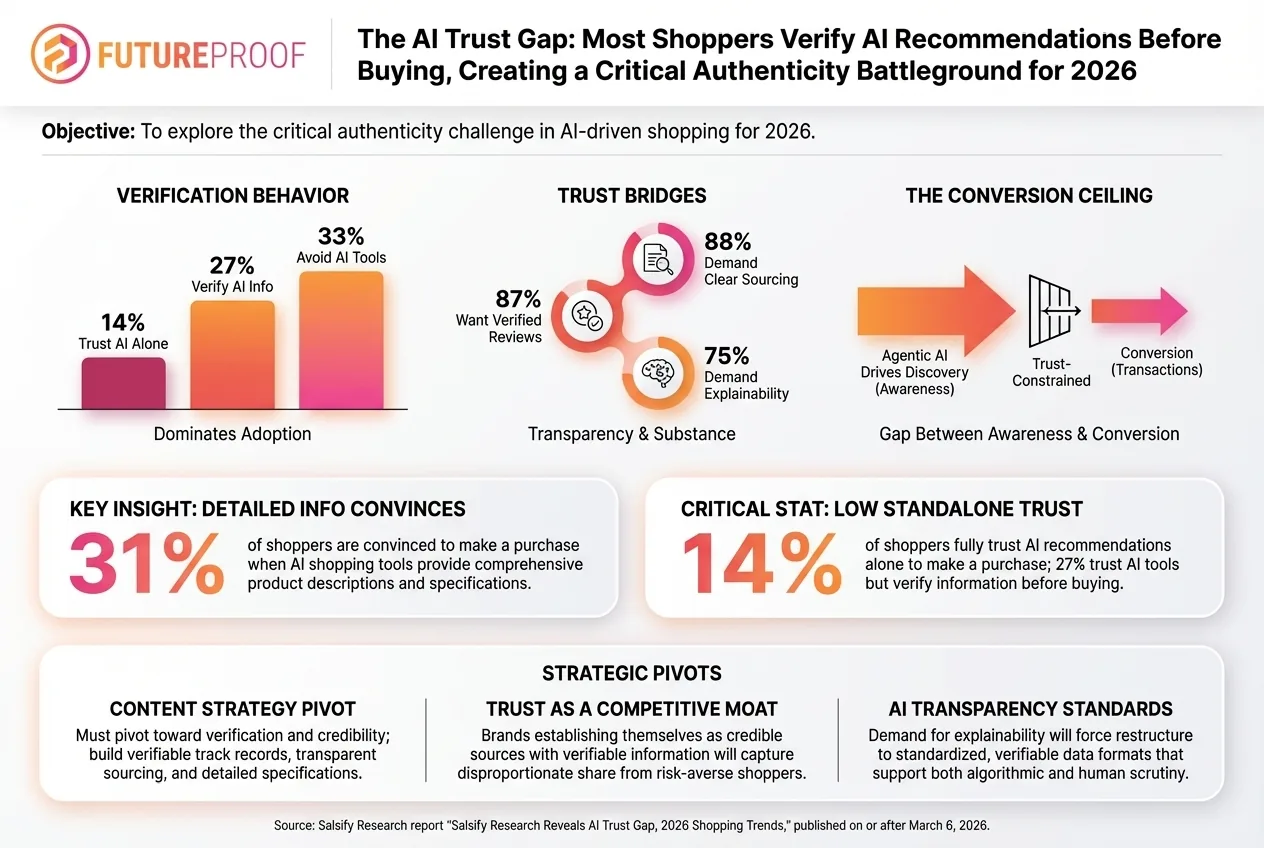
Salsify Research, in its March 2026 report on AI Trust Gap and Shopping Trends, has delivered startling insights that serve as a wake-up call for the entire e-commerce ecosystem. The numbers paint a clear picture of skepticism: a mere 14% of shoppers are willing to trust AI recommendations alone to make a purchase. This statistic is not just a data point; it represents a fundamental barrier to the widespread adoption and effectiveness of AI shopping tools that so many brands are investing in. The vast majority of consumers remain unconvinced, necessitating a paradigm shift in how AI is integrated into the customer journey. Further eroding the confidence in standalone AI, 27% of shoppers actively choose to verify AI suggestions with other independent sources before committing to a purchase. This behavior indicates a deep-seated need for validation, a desire to cross-reference and confirm information, reflecting a hesitance to fully surrender agency to an algorithm. Even more striking is the finding that a significant 33% of consumers outright avoid AI shopping tools entirely. This third of the market represents a substantial segment that is either alienated by current AI implementations, distrustful of the technology, or simply prefers traditional shopping methods, bypassing AI-driven personalized shopping experiences altogether. This data collectively underscores that the initial promise of AI, to seamlessly guide and enhance purchasing decisions, is encountering a significant roadblock in the form of consumer skepticism and a fundamental lack of trust.
The underlying reasons for this pervasive AI trust gap are multifaceted, ranging from concerns about data privacy and algorithmic bias to a general apprehension regarding the perceived "black box" nature of AI. Consumers, increasingly discerning and digitally literate, are wary of being manipulated or presented with information that serves the interests of the AI provider more than their own. They crave authenticity and transparency, often having encountered instances where AI recommendations felt irrelevant, intrusive, or simply wrong. This experience has fostered a sense of caution, prompting them to either seek external validation or opt out entirely. For brands, understanding this deep-seated skepticism is the first step toward bridging the gap. It's not enough to simply deploy AI; the crucial next step is to make that AI trustworthy.
The Salsify research unequivocally points to transparency as the critical turning point in this evolving narrative. When AI tools are designed and deployed with a clear emphasis on openness, they begin to chip away at consumer doubt. The report highlights a powerful correlation: when AI tools provide detailed product descriptions and comprehensive specifications, a notable 31% of shoppers are then convinced to make a purchase. This specific data point is a beacon, illustrating a clear pathway forward. It suggests that the reluctance isn't an inherent rejection of AI itself, but rather a rejection of opaque, unsupported AI. Consumers aren't asking for less AI; they're demanding better, more transparent AI. Detailed product descriptions go beyond superficial features, delving into the intricacies of material composition, manufacturing processes, dimensions, weight, compatibility, and performance metrics. Specifications provide objective, verifiable facts that build a foundation of credibility. When an AI recommendation is backed by a wealth of clear, accessible, and granular product data, it transforms from an abstract suggestion into a well-supported proposition, giving the consumer the confidence and information they need to proceed.
This demand for transparency extends far beyond basic product details. Shoppers are explicitly articulating their needs, drawing a clear roadmap for brands striving to build lasting trust in the AI era. The Salsify research identifies three paramount areas where consumers are seeking greater clarity and verifiable information, which collectively form the bedrock of AI-powered consumer trust and represent a new competitive advantage for forward-thinking brands.
Firstly, a staggering 88% of shoppers demand sourcing information. In an age of heightened ethical awareness, environmental consciousness, and a desire for authentic products, consumers want to know where their products come from. This isn't just about curiosity; it's about aligning purchases with personal values. Shoppers want to understand the origins of raw materials, the conditions under which products are manufactured, the supply chain journey, and the ethical practices of the brands they support. This includes transparency around labor practices, sustainability initiatives, and the geographical provenance of components. For instance, knowing if a garment's cotton is sustainably grown, if its production involves fair labor, or if a tech device uses ethically sourced rare earth minerals can be a decisive factor. Brands that can integrate comprehensive, verifiable sourcing information directly into their AI-driven product discovery process will unlock a significant trust dividend. Leveraging technologies like blockchain for supply chain transparency, providing interactive maps of manufacturing sites, or clearly outlining sustainability certifications can transform a generic product page into a compelling narrative of responsible commerce, fostering deep customer loyalty.
Secondly, 87% of shoppers want verified reviews. The power of social proof remains an immutable force in purchasing decisions, yet the proliferation of fake or incentivized reviews has eroded consumer confidence in this critical resource. Shoppers are savvy; they can often detect insincere endorsements and are increasingly looking for mechanisms to ensure the authenticity of peer feedback. Verified reviews provide this crucial assurance. This means reviews from actual purchasers, confirmed through integration with order history, or moderated by robust systems that filter out spam and manipulation. AI can play a crucial role here, not just in presenting reviews, but in actively helping to verify their legitimacy, summarizing key themes from authentic feedback, and even identifying review patterns that suggest manipulation. Brands should prioritize partnerships with reputable review platforms and implement their own rigorous verification processes, clearly communicating these efforts to consumers. Integrating AI to analyze and surface the most relevant, credible reviews – perhaps even indicating how many verified purchases are associated with a specific review – will significantly bolster consumer confidence in both the product and the AI's ability to guide them to it. This level of curated, trustworthy social proof validates AI recommendations with human experience, a powerful combination.
Thirdly, and perhaps most indicative of the growing desire for transparency in AI itself, 75% of shoppers want to understand how AI responses are generated. This goes beyond the product itself; it's about the algorithm, the logic, and the data inputs that inform the AI's suggestions. Consumers are no longer content with a "black box" where recommendations magically appear. They want explainable AI (XAI). They want to know if the AI prioritized price, sustainability, user reviews, availability, or compatibility, and why. For example, an AI might recommend a specific laptop, and alongside that recommendation, a brief explanation could state: "This recommendation is based on your recent searches for high-performance gaming laptops, positive verified reviews regarding its processing power, and its current promotional price." This level of contextualization demystifies the AI, building trust not just in the recommendation, but in the intelligence behind it. Brands can implement "why this recommendation" features, offering snippets of the AI's decision-making process. This transparency fosters a sense of agency and control for the consumer, allowing them to better evaluate the AI's logic and determine if it aligns with their personal criteria. It transforms the AI from an opaque oracle into a helpful, understandable assistant.
For brands, these insights are not merely observations; they constitute a blueprint for a new competitive advantage in the rapidly evolving digital commerce landscape. The battleground for market share in 2026 is shifting. It's no longer solely about having the best product or the lowest price; it's profoundly about possessing the most credible, verifiable product data and the most transparent, trustworthy AI. Brands that prioritize data integrity and invest in comprehensive, accessible product information management (PIM) systems will be the ones that succeed. Rich, accurate product content, including detailed descriptions, specifications, high-quality media, and crucially, verifiable attributes like sourcing and ethical certifications, is now central to conversion. When agentic AI, which acts autonomously to discover and present products based on user intent, drives a significant portion of discovery in 2026, the trustworthiness of the data it draws upon will be paramount. If an agentic AI recommends a product, but a shopper's subsequent verification reveals incomplete or questionable data, both the product and the AI (and by extension, the brand) will suffer a blow to credibility. Conversely, an agentic AI that consistently provides well-supported, transparent, and verifiable recommendations will build immense consumer loyalty and drive unparalleled conversion rates.
The implications for brand reputation are also immense. In an era where trust is fragile and easily lost, brands that champion transparency in their AI implementations and product data will cultivate a reputation for integrity and reliability. This translates directly into enhanced customer loyalty, increased lifetime value, and a stronger market position. Brands that remain opaque, or whose AI recommendations are frequently met with skepticism and require extensive verification, risk alienating a significant portion of their potential customer base. Investing in robust data governance, clear communication about AI methodologies, and mechanisms for immediate customer feedback on AI interactions will be crucial. This isn't just a technical challenge; it's a strategic imperative that requires a commitment from leadership to embed trust and transparency into the very core of their digital strategy. The competitive landscape will favor those who can articulate not just what their products do, but where they come from, how they are made, what verified customers think of them, and why an AI recommends them.
Ultimately, the Salsify research underscores a fundamental truth: AI is a powerful tool, but its effectiveness in commerce is inextricably linked to the human element of trust. The future of retail innovation and e-commerce trends is not about replacing human judgment with artificial intelligence, but rather about enhancing human decision-making with intelligent, transparent, and verifiable AI. Brands that successfully bridge the AI trust gap by embracing radical transparency, providing comprehensive verifiable product data, and making their AI explainable will unlock unprecedented opportunities for engagement, conversion, and enduring customer relationships. As agentic AI drives discovery in 2026 and beyond, trust is indeed becoming the true battleground, and victory will belong to those who prioritize authenticity, clarity, and unwavering commitment to the discerning consumer.